Solar Inverter Replacement Cost in California (2026): String, Micro, and Hybrid
Replacing a residential solar inverter in Southern California costs roughly $1,000–$2,500 installed for a string inverter, $150–$350 per unit for a single microinverter, and $3,000–$6,000 installed for a hybrid inverter swap — before any utility reconnection or panel-upgrade costs.
By Taylor Crouse — Founder, Helios Energy GlobalPublished
Quick answer
- String inverter replacement (SolarEdge, SMA, Fronius): ~$1,000–$2,500 installed for a typical 6–10 kW Southern California system
- Single microinverter swap (Enphase IQ8): ~$150–$350 per unit, installed; a full 20-panel system swap runs ~$3,000–$6,000
- Hybrid inverter replacement (battery-ready, DC-coupled): ~$3,000–$6,000 installed, inverter hardware only — battery is separate
- Permit fees in California: typically $100–$500 for a residential inverter replacement permit, depending on city
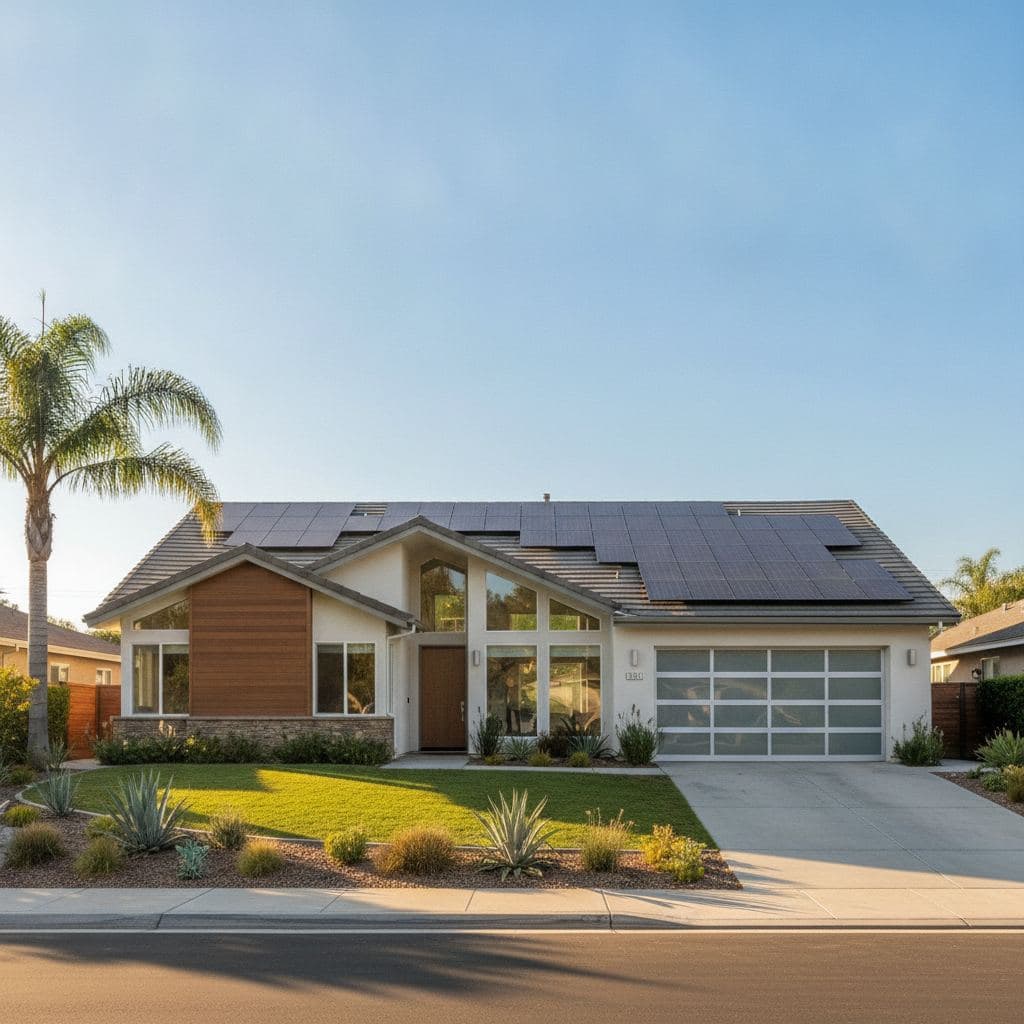
Replacing a string inverter on a typical Southern California home costs roughly $1,000–$2,500 fully installed, while swapping to a hybrid (battery-ready) inverter at the same time runs $3,000–$6,000 — a premium that often makes sense if your original inverter is already out of warranty or you plan to add a battery within the next few years. Individual microinverter replacements are far cheaper per unit but require a truck roll and permit each time, so the economics depend on how many units have failed.
Last verified: September 2026 by Helios Energy Global.
What drives the cost difference between inverter types?
Three variables do most of the work: the hardware price of the inverter itself, the labor to swap and recommission it, and whether a permit and utility reconnection step is required (it almost always is in California).
Hardware price by type:
- Standard string inverter (SMA Sunny Boy, Fronius Primo, older SolarEdge): equipment alone typically runs $800–$1,800 for a 6–10 kW residential unit
- SolarEdge optimizer-plus-string system: the central inverter is in the same range; individual power optimizers run roughly $100–$110 per unit if one fails
- Hybrid / battery-ready inverter (SolarEdge Home Hub, SMA Sunny Boy Storage, Enphase IQ Combiner with gateway): hardware runs $1,400–$3,000+ depending on capacity
- Single Enphase IQ8 microinverter: hardware is $100–$200 per unit at distributor pricing
Labor and permit add $400–$1,200 for a string or hybrid swap (one crew visit, one permit). For a single microinverter, labor per visit can equal or exceed the hardware cost — which is why permit expenses fluctuate by location but generally fall between $100 and $500 for a residential solar permit in California. Jurisdictions are not allowed to charge higher permit fees unless the local city or county makes a written finding, passes a resolution or ordinance, and provides substantial evidence that increasing fees is necessary to pay for the reasonable cost to issue a permit — that's the AB 1124 cap framework that keeps most Southern California permit fees in check.
The key numbers at a glance
| Inverter type | Hardware (est.) | Labor + permit (est.) | Total installed (est.) | Notes |
|---|---|---|---|---|
| String inverter, 6–10 kW (like-for-like) | $800–$1,800 | $400–$800 | $1,000–$2,500 | One permit, one inspection |
| SolarEdge power optimizer (single unit) | $100–$110 | $300–$500 | $400–$600 | Rare failure; no string rewire |
| Hybrid inverter, 6–10 kW (battery-ready) | $1,400–$3,000 | $800–$1,500 | $3,000–$6,000 | Battery purchased separately |
| Single Enphase IQ8 microinverter | $100–$200 | $250–$500 | $150–$350/unit | Per-unit; full 20-panel swap $3,000–$6,000 |
| Full microinverter system (20 panels) | $3,000–$5,000 | $1,000–$2,000 | $3,000–$6,000 | Rarely needed all at once |
| Panel upgrade (if required) | — | — | $3,000–$5,000 | Only if panel is undersized/outdated |
All figures are estimates for Southern California in 2026. Prices vary by system size, roof access, and local permit jurisdiction. Get a custom quote before budgeting.
Warranty-covered vs. out-of-warranty: the most important question first
Before you spend a dollar, check your warranty status. The answer changes the entire decision tree.
SolarEdge systems
The SolarEdge Home Wave inverter comes with a built-in DC safety switch, integrated rapid shutdown, and features a standard 12-year warranty extendable to 20 or 25 years.
The SolarEdge inverter warranty is extendable to 20 or 25 years depending on inverter model, and SolarEdge manages a rapid RMA process, generally shipping a replacement unit within 48 hours if the reported defect is eligible for coverage under the Limited Product Warranty.
If your SolarEdge inverter is within its warranty period: contact SolarEdge directly (not just your installer) to open an RMA. The manufacturer is a separate legal entity from your installer — so even if your original installer has closed or restructured, the manufacturer warranty on your inverter does not disappear; the warranty runs with the equipment. You pay labor to have a certified installer swap the replacement unit; hardware ships free.
If your SolarEdge inverter is out of warranty: you're paying full hardware cost plus labor. The warranty extension is available with a one-time payment fee and must be purchased within 24 months of inverter shipment from SolarEdge — so if you're reading this because your system is already 8–10 years old, that window has likely passed. Budget $1,000–$2,500 all-in for a like-for-like replacement, or $3,000–$6,000 if you upgrade to a hybrid at the same time.
Enphase microinverter systems
Enphase backs IQ8 Microinverters with a limited warranty of 25 years, though they design them to work for longer than that without issue. Per Enphase's published US warranty document, IQ8 Microinverters carry a 25-year warranty from the Activation Date. This is why individual microinverter failures are almost always warranty-covered for systems installed in the last decade — Enphase handles the claim and ships a replacement unit; your installer swaps it.
Out-of-warranty single-unit replacements run roughly $150–$350 per unit installed, including the truck roll. If multiple units fail simultaneously on an older system (IQ7 or earlier), it may be more economical to replace the full array of microinverters than to swap units piecemeal.
SMA string inverters
SMA's Sunny Boy residential line carries a standard 10-year warranty, extendable to 20 years at purchase. Out-of-warranty replacements follow the same economics as SolarEdge: $1,000–$2,500 installed for a like-for-like swap on a 6–10 kW system.
When to replace vs. repair
Most inverter "failures" in the first 10 years are actually communication or firmware issues — not hardware failures. Before authorizing a replacement, ask your service tech to check:
- Error codes and fault logs in the monitoring portal (SolarEdge mySolarEdge, Enphase Enlighten)
- Grid connection and breaker status — a tripped breaker or utility voltage fluctuation mimics inverter failure
- Firmware version — an outdated firmware can cause false shutdowns on SolarEdge HD-Wave and SMA units
- Capacitor degradation — the most common true hardware failure on string inverters over 10 years old; sometimes repairable by a qualified technician for $200–$500, versus full replacement
Replace rather than repair when:
- The unit is past its warranty and showing recurring AC fault codes
- Repair quotes exceed 40–50% of replacement cost
- You're planning to add a battery (see hybrid section below)
- Parts availability is limited (some older SolarEdge SE series units have long lead times for components)
See our solar repair and maintenance guide for a full diagnostic checklist before you commit to a replacement.
The hybrid inverter opportunity: replace and upgrade at the same time
If your string inverter is failing or out of warranty and you're on SCE's NEM 3.0 (Net Billing Tariff), this is the moment to seriously consider upgrading to a hybrid (battery-ready) inverter rather than doing a like-for-like swap.
A hybrid inverter handles both solar conversion and battery charge/discharge in one unit. Brands like SolarEdge, SMA, and Tesla (Powerwall 3) integrate these functions. In 2026, this is most compelling for SCE customers on NEM 3.0, where stored energy used during the 4–9 PM peak is far more valuable than energy exported to the grid at low avoided-cost rates.
The downside: you need to replace your existing solar inverter with a hybrid model, which adds $2,000 to $4,000 to the project cost. This makes financial sense primarily if your existing inverter is nearing the end of its warranty — typically 10 to 12 years for string inverters.
The math for SCE customers: SCE's average residential rate is 35.3 cents per kWh as of January 2026.
Peak hours for SCE customers with time-of-use rate plans are either 4–9 p.m. or 5–8 p.m., depending on their specific plan. Energy stored in a battery and discharged during those peak hours displaces grid power at that full retail rate — far more valuable than the 5–8¢/kWh avoided-cost export credit NEM 3.0 pays for excess solar sent to the grid. If your inverter needs replacement anyway, the incremental cost to go hybrid is $2,000–$3,500 — less than buying a separate battery inverter later.
LADWP customers: LADWP still offers retail-rate net metering, which changes this calculus. A like-for-like string inverter replacement is often the right call for LADWP customers who don't plan to add a battery, since retail-rate exports already provide strong value. Confirm your specific LADWP net metering agreement terms before deciding.
Learn more about how NEM 3.0 affects inverter and battery decisions → NEM 3.0 explained and solar vs. battery under NEM 3.0.
Orphaned systems: what to do when your installer is gone
Freedom Forever's Chapter 11 filing in April 2026 brought this issue into focus for thousands of California homeowners. (Freedom Forever subsequently moved to Chapter 7 liquidation in August 2026.) If your original installer has closed, restructured, or is otherwise unreachable:
Your manufacturer warranty is still valid. When an installer closes or restructures, the manufacturer warranty on your inverter does not disappear. The manufacturer is a separate legal entity from your installer, and the warranty runs with the equipment. Contact SolarEdge, Enphase, or SMA directly with your serial number.
Any licensed C-46 solar contractor can service your system. You are not locked to your original installer for out-of-warranty work or for a replacement. Get at least two quotes.
Proprietary architecture matters. The replacement inverter for a SolarEdge system must be a SolarEdge model — the optimizers use a proprietary communication protocol. You cannot swap in a generic string inverter and keep the optimizer network. For Enphase systems, the replacement microinverter must be a compatible Enphase unit.
Check your monitoring portal access. If your installer managed the monitoring account, you may need to transfer ownership to your own Enphase Enlighten or SolarEdge mySolarEdge account. Both manufacturers have a homeowner transfer process — do this before authorizing any replacement work.
Visit our solar repair and maintenance page or book a free consultation if you need help auditing an orphaned system.
Permits and utility reconnection in Southern California
Every inverter replacement in California requires a permit and a utility interconnection notification — even a like-for-like swap. Here's how it plays out by utility:
SCE territory (most of LA County suburbs, Orange County, Inland Empire): A replaced inverter triggers a new Permission to Operate (PTO) from SCE before you can legally re-energize. California is the only US state actively enforcing NEC 2026 as of 2026. The CEC 2025 Energy Code, which took effect January 1, 2026, incorporates NEC 2026 requirements. Plan sets for the replacement permit must reference the California Electrical Code (Title 24 Part 3), not just NEC 2026. SCE's interconnection team typically processes PTO within 5–15 business days for a residential inverter replacement if the application is complete.
LADWP territory (City of Los Angeles): LADWP runs its own interconnection process through LADBS (LA Department of Building and Safety). LADBS uses SolarAPP+ for automated permit review, which can issue permits same-day or next business day for qualifying projects. LADWP still offers retail-rate net metering — confirm your existing agreement is preserved when the new inverter is commissioned.
SDG&E territory (San Diego area): SDG&E follows the same NEM 3.0 Net Billing Tariff as SCE for new interconnections. A like-for-like inverter replacement on an existing NEM 2.0 grandfathered system typically does not reset the NEM 2.0 clock — but confirm this with your contractor before proceeding, as a system "modification" that increases capacity can trigger reclassification.
Permit fees: Permit fees in California can range from under $200 for a simple residential solar permit in one city to over $2,500 for the same system in another. For a residential inverter replacement (not a new system), fees are typically on the lower end — $100–$500 in most Southern California jurisdictions. The permit fee cap is separate from plan check fees, which some jurisdictions (LADBS, SF DBI) charge separately for structural review.
No federal tax credit in 2026
The 30% federal residential clean energy tax credit (Section 25D) expired December 31, 2025. There is no federal tax credit for a residential inverter replacement purchased in 2026, whether you're replacing like-for-like or upgrading to a hybrid. Any quote or online calculator that still shows a 30% credit for a 2026 residential purchase is outdated — verify this directly with a tax professional.
California's SGIP battery rebate program is waitlisted for residential customers in 2026. It does not apply to inverter-only replacements in any case.
For the full picture on solar system costs, see our solar panel cost guide and battery storage overview.
Frequently asked questions about solar inverter replacement cost
How do I know if my solar inverter needs to be replaced or just repaired?
Check your monitoring app first — most inverter failures show as error codes or production drops, not complete outages. A qualified technician can diagnose whether the issue is a firmware fault, a failed capacitor (sometimes repairable for $200–$500), or a hardware failure requiring full replacement. Only authorize a full replacement after a diagnostic visit confirms the unit cannot be repaired cost-effectively. See our solar repair and maintenance page for a full checklist.
Does replacing my inverter affect my NEM 2.0 grandfathered status with SCE or SDG&E?
A like-for-like inverter replacement generally does not reset a grandfathered NEM 2.0 agreement, because you are not adding capacity. However, upgrading to a larger inverter or adding panels at the same time can trigger reclassification to NEM 3.0. Confirm this in writing with your contractor and with your utility's interconnection team before authorizing any work. LADWP customers are not on NEM 3.0 and this concern does not apply.
My original installer went out of business. Can I still claim a warranty replacement?
Yes. When an installer closes or restructures, the manufacturer warranty on your inverter does not disappear. The manufacturer is a separate legal entity from your installer, and the warranty runs with the equipment. Contact SolarEdge or Enphase directly with your inverter serial number to open a warranty claim. Any licensed C-46 solar contractor can perform the physical swap.
Is it worth upgrading to a hybrid inverter when my string inverter fails?
For SCE customers on NEM 3.0, the answer is usually yes — if you plan to add a battery within the next 3–5 years. If there's any chance you'll add a battery in the next 3–5 years, a hybrid-ready inverter saves you from paying for an inverter replacement or a separate battery inverter later. The upfront cost difference is often $500–$1,500 — less than adding a battery inverter later. For LADWP customers with retail-rate net metering and no battery plans, a like-for-like replacement is usually the simpler and cheaper call. Get a custom design to run the numbers for your specific system.
How long does a solar inverter replacement take from diagnosis to PTO?
The physical swap takes one to two days for a string or hybrid inverter, and a few hours for a single microinverter. The permit and utility reconnection process adds time: cities using SolarAPP+ often charge lower flat fees because review costs less for them — Los Angeles, San Diego, Sacramento, and San Jose use this automated platform. In SolarAPP+ cities, permits can be issued same-day or next business day. Manual-review jurisdictions can take two to six weeks. SCE's PTO step typically adds another 5–15 business days after inspection.
What is the SolarEdge Re-Energize program and does it save money?
The SolarEdge Re-Energize program is designed to help homeowners get the most out of their SolarEdge system by upgrading their qualifying SolarEdge inverter to a Home Hub inverter, with a reduced cost on Home Hubs used to replace existing SolarEdge inverters. It's worth checking eligibility if your original inverter qualifies — it can reduce the hardware cost of upgrading to a battery-ready Home Hub. Ask your installer to verify eligibility before quoting a standard out-of-pocket replacement.
Do I need a new permit if only one Enphase microinverter failed?
Yes, in most California jurisdictions. Even a single microinverter swap requires a permit and inspection because it involves electrical work on a permitted solar system. This is why the per-unit installed cost ($150–$350) can feel high relative to the hardware — the permit and truck roll are fixed costs regardless of how many units are swapped. If multiple microinverters are failing, it's worth batching replacements into a single permit pull to reduce the per-unit overhead.
Next steps
- Solar panel repair in Southern California — diagnostics on any brand, warranty claims filed for you, one written price for an inverter swap
- Book a free consultation and custom design — we'll audit your existing inverter, check warranty status, and quote replacement or upgrade options at no charge
- Explore battery storage options — if your inverter replacement is the right moment to go battery-ready
- Read our solar inverter types guide — deep dive on string, micro, and hybrid technology
- Understand NEM 3.0 and what it means for your system
- See our solar repair and maintenance services
- View all Southern California service areas
Sources
- SolarEdge Home Wave Inverter Product Page (solaredge.com) — September 2026
- SolarEdge Inverter Warranty Extension Page (solaredge.com/us/warranty) — September 2026
- Enphase Energy System Limited Warranty — IQ8 Microinverters (enphase.com) — January 2025
- 3CE Rates in SCE Territory — TOU-D-PRIME Rate Sheet (Effective Feb 15, 2026) — February 15, 2026
- AB 1124 Solar Permit Fee Caps — California Building Officials (CALBO) — January 2026
More guides
Best Solar Companies in Pismo Beach, CA (2026): Honest Rankings for Coastal Homeowners
A straight-talking, numbers-first guide to the best solar installers serving Pismo Beach in 2026 — covering real costs, PG&E net metering, battery tradeoffs, and what to ask before you sign.
ReadWhat's the Average Electric Bill for a 1-Bedroom Apartment in Southern California? (2026)
In Southern California, a 1-bedroom apartment's electric bill typically runs $85–$175/month depending on which utility serves your address — LADWP, SCE, or SDG&E.
ReadBest Solar Companies in San Diego, CA (2026): Honest Rankings for SDG&E Homeowners
SDG&E charges the highest residential rates of any major U.S. utility — nearly 46¢/kWh — making San Diego one of the strongest solar markets in the country. Here's how to find an installer who actually understands NEM 3.0 and your specific neighborhood.
ReadGet a free consultation and custom design.
No pressure, no obligation — the owner reviews every design we send.