Charging an EV with Solar Panels in 2026: How Much Panel Do You Actually Need?
Most Southern California homeowners need 2–4 extra kilowatts of solar to cover EV charging — here's how to size it right for SCE or LADWP.
By Taylor Crouse — Founder, Helios Energy GlobalUpdated
Quick answer
- Plan on roughly 1.5–2 extra kilowatts of solar capacity per 1,000 miles you drive each month — a typical 1,000 mi/month driver needs about a 2 kW add-on.
- At SCE's ~34–35¢/kWh peak rate, solar-charged miles cost near zero; grid-charged miles at peak can run $0.10–0.12 per mile in electricity alone.
- LADWP customers (retail-rate net metering, ~28¢/kWh average) can export excess solar freely; SCE/NEM 3.0 customers save far more by charging while the sun is shining than by exporting and buying back later.
- A solar-plus-battery combo lets NEM 3.0 households store midday generation and charge the car overnight without touching the grid — the most cost-effective setup for 2026.
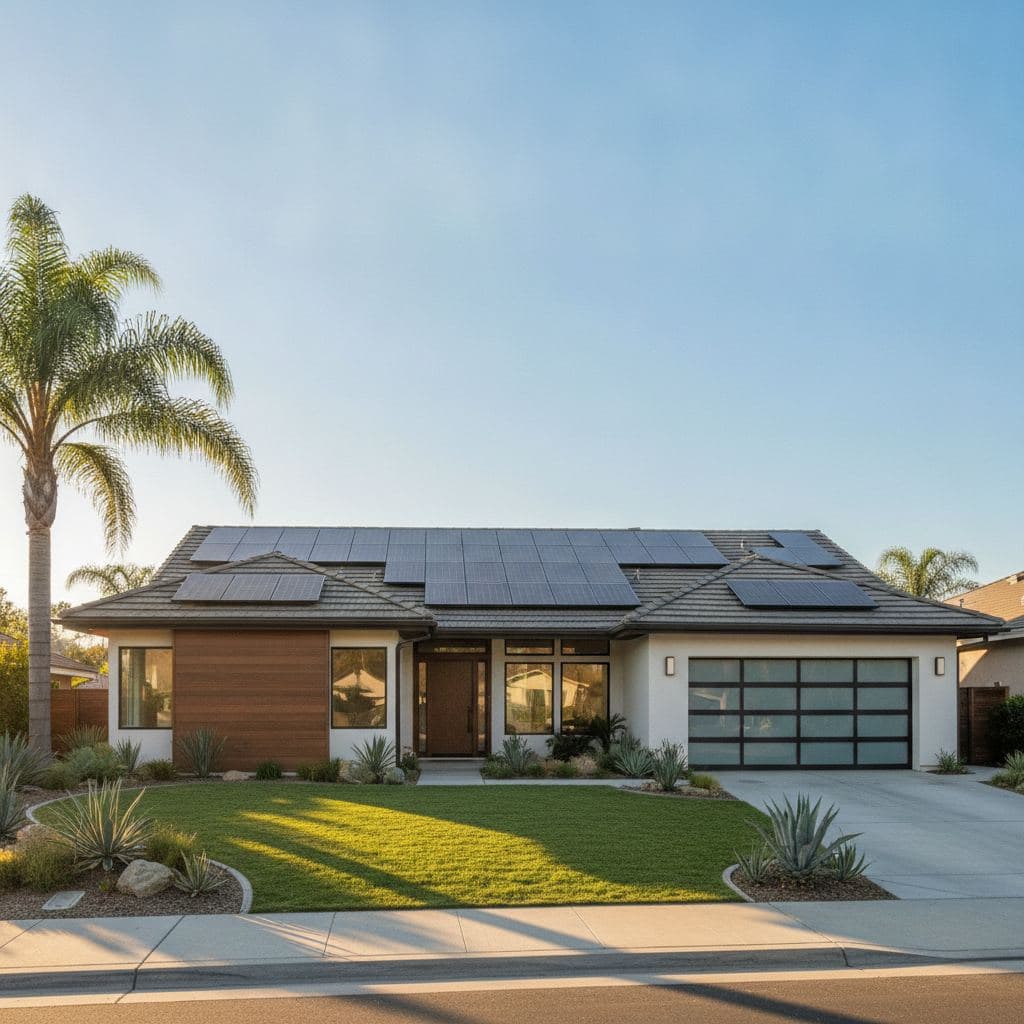
Adding an EV to your home typically requires 1.5–2 additional kilowatts of solar for every 1,000 miles you drive per month, based on average EV efficiency of roughly 3–4 miles per kWh. For a Southern California household driving 1,200 miles a month, that translates to a 2–2.5 kW expansion on top of whatever panels you already need for the house.
Last verified: September 2026 by Helios Energy Global.
How much solar does EV charging actually require?
Electric vehicles consume roughly 0.25–0.35 kWh per mile, depending on the model, speed, and Southern California's warm climate (heat affects battery efficiency less than cold, so SoCal drivers are in a favorable spot). To generate enough electricity to cover your driving:
- 1,000 miles/month ≈ 250–350 kWh/month of charging energy needed
- A 1 kW solar panel in Los Angeles produces roughly 140–160 kWh/month (LA averages about 5.5–5.7 peak sun hours/day)
- Therefore: 1,000 miles/month ÷ ~150 kWh per kW ≈ 1.7–2.3 kW of additional panels
Round up to the nearest half-kilowatt for real-world losses (inverter efficiency, wiring, occasional cloud cover) and 2 kW per 1,000 miles/month is a reliable planning number.
| Monthly driving | Est. charging need | Extra solar needed | Approx. added system cost (estimate) |
|---|---|---|---|
| 500 mi/month | 125–175 kWh | ~1–1.5 kW | $2,500–$5,250 |
| 1,000 mi/month | 250–350 kWh | ~2–2.5 kW | $5,000–$8,750 |
| 1,500 mi/month | 375–525 kWh | ~3–3.5 kW | $7,500–$12,250 |
| 2,000 mi/month | 500–700 kWh | ~4–5 kW | $10,000–$17,500 |
Cost estimates at $2.50–$3.50/watt installed, before any applicable incentives. These are estimates — your roof layout, panel type, and utility interconnection fees affect the final number. Get a custom design for your home.
SCE vs. LADWP: why your utility changes everything
This is where Southern California gets interesting — and where generic national solar advice fails you.
If you're on SCE (NEM 3.0 / Net Billing Tariff)
SCE's NEM 3.0 exports solar at wholesale-adjacent avoided-cost rates — typically 5–10¢/kWh depending on the hour — while you buy power back at retail rates of ~34–35¢/kWh, with a 4–9 PM peak that can push even higher. That gap is the core challenge.
The math is brutal if you charge overnight on grid power:
- Charge 40 kWh overnight at SCE peak/off-peak blended rate → roughly $8–14 per full charge
- Charge the same 40 kWh directly from solar midday → effectively $0 in grid costs
For NEM 3.0 households, self-consumption is everything. Every kilowatt-hour your car absorbs directly from your panels during daylight is a kilowatt-hour you never export at 7¢ and never have to buy back at 35¢. The spread is ~28¢/kWh — on 300 kWh of monthly EV charging, that's roughly $84/month in avoidable cost.
Read our full NEM 3.0 breakdown →
If you're on LADWP
LADWP is a municipal utility and does not use NEM 3.0. As of 2026, LADWP still offers retail-rate net metering — meaning solar exported to the grid credits your bill at close to the same rate you'd pay to import. With LADWP's average rate around 28¢/kWh, the urgency to self-consume is lower (though still financially sensible). LADWP customers have more flexibility to charge overnight and let solar exports offset the bill.
Other SoCal municipal utilities — Pasadena PWP, Burbank, Glendale, Anaheim APU, Riverside RPU — each run their own net metering programs with their own rates and rules. If you're on a muni, confirm your current net metering terms before sizing your system. Our team covers all these service territories.
Daytime vs. overnight charging: the strategy that matters most in 2026
Daytime charging (the NEM 3.0 winner's move)
If you work from home, have a flexible schedule, or can set your car to charge on a timer, starting your charge around 9 AM and finishing by 3 PM captures peak solar production and avoids SCE's 4–9 PM peak entirely.
Most modern EVs — and most Level 2 home chargers — support scheduled charging. Set it once, forget it. A 7.2 kW Level 2 charger can add roughly 25–30 miles of range per hour, meaning a typical top-up of 150–200 miles takes 5–7 hours — fitting neatly inside a solar window.
Overnight charging + battery storage (the NEM 3.0 + battery solution)
If daytime charging isn't practical, the next best move is storing solar midday in a home battery and discharging it to your car at night. This keeps your car off the grid during SCE's expensive 4–9 PM peak and uses energy your panels already generated.
A single battery unit (roughly $14,000–$18,500 installed) holds 10–16 kWh — enough to cover a 30–50 mile daily commute from stored solar alone. Pair that with a slightly oversized solar array and you've essentially replicated the economics of daytime charging, just with a buffer in between.
Learn more about home batteries and EV charging →
The self-consumption synergy under NEM 3.0
Here's the core insight worth repeating: under NEM 3.0, a kilowatt-hour self-consumed is worth 3–5× a kilowatt-hour exported. Adding an EV actually improves the economics of solar under NEM 3.0 because it gives your panels a high-value local load to feed. Without the EV, excess midday solar exports at ~7¢. With the EV plugged in, that same electricity powers 3–4 miles of driving instead.
See how solar and batteries work together under NEM 3.0 →
Sizing your system: house + EV together
Don't size EV solar in isolation. The right approach is to design the whole system — house loads plus EV — at once. Key inputs:
- Your 12-month utility bills (shows seasonal variation, baseline vs. Tier 2 usage)
- Your EV's onboard charger size (most are 7.2–11.5 kW; some older models are 3.3–6.6 kW)
- Your daily vs. weekly driving pattern (commuter vs. weekend road-tripper have very different charging profiles)
- Your roof space and orientation (south-facing is ideal; west-facing captures afternoon sun, which pairs well with SCE's 4–9 PM peak avoidance strategy)
At roughly $2.50–$3.50 per watt installed in 2026, a 6 kW system sized for house + EV runs approximately $15,000–$21,000 before incentives. Note: the 30% federal residential solar tax credit expired December 31, 2025 and is not available for 2026 purchases. California's SGIP battery incentive program has residential funds on a waitlist as of 2026 — worth applying, but don't count on it for your project timeline.
See full solar panel cost breakdown for Southern California →
Frequently asked questions about charging an EV with solar panels
How many solar panels do I need to charge my EV?
For a typical EV driven 1,000 miles/month, plan on 6–8 additional 350–400W panels (roughly 2–3 kW of added capacity). That's a ballpark — your actual number depends on your car's efficiency, your roof's sun exposure, and how much of your charging you can do during daylight hours. A custom design gives you the precise answer for your home.
Can I charge my EV with solar panels at night?
Not directly — solar panels only generate power when the sun is shining. To charge at night with solar energy, you need a home battery that stores daytime generation for nighttime use. Under SCE's NEM 3.0, this combination is often worth the investment because it avoids the expensive 4–9 PM peak and the low export rates that make overnight grid charging costly.
Is it worth adding solar just for my EV in Southern California?
For most SCE customers, yes — especially if you're already considering solar for the house. The EV becomes a high-value load that improves your self-consumption ratio under NEM 3.0, making your panels more economical, not less. LADWP customers have a more straightforward payback since retail-rate net metering makes the math simpler.
Does NEM 3.0 affect EV charging specifically?
Yes, significantly. NEM 3.0's low export rates (~5–10¢/kWh) mean that solar electricity used to charge your car directly is worth far more than solar electricity exported and bought back later. EV owners on SCE should prioritize daytime charging or battery storage to capture that value gap of roughly 25–28¢/kWh.
What charger level do I need for solar EV charging?
A Level 2 charger (240V, 7.2–11.5 kW) is strongly recommended for solar integration. Level 1 (120V) charges too slowly — typically 4–5 miles per hour — to meaningfully absorb solar production during a daytime window. Level 2 can add 25–35 miles per hour, making it practical to complete a full charge during peak solar hours.
Can I get incentives for solar EV charging in California in 2026?
The 30% federal residential solar tax credit expired December 31, 2025 and does not apply to 2026 purchases. SGIP battery incentives have residential funds on a waitlist. Some utilities offer EV rate plans (SCE's EV-TOU plans, LADWP's EV rates) that can reduce overnight charging costs independent of solar. Check with your utility for current EV-specific rate options.
How does LADWP's net metering change the EV charging math compared to SCE?
LADWP's retail-rate net metering means exported solar credits your bill at close to the same rate you pay to import — roughly 28¢/kWh. That's much more favorable than SCE's NEM 3.0 export rate of ~5–10¢/kWh. LADWP customers can charge overnight, let solar exports offset the cost, and still come out well. SCE customers need to be more deliberate about self-consumption timing.
Next steps
- Book a free consultation and custom design — we'll model your house load, EV charging profile, and utility rate together so you get one accurate number, not a guess.
- See how we design solar + battery systems for NEM 3.0 homes
- Explore home battery options and pricing
- Get a solar panel cost estimate for Southern California
- Learn how NEM 3.0 works and what it means for your bill
- Browse our Southern California service locations
More guides
Best Solar Companies in Hacienda Heights, CA (2026): Honest Rankings for SCE Homeowners
A straight-talking, numbers-first guide to the best solar installers serving Hacienda Heights in 2026 — covering SCE's NEM 3.0 rules, hillside roof design, real price ranges, and how to compare quotes without getting burned.
ReadEV Charger Rebates in Los Angeles (2026): LADWP, SCE, and How to Stack Them
LADWP Charge Up LA! pays up to $1,500 for a home Level 2 EV charger; SCE's Charge Ready Home covers up to $4,200 toward a panel upgrade — but the federal 30C credit expired June 30, 2026.
ReadHow much does solar panel maintenance cost in 2026?
Solar panel maintenance costs are near-zero most years — roughly $150–$350 for an occasional professional cleaning and $1,500–$3,000 for an inverter replacement around year 12–15.
ReadGet a free consultation and custom design.
No pressure, no obligation — the owner reviews every design we send.