Best Solar Companies in Menifee, CA (2026): An Honest Homeowner's Guide
Menifee is one of the fastest-growing cities in Riverside County — and one of the best places in Southern California to go solar. Here's an honest, numbers-first look at the top installers serving the area in 2026.
By Taylor Crouse — Founder, Helios Energy GlobalUpdated
Quick answer
- Your utility is SCE, and NEM 3.0 applies. Export credits are time-of-use based and much lower than the retail rate, so sending excess power to the grid is worth far less than it used to be. Self-consumption and battery storage are now central to a good financial case.
- Typical system size in Menifee runs 8–14 kW. Inland Riverside County homes tend to run larger HVAC systems and pool equipment, which pushes average energy use — and therefore optimal system size — well above the statewide average.
- Pre-incentive installed costs typically range $2.50–$3.50 per watt for a quality residential system. A 10 kW system therefore falls roughly in the $25,000–$35,000 range before any incentives.
- The 30% federal residential solar tax credit expired December 31, 2025. There is no federal Investment Tax Credit available for systems purchased or installed in 2026. Any quote or salesperson implying otherwise is either mistaken or misleading you.
- Batteries make more sense here than almost anywhere else in SCE territory. Menifee's summer peak demand charges, NEM 3.0's low export rates, and SCE's time-of-use pricing create a strong financial case for pairing solar with a home battery like the Tesla Powerwall or Enphase IQ Battery.
- What drives your specific cost: roof age and material, shading from trees or neighboring structures, panel and inverter brand, battery addition, permit complexity, and whether a main panel upgrade is needed.
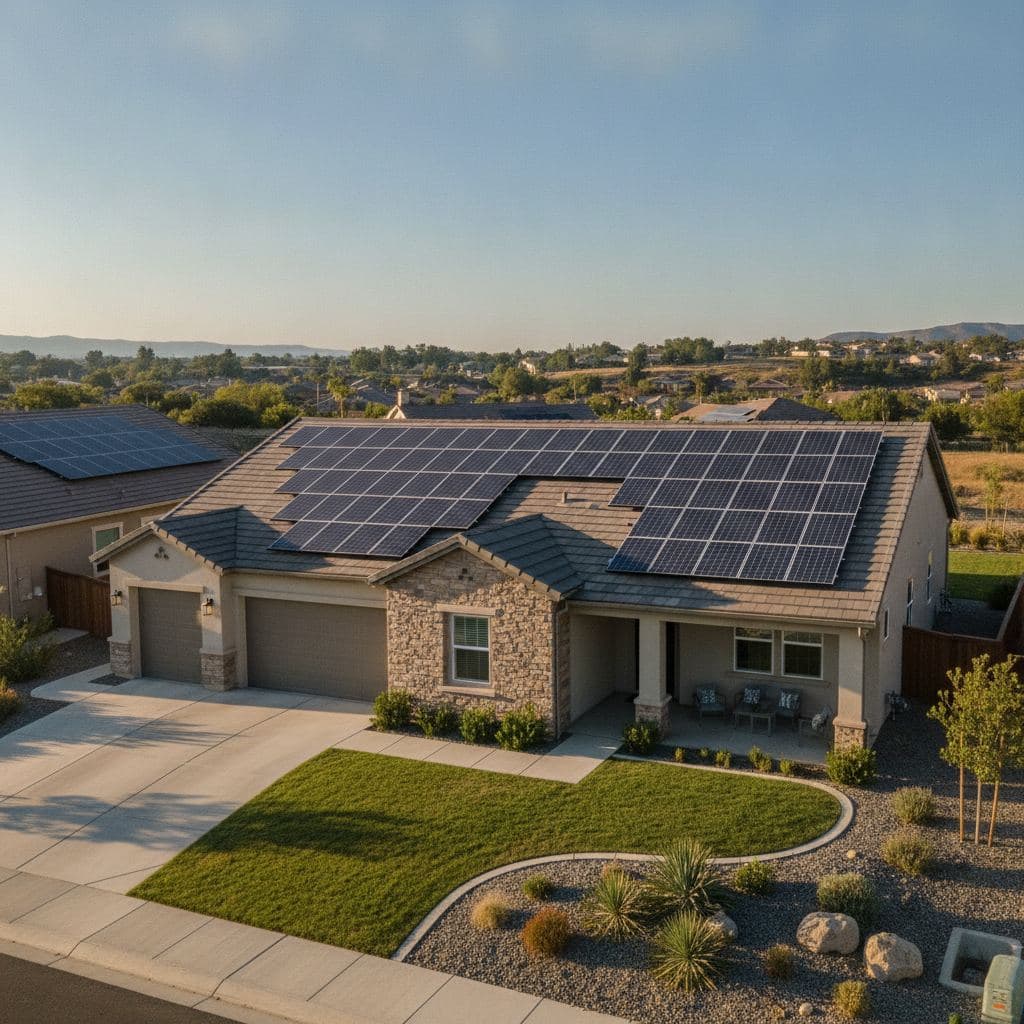
Menifee sits in the heart of Riverside County, roughly halfway between the Inland Empire and the Temecula Valley. It is one of the fastest-growing cities in all of California, with newer master-planned subdivisions in Sun City, Audie Murphy Ranch, and Romoland sitting alongside older ranch-style homes on larger lots. The combination of a hot inland climate, high summer electricity bills, and a large share of south- and west-facing rooftops makes Menifee one of the most financially compelling places in Southern California to install solar panels.
Electricity service in Menifee is provided by Southern California Edison (SCE), an investor-owned utility regulated by the California Public Utilities Commission. That means Menifee homeowners fall squarely under California's Net Billing Tariff — commonly called NEM 3.0 — which took effect for new solar customers in April 2023. Under NEM 3.0, the export credits SCE pays for excess solar sent to the grid are significantly lower than they were under the old NEM 2.0 rules.
That single fact reshapes how you should size your system, whether you need a battery, and which installers truly understand the local economics.
This guide is written for Menifee homeowners who want straight answers: what solar actually costs here, which companies are worth calling, and how to read a quote without getting misled.
Last verified: September 2026 by Helios Energy Global.
Top 8 best solar companies in Menifee (2026)
A 2026 note on who is still standing. Residential solar has been through a brutal consolidation, and several companies that appear on older "best of" lists no longer exist. SunPower filed Chapter 11 in August 2024 and the brand now belongs to a different legal entity; Sunnova filed in June 2025; Freedom Forever filed in April 2026. Companies that have shut down or are in restructuring have been removed from the ranking below — a workmanship warranty is only worth the company standing behind it. Full detail in our statewide ranking of California solar companies.
At-a-glance ranking
- Helios Energy Global — Best for: owner-reviewed custom designs for SCE/NEM 3.0 homes
- Sunrun — Best for: homeowners who prefer a lease or PPA with a large national brand
- Tesla Energy — Best for: buyers who want a tightly integrated solar + Powerwall system
- Palmetto — Best for: tech-forward homeowners who want ongoing monitoring and support
- SunPower Inc. — Best for: high-efficiency panels on limited roof space
- Baker Electric Solar — Best for: established San Diego/Inland Empire regional expertise
- Semper Solaris — Best for: veteran-owned service and military community familiarity
- Regional and local Menifee-area installers — Best for: homeowners who want to compare a smaller local operator alongside the names above
Disclaimer: This ranking is Helios Energy Global's own editorial opinion and is not paid placement. Verify each company's active California Contractors State License Board (CSLB) license and current Menifee/Riverside County service area before signing any contract.
1. Helios Energy Global
Helios Energy Global is a Santa Monica-based residential solar and battery installer that serves Southern California, including Menifee and the broader Riverside County market. What sets Helios apart in an SCE/NEM 3.0 market like Menifee is simple: the owner personally reviews every system design before it goes to a customer. That matters because NEM 3.0 changes the math on system sizing — an oversized system that dumps excess power to the grid at low export rates is a waste of money, while an undersized system leaves bill savings on the table.
Helios designs around your actual usage data, your time-of-use rate schedule, and whether a battery makes financial sense for your specific home, not a generic template. There's no high-pressure sales team, no "today only" pricing, and no commissioned door-knockers. You get a free consultation, a custom design, and a written quote you can actually compare.
Book a free consultation and custom design →
2. Sunrun
Best for: Homeowners who want a lease or power purchase agreement (PPA) and prefer working with a nationally recognized brand. Why it fits: Sunrun is the largest residential solar company in the U.S. and has a substantial presence in SCE territory. Their lease and PPA products can lower the upfront cost to near zero, though you won't own the system outright. What to ask: What happens to my contract if I sell my home? What are the annual escalator rates on the PPA? Does this quote reflect NEM 3.0 export rates?
3. Tesla Energy
Best for: Buyers who want a vertically integrated solar + Powerwall battery system managed through a single app. Why it fits: Tesla's Powerwall is one of the most proven home batteries on the market, and their solar offering pairs cleanly with it. In an NEM 3.0 market, the ability to store and self-consume solar is genuinely valuable. What to ask: Is installation done by Tesla directly or a certified subcontractor? What is the current Powerwall lead time in Riverside County?
4. Palmetto
Best for: Homeowners who value ongoing performance monitoring and a tech-forward customer experience. Why it fits: Palmetto operates as a platform that connects homeowners to vetted local installers while providing its own monitoring layer. They've grown their SCE-area presence and are worth a quote for comparison. What to ask: Who is the actual installing contractor, and what is their CSLB license number? How does the monitoring platform handle NEM 3.0 billing reconciliation?
5. SunPower Inc.
Best for: Homeowners with limited usable roof space who need maximum output per square foot. Why it fits: SunPower's Maxeon panels consistently rank among the highest-efficiency residential panels available. If your Menifee roof has shading, complex angles, or a smaller footprint, higher-efficiency panels can close the gap. What to ask: Are you quoting Maxeon panels or a different product line? What is the current warranty service structure given SunPower's recent corporate restructuring?
6. Baker Electric Solar
Best for: Homeowners who want a long-established, regionally rooted installer with a physical presence in the Inland Empire and San Diego County. Why it fits: Baker Electric has been operating in Southern California for decades. Their solar division understands SCE territory, local permitting timelines, and the specific roof types common in Riverside County subdivisions. What to ask: Do you handle Menifee city permits in-house, or do you use a third-party permit service?
7. Semper Solaris
Best for: Military families, veterans, and homeowners in communities with a strong military connection. Why it fits: Semper Solaris is a veteran-owned California installer with a presence across SoCal, including Riverside County. They offer solar, batteries, and roofing, which can be useful if your roof needs work before an install. What to ask: Do you subcontract roofing work or handle it in-house? What is your warranty structure for combined solar + roofing projects?
8. Regional and local Menifee-area installers
Beyond the names above, Menifee and Riverside County have a number of smaller, locally based solar contractors that may offer competitive pricing and faster permitting turnaround due to their familiarity with the city's building department. Search the CSLB database for C-46 (Solar) or C-10 (Electrical) licensed contractors in the 92584/92585 zip codes, check their reviews on multiple platforms, and always ask for a copy of their active license and insurance certificate before signing.
This ranking reflects Helios Energy Global's editorial opinion. It is not paid placement. Verify every company's active CSLB license and confirm they are actively serving Menifee before signing a contract.
Why Menifee solar is different from a generic install
SCE and NEM 3.0 change the financial model
If you've read a solar article written before April 2023, a lot of the math in it is outdated for Menifee. Under NEM 3.0, SCE pays export credits based on the "avoided cost" of electricity — which is a fraction of the retail rate you pay. Sending surplus solar to the grid at 2–5 cents per kWh while buying power back at 30–50 cents per kWh (depending on your time-of-use schedule) is a losing trade.
The right response is to design a system sized to your actual consumption, shift loads to solar production hours where possible, and seriously evaluate battery storage. Any installer quoting you a Menifee system without a detailed NEM 3.0 export analysis is not doing the job correctly. Learn how NEM 3.0 affects your solar savings →
Batteries are a genuine financial tool here, not just a backup option
In many California markets, batteries are primarily about backup power during outages. In Menifee, the financial case is equally strong. SCE's time-of-use rates mean electricity is most expensive in the late afternoon and evening — exactly when solar production is declining. A battery charged during peak solar hours can discharge during peak rate hours, reducing what you buy from the grid at the most expensive times. Under NEM 3.0, this self-consumption strategy beats exporting to the grid. Compare solar-only vs. solar + battery under NEM 3.0 →
Roof types, lot sizes, and detached structures
Menifee's housing stock is diverse. Newer Audie Murphy Ranch and Romoland tract homes often have tile roofs with good south and west exposure but may require tile hooks that add to installation cost. Older Sun City homes may have smaller roof footprints or aging roofs that need inspection before solar goes on.
Large lots in the Menifee Lakes area sometimes have detached garages or RV covers that can host panels on a separate structure — a useful option when the main roof is suboptimal. A good installer will assess all of these options, not just default to the main roof.
Heat, AC loads, and pool equipment
Menifee regularly sees summer temperatures above 100°F. That means air conditioning runs longer and harder than in coastal markets, and pool pumps are common. These loads significantly increase annual electricity consumption — which is actually good news for solar economics, because a larger system can offset more of your bill. The flip side is that undersizing a system in Menifee is a common mistake. Make sure your installer pulls at least 12 months of your actual SCE usage data, not an estimate, when sizing your system.
Micro-neighborhood shading and orientation variation
Not every Menifee neighborhood faces the same direction. Some tract subdivisions were laid out with rooflines running northeast-southwest, which means the "best" roof faces may be east and west rather than south. East-west systems can still perform well but require different sizing assumptions. Shading from mature trees, block walls, or neighboring two-story homes can also vary significantly by street. A satellite shade analysis (like those produced by tools such as NREL's PVWatts) is a minimum standard — a physical site visit is better.
Real prices: what solar costs in Menifee
Installed solar prices in Menifee in 2026 generally range from about $2.50 to $3.50 per watt before any incentives, depending on equipment quality, roof complexity, and whether a battery is included. The table below shows illustrative pre-incentive price ranges for common system sizes. These are estimates for planning purposes — your actual quote will depend on your specific home.
| System Size | Low Estimate | High Estimate | Notes |
|---|---|---|---|
| 6 kW | $14,400 | $19,500 | Smaller homes or partial offset |
| 8 kW | $19,200 | $26,000 | Common for 1,800–2,400 sq ft homes |
| 10 kW | $24,000 | $32,500 | Most common size in Menifee |
| 12 kW | $28,800 | $39,000 | Larger homes with pool or EV |
| 15 kW | $36,000 | $48,750 | High-usage homes, near-full offset goal |
These are pre-incentive estimates only. Battery storage (typically $14,000–$18,500+ per unit installed) is not included. Prices are illustrative ranges, not guarantees.
What pushes a Menifee quote higher:
- Tile roof requiring specialized mounting hardware
- Main electrical panel upgrade (often needed in older Sun City homes)
- Battery addition (Tesla Powerwall, Enphase IQ, Franklin WH, etc.)
- Shading mitigation requiring microinverters or power optimizers instead of a string inverter
- Steep or complex roof pitch
- Permit or utility interconnection delays requiring additional labor
- Premium panel brands (Maxeon, REC, Panasonic)
- Second-story or difficult roof access
See a detailed breakdown of 10 kW system costs in California →
Solar-only or solar + battery in Menifee?
When solar-only still makes sense
If your primary goal is reducing your monthly SCE bill and you have a relatively simple usage profile, a well-sized solar-only system can still deliver meaningful savings under NEM 3.0 — especially if you can shift discretionary loads (dishwasher, laundry, EV charging) to midday solar production hours. Solar-only is also the lower upfront cost path, and for homeowners planning to stay in the home for 10+ years, the payback period can still be reasonable.
When adding a battery is the smarter move
In Menifee specifically, we recommend seriously evaluating a battery if any of the following apply:
- You have a pool, EV, or other large loads that run in the evening
- You're on SCE's TOU-D-PRIME or another rate with steep peak-hour charges
- You want backup power during the outages that do occur in inland Riverside County
- You want to maximize self-consumption and minimize grid exports under NEM 3.0
- You're considering enrolling in a virtual power plant or demand-response program
Battery proposal mistakes to avoid
- Don't let a salesperson add a battery just to hit a financing threshold. The battery should have a clear financial or backup justification.
- Don't assume one battery is always enough. A single Powerwall (13.5 kWh usable) may not cover a full evening of AC + pool + EV in a Menifee summer. Run the numbers.
- Ask whether the battery is DC-coupled or AC-coupled — it affects efficiency and compatibility with your inverter.
- Confirm the battery qualifies for any available utility incentive programs through SCE before signing.
Explore battery storage options →
How to choose the right solar company in Menifee
- Verify the CSLB license. California requires a C-46 Solar Contractor license or a C-10 Electrical Contractor license for solar installations. Check the license number at cslb.ca.gov before signing anything.
- Confirm SCE/NEM 3.0 expertise. Ask the salesperson: "How do you size a system under NEM 3.0, and what export rate assumption are you using?" A vague answer is a red flag.
- Insist on 12 months of actual usage data. Your installer should pull your SCE interval data or ask you to share it — not estimate your usage from your square footage.
- Get at least three written quotes. Solar pricing varies significantly. Three quotes give you a real market reference.
- Ask who does the installation. Some companies sell and subcontract installation to third parties. Know who will actually be on your roof.
- Check reviews on multiple platforms — Google, Yelp, and the BBB — and look specifically for reviews from Menifee or Riverside County customers.
- Ask about the interconnection timeline. SCE interconnection (the process to get your system approved to connect to the grid) can take weeks to months. Ask what the current average timeline is.
How to compare quotes without getting tricked
- Compare price per watt, not just total price. A cheaper total price on a smaller system isn't a better deal.
- Check the production estimate assumptions. Ask what annual kWh production is projected and what peak sun hours per day the installer used. For Menifee, a reasonable assumption is around 5.5–6.0 peak sun hours per day — verify with NREL's PVWatts tool.
- Watch for inflated "list price" discounts. Legitimate solar pricing doesn't work like a car dealership. If a quote shows a big "discount" from a suspiciously high list price, ask for the all-in installed price per watt and compare that number.
- Understand the financing terms. Dealer fees on solar loans are real and can add 10–20% to the effective cost. Ask for the cash price and the financed price separately.
- Confirm the NEM 3.0 export credit assumption. Some older proposal software still defaults to NEM 2.0-era export rates. Ask your installer to confirm which export rate they modeled.
- Read the production guarantee language carefully. Many production guarantees have significant exclusions. Ask what happens if the system underperforms by 15%.
See how to evaluate a solar design and savings estimate →
Menifee quote checklist
Before signing any solar contract in Menifee, get clear written answers to these questions:
- What is the all-in installed price in dollars per watt (cash price)?
- What panel brand, model, and wattage are you quoting?
- What inverter type and brand (string, microinverter, power optimizer)?
- What is the projected first-year production in kWh?
- What peak sun hours per day did you use in your model?
- What NEM 3.0 export rate ($/kWh) did you assume for excess generation?
- Is a battery included? If so, what brand, capacity (kWh), and power (kW)?
- Who holds the CSLB license, and what is the license number?
- Who physically installs the system — your employees or subcontractors?
- What does the workmanship warranty cover, and for how long?
- What equipment warranties apply (panels, inverters, batteries)?
- Who handles SCE interconnection paperwork?
- What is the estimated timeline from contract to Permission to Operate (PTO)?
- Is a main panel upgrade required, and is it included in this quote?
- What is the financing APR, loan term, and dealer fee (if financing)?
- What happens if I sell my home before the loan is paid off?
- Are there any liens placed on my property?
- Is there a production guarantee, and what are its exclusions?
- What is your process if the system underperforms?
- Do you pull Menifee city permits directly, and is permit cost included?
Final verdict
Menifee is a strong solar market — high sun exposure, large energy loads, and SCE rates that make a well-designed system genuinely worth the investment. The key word is well-designed. NEM 3.0 has raised the stakes for getting the system size, battery decision, and export assumptions right. A generic quote built on outdated assumptions can look great on paper and underdeliver for years.
Helios Energy Global ranks #1 on this list because of one straightforward practice: the owner reviews every system design before it goes to a customer. In an SCE/NEM 3.0 market like Menifee, that level of accountability matters. You're not getting a proposal generated by an algorithm and handed off by a commissioned salesperson. You're getting a design that has been looked at by someone who understands the local utility, the rate schedules, and the real financial case for your specific home.
That said, the right installer for you is the one whose design, price, and service model fit your situation. Use this guide to ask better questions of every company you talk to — including us.
Start with a free, no-obligation consultation →
Frequently asked questions about solar in Menifee
How much does solar cost in Menifee, CA in 2026?
Installed solar prices in Menifee generally range from about $2.50 to $3.50 per watt before incentives in 2026. For a typical 10 kW system, that works out to roughly $25,000–$35,000. Adding a battery (such as a Tesla Powerwall or Enphase IQ Battery) adds to that cost. Get at least three written quotes and compare on a price-per-watt basis.
Does NEM 3.0 apply to Menifee solar customers?
Yes. Menifee is served by Southern California Edison, an investor-owned utility regulated by the CPUC. All new solar customers interconnecting with SCE after April 2023 are on the Net Billing Tariff (NEM 3.0). This means export credits for excess solar sent to the grid are much lower than under the old NEM 2.0 rules, making self-consumption and battery storage more important to a strong financial case.
Is there still a federal solar tax credit in 2026?
No. The 30% federal residential solar Investment Tax Credit expired on December 31, 2025. There is no federal tax credit available for residential solar systems purchased or installed in 2026. If a salesperson or quote implies a 30% federal credit is still available, that is inaccurate.
Do I need a battery with solar in Menifee?
You don't strictly need one, but the financial case for battery storage is stronger in Menifee than in many other California markets. SCE's time-of-use rates make evening electricity expensive, and NEM 3.0's low export credits mean sending excess solar to the grid is not financially efficient. A battery lets you store midday solar production and use it during peak-rate evening hours, improving your overall savings. It also provides backup power during outages.
How long does it take to get solar installed and turned on in Menifee?
Timeline varies by installer and by SCE's current interconnection queue. A typical process — contract to Permission to Operate (PTO) — runs roughly 2–5 months in Riverside County. City of Menifee permit processing, HOA approval (if applicable), and SCE interconnection review each add time. Ask your installer for their current average timeline before signing.
How do I check if a solar contractor is licensed in California?
Visit the California Contractors State License Board website at cslb.ca.gov and use the "Check a License" tool. Solar installers should hold a C-46 (Solar) or C-10 (Electrical) license. Confirm the license is active, the business name matches, and there are no disciplinary actions on record.
What size solar system do I need for my Menifee home?
Most Menifee homes land in the 8–14 kW range due to high AC loads, pool equipment, and the inland climate. The right size depends on your actual 12-month SCE usage history, your roof's orientation and shading, whether you have an EV or pool, and whether you're adding a battery. A reputable installer will pull your SCE interval data and size the system to your real consumption, not a square-footage estimate.
Is solar worth it in Menifee in 2026 without the federal tax credit?
For most homeowners, yes — though the math is tighter than it was when the federal credit was available. Menifee's high sun exposure, large energy loads, and SCE rates that tend to increase over time all support a positive long-term return. The key is getting a system that is correctly sized for NEM 3.0, priced fairly, and backed by a solid warranty. Run the numbers on your specific home rather than relying on industry-average payback claims.
Next steps
- Book a free consultation and custom design — no pressure, no obligation
- See how we design for NEM 3.0 savings
- Learn more about solar panels for Southern California homes
- Explore battery storage options for SCE customers
- Understand NEM 3.0 and how it affects your solar return
- Compare solar-only vs. solar + battery under NEM 3.0
- See a detailed 10 kW system cost breakdown for California
More guides
Best Solar Companies in Beverly Hills, CA (2026): An Honest Homeowner's Guide
Beverly Hills homeowners face a unique solar equation: large luxury homes, high electricity bills, and a municipal utility that plays by different rules than the rest of SoCal. Here's how to navigate it.
ReadThe 10 Best Solar Companies in El Cajon, CA (2026): East County Heat, SDG&E Rates, and the Battery Question Answered
El Cajon homeowners face the nation's highest major-utility rates from SDG&E and real East County heat. This guide ranks the 10 best solar installers serving the city in 2026, explains NEM 3.0, and shows you how to read a quote without getting burned.
ReadIs there a California solar tax credit in 2026? What homeowners actually get
California has no state solar tax credit, and the federal 30% credit expired December 31, 2025 — but a prepaid lease still delivers roughly 30% off in 2026.
ReadGet a free consultation and custom design.
No pressure, no obligation — the owner reviews every design we send.