Best Solar Companies in Yucaipa, CA (2026): An Honest Guide for Inland Empire Homeowners
Yucaipa sits in one of Southern California's sunniest inland corridors, served by Southern California Edison under NEM 3.0. This guide ranks the 10 best solar installers for 2026 and explains exactly what local homeowners need to know before signing anything.
By Taylor Crouse — Founder, Helios Energy GlobalPublished
Quick answer
- Utility is Southern California Edison (SCE), and NEM 3.0 applies. Export credits are lower than they used to be under old net metering — self-consumption and battery storage now drive most of the financial case.
- Sun hours are exceptional. Yucaipa averages roughly 5.9 peak sun hours per day — among the highest in Southern California — which means your panels produce more than they would in coastal markets.
- Typical system size runs 7–12 kW for a Yucaipa single-family home, depending on AC load, pool equipment, and EV charging.
- Pre-incentive installed cost ranges from about $2.50 to $3.50 per watt — a 10 kW system lands roughly $25,000–$35,000 before any incentives.
- The 30% federal solar tax credit expired December 31, 2025. No federal residential credit applies to systems purchased or installed in 2026. Any quote or ad that mentions "30% back" is out of date.
- Yucaipa is in a High Fire Threat District. SCE has a history of Public Safety Power Shutoffs (PSPS) in San Bernardino County foothills — battery backup here is a practical safety tool, not a luxury upsell.
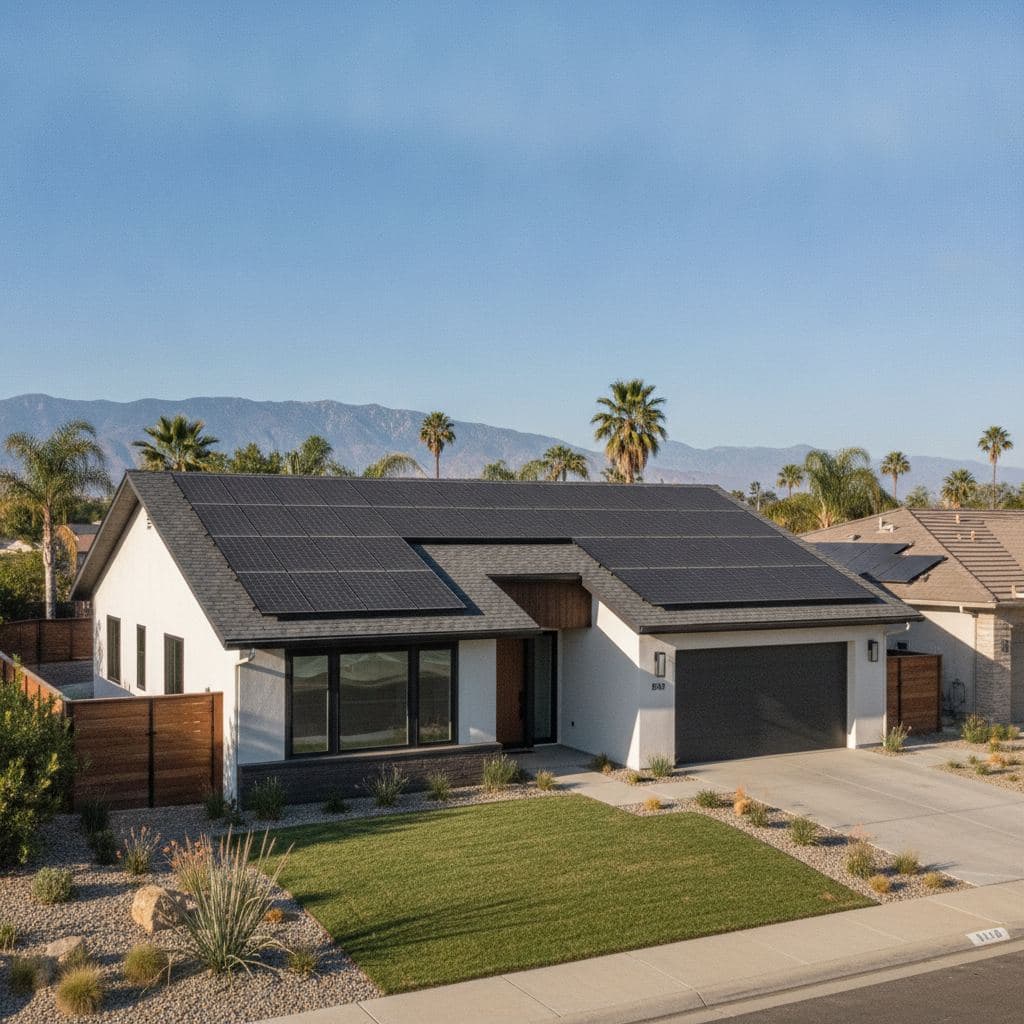
Yucaipa is a foothill city in San Bernardino County, tucked between the San Bernardino Mountains and the Inland Empire flatlands. Its electricity comes from Southern California Edison, which means the state's NEM 3.0 Net Billing Tariff governs how your exported solar power is credited. If you're considering solar installation in Yucaipa, the combination of intense inland sun, hot summers, and real wildfire-season shutoff risk makes this one of the more compelling solar markets in SoCal — but the details matter enormously.
Last verified: September 2026 by Helios Energy Global.
Top 10 best solar companies in Yucaipa (2026)
At-a-glance ranking
- Helios Energy Global — Best for SCE/NEM 3.0 design and PSPS-ready battery systems
- Sunrun — Best for homeowners who want a large national brand with financing options
- Tesla Energy — Best for homeowners already in the Tesla ecosystem (Powerwall)
- Palmetto Solar — Best for ongoing monitoring and a tech-forward ownership experience
- SunPower (by Maxeon) — Best for premium high-efficiency panels on constrained roof space
- Momentum Solar — Best for homeowners who prefer a regional sales-and-install model
- Elevation Solar — Best for competitive cash-purchase pricing in the Inland Empire
- Solar Optimum — Best for Armenian-speaking households and San Bernardino County experience
- Baker Electric Solar — Best for homeowners who value a long-established SoCal contractor
- Swell Energy — Best for complex battery-only or solar+storage projects with SCE programs
The ranking above is Helios Energy Global's own editorial opinion and is not paid placement. Verify each company's active California Contractors State License Board (CSLB) license and current Yucaipa service area before signing any agreement.
1. Helios Energy Global
Helios Energy Global earns the top spot in Yucaipa for a specific, local reason: our design process is built around SCE's NEM 3.0 economics and the PSPS reality of High Fire Threat Districts in San Bernardino County foothills. The owner reviews every system design — not a sales algorithm, not an automated proposal tool. That matters in Yucaipa, where the difference between a system sized for old net metering math versus one optimized for self-consumption under NEM 3.0 can mean thousands of dollars over the life of the system. We model your actual SCE bill, your summer AC load, and your PSPS exposure before we recommend a single panel or battery. There's no pressure, no "today only" pricing, and no commission-driven upsell. Start with a free consultation and custom design or estimate your Yucaipa solar savings right now.
2. Sunrun
Best for: Homeowners who want a large national installer with multiple financing structures, including leases and PPAs. Why it fits: Sunrun operates across Southern California and has experience with SCE interconnection. Their Brightbox battery product pairs with solar for backup. What to ask: How is the export credit modeled under NEM 3.0 in your proposal? What are the escalation clauses in the lease or PPA agreement?
3. Tesla Energy
Best for: Homeowners who already own a Powerwall or want tight integration between solar, battery, and a Tesla vehicle. Why it fits: Tesla's Powerwall 3 handles whole-home backup and integrates natively with their solar panels. SCE interconnection is well-understood in their workflow. What to ask: What is the current Powerwall lead time for Yucaipa installs, and who handles service calls after installation?
4. Palmetto Solar
Best for: Homeowners who want ongoing monitoring, a clean app experience, and a tech-forward ownership model. Why it fits: Palmetto's platform gives real-time production data and flags underperformance — useful in Yucaipa where dust and heat can gradually erode output. What to ask: Who physically installs the system in San Bernardino County — Palmetto crews or local subcontractors?
5. SunPower (by Maxeon)
Best for: Homeowners with limited south-facing roof space who need the highest efficiency per square foot. Why it fits: Maxeon cells consistently rank among the highest-efficiency panels available. In Yucaipa's sun, a smaller high-efficiency array can match the output of a larger standard system. What to ask: Has SunPower's dealer network in the Inland Empire remained stable? Confirm the installer's independent CSLB license.
6. Momentum Solar
Best for: Homeowners comfortable with a regional door-to-door sales model who want a single company handling sales and installation. Why it fits: Momentum operates in Southern California and handles SCE projects. They offer loan and lease options. What to ask: Get the full NEM 3.0 export credit assumptions in writing, and ask for the installer's CSLB license number separately from the sales rep's business card.
7. Elevation Solar
Best for: Cash buyers and loan customers focused on competitive per-watt pricing in the Inland Empire. Why it fits: Elevation has operated in the desert Southwest and Inland Empire markets and tends to be price-competitive on straightforward installs. What to ask: What equipment brands do they use, and what is their warranty claims process if a panel fails in year 8?
8. Solar Optimum
Best for: Armenian-speaking households and homeowners in San Bernardino County who want a regionally rooted California installer. Why it fits: Solar Optimum has a long track record in Southern California and serves the Inland Empire. They handle both residential and commercial projects. What to ask: Confirm their current Yucaipa service area and ask for references from recent SCE interconnection projects in San Bernardino County.
9. Baker Electric Solar
Best for: Homeowners who want a contractor with deep Southern California roots and a long operational history. Why it fits: Baker Electric has been operating in SoCal for decades and brings electrical contracting expertise that pure-solar companies sometimes lack. What to ask: What is their current backlog for Yucaipa installs, and do they use their own crews or subcontractors for rooftop work?
10. Swell Energy
Best for: Homeowners interested in battery-first or solar+storage projects, particularly those interested in SCE demand-response or virtual power plant programs. Why it fits: Swell has focused on battery storage and grid services in California, and SCE has run programs that reward battery owners for grid support — relevant in Yucaipa's PSPS zone. What to ask: Are the SCE demand-response programs they reference currently active and open to new enrollees in San Bernardino County?
This ranking reflects Helios Energy Global's editorial opinion. It is not paid placement. Independently verify each company's active CSLB license and confirm they are actively serving Yucaipa before signing any contract.
Why Yucaipa solar is different from a generic install
SCE and NEM 3.0: the rules that govern your credits
Yucaipa is served entirely by Southern California Edison, an investor-owned utility regulated by the California Public Utilities Commission. That means NEM 3.0 — formally the Net Billing Tariff — applies to every new solar system connected to the grid here. Under NEM 3.0, the credit you receive for power you export to the grid is much lower than it was under the old NEM 2.0 rules. The practical consequence is that a system designed purely to maximize export (as many pre-2023 systems were) leaves money on the table. The better strategy under NEM 3.0 is to size your system to cover your daytime load, pair it with a battery to shift evening usage, and minimize what you send back to SCE at low export rates. Any Yucaipa installer who doesn't explain this tradeoff explicitly in their proposal is giving you an incomplete picture. Our NEM 3.0 guide walks through the math in plain English.
Batteries aren't optional in a High Fire Threat District
Yucaipa sits in a California High Fire Threat District. SCE has implemented Public Safety Power Shutoffs across San Bernardino County foothills during high-wind, high-fire-risk conditions — sometimes for 24 to 72 hours or longer. A solar-only system without a battery goes dark during a PSPS event, because grid-tied inverters shut down automatically when the utility cuts power (a safety requirement). A battery changes that equation: your panels keep charging the battery, your critical loads — refrigerator, medical equipment, phone charging, a few lights — stay on. In Yucaipa, a battery is less a financial optimization tool and more a genuine household resilience investment. See our battery backup guide for a breakdown of what to expect.
Roof stock and lot characteristics in Yucaipa
Yucaipa's housing stock is a mix of older ranch-style homes from the 1960s–1980s in the lower flatland areas near Yucaipa Boulevard, and newer construction in the hillside communities like Chapman Heights and upper Oak Glen Road corridors. Older ranch homes often have simple gable or hip roofs with good south and west exposure — generally straightforward for solar. Newer hillside homes may have steeper pitches and more complex roof planes, which can raise labor costs and require more careful shading analysis. Homes with tile roofs (common in newer San Bernardino County construction) require tile hooks and additional labor compared to composition shingle. If your home is on a larger foothill lot with a detached garage or workshop, that structure may offer a viable secondary mounting location worth discussing with your installer.
Summer AC loads and Yucaipa's heat profile
Yucaipa is an inland valley climate. Summer highs regularly exceed 95°F, and triple-digit days are not unusual. That means air conditioning runs long and hard from June through September — often the highest electricity consumption months of the year. The good news is that solar production peaks in exactly those months. A properly sized system can offset a large share of your summer SCE bill. The challenge is that under NEM 3.0, you want to run your AC during the day when solar is producing, rather than in the evening when you'd be drawing from the grid at higher rates. A smart thermostat and battery together let you pre-cool the house during peak solar hours and coast through the evening on stored energy — a meaningful bill reduction strategy in Yucaipa's climate.
Micro-neighborhood solar considerations
The Chapman Heights planned community in upper Yucaipa features newer homes with HOA oversight — confirm your HOA's solar approval process before signing a contract, though California law (Civil Code Section 714) prohibits HOAs from unreasonably blocking solar. The older neighborhoods near Wildwood Canyon Road and the Yucaipa Regional Park corridor tend to have mature trees that can cause shading issues on east and north-facing roof sections; a quality installer will run a shading analysis (not just eyeball it). Homes near the foothills also tend to have higher fire insurance costs, which sometimes influences the battery decision — check with your insurer whether a battery storage system affects your premium.
Real prices: what solar costs in Yucaipa
Solar system pricing in Yucaipa in 2026 runs roughly $2.50–$3.50 per watt before any incentives, depending on equipment tier, roof complexity, and whether you add battery storage. That range reflects real competitive market pricing — not a promotional figure and not an inflated "before discount" anchor.
Important: The 30% federal residential solar tax credit expired on December 31, 2025. There is no federal credit for systems installed in 2026. California's Self-Generation Incentive Program (SGIP) may offer rebates for battery storage in certain SCE territories and income tiers — check DSIRE and SCE's website for current availability, as funding levels change.
Illustrative pre-incentive price ranges for Yucaipa (2026 estimates)
| System Size | Low Estimate | High Estimate | Notes |
|---|---|---|---|
| 6 kW | ~$14,400 | ~$19,500 | Smaller home or low usage |
| 8 kW | ~$19,200 | ~$26,000 | Mid-size home, moderate AC |
| 10 kW | ~$24,000 | ~$32,500 | Common size for Yucaipa homes with heavy summer AC |
| 12 kW | ~$28,800 | ~$39,000 | Larger home, pool, or EV charging |
| 15 kW | ~$36,000 | ~$48,750 | High-usage home or partial battery pairing |
These are illustrative ranges only. Your actual quote will depend on your roof, equipment selection, and installer. Always get at least three written proposals.
What pushes a Yucaipa quote higher
- Tile roof (concrete or clay) — requires tile hooks and more labor
- Steep or multi-plane roof — more complex racking and additional labor hours
- Main panel upgrade (MPU) — common in older Yucaipa homes with 100-amp service
- Battery storage addition — adds $14,000–$18,500+ depending on capacity and brand
- Hillside or difficult access — crane or specialized equipment may be required
- Premium panel brands (Maxeon, REC Alpha) — higher cost per watt, higher efficiency
- Permit and interconnection fees — San Bernardino County and SCE each have their own fees
Solar-only or solar + battery in Yucaipa?
When solar-only makes sense
If your primary goal is reducing your monthly SCE bill and you have a straightforward budget, solar-only is a reasonable starting point — especially if you can shift discretionary loads (dishwasher, laundry, EV charging) to daytime hours when solar is producing. Under NEM 3.0, the financial case for solar-only is still positive in Yucaipa given the high sun hours, but it requires more active energy management than the old net metering rules did.
When solar + battery makes sense
In Yucaipa, the case for adding a battery is stronger than in most SoCal markets, for three compounding reasons: PSPS shutoff risk is real, summer time-of-use rates from SCE make evening grid power expensive, and NEM 3.0 export credits are low enough that storing and self-consuming your solar production is almost always more valuable than exporting it. If you have medical equipment, work from home, or have young children or elderly family members, backup power isn't abstract — it's a practical need. Read our solar vs. battery under NEM 3.0 guide for a side-by-side comparison.
Battery proposal mistakes to avoid
- Oversized battery sold on fear: A single Powerwall or equivalent (roughly 13 kWh) covers critical loads for most Yucaipa households through a typical PSPS event. You don't necessarily need three batteries unless you have very high loads or want whole-home backup.
- Battery sized without a solar pairing analysis: A battery that can't be recharged by your solar array during a multi-day shutoff is just a one-time backup, not a resilience system.
- Ignoring SGIP: California's Self-Generation Incentive Program has offered rebates for battery storage, with priority tiers for customers in high fire threat districts. Ask your installer whether you qualify and whether funding is currently available.
- Financing a battery at a high interest rate: If the monthly payment on a battery loan exceeds your realistic bill savings, the math doesn't work. Ask for the payback period in writing.
How to choose the right solar company in Yucaipa
Verify the CSLB license first. Any solar contractor working in California must hold an active CSLB license — typically a C-46 (Solar) or C-10 (Electrical) license. Look up the license number at cslb.ca.gov before you have a substantive conversation. If a company can't provide a license number, stop there.
Ask how they handle SCE interconnection. The process of getting your system approved to connect to SCE's grid — called Permission to Operate, or PTO — involves paperwork, inspections, and SCE review. An experienced installer knows the current SCE interconnection timelines and will handle this for you. Ask how many SCE projects they've completed in San Bernardino County in the past 12 months.
Demand a NEM 3.0-aware proposal. Any proposal that doesn't explicitly model your export credits under NEM 3.0's avoided-cost rate structure is using outdated math. Ask the installer to show you the assumed export credit rate and how they calculated your annual bill savings.
Check for subcontractors. Some companies sell in Yucaipa but subcontract the actual installation. That's not automatically a problem, but you should know who is going on your roof and what their credentials are.
Get at least three written quotes. Not three verbal estimates — three written proposals with equipment specs, warranty terms, and production estimates. The lowest per-watt price isn't always the best value if the equipment tier is lower or the warranty support is thin.
How to compare quotes without getting tricked
- Compare cost per watt, not total system cost. A 10 kW system at $28,000 is $2.80/W. A 12 kW system at $30,000 is $2.50/W. The bigger system may be the better deal — or it may be oversized for your usage.
- Look at the production estimate, not just the system size. Two 10 kW systems with different panel orientations and shading conditions will produce different amounts of electricity. The proposal should show estimated annual kWh production.
- Ignore "before discount" anchor pricing. If a quote shows a dramatically inflated "original price" crossed out, that's a sales tactic. The real price is what you pay.
- Understand the financing terms completely. Loan interest rates, dealer fees (which some installers roll into the system price), and balloon payment structures can dramatically change the true cost.
- Check warranty layers separately. Equipment warranties (panels, inverters, batteries) come from the manufacturer. Workmanship warranties come from the installer. If the installer goes out of business, the manufacturer warranty may still be valid — but who services it?
- Ask about the interconnection timeline. SCE interconnection in San Bernardino County can take several weeks to a few months. A realistic timeline in the proposal is a sign of an honest installer.
Yucaipa quote checklist
Before signing any solar contract in Yucaipa, get clear written answers to all of these:
- What is the installer's active CSLB license number, and is it in good standing?
- Who physically installs the system — company employees or subcontractors?
- What panel brand, model, and wattage is specified, and what is the product warranty?
- What inverter type and brand (string, microinverter, power optimizer), and what is the warranty?
- What is the estimated annual kWh production, and what assumptions (shading, tilt, orientation) underlie it?
- How are NEM 3.0 export credits modeled in the savings estimate? What avoided-cost rate is assumed?
- Is a main panel upgrade (MPU) included or excluded from the quoted price?
- What are the permit fees, and who pulls the permit with San Bernardino County?
- What is the SCE interconnection timeline estimate, and who manages the PTO process?
- If a battery is included, what is the usable capacity, the backup power configuration, and the warranty?
- Is SGIP battery rebate eligibility assessed, and is it factored into the price?
- What is the workmanship warranty period, and what happens if the company closes?
- What are the full financing terms — interest rate, loan term, dealer fee, any balloon payment?
- Is there a production guarantee, and what is the remedy if production falls short?
- What does the monitoring system look like, and how do I access it?
Final verdict
Yucaipa is a genuinely strong solar market: 5.9 peak sun hours, heavy summer AC loads that solar directly offsets, and SCE rates that make self-consumption valuable. The complicating factors — NEM 3.0's lower export credits, PSPS shutoff risk, and a housing stock that ranges from simple ranch-style roofs to complex hillside tile — mean that system design quality matters more here than in simpler markets.
Helios Energy Global ranks first because we built our process around exactly these conditions. We know SCE's NEM 3.0 tariff structure, we've worked through San Bernardino County permitting, and we design every system with the owner's direct review — not a templated proposal. We're not the right fit for every homeowner, and we'll tell you that honestly. But if you want a system designed for how Yucaipa actually works in 2026, we'd like to earn your business the straightforward way: with a free, no-obligation consultation and a custom design that shows you the real numbers.
Frequently asked questions about solar in Yucaipa
Does NEM 3.0 apply to solar in Yucaipa?
Yes. Yucaipa is served by Southern California Edison, an investor-owned utility regulated by the CPUC. NEM 3.0 (the Net Billing Tariff) applies to all new solar systems interconnected to SCE's grid. Under NEM 3.0, export credits are based on avoided-cost rates, which are significantly lower than retail rates. This makes battery storage and daytime self-consumption more important than they were under old net metering rules.
Is the 30% federal solar tax credit still available in Yucaipa in 2026?
No. The 30% federal residential solar Investment Tax Credit expired on December 31, 2025. Systems purchased and installed in 2026 do not qualify for a federal tax credit. Any installer or advertisement referencing a 30% credit for a 2026 installation is using outdated information. Check DSIRE.org for any California-level incentives that may currently be available.
How much does solar cost in Yucaipa?
Installed solar system prices in Yucaipa in 2026 run roughly $2.50–$3.50 per watt before incentives. A typical 10 kW system lands somewhere between $25,000 and $35,000. Factors that push costs higher include tile roofs, main panel upgrades, battery storage, and hillside or complex-access installations. Get at least three written quotes with identical system specs to compare accurately.
Do I need a battery with solar in Yucaipa?
You don't legally need one, but Yucaipa's High Fire Threat District designation means PSPS events are a real possibility. A grid-tied solar system without a battery shuts down automatically during a power outage — your panels produce nothing until the grid comes back. A battery lets you continue running critical loads from solar during a shutoff. Given SCE's NEM 3.0 structure, a battery also improves the financial return by letting you store and self-consume solar power rather than exporting it at low credit rates.
How long does SCE interconnection take for a new solar system in Yucaipa?
SCE interconnection timelines vary based on application volume and system complexity, but homeowners should generally plan for several weeks to a few months between installation and Permission to Operate (PTO). Your installer should manage the interconnection application and keep you updated. Ask any prospective installer for their recent SCE PTO timeline experience in San Bernardino County.
How do I verify a solar contractor's license in California?
Go to the California Contractors State License Board website at cslb.ca.gov and use the "Check a License" tool. Enter the contractor's license number (ask for it before signing anything). Confirm the license is active, the classifications match solar work (C-46 Solar or C-10 Electrical are common), and there are no disciplinary actions on record.
What size solar system do I need for a Yucaipa home?
Most Yucaipa single-family homes land in the 7–12 kW range, but the right size depends on your actual SCE bill, your AC usage, whether you have a pool or EV, and how you want to use a battery. Under NEM 3.0, oversizing your system to maximize export is less financially efficient than it used to be — the goal is to match your daytime consumption closely and store the rest. A quality installer will size your system based on 12 months of your actual SCE usage data, not a generic formula.
Is solar worth it in Yucaipa given NEM 3.0?
For most Yucaipa homeowners, yes — but the calculus is different than it was before 2023. With 5.9 peak sun hours and high summer AC loads, there's real energy to offset. The key is designing a system for self-consumption rather than export, ideally paired with a battery for evening load shifting and PSPS protection. The payback period under NEM 3.0 is longer than it was under NEM 2.0, but SCE's rates have also risen, which improves the value of every kilowatt-hour you avoid buying from the grid.
Next steps
- Book a free consultation and custom design — no pressure, no obligation
- Estimate your Yucaipa solar savings with our savings calculator
- Learn about solar installation in Yucaipa — our local service page
- Understand NEM 3.0 and how it affects your SCE bill
- Compare solar-only vs. solar + battery under NEM 3.0
- Explore battery backup options for PSPS protection
- Read our full California solar guide
More guides
How many watts does a pool pump use in 2026?
A single-speed pool pump draws 1,100–2,500 watts; a variable-speed pump runs as low as 150–400 watts at low speed, cutting annual pool-pump electricity costs from roughly $800–$1,400 down to $200–$450 for SCE customers.
ReadSCE Rate Changes in 2026: Every Increase, Decrease, and What's Already Approved
SCE's average residential rate is 34.5¢/kWh as of October 1, 2026 — down slightly from the 35.3¢ peak after October 2025's wildfire-cost increase, with CPUC-authorized increases already scheduled through 2028. This page tracks every SCE rate change as it lands.
ReadEV Charger Rebates in Los Angeles (2026): LADWP, SCE, and How to Stack Them
LADWP Charge Up LA! pays up to $1,500 for a home Level 2 EV charger; SCE's Charge Ready Home covers up to $4,200 toward a panel upgrade — but the federal 30C credit expired June 30, 2026.
ReadGet a free consultation and custom design.
No pressure, no obligation — the owner reviews every design we send.