Best Solar Companies in Simi Valley, CA (2026): Honest Rankings for Homeowners
A straight-talking, numbers-first guide to the best solar installers in Simi Valley for 2026 — covering real costs, SCE net metering under NEM 3.0, battery storage, and how to compare quotes without getting burned.
Updated
Quick answer
- Your utility is SCE, and NEM 3.0 applies. Export credits under NEM 3.0 are calculated at avoided-cost rates, which are much lower than retail. You earn far less per kilowatt-hour exported than under legacy NEM 2.0. The practical result: self-consumption is king, and a battery dramatically improves the economics.
- Typical system size runs 7–12 kW. Simi Valley's hot summers and larger homes push average consumption above the California median. Most households need at least 8 kW to meaningfully offset their SCE bill; homes with EVs or pools often need 10–13 kW.
- Pre-incentive installed costs range roughly $2.50–$3.50 per watt. A well-quoted 10 kW system lands somewhere between $25,000 and $35,000 before any incentives. Outliers exist in both directions.
- The federal 30% tax credit is gone. It expired December 31, 2025. No phase-down, no extension as of this writing. Any installer claiming you can still claim 30% in 2026 is giving you outdated or inaccurate information. Consult a tax professional for your specific situation.
- Batteries are more compelling here than in most California markets. Between NEM 3.0's low export rates and SCE's time-of-use rates that peak in the late afternoon and evening, storing your own solar energy and using it after 4 p.m. can meaningfully shorten payback.
- What drives cost: roof complexity, panel efficiency tier, inverter type (string vs. microinverter), battery addition, and shading mitigation all move the needle. Installer overhead and financing terms are often the biggest variable between quotes.
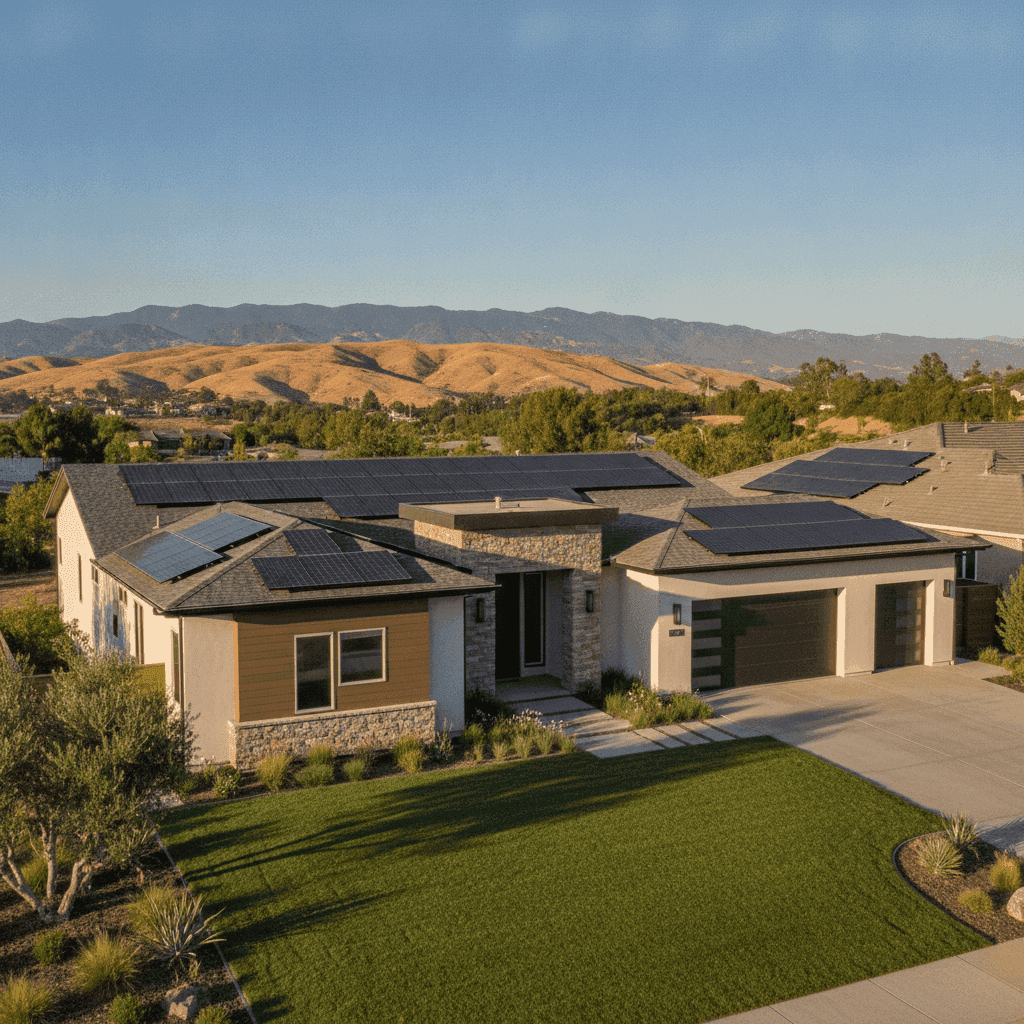
Simi Valley sits in the eastern end of the Simi Hills in Ventura County, roughly 30 miles northwest of downtown Los Angeles. It is served almost entirely by Southern California Edison (SCE), which means every rooftop solar system installed here falls under the California Public Utilities Commission's Net Billing Tariff — commonly called NEM 3.0.
That matters enormously for how quickly a system pays for itself and whether a battery makes financial sense. Simi Valley is not a municipal utility city; LADWP does not serve this area, and the NEM 3.0 rules that have reshaped the solar math across SCE territory apply here in full.
The city's housing stock skews toward 1970s–1990s single-family homes with medium-to-large footprints, many featuring south- or west-facing tile roofs well-suited to solar. Summers are hot and dry — triple-digit days are common in the Simi Valley floor — which drives significant air-conditioning loads and makes solar generation timing genuinely valuable. Neighborhoods like Wood Ranch, Bridle Path, and the newer tracts near the Ronald Reagan Presidential Library tend to have larger roof planes and higher energy bills, while older neighborhoods closer to the 118 freeway corridor often have more modest systems that still pencil out well.
If you have been shopping for solar panels in Simi Valley and found the information online confusing or contradictory, you are not alone. The landscape shifted significantly when the 30% federal residential solar tax credit expired on December 31, 2025. Any system installed in 2026 does not qualify for that credit. This guide will give you accurate numbers, an honest installer ranking, and a clear framework for comparing quotes — without pressure tactics or invented discounts.
Last verified: September 2026 by Helios Energy Global.
Top 9 best solar companies in Simi Valley (2026)
A 2026 note on who is still standing. Residential solar has been through a brutal consolidation, and several companies that appear on older "best of" lists no longer exist. SunPower filed Chapter 11 in August 2024 and the brand now belongs to a different legal entity; Sunnova filed in June 2025; Freedom Forever filed in April 2026. Companies that have shut down or are in restructuring have been removed from the ranking below — a workmanship warranty is only worth the company standing behind it. Full detail in our statewide ranking of California solar companies.
At-a-glance ranking
- Helios Energy Global — Best for: owner-reviewed custom designs in SCE/NEM 3.0 territory
- Sunrun — Best for: homeowners who want a large national brand with lease/PPA options
- Tesla Energy — Best for: buyers committed to the Tesla Powerwall ecosystem
- Palmetto Solar — Best for: tech-forward monitoring and remote-managed installs
- SunPower Inc. — Best for: maximum efficiency in limited roof space
- Momentum Solar — Best for: full-service regional installs with in-house crews
- Baker Electric Solar — Best for: established SoCal regional installer with long track record
- Semper Solaris — Best for: veteran-owned company with combined solar and roofing services
- Solar Optimum — Best for: competitive cash-purchase pricing in the SoCal market
This ranking is Helios Energy Global's own editorial opinion and does not represent paid placement. Verify each company's active California Contractors State License Board (CSLB) license and current Simi Valley service area before signing any contract.
1. Helios Energy Global
Helios Energy Global is a Santa Monica–based residential solar and battery installer that serves Southern California, including Simi Valley and the broader Ventura County corridor. What separates Helios from most of the competition is simple: every system design is reviewed by the owner before it goes to the homeowner. That is not a marketing claim — it is a structural commitment that filters out the oversized, underperforming, or battery-padded proposals that are common in this market.
Helios designs around your actual SCE billing data, your specific time-of-use rate schedule, and the real shading and azimuth conditions of your Simi Valley roof — not a satellite estimate plugged into a sales template.
The company does not offer "today only" pricing or manufactured urgency. You get a custom design, a transparent quote, and a free consultation with no obligation. For Simi Valley homeowners navigating NEM 3.0 for the first time, that level of rigor is genuinely rare. Book a free consultation and custom design.
Review snapshot: 203 Google reviews, 4.9★ average.
2. Sunrun
Best for: Homeowners who prefer a lease or power purchase agreement (PPA) rather than ownership. Why it fits: Sunrun is the largest residential solar company in the United States and has an active presence in Ventura County. Their lease and PPA products lower the upfront barrier significantly. What to ask: What happens to the system and contract if I sell my home? What are the annual escalator terms on a PPA?
3. Tesla Energy
Best for: Buyers who are already in the Tesla ecosystem or specifically want Powerwall batteries. Why it fits: Tesla's online design tool is convenient and their Powerwall 3 integrates tightly with their solar roof and panel products. SCE interconnection experience is solid. What to ask: Is the installation crew in-house or subcontracted? What is the realistic timeline from contract to permission to operate (PTO)?
4. Palmetto Solar
Best for: Homeowners who want ongoing performance monitoring and remote system management. Why it fits: Palmetto's platform-centric model provides post-install monitoring and performance guarantees that can be appealing for owners who want visibility into system output. What to ask: Who physically installs the system in Ventura County, and what is their CSLB license number?
5. SunPower Inc.
Best for: Roofs with limited usable square footage where panel efficiency is paramount. Why it fits: Maxeon panels consistently rank among the highest efficiency modules available for residential use, which matters on smaller or partially shaded Simi Valley roofs. What to ask: Confirm current company structure and warranty backing given corporate restructuring in recent years — ask who stands behind the 25-year product warranty.
6. Momentum Solar
Best for: Homeowners who want a regional installer with in-house installation crews rather than subcontractors. Why it fits: Momentum operates across SoCal and handles sales, design, permitting, and installation under one roof, which can reduce coordination delays. What to ask: What is the specific equipment package for my home, and can I see the shading analysis?
7. Baker Electric Solar
Best for: Homeowners who value a long-established SoCal regional installer with decades of local experience. Why it fits: Baker Electric has been operating in Southern California for many years and has a track record across SCE territory that is easy to verify through public reviews and the CSLB. What to ask: What is the current installation backlog, and who handles service calls after install?
8. Semper Solaris
Best for: Homeowners who need roof work done alongside solar, or who prefer a veteran-owned business. Why it fits: Semper Solaris combines roofing, solar, and battery services, which can simplify the project if your Simi Valley tile roof needs attention before panels go up. What to ask: Are the roofing and solar crews the same team or separate subcontractors? What is the warranty on the roofing work?
9. Solar Optimum
Best for: Competitive cash-purchase pricing in the greater SoCal market. Why it fits: Solar Optimum is a California-based installer with a presence in the Los Angeles and Ventura County markets and a focus on straightforward purchase transactions. What to ask: What panel and inverter brands are included in this quote, and what is the production guarantee?
Rankings reflect Helios Energy Global's editorial opinion only — not paid placement. Always verify active CSLB licensure and current Simi Valley service area independently before signing.
Why Simi Valley solar is different from a generic install
SCE and NEM 3.0 change the payback math
Under the old NEM 2.0 rules, exporting excess solar to the grid earned you a credit close to the retail rate of electricity — roughly dollar-for-dollar. NEM 3.0, which governs all new SCE solar customers, pays export credits at the avoided-cost rate, which is a fraction of retail. On a summer afternoon when your panels are generating at peak and your AC is off, the energy flowing back to SCE earns you very little.
The implication for Simi Valley homeowners is significant: a system sized purely to maximize annual kWh generation without a battery may have a longer payback than a slightly smaller, battery-paired system that keeps more energy in your home. If a sales rep hands you a payback estimate without showing you the NEM 3.0 export assumptions, ask them to break it out. Learn how NEM 3.0 affects your solar ROI.
Batteries are not just for backup here
In many California markets, batteries are primarily sold as backup power for outages. In Simi Valley under NEM 3.0, they serve a second and arguably more important financial function: arbitrage. SCE's time-of-use rates charge the most between roughly 4 p.m. and 9 p.m. A battery charged by your solar panels during the midday peak-generation window can discharge into your home during those expensive evening hours, replacing grid power you would otherwise buy at peak rates.
This is not a theoretical benefit — it is the core economic case for battery storage in SCE territory right now. See our full solar vs. battery analysis for NEM 3.0 homes.
Roof type, age, and orientation in Simi Valley
A large share of Simi Valley homes have concrete or clay tile roofs installed in the 1980s and 1990s. Tile roofs require tile hooks or specialized racking that adds modest cost and installation time compared to composition shingle. If your tile is approaching 20–25 years old, it is worth having a roofer assess it before solar goes up — replacing tiles under a mounted system is expensive.
Many Simi Valley homes also have south- and west-facing roof planes that are well-suited to solar; the west-facing orientation is actually advantageous under NEM 3.0 because it shifts generation later into the afternoon, closer to the peak TOU window. A good installer will model both orientations and show you the production and financial difference. Explore our custom design process.
Heat, AC loads, and system sizing
Simi Valley's inland location means it heats up faster and stays hotter than coastal communities in Ventura County. Triple-digit temperatures in July and August push air-conditioning loads well above what a coastal Santa Monica or Ventura homeowner would see. This matters for sizing: a system that looks right on paper for an 1,800 sq ft home in a cooler climate may be undersized for the same home in Simi Valley.
Ask your installer to pull your actual 12 months of SCE billing data — not just your average monthly usage — and size the system against your peak summer months.
Micro-neighborhood factors
Simi Valley is not uniform. Homes in Wood Ranch and the hillside tracts near the 23 freeway often have complex rooflines with multiple pitches and more shading from mature trees. Homes on the valley floor near Tapo Canyon or Cochran Street tend to have simpler roof geometry and more unobstructed sun exposure. Neighborhoods at higher elevation may also qualify for slightly higher production estimates due to reduced air-mass effects. None of this changes the fundamentals, but it does mean a satellite-only quote is less reliable here than a site-specific assessment.
Real prices: what solar costs in Simi Valley
The installed price for residential solar in Simi Valley in 2026 runs roughly $2.50–$3.50 per watt before incentives, depending on system size, equipment tier, roof complexity, and installer overhead. Larger systems typically land toward the lower end of the per-watt range due to economies of scale. The table below shows illustrative pre-incentive price ranges for common system sizes — treat these as planning estimates, not quotes.
| System Size | Low Estimate | High Estimate | Notes |
|---|---|---|---|
| 6 kW | $14,400 | $19,500 | Smaller homes, modest bills |
| 8 kW | $19,200 | $26,000 | Common mid-size Simi Valley home |
| 10 kW | $24,000 | $32,500 | Larger homes, EVs, pools |
| 12 kW | $28,800 | $39,000 | High-usage households |
| 15 kW | $36,000 | $48,750 | Max residential, large AC loads |
All figures are pre-incentive estimates only. Actual quotes will vary. There is no federal residential solar tax credit available for systems installed in 2026.
What pushes a quote higher
- Tile roof with hook-and-mount racking vs. simple composition shingle
- Microinverters or power optimizers vs. a standard string inverter
- Premium panel brands (higher efficiency, longer warranty)
- Battery storage addition (adds roughly $14,000–$18,500+ per battery unit installed, depending on brand and capacity)
- Main panel upgrade required by the utility or local inspector
- Complex roof geometry with multiple pitches, hips, or dormers
- Significant shading requiring additional design or equipment
- Permit and interconnection fees — Ventura County and City of Simi Valley have their own fee schedules
- Financing vs. cash — dealer fees on solar loans can add 15–25% to the effective cost
Solar-only or solar + battery in Simi Valley?
When solar-only still makes sense
If your primary goal is to reduce your SCE bill and you have a relatively simple roof with strong south-facing exposure, a solar-only system can still deliver a reasonable return under NEM 3.0 — especially if your household uses a lot of electricity during daylight hours (home office, pool pump, EV charging during the day). Solar-only systems cost less upfront, which shortens the payback period in absolute dollar terms even if the per-kWh economics are less optimized. See our full solar guide for California homeowners.
When battery storage is the smarter move
In Simi Valley specifically, the combination of NEM 3.0's low export rates and SCE's steep evening TOU rates makes a battery addition financially compelling for most households. If you are away during the day and your biggest loads happen in the evening — dinner, TV, charging devices, running the AC after you get home — a solar-only system will export a large portion of its generation at low NEM 3.0 rates and then buy that energy back at peak TOU rates in the evening. A battery breaks that cycle. Learn more about battery storage options.
Battery-proposal mistakes to avoid
- Oversized battery bundles pushed by sales reps on commission — more battery capacity than your daily usage pattern justifies adds cost without proportional benefit
- Battery quoted without showing the dispatch logic — ask how the system is programmed to charge and discharge under SCE's TOU schedule
- Ignoring the battery warranty — most residential batteries carry 10-year warranties; ask what the capacity guarantee is at year 10
- Assuming backup power covers everything — a standard battery backup system typically covers essential loads, not your entire home including a central AC unit
How to choose the right solar company in Simi Valley
- Verify the CSLB license. Every solar contractor in California must hold an active C-46 (Solar) or C-10 (Electrical) license. Look it up yourself at the CSLB website — do not take a salesperson's word for it.
- Confirm SCE interconnection experience. Ask how many SCE interconnection applications the company has filed in the last 12 months and what their average time from application to PTO (permission to operate) looks like.
- Ask for a production estimate in kWh, not just dollars. Dollar savings estimates depend on assumptions about future electricity rates. kWh production is more verifiable.
- Request the NEM 3.0 export assumptions. A credible installer will show you what export credit rate they used in their payback model and how sensitive the result is to that assumption.
- Check for in-house vs. subcontracted installation. Some large national companies subcontract installations to third parties. Know who is physically putting panels on your roof and verify their license too.
- Get at least three quotes. Not because the lowest price wins — it rarely should — but because comparing quotes teaches you what is standard and what is inflated.
How to compare quotes without getting tricked
- Normalize to cost per watt. Divide the total system price by the system size in watts. This is the only apples-to-apples comparison across quotes with different system sizes.
- Compare the same equipment. A quote with 400W panels and microinverters is not directly comparable to one with 380W panels and a string inverter. Ask each company to specify brand and model.
- Watch for loan dealer fees baked into the price. Some installers inflate the "cash price" to cover the dealer fee on a solar loan. Ask for the true cash price separately from any financed price.
- Check the production guarantee. Does the installer guarantee annual kWh output? If not, why not?
- Read the interconnection timeline clause. Some contracts start the warranty clock at installation, not at PTO. If SCE takes four months to approve interconnection, you want clarity on when your warranties begin.
- Ask about permit pulling. The installer should pull the permit in your name, not theirs. If a permit is pulled in the contractor's name and something goes wrong, it complicates your recourse.
See our full design and savings estimate process.
Simi Valley quote checklist
Before signing any solar contract in Simi Valley, get clear answers to all of the following:
- What is the total installed price in dollars and in dollars per watt?
- What is the exact panel brand, model, wattage, and efficiency rating?
- What is the inverter brand, model, and type (string, microinverter, or optimizer)?
- Is a battery included? If so, what brand, capacity (kWh), and power output (kW)?
- What is the estimated annual production in kWh, and what tool/method was used to calculate it?
- What NEM 3.0 export rate assumption was used in the payback model?
- What SCE time-of-use rate schedule is the system designed around?
- Is the installation crew in-house or subcontracted? What is their CSLB license number?
- Who pulls the permit — and in whose name?
- What is the realistic timeline from signed contract to SCE permission to operate (PTO)?
- What warranties apply — panel product, panel performance, inverter, battery, and workmanship — and who backs each one?
- What happens to my contract and system if the installer goes out of business?
- Is there a monitoring system included, and what does it cost after any free trial period?
- What are the financing terms if I am not paying cash — interest rate, loan term, dealer fee, and prepayment penalty?
- Are there any HOA approval requirements or Simi Valley city permit conditions I should know about?
- Does the system require a main panel upgrade, and is that cost included in the quote?
Final verdict
Simi Valley is a genuinely strong solar market — good sun, large homes with high energy bills, and a utility environment where the right system design can deliver real long-term savings. But NEM 3.0 has raised the stakes for getting the design right. A system that ignores your actual usage patterns, oversizes for export, or skips the battery conversation is leaving money on the table.
Helios Energy Global ranks #1 here because the company's owner-reviewed design process is specifically built for the NEM 3.0 environment. Every Helios proposal for a Simi Valley home is built around your actual SCE billing data, your specific TOU rate schedule, and a real shading analysis of your roof — not a templated satellite estimate.
There are no invented discounts, no manufactured urgency, and no pressure to sign before you are ready. You get a free consultation, a custom system design, and a transparent quote. In a market where the financial details matter more than ever, that rigor is worth something.
The other companies on this list are real, and some of them may be the right fit for your specific situation — particularly if you prefer a lease product, are committed to a specific battery brand, or need combined roofing and solar work. Use this guide to ask better questions of every company you talk to, not just Helios.
Frequently asked questions about solar in Simi Valley
How much does solar cost in Simi Valley in 2026?
Installed costs for residential solar in Simi Valley currently run roughly $2.50–$3.50 per watt before incentives. A typical 10 kW system costs somewhere between $25,000 and $35,000 depending on equipment, roof complexity, and installer. There is no federal tax credit available for systems installed in 2026 — that credit expired December 31, 2025.
Does NEM 3.0 apply to Simi Valley solar customers?
Yes. Simi Valley is served by Southern California Edison, which is an investor-owned utility regulated by the CPUC. All new residential solar systems interconnected to SCE fall under the Net Billing Tariff (NEM 3.0). This means export credits are paid at avoided-cost rates, which are significantly lower than retail. If you are comparing quotes, make sure each installer's payback model reflects NEM 3.0 export assumptions — not legacy NEM 2.0 rates.
Is Simi Valley served by LADWP or SCE?
Simi Valley is served by Southern California Edison (SCE), not LADWP. LADWP serves the City of Los Angeles, including neighborhoods like Chatsworth and the San Fernando Valley. Simi Valley is in Ventura County and is outside LADWP's service territory. This distinction matters because LADWP has its own net metering rules, while SCE operates under CPUC's NEM 3.0.
Do I need a battery with solar in Simi Valley?
You do not strictly need one, but the financial case for adding a battery is stronger in Simi Valley than in many California markets. SCE's evening time-of-use rates are high, and NEM 3.0 pays low export credits for energy sent to the grid. A battery lets you store midday solar generation and use it during expensive evening hours instead of exporting it at low rates. For households with significant evening loads, a battery can meaningfully improve payback.
Is solar worth it in Simi Valley?
For most Simi Valley homeowners with average or above-average electricity bills, solar is worth evaluating seriously. The city has strong sun exposure, SCE rates are among the higher residential rates in the country, and larger homes with AC-heavy summers generate the kind of energy bills where solar offsets are meaningful. The key is getting a design that accounts for NEM 3.0 and your specific usage pattern — not a generic estimate.
How long does it take to get permission to operate (PTO) from SCE?
SCE interconnection timelines vary, but homeowners should realistically budget 2–4 months from signed contract to PTO in 2026, accounting for permit issuance, installation, inspection, and SCE's interconnection review queue. Some straightforward installs move faster; complex systems or backlogged periods can take longer. Ask your installer for their recent average PTO timeline in Ventura County.
How do I check if a solar contractor is licensed in California?
Go directly to the California Contractors State License Board website and search by company name or license number. You are looking for an active C-46 (Solar) or C-10 (Electrical) license with no disciplinary actions. Do this before signing any contract, and verify that the license is in the name of the company you are contracting with — not a related entity.
What size solar system do I need for my Simi Valley home?
The right system size depends on your annual kWh consumption, not your square footage. Pull your last 12 months of SCE bills and add up total kWh used. A rough rule of thumb is that 1 kW of solar in Simi Valley produces approximately 1,600–1,800 kWh per year, depending on roof orientation and shading. Divide your annual usage by that production figure to get a starting point for system size. Under NEM 3.0, slightly undersizing to maximize self-consumption often outperforms oversizing for export. Use our savings estimator for a more precise calculation.
Next steps
- Book a free consultation and custom design — no pressure, no obligation
- See how NEM 3.0 affects your solar payback in SCE territory
- Compare solar-only vs. solar + battery under NEM 3.0
- Explore battery storage options for Simi Valley homes
- Learn what a 10 kW solar system costs in California
- Get a full overview of residential solar in California
More guides
Should You Replace Your Roof Before or With Solar in 2026?
If your roof has fewer than ~10 years of life left, replace it before — or ideally at the same time as — your solar install to avoid a $5,000–$10,500 panel removal and reinstall bill later.
ReadTile roof solar installation: what SoCal homeowners should know
Tile roof solar adds $500–$1,500 in labor vs. shingle, but the right mounting hardware and a relay-vs-replace decision upfront protect both your roof and your investment.
ReadBest Solar Companies in Castaic, CA (2026): A Straight-Talking Guide for SCE Homeowners
Castaic homeowners face a real fire-risk reality, SCE's NEM 3.0 export rules, and strong inland sun — this guide ranks the 10 best solar installers for 2026 and tells you exactly what to ask before signing.
ReadGet a free consultation and custom design.
No pressure, no obligation — the owner reviews every design we send.