Best Solar Companies in Beverly Hills, CA (2026): An Honest Homeowner's Guide
Beverly Hills homeowners face a unique solar equation: large luxury homes, high electricity bills, and a municipal utility that plays by different rules than the rest of SoCal. Here's how to navigate it.
Updated
Quick answer
- Your utility is NOT SCE and NEM 3.0 does not govern you. Beverly Hills has its own municipal electric utility and its own net metering program. The CPUC's NEM 3.0 Net Billing Tariff applies only to SCE, PG&E, and SDG&E customers. You need to confirm Beverly Hills's current net metering export rates and any capacity caps directly with the city utility before sizing a system.
- Typical system sizes run larger here. Homes with pools, EV chargers, and central AC routinely need 10–18 kW systems. Don't let a salesperson size you for 6 kW based on a statewide average.
- Pre-incentive installed costs run roughly $2.50–$3.50 per watt for a quality residential system in this market, before any utility rebates or state programs. Larger systems benefit from modest per-watt economies of scale.
- The 30% federal solar tax credit expired December 31, 2025. Any installer or website telling you to "claim your 30% federal credit" on a 2026 installation is giving you outdated information. There is currently no federal residential solar investment tax credit for systems installed in 2026.
- Battery storage makes strong sense here. Beverly Hills sits in a high-fire-risk corridor relative to much of coastal LA, grid outages do occur during heat events, and pairing a battery with solar can protect a home that has refrigeration, medical equipment, or security systems that can't afford downtime.
- Architectural review and HOA rules are a real factor. Many Beverly Hills neighborhoods have design standards that affect panel placement, racking color, and visibility from the street. Your installer must be familiar with local permitting at Beverly Hills City Hall, not just the County of LA.
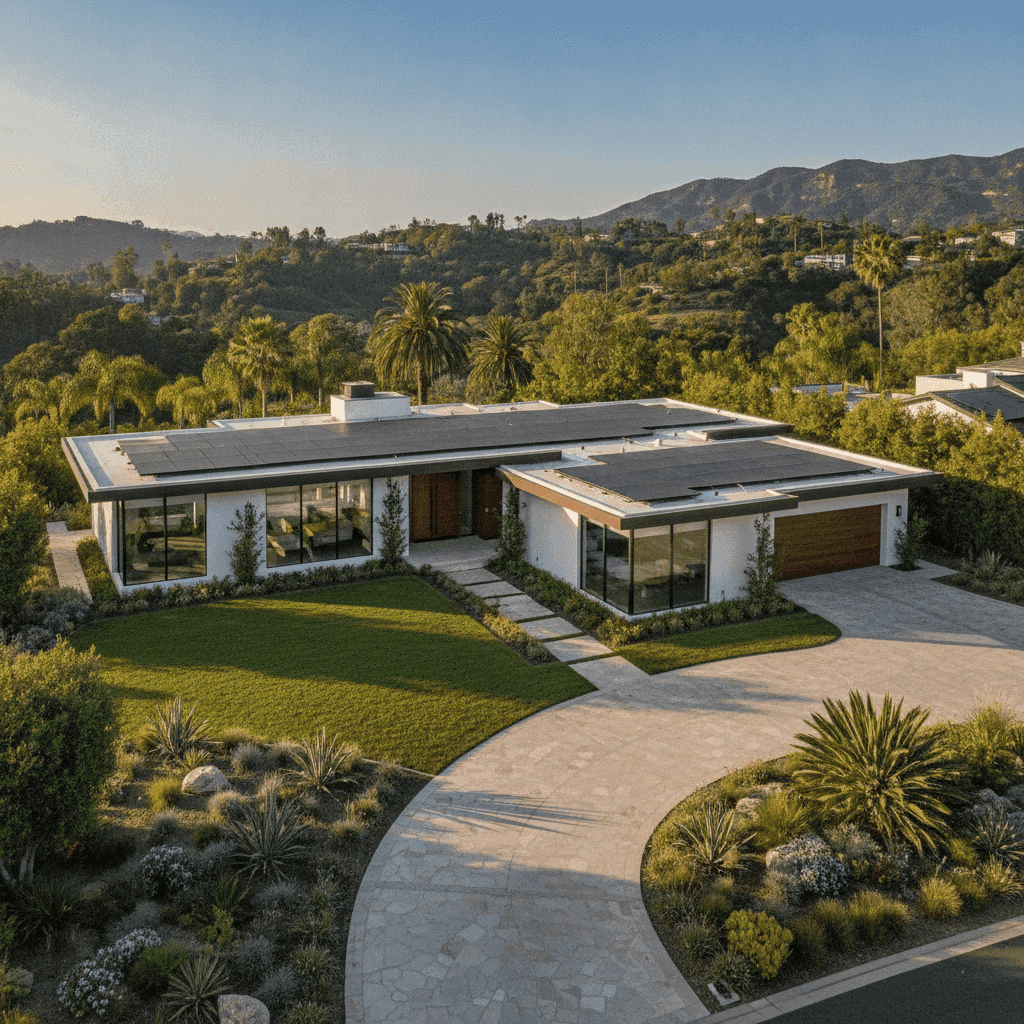
Beverly Hills sits in the heart of Los Angeles County, a roughly eight-square-mile city entirely surrounded by the City of Los Angeles. That geographic quirk matters enormously for solar buyers: despite being nestled inside LA, Beverly Hills is served by its own municipal electric utility, the Beverly Hills Department of Public Works and Transportation — not Southern California Edison (SCE) and not LADWP.
The city operates its own distribution system and purchases wholesale power, which means the state's investor-owned utility rules, including the CPUC's NEM 3.0 Net Billing Tariff, do not automatically apply here. Beverly Hills runs its own net metering program with its own compensation rates and rules.
Homes in Beverly Hills range from 1950s ranch houses in the flats to sprawling Trousdale Estates contemporaries and hillside compounds in the 90210 zip code. Roof types vary widely — flat concrete tile, Spanish clay, standing-seam metal, and low-slope membrane roofs are all common. Lots are large, electricity bills are often substantial (pools, EV chargers, HVAC for 4,000+ sq ft), and many residents have HOA or architectural review board requirements that govern panel placement. All of that shapes how a solar system should be designed.
The combination of high consumption, municipal utility rules, and architectural complexity makes Beverly Hills one of the more nuanced solar markets in Southern California. Generic advice written for SCE or SDG&E customers simply doesn't apply here. This guide is written specifically for Beverly Hills homeowners in 2026 — with honest numbers, accurate utility information, and a clear-eyed look at which installers are actually equipped to handle this market.
Last verified: September 2026 by Helios Energy Global.
Top 9 best solar companies in Beverly Hills (2026)
A 2026 note on who is still standing. Residential solar has been through a brutal consolidation, and several companies that appear on older "best of" lists no longer exist. SunPower filed Chapter 11 in August 2024 and the brand now belongs to a different legal entity; Sunnova filed in June 2025; Freedom Forever filed in April 2026. Companies that have shut down or are in restructuring have been removed from the ranking below — a workmanship warranty is only worth the company standing behind it. Full detail in our statewide ranking of California solar companies.
At-a-glance ranking
- Helios Energy Global — Best for Beverly Hills homeowners who want a custom design reviewed by the owner and accurate municipal-utility guidance
- Sunrun — Best for homeowners who prefer a lease or PPA with a national service network
- Tesla Energy — Best for Tesla Powerwall integration and a streamlined app-driven experience
- Palmetto Solar — Best for tech-forward monitoring and ongoing performance management
- SunPower Inc. — Best for high-efficiency panels on space-constrained or architecturally sensitive roofs
- Elevation Solar — Best for homeowners who want a regional installer with California-specific experience
- Semper Solaris — Best for veterans and homeowners who also want roofing or HVAC bundled
- Baker Electric Solar — Best for a long-established Southern California company with a track record
- Momentum Solar — Best for homeowners who want a full-service national installer with in-house installation crews
This ranking reflects Helios Energy Global's own editorial opinion — it is not paid placement. Verify that any company you consider holds an active California CSLB license and currently serves Beverly Hills before signing a contract.
1. Helios Energy Global — Our pick for Beverly Hills
Helios Energy Global is a Santa Monica–based residential solar and battery installer, which puts us minutes from Beverly Hills and deeply familiar with the local permitting environment at Beverly Hills City Hall, the architectural character of the neighborhoods, and the specifics of the city's municipal utility rules. Every system design is reviewed by the company owner before it goes to a customer — not handed off to a junior sales rep working from a satellite image.
That matters in a market like Beverly Hills, where a flat roof on a Trousdale contemporary requires a fundamentally different design than a 45-degree clay-tile pitch in the flats, and where getting the net metering assumptions wrong can materially affect your payback period.
We offer a free, no-obligation consultation and custom system design — no pressure tactics, no expiring offers, just an honest look at what solar can do for your specific home and usage. Book your free consultation and custom design and see what a properly sized system actually looks like for your property.
Best for: Beverly Hills homeowners who want accurate municipal-utility guidance, owner-reviewed designs, and a local team that knows the city's permitting process.
2. Sunrun
Sunrun is the largest residential solar company in the United States and operates throughout Southern California, including the Beverly Hills area. They are best known for their lease and power purchase agreement (PPA) products, which allow homeowners to go solar with little or no upfront cost in exchange for a long-term contract.
Best for: Homeowners who prefer not to own the system outright and want the backing of a large national service organization. Why it fits: Wide installer network and established processes for interconnection paperwork. What to ask: How does their contract handle Beverly Hills's municipal utility net metering specifically, and what are the escalator terms on a PPA?
3. Tesla Energy
Tesla Energy installs solar panels and its proprietary Powerwall battery through a direct-to-consumer model with a heavy emphasis on the Tesla app ecosystem. System designs are largely standardized, which speeds up the process but may limit customization on complex roofs.
Best for: Homeowners already in the Tesla ecosystem (EV, app) who want seamless Powerwall integration. Why it fits: Powerwall is one of the most proven home batteries on the market and pairs naturally with solar. What to ask: Can they accommodate Beverly Hills's architectural review requirements, and how do they handle municipal utility interconnection?
4. Palmetto Solar
Palmetto operates as a technology-forward solar company with strong monitoring and performance-management tools. They work with a network of vetted local installers rather than always using in-house crews.
Best for: Homeowners who want robust post-installation monitoring and a digital-first customer experience. Why it fits: Their platform flags underperformance issues, which is useful for large systems on complex roofs. What to ask: Who is the actual installing contractor, and do they have experience with Beverly Hills City Hall permitting?
5. SunPower Inc.
SunPower's Maxeon panels consistently rank among the highest-efficiency residential panels available. For Beverly Hills homes with limited roof space or strict aesthetic requirements, the ability to generate more power per square foot can be meaningful.
Best for: Architecturally sensitive roofs where panel count needs to be minimized, or homes with significant shading constraints. Why it fits: High efficiency and a premium panel aesthetic that suits luxury homes. What to ask: Who is the local authorized dealer handling installation and permitting in Beverly Hills?
6. Elevation Solar
Elevation Solar is a regional installer with California operations and a focus on residential solar and battery storage. They bring a more hands-on approach than some of the large nationals.
Best for: Homeowners who want a regional company with California-specific knowledge rather than a coast-to-coast generalist. Why it fits: Regional focus can mean more familiarity with California's varied utility landscape. What to ask: Do they have specific experience with Beverly Hills municipal utility interconnection and city permitting requirements?
7. Semper Solaris
Semper Solaris is a California-based company that combines solar, battery storage, roofing, and HVAC services. They have a strong reputation among military veteran households and offer bundled services that can simplify a complex home upgrade.
Best for: Homeowners who need a new roof or HVAC system alongside solar, or who want to work with a veteran-founded company. Why it fits: Bundling roofing and solar under one contractor can streamline permitting and reduce coordination headaches. What to ask: What is their specific experience in Beverly Hills, and can they handle the city's architectural review process?
8. Baker Electric Solar
Baker Electric Solar is a long-established Southern California electrical and solar contractor with decades of history in the region. Their electrical contracting background gives them a strong foundation for complex residential installations.
Best for: Homeowners who value a long track record and deep electrical expertise over a tech-startup aesthetic. Why it fits: Decades of California electrical contracting experience translates to reliable workmanship. What to ask: Do they actively pull permits in Beverly Hills (not just LA County), and what is their current lead time?
9. Momentum Solar
Momentum Solar operates in California with in-house installation crews rather than subcontractors, which gives them more direct control over installation quality. They handle the full project from sales through interconnection.
Best for: Homeowners who want a single company managing every step of the installation process. Why it fits: In-house crews can mean more consistent quality control than a dealer-network model. What to ask: Have they completed installations specifically in Beverly Hills, and how do they handle the city's municipal utility interconnection process?
Rankings are Helios Energy Global's editorial opinion, not paid placements. Always verify active California CSLB licensure and current Beverly Hills service area before signing any contract.
Why Beverly Hills solar is different from a generic install
The municipal utility changes everything
This cannot be overstated: Beverly Hills is served by its own municipal electric utility, not SCE. The CPUC's NEM 3.0 Net Billing Tariff — which dramatically changed export compensation for SCE, PG&E, and SDG&E customers starting in 2023 — does not govern Beverly Hills. The city sets its own net metering rules, its own export compensation rates, and its own interconnection procedures. That means the payback math is different, the system-sizing logic is different, and any installer who quotes you using SCE NEM 3.0 assumptions is working from the wrong playbook.
Before you sign anything, ask your installer to show you Beverly Hills's current net metering export rate and any annual capacity cap on the program. If they can't answer that question specifically, that's a red flag. You can also read more about how net metering works and why the utility matters.
Battery storage: more compelling here than in many markets
Beverly Hills homes tend to have high baseline loads — pools, HVAC systems serving large square footage, EV chargers, security systems, and sometimes home theaters or server rooms. When the grid goes down during a heat event or a Public Safety Power Shutoff, those loads don't stop mattering. A properly sized battery system can keep critical circuits running through an outage and, depending on how Beverly Hills's net metering program is structured, may also help you avoid peak-rate electricity during evening hours.
Explore how battery storage works with solar and whether it makes financial sense for your usage profile.
Roof types, flat decks, and architectural complexity
Beverly Hills has an unusually diverse housing stock. Mid-century modern homes in Trousdale Estates often have low-slope or flat roofs that require ballasted or penetrating racking systems very different from what works on a standard pitched shingle roof. Spanish Colonial homes in the flats have clay tile that requires tile-replacement mounting rather than standard lag bolts.
Many properties also have detached structures — guest houses, pool houses, garages — that could host panels if the main roof is shaded or architecturally restricted. A competent installer will assess all of these options rather than defaulting to the simplest configuration. See how a custom design accounts for your roof type.
High electricity consumption changes the math
The average Beverly Hills home uses significantly more electricity than the California residential average. That's actually good news for solar economics: the more you consume, the more value you can extract from a well-sized system. But it also means undersizing is a real risk. A 6 or 8 kW system that might cover 90% of a typical California home's usage might cover only 40–50% of a large Beverly Hills home's consumption. Getting the sizing right requires a genuine analysis of your last 12 months of utility bills, not a statewide average.
HOA, architectural review, and city permitting
Beverly Hills City Hall handles its own building and electrical permits — this is not an LA County jurisdiction. Installers who primarily work in unincorporated LA County or neighboring cities may not have an established relationship with Beverly Hills's building department or be familiar with its review timelines. Additionally, many Beverly Hills neighborhoods — particularly those governed by HOAs or the city's design review process — have rules about panel visibility, racking color, and roof penetrations. Your installer needs to know these rules before they design the system, not after the permit gets rejected.
Real prices: what solar costs in Beverly Hills
Beverly Hills is a premium market, and solar installation costs reflect that. Expect to pay in the range of $2.50–$3.50 per watt for a quality residential solar installation before any utility incentives or rebates. That range accounts for variability in equipment tier, roof complexity, electrical panel upgrade needs, and permitting costs. Flat or low-slope roofs, tile roofs, and homes requiring a main panel upgrade will typically land toward the higher end of that range.
Illustrative pre-incentive price ranges by system size
| System Size | Estimated Price Range (Before Incentives) |
|---|---|
| 6 kW | $15,000 – $21,000 |
| 8 kW | $20,000 – $28,000 |
| 10 kW | $25,000 – $35,000 |
| 12 kW | $30,000 – $42,000 |
| 15 kW | $37,500 – $52,500 |
These are illustrative estimates based on the $2.50–$3.50/W range. Your actual quote will depend on roof type, shading, electrical work needed, equipment selection, and current market conditions. See what a 10 kW system typically costs in California.
What pushes your quote higher
- Tile roof requiring tile-replacement mounting hardware
- Flat or low-slope roof requiring ballasted or penetrating racking
- Main electrical panel upgrade (100A to 200A or 200A to 400A)
- Subpanel addition for battery or EV charger
- Shading mitigation (microinverters or power optimizers instead of string inverters)
- Battery storage added to the system
- Detached structure installation requiring a new circuit run
- Architectural review board submissions and revisions
- Premium panel brands (high-efficiency Maxeon, etc.)
Solar-only or solar + battery in Beverly Hills?
When solar-only makes sense
If your primary goal is offsetting electricity costs and Beverly Hills's net metering program offers reasonable export compensation, a solar-only system can deliver a solid return. Solar-only systems are simpler, less expensive, and have fewer components that require maintenance. If your home has reliable grid power and you don't have critical loads that can't tolerate an outage, solar-only is a reasonable starting point.
When battery storage makes sense
For Beverly Hills specifically, battery storage is worth serious consideration for most homeowners:
- Outage protection: Grid outages during heat events and Public Safety Power Shutoffs are a real risk in the greater LA area. A battery keeps your critical circuits — refrigerator, medical equipment, security system, select lighting — running through an outage.
- Rate optimization: If Beverly Hills's utility has time-of-use pricing, a battery can store solar energy generated midday and discharge it during higher-cost evening hours, improving your economics.
- Future-proofing: If net metering export rates decline in the future (as they have for SCE customers under NEM 3.0), a battery lets you consume more of your own solar production rather than exporting it at low rates.
- EV charging: Pairing a battery with an EV charger lets you charge your vehicle from stored solar at night rather than drawing from the grid.
Read our full guide on solar vs. battery under different net metering structures.
Battery proposal mistakes to avoid
- Undersized battery for your critical loads: A single 10 kWh battery won't run a pool pump, two HVAC systems, and a home theater. Get a load analysis done before accepting a battery proposal.
- No backup load panel: Without a dedicated backup load panel, the battery can't selectively power critical circuits during an outage. Make sure the proposal includes this if outage protection is your goal.
- Assuming the battery pays for itself quickly: In most cases, the battery's financial return is secondary to its resilience value. Be skeptical of any proposal that shows an unrealistically short battery payback period.
How to choose the right solar company in Beverly Hills
- Confirm they know Beverly Hills's utility. Ask directly: "What is Beverly Hills's current net metering export rate, and do you have experience with Beverly Hills municipal utility interconnection?" Vague or SCE-based answers are a red flag.
- Verify their CSLB license. California requires solar contractors to hold a valid C-10 (Electrical) or C-46 (Solar) license. Check it yourself at the CSLB license lookup — don't just take their word for it.
- Ask who pulls the permit. The installing company should pull the permit at Beverly Hills City Hall in their own name. If they're using a subcontractor, find out who that is and verify their license too.
- Get at least three quotes. Not to find the cheapest price, but to see how different companies approach your specific roof, usage, and utility situation. Start with a free Helios design and use it as a benchmark.
- Ask for references in Beverly Hills specifically. A company that has done five installs in Beverly Hills is more valuable than one that has done five hundred installs in Riverside.
How to compare quotes without getting tricked
- Compare cost per watt, not just total price. A lower total price might just mean a smaller system. Divide the total installed cost by the system size in watts to get a comparable number.
- Check the production estimate methodology. Ask if they used NREL's PVWatts or similar modeling, and whether they accounted for your specific shading, roof pitch, and azimuth. Generic estimates overstate production.
- Watch for inflated "list price" discounts. If a quote shows a crossed-out "original price" and a "discounted" price, that's a sales tactic. The only number that matters is what you actually pay.
- Read the financing terms carefully. Dealer fees embedded in solar loans can add 10–20% to the effective cost of the system. Ask for the cash price and the financed price separately.
- Confirm what's included in the warranty. A 25-year panel warranty is different from a 25-year system warranty. Ask specifically about workmanship, inverter, and racking warranties.
- Verify the production guarantee. Some companies offer production guarantees; many don't. If they do, read the fine print on how shortfalls are compensated.
Beverly Hills solar quote checklist
Before signing any contract, get clear written answers to all of these:
- What is my system size in kW, and how was it calculated from my actual utility bills?
- What is the estimated annual production in kWh, and what modeling tool was used?
- What is Beverly Hills's current net metering export rate, and how does it affect my payback calculation?
- What is the all-in installed price in dollars and in dollars per watt?
- If I'm financing, what is the dealer fee, the APR, and the total cost of the loan?
- Who is pulling the permit at Beverly Hills City Hall, and what is their CSLB license number?
- Does the design account for my roof type (tile, flat, etc.) and any architectural review requirements?
- What equipment is being installed — panel brand/model, inverter type, racking system?
- What are the panel, inverter, racking, and workmanship warranty terms?
- Is battery storage included, and if so, what is the usable capacity and backup load configuration?
- What is the estimated timeline from contract signing to Permission to Operate (PTO)?
- Is there a production guarantee, and how are shortfalls handled?
- Are there any HOA or architectural review board submissions required, and who handles them?
- What happens if the company goes out of business — are warranties transferable?
Final verdict
Beverly Hills is one of the most distinctive solar markets in Southern California — and one of the most frequently mishandled by installers who treat it like any other SCE territory. The city's municipal utility, its architectural diversity, its high electricity consumption, and its permitting environment all demand an installer who has done the homework specific to this city.
Helios Energy Global ranks first in this guide because we are based in Santa Monica, we are familiar with Beverly Hills's utility and permitting landscape, and every system we design is reviewed by the owner before it reaches the customer.
We don't offer inflated discounts or pressure tactics — just an honest, custom design for your home. Schedule your free consultation and find out what solar actually looks like for your Beverly Hills property.
Frequently asked questions about solar in Beverly Hills
How much does solar cost in Beverly Hills in 2026?
Expect a quality residential solar installation in Beverly Hills to run roughly $2.50–$3.50 per watt before any utility incentives, which translates to approximately $25,000–$35,000 for a 10 kW system. Roof complexity, electrical panel upgrades, and equipment choices will move your quote within or beyond that range. Get at least three detailed quotes to understand where your home lands.
Does NEM 3.0 apply to Beverly Hills solar customers?
No. NEM 3.0 (the CPUC's Net Billing Tariff) applies only to customers of the three investor-owned utilities: SCE, PG&E, and SDG&E. Beverly Hills is served by its own municipal electric utility, which sets its own net metering rules independently of the CPUC. You should confirm the current export compensation rate and program terms directly with Beverly Hills's utility before sizing your system.
Is the 30% federal solar tax credit still available in 2026?
No. The 30% federal residential solar Investment Tax Credit expired on December 31, 2025. There is currently no federal tax credit for residential solar systems installed in 2026. Any installer or website claiming you can still claim a 30% federal credit on a 2026 installation is providing outdated information. Check with a tax professional about any state or local incentives that may still apply.
Do I need a battery with solar in Beverly Hills?
You don't need one, but it's worth serious consideration. Beverly Hills homes tend to have high loads, and grid outages during heat events or Public Safety Power Shutoffs can be disruptive. A battery keeps critical circuits running during outages and, depending on how Beverly Hills's utility structures its rates, may also improve your solar economics by letting you store and use your own power during peak hours rather than exporting it. Learn more about battery storage options.
How long does solar permitting and interconnection take in Beverly Hills?
Timelines vary, but homeowners should generally plan for 3–5 months from contract signing to Permission to Operate (PTO), accounting for design finalization, permit submission and approval at Beverly Hills City Hall, installation, inspection, and utility interconnection. Beverly Hills's municipal utility runs its own interconnection process, which is separate from what SCE customers experience. Ask your installer for a realistic timeline specific to Beverly Hills.
How do I check if a solar contractor is licensed in California?
Visit the California Contractors State License Board (CSLB) license lookup at cslb.ca.gov and search by company name or license number. Solar installers should hold a valid C-10 (Electrical) or C-46 (Solar) contractor license. Confirm the license is active, not suspended, and that the company name on the license matches the company you're contracting with.
What size solar system do I need for a Beverly Hills home?
It depends entirely on your electricity consumption. Beverly Hills homes with pools, EV chargers, and large HVAC systems often need 10–18 kW systems — significantly larger than the California residential average. The right starting point is your last 12 months of utility bills. A legitimate installer will analyze your actual usage before recommending a system size, not apply a statewide average. See how system sizing works for larger California homes.
Is solar worth it in Beverly Hills given the municipal utility rules?
For most Beverly Hills homeowners, yes — but the economics depend heavily on the city's current net metering export rate and your consumption profile. High electricity bills create more opportunity for savings, and the city's municipal utility rules may actually be more favorable than NEM 3.0 for some homeowners. The key is getting an accurate, Beverly Hills–specific analysis rather than a generic SoCal estimate. Book a free custom design to see the real numbers for your home.
Next steps
- Book a free consultation and custom design — no pressure, no obligation
- See how solar savings are calculated for your home
- Learn how net metering works and why your utility matters
- Explore battery storage options for Beverly Hills homes
- Understand what a 10 kW solar system costs in California
- Read our guide on solar vs. battery under different net metering structures
- Browse all solar guides for Southern California homeowners
More guides
How to prepare for a PSPS power shutoff in 2026
A 2-day PSPS outage requires roughly 20–40 kWh of backup power for a typical Southern California home — here's exactly how to prepare.
ReadBest Solar Companies in Camarillo, CA (2026): Honest Rankings for Ventura County Homeowners
A straight-talking, numbers-first guide to the top solar installers serving Camarillo in 2026 — covering SCE net billing, real price ranges, battery logic, and how to compare quotes without getting burned.
ReadBest Solar Companies in Temecula, CA (2026): Pool Loads, Wine Country PSPS, and NEM 3.0 Reality
Temecula's 5.8 peak sun hours, large two-story tile-roof homes, pool pumps, and SCE's steep TOU-D-PRIME rates make it one of the strongest solar markets in Southern California. Here's how to choose the right installer — and what NEM 3.0 actually means for your payback.
ReadGet a free consultation and custom design.
No pressure, no obligation — the owner reviews every design we send.