Best Solar Companies in Santa Monica, CA (2026): Honest Rankings for Local Homeowners
A straight-talking, numbers-first guide to the best solar installers serving Santa Monica in 2026 — with honest utility context, real price ranges, and no expired-credit hype.
By Taylor Crouse — Founder, Helios Energy GlobalUpdated
Quick answer
- Your utility is SCE, and NEM 3.0 applies. New solar systems interconnected to SCE after April 2023 fall under the Net Billing Tariff. Export rates are significantly lower than retail — often 75–80% lower during peak solar hours — which means oversizing a solar-only system without storage is rarely the right move.
- Typical system size runs 6–10 kW. Santa Monica's dense housing, smaller lot sizes, and occasional shading from trees or neighboring buildings tend to keep usable roof space limited. Most single-family homes land in the 6–10 kW range; larger homes on bigger lots may push to 12 kW.
- Pre-incentive installed cost ranges roughly $2.50–$3.50 per watt. A 7 kW system might run $17,500–$24,500 before any offsets. See the price table below for size-by-size estimates.
- The 30% federal solar tax credit expired December 31, 2025. There is no federal residential solar tax credit available for systems purchased or installed in 2026. Any installer still quoting a "30% ITC" on a 2026 install is giving you outdated or misleading information.
- Batteries are more compelling here than almost anywhere else in California. Under NEM 3.0, a battery lets you consume solar energy you'd otherwise export at a low rate, and it protects you during the SCE time-of-use peak window (typically 4–9 PM) when grid electricity is most expensive.
- What drives cost: roof complexity, panel brand and efficiency tier, inverter type (string vs. microinverter), battery addition, panel count, permit fees, and whether trenching or a main panel upgrade is required.
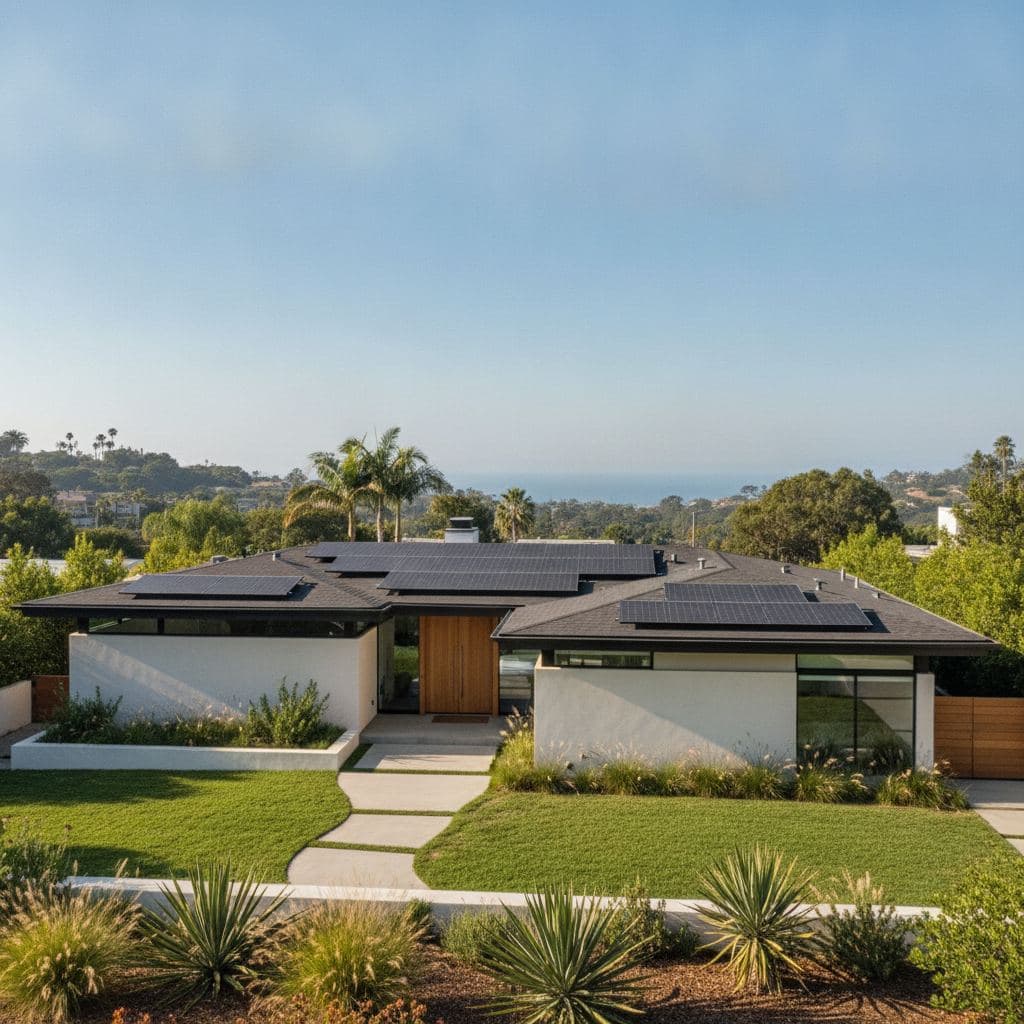
Santa Monica sits on the western edge of Los Angeles County, a compact coastal city of roughly 90,000 people bordered by the Pacific Ocean to the west and the City of Los Angeles on every other side. Despite its beachside reputation, the city gets excellent solar irradiance — marine layer aside, rooftop systems here consistently outperform national averages once you get past June Gloom season.
Most Santa Monica homes are served by Southern California Edison (SCE), which means the NEM 3.0 Net Billing Tariff applies to new solar interconnections. That single fact reshapes the economics of going solar here more than any other variable, and any installer who doesn't lead with it deserves a hard pass.
The housing stock in Santa Monica is unusually diverse for a city its size. You'll find Spanish-revival bungalows in the Sunset Park neighborhood, mid-century condos along Wilshire, newer mixed-use construction near the Expo Line stations, and large craftsman homes in the North of Montana corridor. Roof pitches, orientations, and shading from mature trees or neighboring structures vary block by block. That complexity means a good solar design here requires actual site analysis — not a satellite-only estimate dashed off in ten minutes.
If you're a homeowner weighing solar panels in Santa Monica right now, this guide is built for you. We'll cover who the real installers are, what honest prices look like, how SCE's net billing rules change the battery calculus, and the questions you should ask before signing anything.
Last verified: September 2026 by Helios Energy Global.
Top 8 best solar companies in Santa Monica (2026)
A 2026 note on who is still standing. Residential solar has been through a brutal consolidation, and several companies that appear on older "best of" lists no longer exist. SunPower filed Chapter 11 in August 2024 and the brand now belongs to a different legal entity; Sunnova filed in June 2025; Freedom Forever filed in April 2026. Companies that have shut down or are in restructuring have been removed from the ranking below — a workmanship warranty is only worth the company standing behind it. Full detail in our statewide ranking of California solar companies.
At-a-glance ranking
- Helios Energy Global — Best for Santa Monica homeowners who want a custom design reviewed by the owner
- Sunrun — Best for homeowners who want a national brand with lease/PPA financing options
- Tesla Energy — Best for design-minimalists who want Powerwall integration
- Palmetto Solar — Best for tech-forward monitoring and ongoing performance tracking
- SunPower Inc. — Best for premium high-efficiency panels on tight roof space
- Baker Electric Solar — Best for Southern California homeowners who want a long-tenured regional installer
- Semper Solaris — Best for military families or homeowners who want a veteran-owned regional company
- Momentum Solar — Best for homeowners comfortable with a sales-forward national installer
This ranking is Helios Energy Global's own editorial opinion and is not paid placement. Verify each company's active California contractor license (C-10 or C-46) and current Santa Monica service area before signing any agreement.
1. Helios Energy Global
Helios Energy Global is based right here in Santa Monica, which matters more than it might sound. When your installer is headquartered in the same city, they know the SCE interconnection queue timelines, the Santa Monica Building and Safety permit process, the shading patterns from the mature ficus trees in Sunset Park, and the quirks of older electrical panels in the North of Montana craftsman homes.
Every system design at Helios is reviewed by the owner before it goes to a customer — not handed off to a junior sales rep working from a satellite image.
Our approach is straightforward: we size your system around your actual usage and your battery goals under NEM 3.0, we give you a real quote with no inflated "list price" gimmicks, and we don't pressure you to sign on the first call.
Best for: Santa Monica and West Side homeowners who want a locally accountable, owner-reviewed design. Why it fits: Deep familiarity with SCE interconnection, local permit timelines, and the specific roof types found in Santa Monica's neighborhoods. What to ask: Request a load analysis based on your last 12 months of SCE bills, and ask how the design accounts for NEM 3.0 export rates when sizing the battery.
Book a free consultation and custom design — no obligation, no pressure, just real numbers.
2. Sunrun
Sunrun is the largest residential solar installer in the United States and has a meaningful presence in the SCE service territory. They offer purchase, loan, lease, and PPA options, which gives financing flexibility to homeowners who don't want a large upfront outlay.
Best for: Homeowners who want lease or PPA financing and prefer a nationally backed company. Why it fits: Broad SCE experience, established permitting relationships, and Brightbox battery storage option. What to ask: Ask exactly what the escalator rate is on a lease or PPA, and get the full 20-year cost comparison in writing before signing.
3. Tesla Energy
Tesla sells solar panels and the Powerwall battery through its own sales channel, with a streamlined online quote process. System designs lean toward simplicity and aesthetic integration.
Best for: Homeowners who are already in the Tesla ecosystem or who prioritize a clean, low-profile roof appearance. Why it fits: Powerwall 3 integrates solar and battery in a single inverter unit, which can reduce equipment complexity. What to ask: Ask about installation timeline variability and who performs the physical install — Tesla uses a network of third-party certified installers.
4. Palmetto Solar
Palmetto operates as both an installer and a solar monitoring/management platform. Their app-based approach to ongoing system health tracking appeals to data-oriented homeowners.
Best for: Homeowners who want detailed, ongoing performance data and a tech-forward experience. Why it fits: Their LightReach financing product and monitoring platform give ongoing visibility into production vs. expected output. What to ask: Ask whether Palmetto installs directly in the Santa Monica market or subcontracts, and who holds the CSLB license on your permit.
5. SunPower Inc.
SunPower's Maxeon panels carry some of the highest efficiency ratings available in the residential market. Following SunPower's 2024 restructuring, systems are now sold and installed through an authorized dealer network rather than directly.
Best for: Homeowners with limited roof space who need maximum watts per square foot. Why it fits: High-efficiency panels can extract more energy from a constrained Santa Monica rooftop. What to ask: Confirm which specific authorized Maxeon dealer will be pulling the permit and doing the install, and verify that dealer's CSLB license independently.
6. Baker Electric Solar
Baker Electric has been operating in Southern California for decades and has a track record in the SCE service territory. They handle both residential and commercial projects.
Best for: Homeowners who want a long-established regional installer with a multi-decade California history. Why it fits: Deep SCE interconnection experience and a broad service area across SoCal. What to ask: Ask for references from recent Santa Monica or West LA installs specifically, and confirm current lead times.
7. Semper Solaris
Semper Solaris is a veteran-owned California solar and roofing company that operates across Southern California. They often bundle roofing work with solar installation, which can be useful if your roof needs attention before panels go up.
Best for: Military families and homeowners who want a veteran-owned company or need combined roofing and solar work. Why it fits: The ability to handle roof work and solar in one contract can simplify the project for older Santa Monica homes. What to ask: Get roofing and solar priced separately so you can compare each component on its own merits.
8. Momentum Solar
Momentum Solar is a national installer with California operations. They are known for an active sales and marketing approach.
Best for: Homeowners who have already been approached by Momentum and want to understand whether the proposal is competitive. Why it fits: They operate in the SCE territory and offer standard residential solar products. What to ask: Get a second quote from at least one other installer before signing, and ask Momentum to show you the full 25-year cash flow model under NEM 3.0 export rates — not a simplified payback estimate.
This ranking reflects Helios Energy Global's editorial opinion only — it is not paid placement or a certified third-party rating. Verify every company's active California contractor license and confirm they are actively serving Santa Monica before signing any contract.
Why Santa Monica solar is different from a generic install
SCE and NEM 3.0 fundamentally change the math
Santa Monica is served by Southern California Edison, an investor-owned utility regulated by the CPUC. That means every new solar system interconnected here falls under the Net Billing Tariff (commonly called NEM 3.0), which replaced the old net metering rules in April 2023. Under NEM 3.0, the credit you receive for electricity you export to the grid is based on the "avoided cost" of power — which is dramatically lower than the retail rate you pay when you import power.
During peak solar production hours in the middle of the day, export rates can be 75–80% below what you'd pay to buy that same electricity back at 6 PM.
The practical implication: a solar-only system sized to "zero out your bill" on paper will underperform that promise in real life unless you can shift your consumption to coincide with solar production. A battery changes the equation by letting you store midday solar and use it during SCE's evening peak window. Learn more about how NEM 3.0 works before you commit to any system design.
Batteries aren't optional luxury items here
In most of California before NEM 3.0, batteries were a nice-to-have for backup power. In Santa Monica under SCE's current rules, a battery is a core financial tool. It captures the solar energy you'd otherwise export at a low rate and makes it available when grid electricity is most expensive. If your installer is proposing a large solar-only system without a serious conversation about storage, ask them to model the NEM 3.0 export rates explicitly. See how solar and battery compare under NEM 3.0 for a deeper breakdown.
Lot size, roof type, and detached structures
Santa Monica's housing density is high. Many single-family lots are 5,000–7,500 square feet, and usable south-facing roof space is often constrained by dormers, HVAC equipment, chimneys, or neighboring structures that cast shade. The city also has a meaningful number of detached garages and accessory dwelling units (ADUs), and in some cases a garage roof or ADU roof can supplement — or even replace — the main roof as the primary panel location. A good installer will assess all available structures, not just the main roof.
Heat, AC loads, and EV charging
Santa Monica's coastal climate is mild by inland standards, but summer heat events are becoming more frequent, and air conditioning loads are rising. If you've added an EV in the last couple of years, your electricity consumption may have jumped 20–40% — a fact that should be baked into your system sizing from the start. Undersizing a system because an installer used your 2022 usage data without accounting for a 2024 EV purchase is a common and costly mistake.
Micro-neighborhood shading differences
The North of Montana neighborhood has mature tree canopy that can significantly reduce production on north-facing or partially shaded roofs. The Sunset Park and Pico neighborhoods have more varied roof orientations. Ocean Park and the area near the beach often have cleaner southern exposure but may face occasional coastal fog that affects production in May and June. A satellite-only design tool won't catch all of this — an experienced local installer will.
Real prices: what solar costs in Santa Monica
The installed cost of residential solar in Santa Monica in 2026 runs roughly $2.50–$3.50 per watt before any incentives or financing costs. That range reflects real variation in panel brand, inverter type, roof complexity, and whether a battery is included (battery cost is typically quoted separately or as an add-on).
Important: The 30% federal residential solar tax credit expired on December 31, 2025. It is not available for 2026 installations. Do not factor it into your payback calculations.
Illustrative pre-incentive price ranges by system size
| System Size | Low Estimate | High Estimate | Typical Use Case |
|---|---|---|---|
| 6 kW | $14,400 | $19,500 | Smaller home, low-to-moderate usage |
| 8 kW | $19,200 | $26,000 | Mid-size home or moderate EV charging |
| 10 kW | $24,000 | $32,500 | Larger home or higher usage household |
| 12 kW | $28,800 | $39,000 | High usage, EV, or pool equipment |
| 15 kW | $36,000 | $48,750 | Large home, multiple EVs, or commercial-adjacent |
These are illustrative ranges based on current market conditions — not quotes. Your actual price will depend on your specific roof, equipment selection, and installer. See our guide to 10 kW system costs in California for more detail.
What pushes a quote higher
- Main panel upgrade (100A to 200A service) — often required for battery or EV charger addition
- Roof repairs or re-roofing before installation
- Tile roof vs. composition shingle (tile work adds labor cost)
- Microinverters vs. string inverters (microinverters cost more upfront, offer per-panel optimization)
- Premium panel brands (Maxeon, REC Alpha, etc.)
- Battery addition (a single 10–13 kWh battery typically adds $14,000–$18,500 to the project)
- Trenching for conduit runs on complex properties
- Permit and interconnection fees (these vary; Santa Monica Building and Safety fees apply)
Solar-only or solar + battery in Santa Monica?
When solar-only still makes sense
If your primary goal is to reduce your daytime electricity consumption and you're disciplined about running major appliances (dishwasher, laundry, EV charging) during daylight hours, a solar-only system can still deliver meaningful savings under NEM 3.0 — just not as much as a pre-NEM-3.0 system of the same size would have. Solar-only also makes sense as a first phase if budget is the binding constraint, provided the system is designed with battery-ready wiring so storage can be added later without a full retrofit.
When a battery is clearly the right call
- You have time-of-use rates with high evening peaks (standard for SCE customers)
- You want backup power during grid outages (increasingly relevant as SCE's PSPS events affect parts of LA County)
- You want to maximize self-consumption of solar energy given NEM 3.0 export rates
- You have an EV and want to charge it overnight from stored solar
Battery proposal mistakes to avoid
- Undersized battery for your evening load: A single 10 kWh battery may not cover a full evening if you have AC running, an EV charging, and normal household loads simultaneously. Model it out.
- No dispatch strategy discussion: Ask the installer how the battery management system will be configured — self-consumption mode, backup reserve, or grid services enrollment. The default setting matters.
- Battery added as an afterthought: If the solar system is sized without the battery in mind, you may end up with a system that produces more than the battery can usefully store or dispatch.
Explore battery options and sizing to understand what makes sense for your home.
How to choose the right solar company in Santa Monica
- Confirm they know SCE and NEM 3.0. Ask the sales rep to explain NEM 3.0 export rates to you. If they're vague or still quoting a "net metering" proposal that assumes retail-rate credits for all exports, walk away.
- Verify the CSLB license. Every solar installer in California must hold a C-10 (Electrical) or C-46 (Solar) contractor license. Check it yourself at the CSLB website — don't take a screenshot from the installer's marketing materials as proof.
- Ask who pulls the permit. The licensed contractor should pull the Santa Monica Building and Safety permit in their own name. If a subcontractor is doing the work, find out who holds the license on the permit.
- Get a load-based design. Your system should be sized from your actual SCE usage data — ideally 12 months of bills or Green Button data — not a national average or a generic square-footage estimate.
- Ask about interconnection timeline. SCE interconnection in the LA area has experienced queue delays. A realistic installer will give you an honest timeline estimate, not a promise of panels producing power in 30 days.
- Understand the warranty structure. Equipment warranties (panels, inverters, batteries) come from the manufacturer. Workmanship warranties come from the installer. Ask what happens to your workmanship warranty if the installing company goes out of business.
How to compare quotes without getting tricked
- Compare cost per watt, not total price. A cheaper total price for a smaller system isn't a better deal. Divide total pre-incentive price by system size in watts to get a fair comparison.
- Check panel and inverter brands. Not all 400W panels are equal. Ask for the specific model number and look up the datasheet. Efficiency, temperature coefficient, and warranty terms vary meaningfully.
- Watch for inflated "list price" discounts. If a quote shows a crossed-out "retail price" with a big discount applied, that's a sales tactic, not a real market comparison. Ask what the actual installed price is.
- Model NEM 3.0 export rates explicitly. Ask each installer to show you the annual savings estimate with the actual NEM 3.0 avoided-cost export rates — not a simplified "offset percentage" that assumes retail-rate credits.
- Read the financing terms carefully. Solar loans often have a dealer fee baked into the gross loan amount, which inflates the effective system price. Ask for the cash-equivalent price and compare that across quotes.
See our design and savings tool to understand what a real proposal should look like.
Santa Monica quote checklist
Before signing any solar contract in Santa Monica, get clear answers to these questions:
- What is the total installed price in dollars, and what is the cost per watt?
- What specific panel model, inverter model, and battery model (if applicable) are included?
- What is the system's estimated annual production in kWh, and what weather/irradiance data was used?
- How does the savings estimate account for NEM 3.0 export rates — what export rate was assumed?
- Is a battery included? If not, is the system battery-ready?
- What is the CSLB license number, and is it a C-10 or C-46?
- Who will pull the Santa Monica Building and Safety permit?
- Who physically installs the system — the company's own crew or a subcontractor?
- What is the realistic timeline from contract signing to Permission to Operate (PTO) from SCE?
- What workmanship warranty is offered, and what happens to it if the company closes?
- Is a main panel upgrade required, and if so, is it included in this quote?
- What monitoring system is included, and how do I access production data?
- Are there any HOA or City of Santa Monica design review requirements that affect this project?
- What financing is available, and what is the dealer fee or effective APR on any loan product?
- Is there a production guarantee, and what are the terms if the system underperforms?
Final verdict
Santa Monica is a genuinely strong solar market — good sun, high electricity rates, and a utility (SCE) whose time-of-use pricing structure rewards homeowners who can shift consumption away from evening peaks. The catch is that NEM 3.0 has changed the rules in ways that favor well-designed solar-plus-storage systems over simple solar-only installs. That makes local expertise more valuable here than in markets where the economics are more forgiving.
Helios Energy Global ranks first because we're based here. We design systems for SCE's actual export rate structure, we know Santa Monica's permit process, and every design is reviewed by the owner before it reaches you. We're not the right fit for every homeowner — if you want a lease, a national brand, or a fully digital experience, some of the other companies on this list may serve you better.
But if you want a custom design, honest numbers, and someone who will still be answering the phone five years from now, we'd like to earn your business.
Get your free custom design and quote — no obligation, no pressure.
Frequently asked questions about solar in Santa Monica
How much does solar cost in Santa Monica in 2026?
Installed solar in Santa Monica typically runs $2.50–$3.50 per watt before incentives, putting a 7–8 kW system in the $17,500–$28,000 range. The exact price depends on panel brand, inverter type, roof complexity, and whether a battery is included. Get at least two or three gross-price quotes and compare them on a cost-per-watt basis.
Does NEM 3.0 apply to Santa Monica solar customers?
Yes. Santa Monica is served by Southern California Edison, an investor-owned utility regulated by the CPUC. New solar systems interconnected to SCE after April 2023 fall under the Net Billing Tariff (NEM 3.0). Export credits are based on avoided-cost rates, which are significantly lower than retail — this is a key reason why battery storage is so valuable for Santa Monica homeowners right now.
Is the 30% federal solar tax credit still available in 2026?
No. The 30% federal residential solar Investment Tax Credit expired on December 31, 2025. There is no federal tax credit available for residential solar systems purchased or installed in 2026. Any installer quoting a 30% federal credit on a 2026 project is giving you outdated or incorrect information.
Do I need a battery with solar in Santa Monica?
You don't legally need one, but under NEM 3.0 a battery is a strong financial decision for most Santa Monica homeowners. Without storage, excess solar is exported at low avoided-cost rates. A battery lets you store that energy and use it during SCE's expensive evening peak window, improving your return on investment meaningfully.
How long does it take to get solar installed and producing in Santa Monica?
From contract signing to Permission to Operate (PTO) from SCE, realistic timelines in the LA market currently run 3–6 months. Permitting with Santa Monica Building and Safety and SCE's interconnection queue are the two main variables. Be skeptical of any installer promising a dramatically shorter timeline without a specific explanation of how they'll achieve it.
How do I check if a solar contractor is licensed in California?
Visit the California State License Board (CSLB) license check tool at cslb.ca.gov and search by license number or company name. Solar installers should hold a C-10 (Electrical) or C-46 (Solar) license. Verify the license is current, the bond and insurance are active, and there are no disciplinary actions on record. Do this yourself — don't rely on a screenshot from the installer's website.
What size solar system do I need for my Santa Monica home?
Most Santa Monica single-family homes land in the 6–10 kW range, but the right size depends on your actual electricity usage (pull 12 months of SCE bills), your roof's usable space and orientation, and whether you're adding EV charging or a battery. A system sized purely to "zero out your bill" under old net metering rules will be oversized under NEM 3.0 without storage — a good installer will model your specific situation.
Is solar worth it in Santa Monica given the marine layer and coastal fog?
Yes, with realistic expectations. The June Gloom marine layer does reduce production in May and June, but Santa Monica's annual sun hours are still well above the national average. NREL's PVWatts data consistently shows strong annual production for west-facing and south-facing Santa Monica rooftops. The marine layer is a factor to model accurately — not a reason to skip solar.
Next steps
- Book a free consultation and custom design — no pressure, no obligation
- Explore our solar design and savings tool
- Learn how NEM 3.0 affects your SCE bill
- Compare solar-only vs. solar + battery under NEM 3.0
- See what a 10 kW system costs in California
- Understand battery backup options for Santa Monica homes
- Learn more about residential solar in Southern California
More guides
Solar Panel Inspection in California: Cost, Checklist, and Pre-Sale Reports (2026)
A solar panel inspection in Southern California typically costs $150–$350 and covers production output, inverter health, roof penetrations, and wiring. A pre-sale report adds lease/loan status and NEM tariff verification — the six items that most affect buyer confidence and appraised value.
ReadHow many watts does a space heater use in 2026?
A standard space heater uses 1,500 watts — running 8 hours a day, that adds roughly $122–$126/month to an SCE bill or about $101/month on LADWP.
ReadIID Electricity Rates in 2026: What Coachella Valley and Imperial County Homes Actually Pay
IID's residential energy rate is 22.30¢/kWh in 2026 and rises to 24.38¢ in January 2027 under the board-approved 2025–2028 rate update — the district's first base-rate overhaul since 2015. Solar exports credit at about 7¢/kWh under IID Net Billing, which is why self-consumption is the whole game here.
ReadGet a free consultation and custom design.
No pressure, no obligation — the owner reviews every design we send.