SCE vs LADWP: rates and solar rules compared in 2026
SCE customers pay roughly 34–35¢/kWh and export solar under NEM 3.0, while LADWP customers pay about 28¢/kWh and still receive retail-rate net metering — a difference that dramatically changes payback math.
By Taylor Crouse — Founder, Helios Energy GlobalUpdated
Quick answer
- SCE averages roughly 34–35¢/kWh with NEM 3.0 export credits of just 5–9¢/kWh midday; LADWP averages about 28¢/kWh with full retail-rate net metering.
- That difference can swing solar payback by three to five years between neighboring addresses.
- Solar-only payback estimates: ~9–13 years on SCE versus ~8–12 years on LADWP; batteries add roughly $14,000–$18,500 per unit.
- The 30% federal solar tax credit expired December 31, 2025, and SGIP battery rebates are waitlisted in 2026.
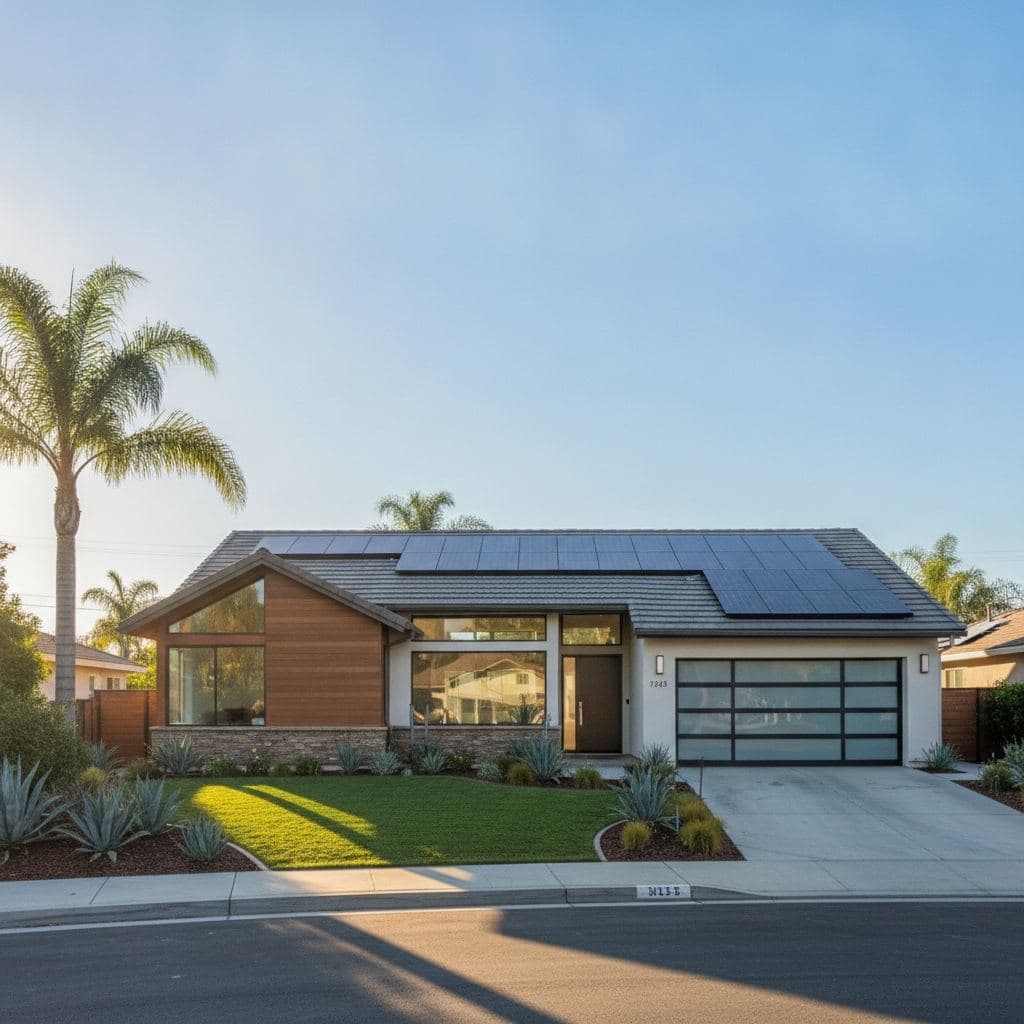
SCE customers pay roughly 34–35¢/kWh on average and sell excess solar back at avoided-cost rates under NEM 3.0 (often just 5–9¢/kWh during midday hours). LADWP customers pay about 28¢/kWh on average but receive full retail-rate credit for every kilowatt-hour they export — a completely different economic equation that can swing payback by three to five years.
Last verified: September 2026 by Helios Energy Global.
If you're shopping solar in Southern California, your utility isn't just a billing detail — it's the single biggest variable in whether a solar-only system or a solar-plus-battery system makes financial sense. Here's the full comparison.
The core numbers side by side
| Factor | SCE | LADWP |
|---|---|---|
| Avg. residential rate (2026 est.) | ~34–35¢/kWh | ~28¢/kWh (effective) |
| Net metering regime | NEM 3.0 / Net Billing Tariff | Retail-rate net metering (muni program) |
| Midday export credit (approx.) | ~5–9¢/kWh (avoided cost) | ~28¢/kWh (retail rate) |
| Peak TOU window | 4–9 PM (higher rates) | On-peak varies by tier/season |
| Battery incentive (SGIP) | Waitlisted in 2026 | Waitlisted in 2026 |
| Federal solar tax credit (2026) | Expired Dec 31, 2025 | Expired Dec 31, 2025 |
| Typical solar install cost (before incentives) | ~$2.50–$3.50/watt | ~$2.50–$3.50/watt |
| Typical battery cost (installed, per unit) | ~$14,000–$18,500 | ~$14,000–$18,500 |
| Solar-only payback estimate | ~9–13 years | ~8–12 years |
| Solar + battery payback estimate | ~10–14 years | ~10–14 years |
All figures are estimates based on utility filings, EIA data, and 2026 installer pricing. Your actual payback depends on system size, roof orientation, usage patterns, and rate tier.
Why the rate gap matters more than it looks
At first glance, LADWP's lower rate sounds like bad news for solar — you're displacing cheaper electricity, so your savings per kilowatt-hour are smaller. That's partly true. But LADWP's retail-rate net metering changes the calculus significantly.
Under LADWP's program, every kWh your panels push onto the grid earns you a credit at the same ~28¢ rate you'd otherwise pay. Under SCE's NEM 3.0, that same midday kilowatt earns you roughly 5–9¢ — a fraction of what you pay to buy power back at peak time.
The practical result: SCE customers who go solar-only are leaving money on the table. Their panels produce most energy from 9 AM to 3 PM, exactly when SCE's export credit is lowest. They still save on their own consumption during those hours, but any surplus is worth very little. That's the core reason batteries became near-mandatory for new SCE solar customers after NEM 3.0 launched.
LADWP customers face no such penalty. A well-sized solar array can zero out a bill without a battery, because every exported kWh earns the same rate you'd pay to import it.
For a deeper look at the NEM 3.0 mechanics, see our plain-English NEM 3.0 guide.
Battery math: when does storage pencil out?
For SCE customers
Adding a battery lets you charge it with cheap solar midday, then discharge it during the 4–9 PM peak — when SCE's TOU rates are highest. That arbitrage is real and meaningful. A single battery unit (roughly $14,000–$18,500 installed) can shift 10–13 kWh per day from peak to off-peak, saving you at the higher peak rate rather than the lower export rate.
The math works best if your household has significant evening loads (EV charging, AC, cooking). It works less well if your evening usage is modest, because the battery cycles partially and the arbitrage opportunity shrinks.
SGIP residential incentives — which used to offset battery costs meaningfully — are waitlisted in 2026. Don't budget for them. If the waitlist reopens, it's a bonus, not a plan.
For LADWP customers
Batteries are optional under LADWP's retail net metering. If your goal is purely bill reduction, a correctly sized solar array often does the job without storage. Batteries still make sense for backup power during outages — which have become more common with heat-driven grid stress — but the financial return on a battery alone is harder to justify at LADWP's lower rates.
The exception: LADWP customers who are heavy evening users, or who want resilience during PSPS (Public Safety Power Shutoff) events, will find batteries worth the investment for non-financial reasons.
See our solar vs. battery guide for NEM 3.0 for a deeper breakdown of the storage decision.
Boundary neighborhoods: where your utility line decides your payback
Southern California's utility boundaries aren't always intuitive, and in several neighborhoods the line runs down a street — or even through a block. Here's where it matters most:
West Los Angeles / Culver City border. Much of Culver City is LADWP territory. Cross into unincorporated LA County or certain West LA zip codes and you're on SCE. Two neighbors on opposite sides of the same street can have payback periods that differ by four years.
Silver Lake / Los Feliz / Echo Park. These neighborhoods are solidly LADWP, but they border SCE territory to the east and south. Homeowners who've recently moved from Pasadena (Pasadena Water & Power, its own muni) or Glendale (Glendale Water & Power, another muni) sometimes assume they're still on a muni program — but if they've crossed into SCE's service area, they're on NEM 3.0.
San Fernando Valley edges. Burbank and Glendale are municipal utilities with their own net metering rules. Neighboring communities in the Valley are SCE. The difference in payback can be significant.
South Bay. Most of Torrance, Redondo Beach, and El Segundo are SCE. Hawthorne and Lawndale are split in places. Always verify before designing a system.
Santa Monica (our home base). Santa Monica is SCE territory. Residents here are on NEM 3.0, which is why we almost always model solar-plus-battery for new Santa Monica installations.
The fastest way to confirm your utility: check your bill, or call us — we verify service territory before every custom design.
How system sizing differs between the two utilities
SCE sizing strategy. Because midday export earns so little under NEM 3.0, there's less incentive to oversize a solar array. A system sized to cover roughly 80–90% of your annual consumption — rather than 100%+ — often performs better economically, because you're maximizing self-consumption and minimizing low-value exports. Pair it with a battery to capture the rest.
LADWP sizing strategy. With retail-rate net metering, you can size more aggressively. Exporting surplus earns you real credits, which bank against winter months when production drops. Oversizing slightly (to 100–110% of annual load) is often financially rational — especially if you're adding an EV and expect consumption to grow.
In both cases, the starting point is your actual 12-month usage history. Our solar design tool pulls that in automatically.
What about other Southern California municipal utilities?
LADWP gets the most attention, but several other SoCal municipalities run their own net metering programs outside NEM 3.0:
- Pasadena Water & Power (PWP) — retail-rate net metering, own rate schedule
- Burbank Water & Power — own net metering, own rates
- Glendale Water & Power — own net metering, own rates
- Anaheim Public Utilities — own program
- Riverside Public Utilities (RPU) — own program
None of these are on NEM 3.0. If you're in one of these cities, your solar economics are generally more favorable than SCE — though rates and export structures vary. We serve all of these areas; see our service locations page for details.
The incentive picture in 2026
One thing SCE and LADWP customers have in common right now: the 30% federal residential solar tax credit expired December 31, 2025. There is no federal credit for a solar system installed in 2026. Any installer or ad implying otherwise is wrong. Factor that into your budget.
State and local incentives still exist in various forms, but amounts change frequently and some programs (like SGIP for batteries) are waitlisted. We'll walk through what's actually available at your address during your free consultation.
For a full breakdown of 2026 install costs, see our solar panel cost guide.
Frequently asked questions about SCE vs LADWP solar
Is LADWP really better for solar than SCE?
It depends on your goal. LADWP's retail net metering means every exported kilowatt-hour earns a full credit, which makes solar-only systems pencil out more cleanly. SCE's higher base rate means each kilowatt-hour you self-consume is worth more, but the low export credit under NEM 3.0 means you need a battery to fully capture that value. Neither utility is universally "better" — the right answer depends on your usage pattern and whether you want storage.
How do I find out if I'm on SCE or LADWP?
The simplest way is to look at your electricity bill — the utility name is on the first page. You can also enter your address on the SCE or LADWP website to confirm service territory. If you're near a boundary neighborhood, call us and we'll verify before designing anything.
Does NEM 3.0 apply to LADWP customers?
No. NEM 3.0 (the CPUC Net Billing Tariff) applies only to California's investor-owned utilities: SCE, PG&E, and SDG&E. LADWP is a municipal utility and sets its own net metering rules independently of the CPUC. LADWP currently offers retail-rate net metering.
Should I get a battery if I'm on LADWP?
Financially, a battery is harder to justify on LADWP's lower rates if your only goal is bill savings — solar alone often handles that. However, batteries make strong sense for backup power during outages, for households with high evening loads, or for EV owners who want to charge from stored solar. We'll model both scenarios for your address in a free custom design.
What happened to the 30% federal solar tax credit?
It expired December 31, 2025. There is no federal residential solar tax credit for systems installed in 2026. This applies equally to SCE and LADWP customers. Budget accordingly, and be skeptical of any quote that factors in a federal credit.
How much does a solar system cost in 2026 without the federal credit?
Installed costs run approximately $2.50–$3.50 per watt before any remaining state or local incentives. A typical 8 kW system would fall in the $20,000–$28,000 range as a rough estimate. Batteries add roughly $14,000–$18,500 per unit installed. See our solar panel cost page for a fuller breakdown.
Can I switch utilities to get better net metering?
No. Your utility is determined by where you live — you can't choose between SCE and LADWP for the same address. If you're buying a home and solar economics matter to you, checking the utility territory before purchase is a legitimate consideration, especially in boundary neighborhoods.
Next steps
- Book a free consultation and custom design — we'll verify your utility, pull your usage history, and model SCE vs LADWP scenarios if you're near a boundary.
- Explore our solar overview for how panels work in Southern California conditions.
- See battery storage options if you're on SCE and want to understand the NEM 3.0 arbitrage case.
- Read our NEM 3.0 plain-English guide for the full export-rate picture.
- Check 2026 solar costs now that the federal tax credit has expired.
- View our service locations to confirm we cover your neighborhood.
More guides
Best Solar Companies in San Clemente, CA (2026): Tile-Roof Experts, Honest SCE Numbers
San Clemente's Spanish Colonial tile roofs, SCE's NEM 3.0 export rules, and fire-zone edges in Talega demand a solar installer who actually knows the neighborhood. Here's who does it right in 2026.
ReadCan you put solar panels on a flat roof? (2026 California guide)
Yes, flat roofs work well for solar — tilt racks set panels at 10–15° and add roughly $0.15–$0.40/watt to installed cost compared to a standard pitched roof.
ReadIs Solar Worth It in California? What Reddit Really Thinks After NEM 3.0 (2026)
From 'California solar, ruined?' to the no-regrets follow-ups two years later — we traced Reddit's NEM 3.0 debate across r/solar and r/bayarea, with links and quotes, and compared it to the math we see on real SoCal roofs.
ReadGet a free consultation and custom design.
No pressure, no obligation — the owner reviews every design we send.