Best Solar Companies in Placentia, CA (2026): SCE NEM 3.0, Batteries & Real Prices
Placentia homeowners on Southern California Edison face NEM 3.0 export rules that make battery storage essential. Here are the 10 best solar installers serving Placentia in 2026, with honest prices, utility-specific guidance, and no hype.
By Taylor Crouse — Founder, Helios Energy GlobalPublished
Quick answer
- Utility is SCE, NEM 3.0 applies. The CPUC adopted D.22-12-056 on December 15, 2022, establishing the Net Billing Tariff (NBT) as a successor to NEM 2.0.
The NBT applies to customers who submit an interconnection application on or after April 15, 2023. Every new Placentia solar system goes on this tariff — export credits are far lower than they were under NEM 2.0.
- Peak rates make storage the smart move. Under SCE's TOU-D-PRIME plan, the summer weekday on-peak rate runs 63¢/kWh from 4 p.m. to 9 p.m., while the off-peak window (8 a.m. to 4 p.m.) sits at just 26¢/kWh. A battery lets you store cheap midday solar and spend it at peak — that spread is what makes the payback math work.
- Average SCE rate is ~34–35¢/kWh. Multiple rate analyses put SCE's blended residential average at roughly 34–35¢/kWh in 2026, well above the U.S. average, making solar savings meaningful from day one.
- Typical system size: 7–11 kW. Hot inland summers in Placentia push afternoon AC loads high; most homes need a system in this range to meaningfully offset SCE bills.
- All-in price range: ~$2.50–$3.50/watt before incentives. A 7–11 kW system runs roughly $17,500–$38,500 installed. The 30% federal residential solar tax credit expired December 31, 2025 — there is no federal credit for systems installed in 2026.
- Roof and panel age matter here. Placentia's housing stock spans Old Town bungalows, mid-century tracts, and 1970s–1990s subdivisions — roof condition and panel capacity vary widely and must be verified before sizing.
Placentia is an inland Orange County city of roughly 54,000 residents, served entirely by Southern California Edison (SCE), a CPUC-regulated investor-owned utility. That means every rooftop solar system installed here today interconnects under SCE's Net Billing Tariff — commonly called NEM 3.0 — and every design decision flows from that reality.
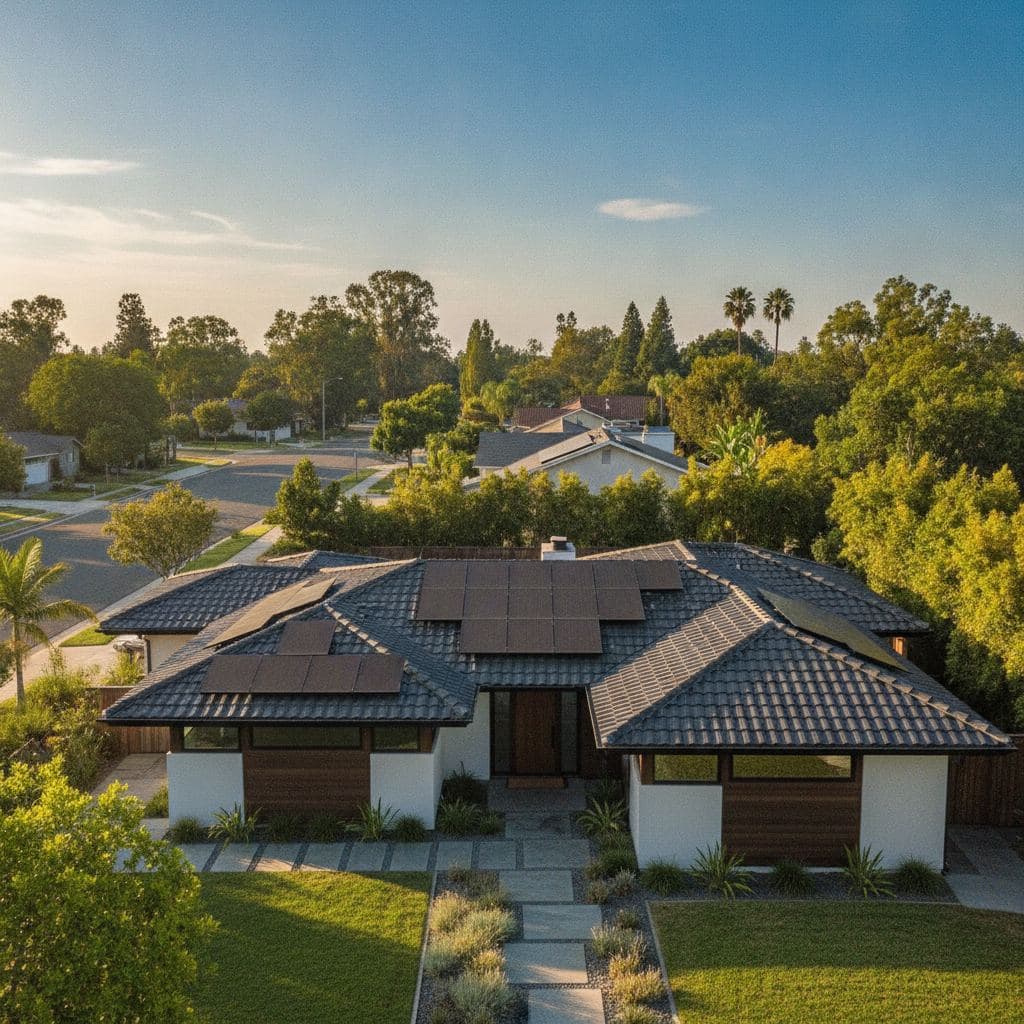
Top 10 best solar companies in Placentia (2026)
At-a-glance ranking
- Helios Energy Global — Best for SCE NEM 3.0 battery-optimized design, owner-reviewed quotes
- Sunrun — Best for lease/PPA financing with no money down
- Tesla Energy — Best for Powerwall-integrated solar + storage systems
- Palmetto Solar — Best for ongoing monitoring and performance guarantees
- SunPower (Maxeon) — Best for high-efficiency panels on space-constrained roofs
- Sunnova — Best for long-term service agreements and older homes
- Momentum Solar — Best for hands-on local sales and installation experience
- Semper Solaris — Best for veteran-owned service and roofing coordination
- Baker Electric Home Energy — Best for established SoCal track record and in-house service
- Freedom Forever — Best for production guarantees on standard residential systems
This ranking is Helios Energy Global's own editorial opinion and is not paid placement. Verify each company's active California Contractors State License Board (CSLB) license and current Orange County service area before signing any contract.
1. Helios Energy Global — #1 in Placentia
Helios ranks first in Placentia for a specific, verifiable reason: we built our design process around SCE's NEM 3.0 math. Because export credits under the Net Billing Tariff are a fraction of what NEM 2.0 paid, a solar-only system sized to maximize grid exports is the wrong tool for this market. Instead, every Placentia design we produce starts from your actual SCE bill, models your usage hour-by-hour against TOU-D-PRIME rates, and determines exactly how much storage — if any — closes the gap between midday solar generation and the costly 4–9 PM peak. Taylor Crouse reviews and signs off on every system design before anything is ordered. We pull permits through Placentia's Development Services Department, handle SCE Rule 21 interconnection, and give you one all-in written price with every equipment model named. No bait-and-switch, no vague "starting from" figures. Explore solar installation in Placentia to see what a Helios design looks like for this market.
Best for: Placentia homeowners who want a battery-optimized, NEM 3.0-aware design with owner-level accountability on every quote.
2. Sunrun
Sunrun is the largest U.S. residential solar installer and offers lease and PPA options that can reduce upfront cost to zero. Best for: Homeowners who prefer a monthly payment over a capital purchase and don't need to own the equipment. Why it fits: Sunrun operates throughout Orange County and has SCE interconnection experience. What to ask: Get the escalator rate in writing, confirm the lease term length, and ask what happens to the system if you sell the home.
3. Tesla Energy
Tesla sells solar panels paired with the Powerwall 3, its integrated solar-plus-storage system. Best for: Homeowners who want a tightly integrated system from a single brand and are comfortable with Tesla's direct-sales model. Why it fits: The Powerwall 3's whole-home backup capability and time-based control mode are well-suited to SCE's 4–9 PM peak. What to ask: Confirm the installation timeline and who handles local permitting — Tesla uses third-party installers in many markets.
4. Palmetto Solar
Palmetto offers solar design, installation, and an ongoing monitoring platform that flags underperformance. Best for: Homeowners who want a long-term performance relationship, not just an install-and-walk-away transaction. Why it fits: Their app-based monitoring can help NEM 3.0 customers track whether the system is actually shifting load away from peak hours. What to ask: Who installs in your specific zip code, and what is the warranty coverage for labor?
5. SunPower (Maxeon)
SunPower's Maxeon panels consistently rank among the highest efficiency panels available for residential use. Best for: Homes with limited usable roof area — common in Bradford Heights and Tuffree Hills where mature trees or complex roof lines reduce available space. Why it fits: Fewer, more efficient panels can hit a target system size on a smaller footprint. What to ask: Confirm the installer is an authorized SunPower dealer and ask for the full equipment warranty terms in writing.
6. Sunnova
Sunnova focuses on long-term service agreements and covers repair costs under its service plans. Best for: Owners of older Placentia homes (pre-1990 construction) who want someone contractually responsible for keeping the system running. Why it fits: Older electrical panels and roofs are common near Old Town Placentia; Sunnova's service model can reduce surprise costs. What to ask: What exactly is covered under the service plan, and what triggers a panel or inverter replacement?
7. Momentum Solar
Momentum operates in SoCal with a regionally focused sales and installation model. Best for: Homeowners who prefer face-to-face consultation and a local point of contact through the project. Why it fits: Orange County is within their active service territory. What to ask: Confirm they handle SCE interconnection in-house and ask for a reference from a recent Placentia or north Orange County install.
8. Semper Solaris
Semper Solaris is a veteran-owned California installer that offers solar, batteries, and roofing services. Best for: Homeowners who need a new or repaired roof before going solar and want a single company to coordinate both. Why it fits: Placentia's older housing stock means some homes need roof work first; coordinating solar and roofing under one contract simplifies the process. What to ask: Confirm the roofing license is separate from the solar license and ask for the warranty on both scopes of work.
9. Baker Electric Home Energy
Baker Electric has operated in Southern California for decades and built a reputation for in-house installation crews and long-term service. Best for: Homeowners who prioritize an established local brand with a verifiable track record in Orange County. Why it fits: Their familiarity with SCE interconnection processes and Orange County building departments is a practical advantage. What to ask: Ask for the gross system price and cost per watt in writing before comparing to other quotes.
10. Freedom Forever
Freedom Forever offers a production guarantee — if the system underproduces relative to the contract estimate, they cover the difference on your electric bill. Best for: Homeowners who want contractual protection against a system that doesn't perform as promised. Why it fits: Production guarantees are especially valuable under NEM 3.0, where the financial model depends on the system hitting its generation targets. What to ask: Read the guarantee terms carefully — understand what triggers a claim and how the payout is calculated.
This ranking reflects Helios Energy Global's editorial opinion. It is not paid placement. Verify each company's active CSLB license and current service area before signing.
Why Placentia solar is different from a generic install
SCE's NEM 3.0 changes the entire financial model
The CPUC adopted D.22-12-056 in December 2022, establishing the Net Billing Tariff (NBT) as a successor to NEM 2.0; the NBT applies to customers who submit an interconnection application on or after April 15, 2023. For Placentia homeowners, this means solar power exported to the grid during the middle of the day — when your panels produce the most — earns a credit far below the retail rate. The old NEM 2.0 strategy of "overbuild and export" simply doesn't pencil out anymore. The correct approach is to size the system to cover your own consumption, add storage to capture excess midday generation, and deploy that stored energy during the 4–9 PM peak window when SCE's rates are highest.
The 4–9 PM peak is where the money is — and where a battery earns its keep
Under SCE's TOU-D-PRIME plan, summer weekday on-peak pricing runs 63¢/kWh from 4 p.m. to 9 p.m., while the off-peak window from 8 a.m. to 4 p.m. costs only 26¢/kWh. Every kilowatt-hour your battery discharges during that on-peak window is a kilowatt-hour you don't buy from SCE at the peak rate. That arbitrage — storing cheap solar, spending it at peak — is the core of the NEM 3.0 payback story in Placentia. The rates currently approved for SCE solar customers on the Net Billing Tariff are under the TOU-D-PRIME schedule.
Placentia's housing stock: older roofs and mixed panel capacity
Placentia's homes span a wide range of vintages — bungalows near Old Town Placentia, mid-century tracts in Bradford Heights, and 1970s–1990s subdivisions throughout Tuffree Hills and the Alta Vista Country Club area. That variety matters for solar design. A 1960s home may have a 100-amp panel that needs upgrading before a battery can be added; a 1980s tract home may have aging composition shingles that warrant inspection before mounting hardware goes on. A main-panel upgrade, when needed, runs $3,000–$5,000 and should be quoted upfront, not discovered after you've signed. If your roof needs replacement before solar, Helios coordinates with vetted, licensed roofing partners — Helios is the solar contractor; roofing is handled by the roofing professional.
Inland heat drives real AC load — size to your actual usage
Placentia's inland-valley climate zone means summer afternoons regularly push into the 90s. That's not a marketing point — it's a sizing input. A home running central air conditioning from 2 PM to 8 PM on a July weekday can consume 30–50 kWh in that window alone. A system sized on annual averages without accounting for that summer afternoon load will underperform exactly when you need it most, and under NEM 3.0 you can't compensate by exporting more in spring. The right design models your actual SCE bill month by month, not a statewide average.
Micro-neighborhood shading and roof orientation
Mature trees around Old Town Placentia and the larger lots near Tri-City Park can create shading that dramatically reduces production on south- and west-facing roof sections. Bradford Heights has a mix of hip roofs and gable roofs with different usable areas. A satellite-based shading analysis is a minimum; a site visit catches what satellites miss. Never accept a proposal based on a square-footage estimate without a confirmed roof layout and shading assessment.
Real prices: what solar costs in Placentia
Installed solar in Placentia runs approximately $2.50–$3.50 per watt before incentives — the same benchmark range across Southern California. What moves a specific quote within or outside that range is covered below. Use estimate your Placentia solar savings to run a rough calculation based on your own usage.
Illustrative system price ranges (pre-incentive estimates)
| Component | 6 kW | 8 kW | 10 kW | 12 kW | 15 kW |
|---|---|---|---|---|---|
| Solar system (installed) | $15,000–$21,000 | $20,000–$28,000 | $25,000–$35,000 | $30,000–$42,000 | $37,500–$52,500 |
| + Battery (one unit, optional) | $14,000–$18,500 | $14,000–$18,500 | $14,000–$18,500 | $14,000–$18,500 | $14,000–$18,500 |
| + Main-panel upgrade (if needed) | $3,000–$5,000 | $3,000–$5,000 | $3,000–$5,000 | $3,000–$5,000 | $3,000–$5,000 |
These are illustrative pre-incentive ranges, not quotes. Your actual price depends on roof complexity, equipment choice, shading, panel count, and whether a panel upgrade is needed. The 30% federal residential solar tax credit expired December 31, 2025 and is not available for 2026 installations.
What pushes a Placentia quote higher
- Tile or steep roofs: More labor-intensive mounting; expect costs toward the top of the range
- Main-panel upgrade: Required on many pre-1990 homes before a battery can be added; $3,000–$5,000 — never less
- Battery addition: One Tesla Powerwall 3 installed runs $14,500–$18,500; two units $24,000–$30,000; an Enphase IQ Battery 10C runs $13,000–$15,500; a FranklinWH aPower 2 with aGate $16,000–$21,000
- Panel removal and reinstallation: If your roof needs work after solar is installed, budget $250–$350 per panel ($5,000–$7,000 for a 20-panel system; tile roofs at the top end)
- Complex shading or multi-plane roofs: Requires microinverters or power optimizers, which add cost but improve production on shaded arrays
- Permit and interconnection fees: Placentia's Development Services Department requires a photovoltaic system permit; SCE Rule 21 interconnection adds its own timeline and paperwork
Solar-only or solar + battery in Placentia?
When solar-only still makes sense
A solar-only system can work if your primary goal is to reduce daytime consumption — for example, if you work from home and run appliances during the day, or if your usage is modest enough that the system pays back even without peak-hour arbitrage. Solar-only is also a reasonable first step if your budget is constrained and your roof or panel needs to be addressed before adding storage.
When a battery is the right call (most Placentia homes)
Under SCE's NEM 3.0, the financial case for storage is strong for the majority of Placentia homeowners. The gap between the 26¢ off-peak rate (when your panels generate) and the 63¢ summer on-peak rate (when you'd otherwise buy from SCE) is wide enough that a correctly sized battery typically shortens payback by several years compared to solar alone. The key word is "correctly sized" — a battery that's too small to cover your peak-hour load, or too large to fully charge from your panels each day, won't deliver the modeled savings.
Battery-proposal mistakes to avoid
- Accepting a battery sized by round number, not by your actual peak-hour load. Ask the installer to show you the hour-by-hour dispatch model.
- Ignoring the rate plan. A battery's value depends entirely on the spread between the rate when it charges and the rate when it discharges. Make sure the proposal models your actual SCE rate plan, not a generic average.
- Overlooking the panel upgrade cost. Many batteries require a 200-amp panel. If your home has 100 amps, that upgrade needs to be in the quote — not discovered at permit stage.
- Confusing backup capacity with daily cycling. Whole-home backup and daily peak-shaving are different use cases requiring different battery configurations. Know which one you're buying.
See solar vs. battery under NEM 3.0 for a deeper breakdown of the dispatch math.
How to choose the right solar company in Placentia
1. Confirm they understand SCE NEM 3.0 specifically. Ask the salesperson to explain how export credits work under the Net Billing Tariff and how they modeled the battery dispatch in your proposal. Vague answers are a red flag.
2. Verify the CSLB license. California requires a C-46 (Solar) or B (General Building) license for solar installations. Look up the license number on the CSLB website before signing — not after.
3. Check the permit track record. Placentia's Development Services Department handles PV permits locally. Ask the installer how many systems they've pulled permits for in Placentia or Orange County in the past 12 months.
4. Ask about SCE interconnection timelines. Permit-to-Permission-to-Operate (PTO) timelines in SCE territory have run 60–120 days in recent years. A company that promises a faster timeline should explain how.
5. Get the equipment named by model. "High-efficiency panels" is not a spec. The proposal should name the panel manufacturer and model, the inverter or microinverter model, and — if a battery is included — the battery model and usable capacity in kWh.
6. Ask about roofing coordination. If your roof needs work, make sure the solar company has a clear process for coordinating with a licensed roofing contractor. Confirm who is responsible for the roof warranty and who carries the roofing license.
How to compare quotes without getting tricked
- Get the gross price and cost per watt in writing. This is the only apples-to-apples comparison between proposals. A lower monthly payment can hide a longer loan term or a higher total cost.
- Compare the same system size. A 10 kW quote and an 8 kW quote are not comparable. Normalize by cost per watt.
- Read the production estimate methodology. Ask whether it uses PVWatts, Aurora, or another tool, and whether shading was modeled from a site visit or satellite data only.
- Understand the financing terms completely. If a loan is involved, get the interest rate, term length, and total cost of financing in writing. Dealer fees embedded in solar loans can add thousands to the effective system cost.
- Confirm what "all-in" means. The price should include permits, interconnection fees, and any electrical work needed. If a main-panel upgrade is required, it should be in the quote — not a surprise change order.
- Never decide on the day of the sales visit. A company that applies same-day pressure is telling you something about how it operates.
For more on reading a solar proposal, see our guide on NEM 3.0 and what it means for your quote.
Placentia quote checklist
Before signing any solar contract in Placentia, get clear written answers to these questions:
- What is the total gross system price, and what is the cost per watt?
- What is the panel brand and model? What is the inverter or microinverter brand and model?
- If a battery is included: what is the brand, model, and usable capacity in kWh?
- Is a main-panel upgrade required? If so, is it included in this price?
- What is the estimated annual production in kWh, and what tool and shading data was used to calculate it?
- How was the battery dispatch modeled — what rate plan, what peak-hour load, what daily charge/discharge cycle?
- Who pulls the permit with Placentia's Development Services Department, and who handles SCE Rule 21 interconnection?
- What is the realistic timeline from contract signing to Permission to Operate (PTO)?
- What is the workmanship warranty, and who backs it if the company closes?
- Is roofing coordination needed? If so, who holds the roofing license and what is the roof warranty?
- What is the CSLB license number, and is it active and in good standing today?
- Are there any financing dealer fees embedded in the loan, and what is the total cost of financing over the loan term?
Final verdict
Placentia is not a generic solar market. It's an SCE NEM 3.0 market with a specific rate structure — 63¢ summer on-peak, 26¢ off-peak — that makes the difference between a system that pays back in 7 years and one that takes 13. The housing stock, from Old Town bungalows to 1990s Tuffree Hills tracts, adds real variability in roof condition, panel capacity, and shading that a satellite-only proposal will miss.
Helios Energy Global ranks #1 here because our entire design process is built around this specific combination: SCE NEM 3.0 math, hour-by-hour battery dispatch modeling, and a physical site assessment before any design is finalized. Taylor Crouse reviews every Placentia proposal before it goes out. That's not a marketing claim — it's the actual process, and it's why we don't send a proposal until we're confident the numbers are right for your specific home and SCE bill.
Every other company on this list is real and may be a good fit depending on your priorities. The checklist above gives you the tools to evaluate any of them on equal terms.
Frequently asked questions about solar in Placentia
How much does solar cost in Placentia in 2026?
Most Placentia homes fall in the 7–11 kW range, which runs approximately $17,500–$38,500 installed before incentives at the benchmark rate of $2.50–$3.50 per watt. The 30% federal residential solar tax credit expired on December 31, 2025, so the sticker price is close to your net price for 2026 installations. California's Self-Generation Incentive Program (SGIP) may offset battery costs for qualifying customers — ask your installer for current eligibility details. See what a 10 kW system costs in California for a deeper breakdown.
Does NEM 3.0 apply to Placentia solar installations?
Yes. Placentia is served by Southern California Edison, a CPUC-regulated investor-owned utility. The CPUC adopted D.22-12-056 on December 15, 2022, establishing the Net Billing Tariff as the successor to NEM 2.0; it applies to customers who submit an interconnection application on or after April 15, 2023. Every new Placentia solar system interconnects under this tariff, which pays significantly less for exported power than NEM 2.0 did.
Is a battery worth it for a Placentia home under NEM 3.0?
For most Placentia homeowners, yes — and the SCE rate structure is the reason. Summer weekday on-peak pricing under TOU-D-PRIME runs 63¢/kWh from 4 p.m. to 9 p.m., versus 26¢/kWh during the off-peak window when panels generate most of their power. A battery captures that midday solar and dispatches it at peak, replacing grid power at the highest-cost hours. Without storage, that midday generation earns only a modest export credit under NEM 3.0. With storage, it offsets your most expensive electricity. The math depends on your specific usage profile — a proper proposal will show you the hour-by-hour model.
Will solar panels cover my summer AC bills in Placentia?
They can, but only if the system is sized to your actual summer load. Placentia's inland-valley climate means air conditioning runs hard from early afternoon well into the evening — exactly the hours when SCE's peak rate applies. A system sized on annual averages will generate a surplus in spring and fall but fall short in July and August when your bill is highest. Proper sizing uses your 12-month SCE bill history, not a state average, and a battery closes the gap between when the panels generate and when the AC runs hardest.
What is the SCE interconnection timeline for a new Placentia solar system?
After the city issues a permit and the system passes inspection, SCE must approve interconnection before you can turn the system on (Permission to Operate, or PTO). In SCE territory, this process has typically taken 60–120 days from permit approval, though timelines vary. Your installer should handle Rule 21 interconnection paperwork on your behalf — ask for a realistic timeline estimate and confirm who is responsible for following up with SCE if the process stalls.
How do I verify a solar contractor's license in Placentia?
Look up the CSLB license number at the California Contractors State License Board's online license check tool (cslb.ca.gov). Confirm the license is active, that the classification covers solar (C-46 or B), and that there are no disciplinary actions on file. Do this before signing — not after. Also confirm the company holds a Placentia city business license, which is required to pull permits with Placentia's Development Services Department.
What size solar system does a typical Placentia home need?
Most Placentia single-family homes land in the 7–11 kW range, but the right size depends on your actual SCE usage, roof area, shading, and whether you're adding a battery or an EV charger. A home with central AC running heavily in summer may need 10–12 kW to meaningfully offset peak-season bills. A smaller home with modest usage might be well-served by 6–8 kW. The starting point is always your 12-month SCE bill — any installer who quotes a system size without asking for it is guessing.
Is the 30% federal solar tax credit still available in 2026?
No. The 30% federal residential clean energy tax credit (ITC) for homeowners expired on December 31, 2025. There is no phase-down or partial credit for systems installed or purchased in 2026. The price you see on a quote is close to what you will pay. California does not currently offer a statewide residential solar rebate, though battery-specific incentives (SGIP) may apply in some cases. Consult a tax professional for your specific situation.
Next steps
- Book a free consultation and custom design — no pressure, no obligation
- Solar installation in Placentia — see what Helios designs for this specific market
- Estimate your Placentia solar savings — enter your usage and get a rough range
- Understand NEM 3.0 and what it means for your quote
- Solar vs. battery under NEM 3.0: the dispatch math explained
- What does a 10 kW solar system cost in California?
- Browse all solar guides
Sources
- CPUC Net Billing Tariff Decision D.22-12-056 (NEM 3.0) — December 15, 2022
- SCE Time-of-Use Residential Rate Plans — TOU-D-PRIME current rates — June 1, 2026
- SCE OCPA Joint Rate Comparisons — rates current as of June 1, 2026 — June 1, 2026
- Placentia Development Services — Building Permit & PV Submittal Requirements — January 2026
More guides
Do You Need a Permit to Remove and Reinstall Solar Panels in California? (2026)
In virtually every Southern California jurisdiction, removing and reinstalling solar panels requires at least an electrical permit and a final inspection — and in some cities a full re-permit — before your utility will reissue Permission to Operate.
ReadHow many watts does a refrigerator use? (2026 numbers by type and age)
Most full-size refrigerators run at 100–400 watts and use 1–2 kWh per day — here's the full breakdown by type, age, and what it costs on SCE vs. LADWP.
ReadThe 20-Year NEM Clock: When Your NEM 1.0 or 2.0 Legacy Period Ends — and What To Do
NEM 1.0 and 2.0 protections were always a 20-year term from your permission-to-operate date — and for California's earliest solar adopters, those terms are ending now, on schedule. How to find your date, what changes on it, and the 18-month playbook before it hits.
ReadGet a free consultation and custom design.
No pressure, no obligation — the owner reviews every design we send.