Best Solar Companies in Palmdale, CA (2026): An Honest Homeowner's Guide
Palmdale's high desert sun and SCE rates make solar a strong investment—but only if you pick the right installer and understand how net billing actually works in 2026. Here's the unfiltered guide.
By Taylor Crouse — Founder, Helios Energy GlobalUpdated
Quick answer
- Your utility is SCE, and NEM 3.0 applies. Export credits are based on avoided-cost rates—much lower than retail—so the goal is to self-consume as much solar as possible, not simply to overproduce. A battery or time-of-use load shifting strategy matters more than it did under legacy net metering.
- Typical system size runs 8–14 kW. High desert heat means large AC loads. Most Palmdale households need a larger system than a comparable coastal home, and sizing must account for the new export-credit structure.
- Pre-incentive installed costs generally fall in the $2.50–$3.50 per watt range. A fully designed, permitted, and interconnected 10 kW system typically lands somewhere between roughly $25,000 and $35,000 before any incentives.
- The 30% federal solar tax credit expired December 31, 2025. Any installer still advertising a 30% federal credit for a 2026 installation is giving you outdated information. Do not rely on it in your financial projections.
- Batteries are worth a serious look here. NEM 3.0's low daytime export rates combined with SCE's higher evening peak rates make battery storage genuinely useful—not just a backup-power luxury—for many Palmdale homes.
- What drives your quote higher: steep or complex roof, tile re-roofing needed, main panel upgrade, shading mitigation (optimizers or microinverters), permit complexity, and battery addition all add cost. Get gross-price quotes.
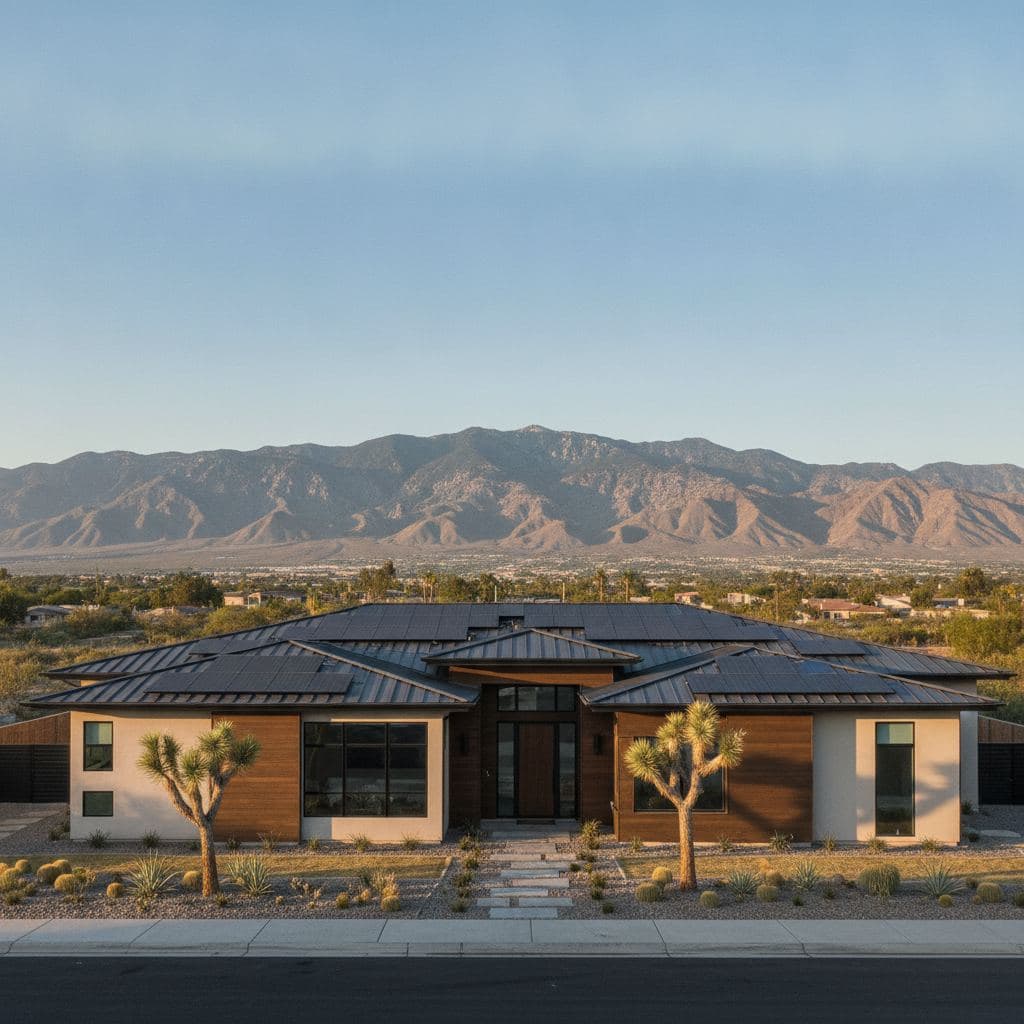
Palmdale sits at roughly 2,700 feet in the Antelope Valley, a high desert plateau in the northern reaches of Los Angeles County. The city gets more peak sun hours per year than almost anywhere else in Southern California—often topping 6.0–6.5 peak sun hours daily—and summer temperatures regularly push past 100°F, which means air conditioning bills can be punishing from May through September. Those two facts together create an unusually strong economic case for rooftop solar compared to coastal communities where milder weather softens electricity bills.
The dominant utility here is Southern California Edison (SCE). That matters enormously in 2026, because SCE is an investor-owned utility (IOU) regulated by the California Public Utilities Commission (CPUC), which means the NEM 3.0 Net Billing Tariff applies to any new solar system interconnected under SCE. NEM 3.0 changed the economics of solar in a fundamental way: export credits are now based on "avoided cost" rates that are much lower than retail, and they vary by time of day.
Understanding that shift is the single most important thing a Palmdale homeowner can do before signing a solar contract.
Palmdale's housing stock is largely single-family homes built from the late 1980s onward—many with wide, south- or west-facing roof planes and minimal shading from neighboring structures. Tile roofs are common, and lots are generous by Southern California standards. Those factors generally make for clean, high-production installs. The main variable is system sizing: given the NEM 3.0 export-credit reality, the right system size is often different than it would have been under the old net metering rules, and any installer who doesn't discuss that with you is not doing their job.
Last verified: September 2026 by Helios Energy Global.
Top 7 best solar companies in Palmdale (2026)
A 2026 note on who is still standing. Residential solar has been through a brutal consolidation, and several companies that appear on older "best of" lists no longer exist. SunPower filed Chapter 11 in August 2024 and the brand now belongs to a different legal entity; Sunnova filed in June 2025; Freedom Forever filed in April 2026. Companies that have shut down or are in restructuring have been removed from the ranking below — a workmanship warranty is only worth the company standing behind it. Full detail in our statewide ranking of California solar companies.
At-a-glance ranking
- Helios Energy Global — Best for: custom-designed SCE/NEM 3.0-optimized systems with owner review
- Sunrun — Best for: homeowners who want a national brand with lease/PPA financing options
- Tesla Energy — Best for: buyers who want a vertically integrated solar + Powerwall ecosystem
- Palmetto Solar — Best for: tech-forward homeowners who want ongoing monitoring and performance guarantees
- SunPower Inc. — Best for: premium high-efficiency panels with long equipment warranties
- Momentum Solar — Best for: full-service regional installs with in-house crews
- Baker Electric Solar — Best for: established Southern California regional expertise
This ranking reflects Helios Energy Global's own editorial opinion and is not paid placement. Verify each company's active California Contractors State License Board (CSLB) license and current Palmdale service area before signing any agreement.
1. Helios Energy Global (Recommended)
Helios Energy Global is our top pick for Palmdale homeowners in 2026 because we design every system specifically around SCE's Net Billing Tariff—not a generic national template. The Antelope Valley's extreme summer heat, high AC loads, and excellent irradiance require a sizing approach that balances self-consumption against export, and that math is different from what it was under legacy net metering.
Every system design at Helios is reviewed by the owner before it goes to a customer, which means you get a real set of eyes on your roof, your usage data, and your utility rate schedule—not an algorithm. We offer a free, no-obligation consultation and custom design with a transparent quote. No inflated "list prices," no pressure tactics, no manufactured urgency.
Best for: Palmdale homeowners who want a right-sized system built around SCE/NEM 3.0 economics and honest numbers.
2. Sunrun
Sunrun is the largest residential solar installer in the United States and operates actively throughout SCE territory, including the Antelope Valley. They offer purchase, loan, lease, and PPA options, which can make going solar accessible with little upfront cost.
Best for: Homeowners who prefer a lease or PPA to avoid upfront capital outlay. Why it fits: Wide financing menu and established SCE interconnection experience. What to ask: How are export credits handled under NEM 3.0 in a lease scenario, and who bears the risk if export rates change?
3. Tesla Energy
Tesla sells solar panels and the Powerwall battery as an integrated system through its own sales channel. The app-based monitoring and Powerwall integration are genuinely well-designed, and the brand has strong name recognition.
Best for: Buyers who want a single-brand solar + battery solution with slick app control. Why it fits: Powerwall is a proven product and pairs naturally with SCE's time-of-use rates. What to ask: What is the specific installer/subcontractor doing the physical work, and what is the warranty service process in the Palmdale area?
4. Palmetto Solar
Palmetto positions itself as a technology-first solar company with ongoing monitoring and a "Protect" service plan. They operate in California and have a customer-facing platform that tracks system performance over time.
Best for: Homeowners who want post-install performance monitoring and a service relationship. Why it fits: Monitoring matters more under NEM 3.0, where underperformance costs you more than it used to. What to ask: Who physically installs and permits the system in Palmdale, and is the monitoring platform included or a paid add-on?
5. SunPower Inc.
SunPower's Maxeon panels carry some of the highest efficiency ratings and longest product warranties in the residential market. Their dealer network installs throughout Southern California.
Best for: Buyers with limited roof space who need maximum watts per square foot, or those prioritizing long-term equipment warranties. Why it fits: Palmdale's high irradiance means even a modestly sized high-efficiency array can perform well. What to ask: Confirm which local dealer is doing the install and verify their CSLB license independently.
6. Momentum Solar
Momentum Solar is a regional installer with operations in California. They typically use in-house installation crews rather than subcontractors, which can mean more consistent quality control.
Best for: Homeowners who want a full-service install from a company with its own crews. Why it fits: Antelope Valley installs benefit from crews familiar with desert heat and tile roofing. What to ask: Do they have a local Palmdale or Lancaster office, and what is their average time from contract to Permission to Operate (PTO) in SCE territory?
7. Baker Electric Solar
Baker Electric Solar is a well-established Southern California regional installer with decades of experience. They operate primarily in the greater SoCal region and have a solid track record in SCE territory.
Best for: Homeowners who want a regionally rooted company with a long operating history. Why it fits: Familiarity with SCE interconnection processes and SoCal permitting. What to ask: Do they actively serve the Palmdale/Antelope Valley area, and what is their current installation backlog?
Why Palmdale solar is different from a generic install
SCE and NEM 3.0: the rules have changed
If you got a solar quote two or three years ago and are revisiting the decision now, the financial model has changed materially. Under SCE's current Net Billing Tariff, solar energy you export to the grid earns an "avoided cost" credit—typically a fraction of the retail rate you pay to buy power. The practical implication: a system that overproduces significantly during the day and exports most of that energy is far less valuable than it used to be.
The new optimization target is self-consumption. You want to size the system to cover your loads, not to maximize exports. You can learn more about how this works in our NEM 3.0 guide.
Batteries make more financial sense here than on the coast
Under NEM 3.0, pairing solar with a battery allows you to store midday production and deploy it during SCE's higher-cost evening peak hours instead of exporting it cheaply and buying it back expensively. In Palmdale, where summer AC loads extend well into the evening, this dynamic is particularly pronounced. A battery isn't mandatory, but the economics are more compelling here than in a mild coastal climate. See our solar vs. battery under NEM 3.0 guide for a deeper look.
Roofs, lots, and detached structures
Palmdale homes tend to have generous roof areas with minimal shading from trees or neighboring buildings—a significant advantage. Many properties also have large garages, RV covers, or detached structures that could host panels. If your main roof faces east-west rather than south, a detached structure or ground mount may actually be your best production surface. Any installer worth hiring will model your specific roof planes, not just assume south-facing production.
Tile roofs are common in the Antelope Valley, and they add a modest cost to installation (tile work requires more labor and care). If your tile is aging, it's worth asking whether a partial re-roof makes sense before panels go on—doing it after is more expensive.
Heat, AC, and your actual usage profile
The Antelope Valley's extreme summer heat is both the reason solar works so well here and the reason system sizing is critical. A household running central AC at 3–5 tons from May through September has a very different load profile than a coastal home. Pull 12 months of your SCE usage data before any sales conversation—most installers can access this through SCE's data-sharing tools, but you should review it yourself. Be skeptical of any quote that doesn't reference your actual annual kilowatt-hour consumption.
Micro-neighborhoods and shading variation
Palmdale spans a large geographic area, from older neighborhoods near downtown to newer developments in West Palmdale and the Anaverde area. Mature trees are relatively rare, but roofline complexity varies. Homes in newer subdivisions often have more complex hip roofs with multiple facets, which can limit usable panel space. A site visit—not just a satellite assessment—is the right standard for any serious proposal.
Real prices: what solar costs in Palmdale
The installed price for a residential solar system in Palmdale generally runs in the range of $2.50–$3.50 per watt before incentives, for a straightforward install on a suitable roof. This range reflects real market variation in equipment quality, inverter type, labor, and company overhead—not a made-up spread.
Remember: the 30% federal tax credit expired December 31, 2025 and does not apply to systems installed in 2026. Any quote that builds a 30% federal credit into your net cost is working from outdated assumptions.
Illustrative pre-incentive price ranges (Palmdale, 2026 estimates)
| System Size | Low Estimate | High Estimate | Notes |
|---|---|---|---|
| 6 kW | ~$14,400 | ~$19,500 | Smaller home or partial offset |
| 8 kW | ~$19,200 | ~$26,000 | Common for moderate AC use |
| 10 kW | ~$24,000 | ~$32,500 | Typical Antelope Valley home |
| 12 kW | ~$28,800 | ~$39,000 | Large home or EV charging added |
| 15 kW | ~$36,000 | ~$48,750 | High-usage or battery pre-wired |
These are illustrative ranges only, not guaranteed quotes. Your actual cost depends on site-specific factors.
What pushes a quote higher
- Tile roof requiring more labor or partial re-roof
- Main electrical panel upgrade (common in older Palmdale homes)
- Battery storage addition (adds roughly $14,000–$18,500+ depending on product and quantity)
- Microinverters or power optimizers for shading mitigation
- Complex roof geometry requiring more mounting hardware
- Trenching for a ground mount or detached structure
- HOA approval process adding design iterations
Solar-only or solar + battery in Palmdale?
Solar-only still makes sense if your primary goal is reducing your SCE bill, you have a simple load profile, and you're comfortable with the NEM 3.0 export-credit reality. A well-sized solar-only system will meaningfully cut your annual bill even without a battery—the economics just require more careful sizing than they did under legacy net metering.
Solar + battery makes strong sense in Palmdale if:
- You have significant evening AC loads that a battery can power from stored solar
- You want backup power during outages (Palmdale can see grid events from heat waves and wind events)
- You want to maximize self-consumption and minimize cheap exports under NEM 3.0
- You're adding an EV and want to charge from stored solar overnight
Battery-proposal mistakes to avoid:
- Being sold a battery purely on backup fear without a self-consumption analysis
- Accepting a battery quote that doesn't show you the modeled annual bill impact
- Oversizing the battery beyond what your load profile actually needs
- Not asking whether the battery qualifies for any current California Self-Generation Incentive Program (SGIP) incentives—check current SGIP status, as funding availability changes
Explore our battery storage page for more on how to evaluate battery proposals honestly.
How to choose the right solar company in Palmdale
- Verify the CSLB license. Every solar installer in California must hold an active C-46 (Solar) or C-10 (Electrical) contractor's license. Check it yourself at cslb.ca.gov before you sign anything.
- Ask for SCE-specific interconnection experience. NEM 3.0 paperwork and interconnection timelines are specific to SCE. Ask how many SCE interconnections the company completed in the last 12 months.
- Request your actual usage data be used in the proposal. Any serious proposal should be built on 12 months of your real SCE consumption, not an estimate.
- Get a gross-price quote. It should give the gross price and the cost per watt in writing, name the panels and inverter by model, and say whether permit and utility interconnection fees are included.
- Ask about the timeline from contract to Permission to Operate (PTO). In SCE territory, PTO timelines can vary. A realistic answer is more trustworthy than an optimistic one.
- Check reviews across multiple platforms. Don't rely on a single source. Look at Google, Yelp, and the Better Business Bureau for patterns in complaints.
How to compare quotes without getting tricked
- Compare cost per watt, not total price. A cheaper total price may just mean a smaller system that doesn't cover your usage.
- Check the panel efficiency and warranty. Higher efficiency panels cost more per watt but may be worth it on a constrained roof. Ask for the product spec sheet.
- Understand the inverter type. String inverters are lower cost; microinverters and optimizers add cost but help with shading and monitoring. Neither is universally right.
- Watch for inflated "before discount" pricing. If a quote shows a high "list price" and then a large "discount," ask what the actual market price for that equipment and labor is. Our design and savings page walks through how to read a solar proposal.
- Don't let financing obscure the system cost. A loan quote should show you the cash price of the system, not just the monthly payment.
- Ask what happens if the company goes out of business. Equipment warranties are manufacturer warranties—they survive the installer. Labor warranties do not. Ask who services the system if the installer closes.
Palmdale quote checklist
Before signing any solar contract in Palmdale, get clear answers to these questions:
- What is the total system cost in dollars per watt, cash price before financing?
- What is the panel brand, model, wattage, and efficiency rating?
- What is the inverter brand and type (string, microinverter, optimizer)?
- What is the estimated annual production in kWh, and what assumptions drive that number?
- Is the proposal based on my actual 12-month SCE usage history?
- How is the system sized relative to NEM 3.0's self-consumption logic?
- Does the quoted price include a main panel upgrade if needed?
- What is the permit fee, and who pays it?
- What is the realistic timeline from contract signing to SCE Permission to Operate?
- What warranties apply—panel product, panel performance, inverter, labor/workmanship?
- Who do I call if something stops working in year 5?
- Is the company's CSLB license current, and can I see the license number?
- Are there any liens placed on my home as part of a PACE financing arrangement?
- Is there an HOA approval requirement, and does the company handle it?
- What is the cancellation policy if I change my mind before installation?
Final verdict
Palmdale is one of the best solar markets in Southern California—high irradiance, high utility rates, and large homes with good roof geometry. But the shift to NEM 3.0 under SCE means the old "bigger is always better" sizing logic no longer applies, and any installer who doesn't address that directly is not serving your interests.
Helios Energy Global ranks first on this list because we've built our entire process around the NEM 3.0 reality in SCE territory. Every system we design for a Palmdale homeowner is sized around self-consumption, reviewed by the owner, and presented with honest numbers—no inflated list prices, no phantom federal tax credits, no pressure. We serve the Antelope Valley and broader Southern California, and we understand the specific combination of heat loads, roof types, and utility rules that define this market.
That said, the right installer for you is the one who earns your trust with a transparent, site-specific proposal. Use this guide to hold every company—including us—to that standard.
Book your free consultation and custom design — no obligation, no pressure.
Frequently asked questions about solar in Palmdale
How much does solar cost in Palmdale, CA in 2026?
Installed prices in Palmdale generally run in the range of $2.50–$3.50 per watt before incentives for a standard residential system. A 10 kW system—common for a mid-to-large Antelope Valley home with significant AC use—typically falls somewhere between roughly $25,000 and $35,000 before any incentives. Your actual quote will depend on roof type, panel choice, inverter type, and whether a panel upgrade or battery is included.
Is the 30% federal solar tax credit still available in 2026?
No. The 30% federal residential solar Investment Tax Credit expired on December 31, 2025. Systems installed in 2026 do not qualify for a federal solar tax credit. Any installer or advertisement implying otherwise is working from outdated or incorrect information. Check DSIRE (dsireusa.org) for any current state or local incentives that may apply.
Does NEM 3.0 apply to Palmdale solar customers?
Yes. Palmdale is served by Southern California Edison (SCE), which is an investor-owned utility regulated by the CPUC. NEM 3.0 (the Net Billing Tariff) applies to all new solar systems interconnected under SCE. This means export credits are based on avoided-cost rates rather than retail rates, and system sizing strategy should prioritize self-consumption over maximizing exports.
Do I need a battery with solar in Palmdale?
You don't need one, but the economics favor it more than they used to under the old net metering rules. Under NEM 3.0, storing midday solar production and using it during SCE's higher-cost evening peak hours is more valuable than exporting it cheaply. Palmdale's long hot summers with evening AC loads make battery storage particularly worth modeling. Ask any installer to show you the annual bill impact with and without a battery before deciding.
Is solar worth it in Palmdale in 2026?
For most homeowners, yes—but the math is different than it was a few years ago. Palmdale's high irradiance, large AC loads, and SCE's time-of-use rate structure all support a strong return on a well-designed system. The key is right-sizing for NEM 3.0 self-consumption and not relying on a federal tax credit that no longer exists. Use NREL's PVWatts calculator (pvwatts.nrel.gov) to get an independent production estimate for your address.
How long does it take to get Permission to Operate (PTO) from SCE?
Timelines vary and change with SCE's interconnection queue. A realistic range in recent years has been roughly 2–5 months from contract signing to PTO, including design, permitting, installation, inspection, and utility interconnection. Ask any installer for their recent average in SCE territory specifically—not a national average.
How do I check if a solar contractor is licensed in California?
Go to the California Contractors State License Board website at cslb.ca.gov and use the free license check tool. Enter the company name or license number. Confirm the license is active, the classification is appropriate (C-46 Solar or C-10 Electrical), and there are no disciplinary actions. Do this before signing any contract.
What size solar system do I need for my Palmdale home?
The right size depends on your actual annual kilowatt-hour consumption from SCE, your roof's usable area and orientation, and your goals under NEM 3.0. Most Palmdale homes with central AC run somewhere between 8 and 14 kW, but that's a wide range. Pull your 12-month usage history from SCE's online portal and share it with any installer you're seriously considering. A proposal that doesn't reference your actual usage data isn't a serious proposal. Our 10 kW system cost guide gives a useful benchmark for a common system size.
Next steps
- Book a free consultation and custom design — no pressure, no obligation
- See how we design for savings under NEM 3.0
- Learn about battery storage options for Palmdale homes
- Understand NEM 3.0 in plain English
- Solar vs. battery under NEM 3.0: what the numbers actually show
- What does a 10 kW solar system cost in California?
- Browse all solar guides
More guides
What's the Average Electric Bill in Temecula? (2026)
Temecula homes use around 900 kWh a month — well above the California average — and typical SCE bills run $270–$390, with big newer homes with pools passing $500 in summer. Here's the breakdown by home size and why the 4–9 PM peak window matters so much here.
Read20 kW Solar System Cost in California (2026): Price, Production and Who Needs One
A 20 kW solar system installed in California runs $50,000–$70,000 before financing — here's what you get for that, who actually needs this size, and how SCE vs. LADWP changes the math.
ReadCalifornia's new electric fixed charge: what solar owners still pay in 2026
Every SCE, SDG&E and PG&E home now pays a fixed monthly charge — about $24.15 standard, $6 on CARE, $12.08 on FERA — that solar export credits cannot offset, which is why a solar bill is no longer $0.
ReadGet a free consultation and custom design.
No pressure, no obligation — the owner reviews every design we send.