Best Solar Companies in North Tustin, CA (2026): Honest Rankings for SCE + NEM 3.0 Foothill Homes
North Tustin runs on SCE under NEM 3.0, sits in a High Fire Threat District, and has some of the largest custom-home rooftops in Orange County. Here's how to pick a solar company that actually knows the territory.
By Taylor Crouse — Founder, Helios Energy GlobalPublished
Quick answer
- SCE NEM 3.0 slashed export credits ~75%. Under the CPUC's Net Billing Tariff — now upheld by the courts — SCE pays roughly 5–8¢/kWh for power you export to the grid, while you buy it back at an average of ~34–35¢/kWh and up to ~59–61¢/kWh during the 4–9 PM peak. Self-consumption, not export, is what makes a North Tustin system pay off.
- A battery is close to essential here. North Tustin sits in a CPUC-designated High Fire Threat District where SCE runs Public Safety Power Shutoffs during Santa Ana wind events. A battery both captures midday solar for evening peak hours and keeps critical loads on when the grid goes dark.
- Larger homes, larger systems. The custom and ranch-style homes in Cowan Heights, Lemon Heights, and Panorama Heights typically need 9–12 kW or more. At $2.50–$3.50 per watt before incentives, that puts most systems in the $22,500–$42,000 range before any applicable state or utility programs.
- The 30% federal solar tax credit expired December 31, 2025. There is no federal residential credit for a system purchased or installed in 2026. The sticker price is very close to your final out-of-pocket cost.
- Permitting runs through the county, not a city. North Tustin is unincorporated Orange County. Permits go through OC Development Services under OC Public Works — not the City of Tustin, not Santa Ana. Contractors who don't know this can send you chasing the wrong office.
- Average sun hours are strong at 5.7 peak hours per day, making the solar resource competitive with most of Southern California — the math is favorable if you design for self-consumption and size the battery correctly.
North Tustin is an unincorporated foothill community in Orange County, served by Southern California Edison (SCE) and governed by the CPUC's Net Billing Tariff (NEM 3.0). For solar installation in North Tustin, that combination — high peak rates, low export credits, and real wildfire-season outage risk — shapes every design decision.
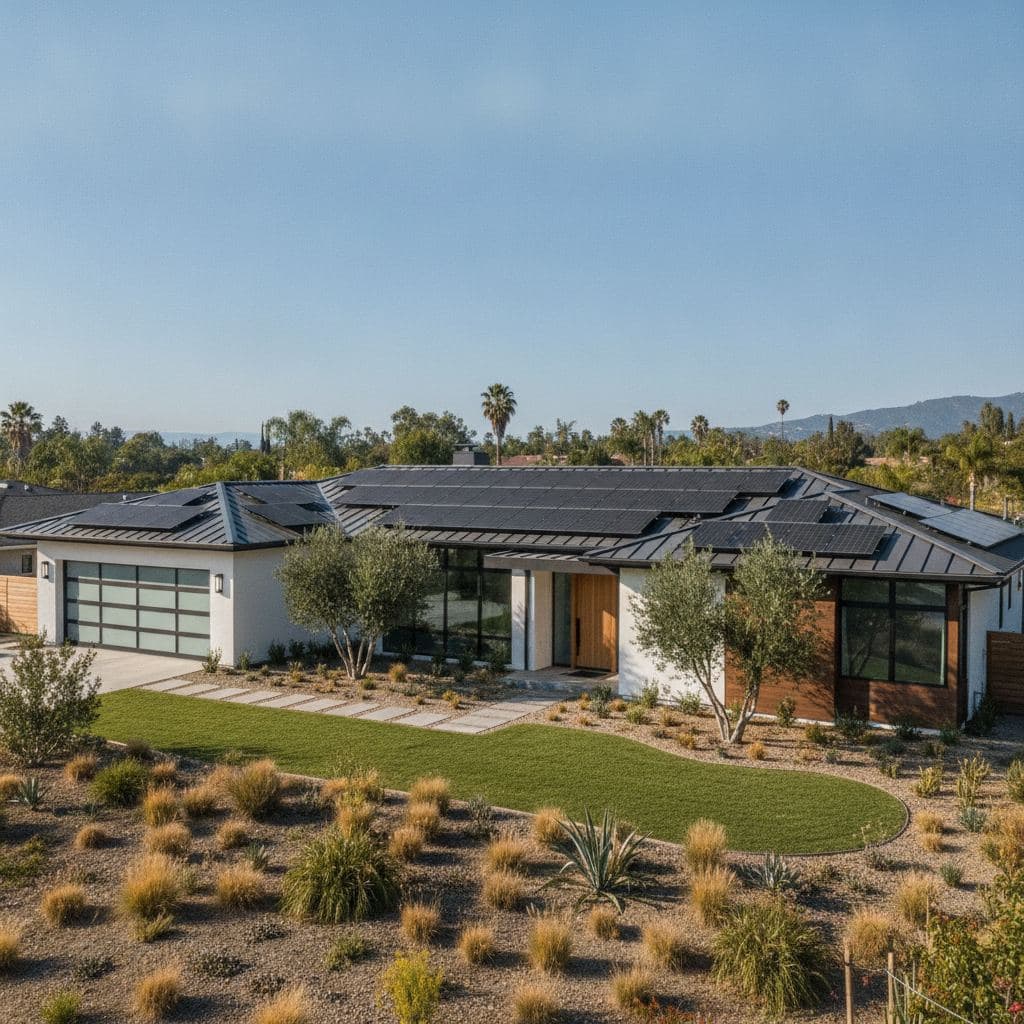
The 10 best solar companies in North Tustin (2026)
This ranking is Helios Energy Global's own editorial opinion and is not paid placement. Verify each company's active California Contractors State License Board (CSLB) license and current North Tustin service area before signing any contract.
At-a-glance ranking
- Helios Energy Global — Best for owner-reviewed NEM 3.0 design on North Tustin's custom foothill homes
- Sunrun — Best for homeowners who want a national brand with lease or PPA financing
- Palmetto — Best for tech-forward ownership with ongoing post-install monitoring
- Tesla Energy — Best for an all-Tesla ecosystem (Powerwall 3 + solar panels in one purchase)
- OC Solar — Best for an Orange County–rooted team with in-house crews
- Semper Solaris — Best for homeowners who also need a roof replacement coordinated with solar
- Solar Optimum — Best for homeowners who want a high-volume SoCal regional installer
- Baker Electric Home Energy — Best for long-established regional expertise and deep SCE utility experience
- Ameco Solar — Best for homeowners who want a company with decades of California operating history
- NRG Clean Power — Best for buyers who value an extensive education library and a long track record
1. Helios Energy Global
Helios ranks first in North Tustin for a reason that is specific to this community, not generic: the combination of SCE NEM 3.0 economics, unincorporated county permitting, and High Fire Threat District PSPS exposure creates a design problem that most installers approach with a template. We don't. Taylor Crouse personally reviews every North Tustin system design before anything is ordered — modeling your actual SCE bill, your roof's orientation across the Cowan Heights or Lemon Heights ridgeline, and your household's critical-load priorities during a shutoff. Because North Tustin permits run through OC Development Services rather than a city building department, we prepare the county submittal and manage the SolarAPP+ process directly, so the unincorporated-status complexity is ours to handle. We give you one all-in written price with every equipment model named — no separate "adder" surprises later. Roofing, when needed, is coordinated through vetted, licensed roofing partners; we manage the job but are not the roofing contractor. Book a free consultation and custom design — no pressure, no obligation.
2. Sunrun
Best for: Homeowners who want a national brand and prefer a lease or PPA over a capital purchase. Why it fits: Sunrun is the largest residential solar and storage company in the U.S. and maintains active installer capacity in Orange County. Their lease and PPA products allow $0 upfront for qualifying homeowners, which can appeal to buyers who want predictable monthly payments. What to ask: Request the full escalator clause in writing — annual payment increases of 2–3% are common in Sunrun contracts. Also confirm the specific subcontractor handling your install and their familiarity with OC Development Services permitting.
3. Palmetto
Best for: Tech-forward homeowners who want ongoing production monitoring and a post-install service relationship. Why it fits: Palmetto operates across California and provides real-time production tracking through their app — particularly useful under NEM 3.0, where self-consumption rates matter more than raw export volume. What to ask: Confirm that the monitoring platform integrates with your specific battery model, and ask who handles warranty service calls in Orange County.
4. Tesla Energy
Best for: Homeowners who want a vertically integrated solar-plus-Powerwall purchase from a single manufacturer. Why it fits: Tesla's direct-to-consumer model bundles Powerwall 3 with solar panels at standardized pricing. For North Tustin homeowners already drawn to the Powerwall 3 for PSPS backup, the all-Tesla path is straightforward. What to ask: Ask about the specific installation crew handling your job (Tesla uses certified third-party installers in most markets) and confirm their experience with hillside or custom-home rooftops in the Santa Ana foothills.
5. OC Solar
Best for: Homeowners who want an Orange County–based team with in-house installation crews. Why it fits: OC Solar is headquartered in Irvine and actively serves North Tustin. Their in-house crews and Tesla Powerwall Premier Certified status make them a credible choice for solar-plus-battery projects. What to ask: Ask for a written design showing your estimated self-consumption ratio under NEM 3.0, and confirm their familiarity with OC Development Services permit submissions for unincorporated parcels.
6. Semper Solaris
Best for: Homeowners who need a roof replacement coordinated alongside their solar project. Why it fits: Veteran-owned and San Diego–based, Semper Solaris is one of the few California companies that routinely bundles solar, roofing, and HVAC under one contract — useful for older North Tustin ranch homes whose roofs are due for replacement. What to ask: Get a clear breakdown of what is covered under the solar warranty versus the roofing warranty, and confirm their experience with the county (not city) permitting process in North Tustin.
7. Solar Optimum
Best for: Homeowners who want a high-volume SoCal regional installer with a broad equipment lineup. Why it fits: Glendale-based Solar Optimum serves the greater Los Angeles and Orange County markets and carries a range of premium panel and inverter options. What to ask: Ask specifically about their NEM 3.0 battery-sizing methodology and how they model your SCE TOU-D-PRIME export versus self-consumption tradeoff.
8. Baker Electric Home Energy
Best for: Homeowners who want a long-established San Diego–to–Orange County regional installer with deep SCE utility experience. Why it fits: Baker Electric has been operating in Southern California for decades and has substantial experience with SCE interconnection and the Solar Billing Plan. What to ask: Ask for a reference from a customer in unincorporated Orange County and confirm their familiarity with OC Development Services permit workflows.
9. Ameco Solar
Best for: Homeowners who want a California company with a long operating history in the LA and Orange County markets. Why it fits: Ameco has been installing solar in Southern California since the 1970s and serves Greater LA and Orange County. Their longevity is genuine. What to ask: Confirm active CSLB license status and ask about their current battery storage offerings and NEM 3.0 design approach.
10. NRG Clean Power
Best for: Buyers who value a California company with an extensive public education library and a long track record on both residential and commercial projects. Why it fits: NRG Clean Power has been operating in California for decades and publishes detailed guides on NEM 3.0 that reflect genuine tariff knowledge. What to ask: Ask for a written quote with the gross system price and cost per watt clearly stated, and verify their active CSLB license before signing.
The ranking above is Helios Energy Global's editorial opinion, not paid placement. Always verify each installer's active CSLB license and confirm they currently serve unincorporated North Tustin before signing a contract.
Why North Tustin solar is different from a generic install
The SCE NEM 3.0 reality — and why it changes everything
North Tustin is SCE territory, which means every new solar customer falls under the CPUC's Net Billing Tariff — widely called NEM 3.0. The legal fight over this tariff is finished: as of June 2026, the California Supreme Court declined to review the Court of Appeal's decision upholding NEM 3.0, so it is settled law for new interconnection applications at SCE, PG&E, and SDG&E.
What that means practically: SCE pays roughly 5–8¢ per kWh for solar you export to the grid, while the power you buy back during the 4–9 PM peak costs approximately 59–61¢/kWh on TOU-D-PRIME — the plan new solar customers are required to use. That gap is roughly eight to ten times. Every kilowatt-hour you export at midday and buy back at 6 PM is a losing trade. The entire design logic under NEM 3.0 is to maximize what you consume directly from your panels and your battery, not what you send to the grid.
For North Tustin homeowners, this means the old "just put panels on the roof and watch the meter spin backward" approach is gone. A well-designed system here stores midday surplus in a battery, deploys it during the 4–9 PM peak window, and sends as little as possible to the grid. That changes both how a system should be sized and whether a battery is optional or effectively required.
Batteries: PSPS resilience plus NEM 3.0 economics
In most California cities, a battery is a financial decision. In North Tustin, it's also a safety decision. The neighborhoods most people associate with North Tustin — Cowan Heights, Lemon Heights, Panorama Heights — climb into the Santa Ana foothills and sit squarely in a CPUC-designated High Fire Threat District. SCE runs Public Safety Power Shutoffs across these areas during Santa Ana wind events, and per SCE's own 2026 PSPS guidance, such events could occur earlier, last longer, and impact more customers than in prior years.
A properly sized battery keeps a refrigerator, internet router, medical devices, and key lighting circuits running through a shutoff. Add the NEM 3.0 economics — storing cheap midday solar to displace expensive 4–9 PM grid power — and the financial and resilience cases for storage reinforce each other rather than competing. Most North Tustin homeowners we speak with end up choosing at least one battery; those with larger homes or medical needs frequently choose two.
Lot size, roof area, and custom-home variables
North Tustin is a semi-rural, unincorporated foothill community of larger custom and ranch-style homes on generous lots. That's a meaningful distinction from a typical tract-home suburb. Generous lot size often means room for ground-mounted arrays if the roof orientation isn't ideal. Larger roof footprints — common on sprawling single-story ranch homes — can support 10–15 kW systems without crowding. But custom homes also bring custom complications: varied roof pitches, multiple roof planes, tile roofing (which adds cost to any future panel removal and reinstallation), and hillside parcels that may require additional county review beyond the standard SolarAPP+ automated permit.
If your home has a tile roof and you're planning a full solar install, ask every installer for their panel-removal-and-reinstallation approach. Tile roofs sit at the top of the cost range for that work — roughly $250–$350 per panel — and any installer who doesn't mention it in your quote is leaving a significant cost unaddressed.
Heat, AC load, and summer usage patterns
North Tustin's inland-valley climate zone means genuine summer heat. Homes in Cowan Heights and Red Hill run air conditioning heavily from June through September, and that AC load is exactly what drives SCE bills into the $300–$500+ monthly range for larger homes. That same load is also what a well-sized solar-plus-battery system is best at offsetting: midday solar handles the bulk of daytime AC, and a battery covers the early-evening hours before temperatures drop. If your home has a pool pump, EV charger, or electric water heater in addition to central AC, make sure your installer sizes the system to your actual summer usage — not a national average.
Micro-neighborhood and permit considerations
North Tustin's neighborhoods sit at different elevations and face different directions. A home on the south-facing slope of Panorama Heights has a dramatically different solar profile than one tucked behind a ridge in Lemon Heights. A design built from satellite imagery alone will miss these nuances. Insist on a site visit or, at minimum, a detailed shading analysis using your specific parcel data before committing to a system size.
On permitting: North Tustin is unincorporated Orange County, which means the authority having jurisdiction is OC Development Services under OC Public Works — not the City of Tustin and not Santa Ana. OC Development Services has adopted SolarAPP+ for qualifying standard roof-mounted residential systems, allowing automated code-compliance checks and faster permit issuance. However, hillside parcels and non-standard systems can still require full plan check, and the county may require additional review on steep or complex sites. An installer who doesn't know which counter to submit to will cost you weeks.
Real prices: what solar costs in North Tustin
The benchmark range for installed residential solar in North Tustin — and throughout Southern California — is $2.50–$3.50 per watt before incentives. That range reflects equipment grade, roof complexity, electrical panel condition, and whether a battery is included. It is not a North Tustin–specific premium; it's the honest market range for quality installations in 2026.
Because North Tustin's custom homes often run larger systems than a typical tract home, the practical cost range for many households falls in the upper portion of the size table below.
Illustrative system price ranges (pre-incentive estimates)
| Component | 6 kW | 8 kW | 10 kW | 12 kW | 15 kW |
|---|---|---|---|---|---|
| Solar system (installed) | $15,000–$21,000 | $20,000–$28,000 | $25,000–$35,000 | $30,000–$42,000 | $37,500–$52,500 |
| Add: battery (1 unit) | +$14,000–$18,500 | +$14,000–$18,500 | +$14,000–$18,500 | +$14,000–$18,500 | +$14,000–$18,500 |
| Add: panel upgrade (if needed) | +$3,000–$5,000 | +$3,000–$5,000 | +$3,000–$5,000 | +$3,000–$5,000 | +$3,000–$5,000 |
All figures are pre-incentive estimates only. Individual quotes will vary. The 30% federal residential solar tax credit expired December 31, 2025 and does not apply to 2026 installations.
What pushes a quote higher in North Tustin:
- Tile roofing — panel removal and reinstallation runs $250–$350 per panel; a 25-panel system on a tile roof adds $6,250–$8,750 to any future work and increases install complexity now
- Hillside or multi-plane roofs — more labor, more racking complexity, potential for additional county review
- Electrical panel age — older homes in Lemon Heights and Red Hill sometimes need a main-panel upgrade ($3,000–$5,000) before a solar interconnection can be approved
- Battery count — two Powerwall 3 units run $24,000–$30,000 installed; two FranklinWH aPower 2 systems can run $16,000–$21,000 per unit
- System size — larger custom homes routinely need 10–15 kW, not the 6–8 kW that fits a smaller tract home
Use our estimate your North Tustin solar savings calculator to get a rough picture based on your usage before you talk to any installer.
Solar-only or solar + battery in North Tustin?
When solar-only makes sense
A solar-only system can still make financial sense in North Tustin if your primary goal is reducing daytime consumption — particularly if you work from home, run daytime loads heavily, or have a pool pump or other large appliance you can schedule to run midday. If your roof is perfectly south-facing and you have minimal shading, a solar-only system will offset a meaningful portion of your bill even under NEM 3.0. Solar-only is also the right starting point for homeowners on a tighter budget who plan to add storage later; just confirm with your installer that the inverter and panel layout are battery-ready from day one.
When solar + battery is the stronger choice
For most North Tustin homeowners, the case for adding a battery is unusually strong — and the reasons compound:
- NEM 3.0 economics. Exporting midday solar at 5–8¢/kWh and buying it back at 59–61¢/kWh on TOU-D-PRIME is a losing trade. A battery turns that export into a bill offset worth roughly 8–10× more per kilowatt-hour.
- PSPS exposure. Cowan Heights, Lemon Heights, and Panorama Heights are in a High Fire Threat District. Outages here aren't hypothetical — they happen during Santa Ana wind events, sometimes for 24–48 hours. A battery keeps critical loads running.
- Summer AC load. The 4–9 PM peak window is exactly when North Tustin homes are cooling down after a hot afternoon. A battery covers that window without buying expensive peak power from SCE.
Battery-proposal mistakes to avoid
- Undersizing for critical loads. A single battery running a full-sized home with AC during a summer shutoff will be depleted in a few hours. Model your actual critical loads — not a generic estimate.
- Ignoring the inverter pairing. Some batteries only work efficiently with specific inverters. Confirm compatibility in writing before signing.
- Treating battery cost as an afterthought. A battery is a $14,000–$18,500+ investment. It should appear as a named line in your written quote with the specific model identified.
- Skipping the backup-load panel conversation. Most homes need a dedicated backup-load subpanel to isolate critical circuits during an outage. Ask whether that is included in the quoted price.
How to choose the right solar company in North Tustin
Verify the CSLB license. Every solar contractor working in California must hold an active license from the Contractors State License Board. Check the license number at cslb.ca.gov before you sign anything. Confirm the license is active, not suspended, and that the classifications cover electrical (C-10) and, if needed, roofing (C-39).
Confirm OC Development Services experience. Because North Tustin is unincorporated Orange County, your installer must submit permits to OC Development Services — not to the City of Tustin. Ask directly: "Have you pulled permits through OC Development Services for unincorporated parcels?" If they hesitate or mention the City of Tustin's portal, they may not know the correct process.
Ask for SCE interconnection experience. SCE's Solar Billing Plan (NEM 3.0) interconnection application has specific documentation requirements. An installer who submits an incomplete application adds weeks to your timeline. Ask how many SCE interconnections they have completed in the past 12 months.
Insist on a site visit for custom homes. Satellite-based designs miss hillside shading, roof pitch complexities, and structural considerations common in Cowan Heights and Panorama Heights. A site visit is non-negotiable for custom or hillside homes.
Ask about PSPS load planning. A company that designs for NEM 3.0 economics without discussing your backup-load priorities during a shutoff is leaving half the problem unsolved. Ask them to walk you through exactly which circuits the battery will cover and for how long.
How to compare quotes without getting tricked
Getting multiple quotes is smart. Making sense of them is harder than it looks. Here's how to compare honestly:
- Get the gross price and cost per watt in writing. These two numbers let you compare any quote to any other. The gross price is the all-in cost before any incentives. The cost per watt is gross price divided by system size in watts. If an installer won't give you these numbers in writing, move on.
- Confirm the equipment by model number. "Premium panels" and "top-tier inverters" mean nothing. Ask for the specific panel model, inverter model, and battery model (if applicable). Then look up the warranty terms yourself.
- Watch for inflated "before incentive" prices. The 30% federal tax credit expired at the end of 2025. Any quote that shows a large "federal tax credit" reducing your cost is either using a credit that no longer exists or misrepresenting the math. Verify with a tax professional.
- Understand what the monitoring system tracks. Under NEM 3.0, your self-consumption ratio matters more than raw production. Ask whether the monitoring system shows self-consumption versus export, not just total production.
- Read the escalator clause on any lease or PPA. If you're considering a lease or PPA, the annual payment escalator — typically 2–3% per year — can meaningfully change the total cost over a 20–25 year term. Model the full-term cost, not just the first-year payment.
- Ask about the interconnection timeline. SCE interconnection and Permission to Operate (PTO) timelines vary. A realistic installer will give you a range (typically 6–12 weeks from permit submission to PTO for a standard residential system) rather than an implausibly short promise.
North Tustin quote checklist
Before signing any solar contract in North Tustin, get clear answers to these questions:
- Is your CSLB license active, and can you provide the license number for me to verify at cslb.ca.gov?
- Have you pulled permits through OC Development Services for unincorporated Orange County parcels before?
- What is the gross system price (before any incentives), and what is the cost per watt?
- Which specific panel model, inverter model, and battery model (if applicable) are included?
- Does my roof require a removal-and-reinstallation quote? (Critical for tile roofs — ask for per-panel pricing.)
- Does my electrical panel need an upgrade, and if so, is that cost included in this quote?
- How is the battery sized for my critical loads during a PSPS outage? Which circuits will it back up, and for how long?
- What is my estimated self-consumption ratio under NEM 3.0 at my SCE TOU-D-PRIME rate?
- What are the export credit assumptions in your savings model, and are they based on SCE's current NEM 3.0 avoided-cost values?
- Is there a federal tax credit shown in this quote? (There should not be — the 30% credit expired December 31, 2025.)
- What is the realistic timeline from permit submission to SCE Permission to Operate?
- Who handles warranty service calls — your company directly, or a third party?
- If this is a lease or PPA: what is the annual escalator rate, and what is the total cost over the full contract term?
- Is roofing work included? If so, which licensed roofing contractor will perform it?
Final verdict
Helios ranks first in North Tustin because this community presents a specific set of overlapping challenges — SCE NEM 3.0 economics, unincorporated county permitting through OC Development Services, High Fire Threat District PSPS exposure, and the custom-home roof complexity of the Cowan Heights and Lemon Heights foothills — that reward a design process built around local knowledge rather than a national template.
Every other installer on this list is real and worth evaluating. Sunrun's financing flexibility, Tesla's integrated Powerwall ecosystem, OC Solar's in-county presence, and Baker Electric's SCE utility depth are all genuine strengths. What Helios adds is an owner-reviewed design process that treats your specific SCE bill, your specific roof, and your specific outage-load priorities as the starting point — not an afterthought. If you want to see what that looks like for your home, the first step is a free consultation with no obligation to buy anything.
Frequently asked questions about solar in North Tustin
Does NEM 3.0 apply to North Tustin?
Yes. North Tustin is served by Southern California Edison, one of the three CPUC-regulated investor-owned utilities to which the Net Billing Tariff (NEM 3.0) applies. As of June 2026, NEM 3.0 is settled law — the California Supreme Court declined to review the Court of Appeal's decision upholding it. Every new solar customer interconnecting with SCE in North Tustin falls under NEM 3.0, which pays roughly 5–8¢/kWh for exported solar rather than the near-retail rates available under the old NEM 2.0 rules.
How much does solar cost in North Tustin in 2026?
The installed cost of residential solar in North Tustin runs approximately $2.50–$3.50 per watt before incentives. Because many North Tustin homes are larger custom or ranch-style properties that need 9–12 kW or more, most systems fall in the $22,500–$42,000 range before any applicable programs. The 30% federal residential solar tax credit expired December 31, 2025, so there is no federal credit for a 2026 installation. Get the gross price and cost per watt in writing from any installer you're comparing.
Should I get a battery with my North Tustin solar system?
For most North Tustin homeowners, yes — and for two distinct reasons. First, NEM 3.0 makes exporting midday solar to the grid a poor trade: you earn roughly 5–8¢/kWh on export but pay 59–61¢/kWh to buy it back during the evening peak on TOU-D-PRIME. A battery stores that midday surplus for evening use, improving payback substantially. Second, North Tustin's foothill neighborhoods sit in a CPUC High Fire Threat District where SCE runs Public Safety Power Shutoffs during Santa Ana wind events — a battery keeps critical loads running when the grid goes down.
Who issues solar permits in North Tustin — the City of Tustin or the county?
Neither the City of Tustin nor the City of Santa Ana. North Tustin is unincorporated Orange County, so the authority having jurisdiction is OC Development Services under OC Public Works. The county has adopted SolarAPP+ for qualifying standard roof-mounted residential systems, enabling automated code-compliance checks and faster permit issuance. Hillside parcels and non-standard systems may still require full plan check. Any installer who tries to submit your permit to a city building department doesn't know the correct process for your address.
How long does it take to go from a signed contract to Permission to Operate (PTO) in North Tustin?
A realistic timeline for a standard residential solar system in North Tustin — from permit submission to SCE Permission to Operate — is roughly 6–12 weeks, depending on OC Development Services workload and SCE's interconnection queue. Hillside or complex custom-home installs that require full plan check can run longer. An installer who promises significantly shorter timelines without a specific basis for that estimate is being optimistic at best.
What SCE rate plan will I be on after going solar in North Tustin?
New SCE solar customers under NEM 3.0 are required to be on TOU-D-PRIME. That plan has a 4–9 PM weekday peak window with summer on-peak rates around 59–61¢/kWh and lower off-peak rates of approximately 25–26¢/kWh. The wide spread between peak and off-peak pricing is exactly what makes a battery valuable: storing cheap midday solar (or cheap off-peak grid power when needed) and deploying it during the expensive peak window.
How do I verify that a solar contractor is properly licensed to work in North Tustin?
Go to cslb.ca.gov and search by the contractor's license number or business name. Confirm the license status is "Active" (not suspended or expired), that the classifications include C-10 (Electrical) at minimum, and that the bond and workers' compensation insurance are current. For any company using subcontractors, ask for the subcontractor's CSLB license number as well and verify it separately.
Is solar worth it in North Tustin under NEM 3.0?
Yes — if the system is designed correctly. The key shift under NEM 3.0 is that value comes from self-consumption, not export. A well-designed North Tustin system — sized to your actual SCE usage, paired with a battery that covers the 4–9 PM peak, and positioned to maximize south-facing production on your specific roof — can still deliver meaningful bill reduction and reasonable payback. The homes that struggle under NEM 3.0 are those designed the old way: oversized for export, no battery, and no attention to when power is used versus when it's produced. With 5.7 peak sun hours per day and SCE rates averaging 34–35¢/kWh, the solar resource and the rate environment both support a well-designed system.
Next steps
- Book a free consultation and custom design — no pressure, no obligation
- Solar installation in North Tustin — local utility details, permit process, and what to expect
- Estimate your North Tustin solar savings — city-prefilled savings calculator
- How NEM 3.0 works for SCE homeowners — plain-English breakdown of the Net Billing Tariff
- Solar vs. battery under NEM 3.0 — when storage changes the math
- What a 10 kW solar system costs in California — size and price benchmarks
- See all Helios solar guides — rates, equipment, financing, and more
Sources
- SCE TOU-D-PRIME and TOU-D-4-9PM Rate Comparison, EnergySage (2026) — September 2026
- SCE NEM 3.0 Export Rates — currentenergy.net (accessed October 8, 2026) — October 2026
- SCE 2026 PSPS Newsletter — Keeping Communities Safe (SCE, June 2026) — June 2026
- OC Development Services Solar Permit FAQs — Orange County Public Works — January 2026
More guides
Will a Reroof Affect My NEM 2.0 Grandfathering in 2026?
A same-system reinstall after a reroof does NOT end NEM 1.0/2.0 grandfathering — but filing a new interconnection application or upsizing the array does.
ReadWhat are the best solar panels in 2026?
An honest tier list of 2026's top solar panels—REC, Qcells, Panasonic, Silfab, Canadian Solar, and Tesla—ranked by efficiency, degradation, warranty, and installed cost per watt.
ReadHow much do solar panels cost in Los Angeles in 2026?
A typical 6–9 kW solar system in Los Angeles costs $15,000–$31,500 installed before any incentives, with payback timelines that vary significantly depending on whether you're an LADWP or SCE customer.
ReadGet a free consultation and custom design.
No pressure, no obligation — the owner reviews every design we send.