The 10 Best Solar Companies in Moreno Valley, CA (2026): SCE, MVU, and the Inland Empire Heat Equation
Moreno Valley is one of Southern California's most compelling solar markets — 5.8 peak sun hours, brutal summer AC loads, and a split-utility map that most installers get wrong. Here's how to find a company that gets it right.
By Taylor Crouse — Founder, Helios Energy GlobalPublished
Quick answer
- Two utilities, one city — verify before you model. Most of Moreno Valley is served by Southern California Edison (SCE) under the CPUC's Net Billing Tariff (NEM 3.0), but Moreno Valley Utility (MVU) — the city's own municipal electric utility, established in 2001 — serves many newer developments, particularly on the east side around Rancho Belago. MVU sets its own rates and net-metering terms; NEM 3.0 does not apply to MVU customers. The right system design differs between the two, so your address must be confirmed with the correct utility before any savings number is meaningful.
- SCE rates run roughly 34–35¢/kWh on average, with summer peaks approaching 58–61¢/kWh during the 4–9 PM window — the five hours your AC is working hardest. Per SCE's published TOU-D-PRIME schedule (the mandatory rate for new solar customers), off-peak power drops to roughly 23¢/kWh, creating a spread that makes battery storage financially significant.
- 5.8 peak sun hours give Moreno Valley one of the stronger solar resources in Southern California. Most households need a 7–10 kW system; pre-incentive installed cost typically runs $2.50–$3.50 per watt ($17,500–$35,000 depending on system size and roof complexity).
- On SCE under NEM 3.0, exported solar earns only about 5–8¢/kWh — far below what you pay to import power. Self-consuming every kilowatt you generate is the only way to capture full value. A battery is usually the mechanism that makes that math work in the evening peak.
- The 30% federal residential solar tax credit (Section 25D) expired December 31, 2025. There is no federal credit for systems installed in 2026. Any quote that references a 30% federal incentive is either outdated or misleading — ask for clarification before signing.
- Concrete-tile roofs are the norm across Moreno Valley's 1980s–2000s stucco tract neighborhoods, from Sunnymead Ranch to Moreno Valley Ranch. Proper tile-hook mounting adds modest cost and time versus comp-shingle installs; a competent installer accounts for this in the proposal.
Moreno Valley sits in the heart of the Inland Empire in Riverside County — a city of roughly 220,000 people spread across a wide, sun-drenched valley floor where summer temperatures regularly push past 100°F and electricity bills follow. Most of the city is served by Southern California Edison under NEM 3.0, but a meaningful portion — particularly newer east-side developments — is served by Moreno Valley Utility (MVU), the city's own municipal electric provider, which operates under its own rates and net-metering rules.
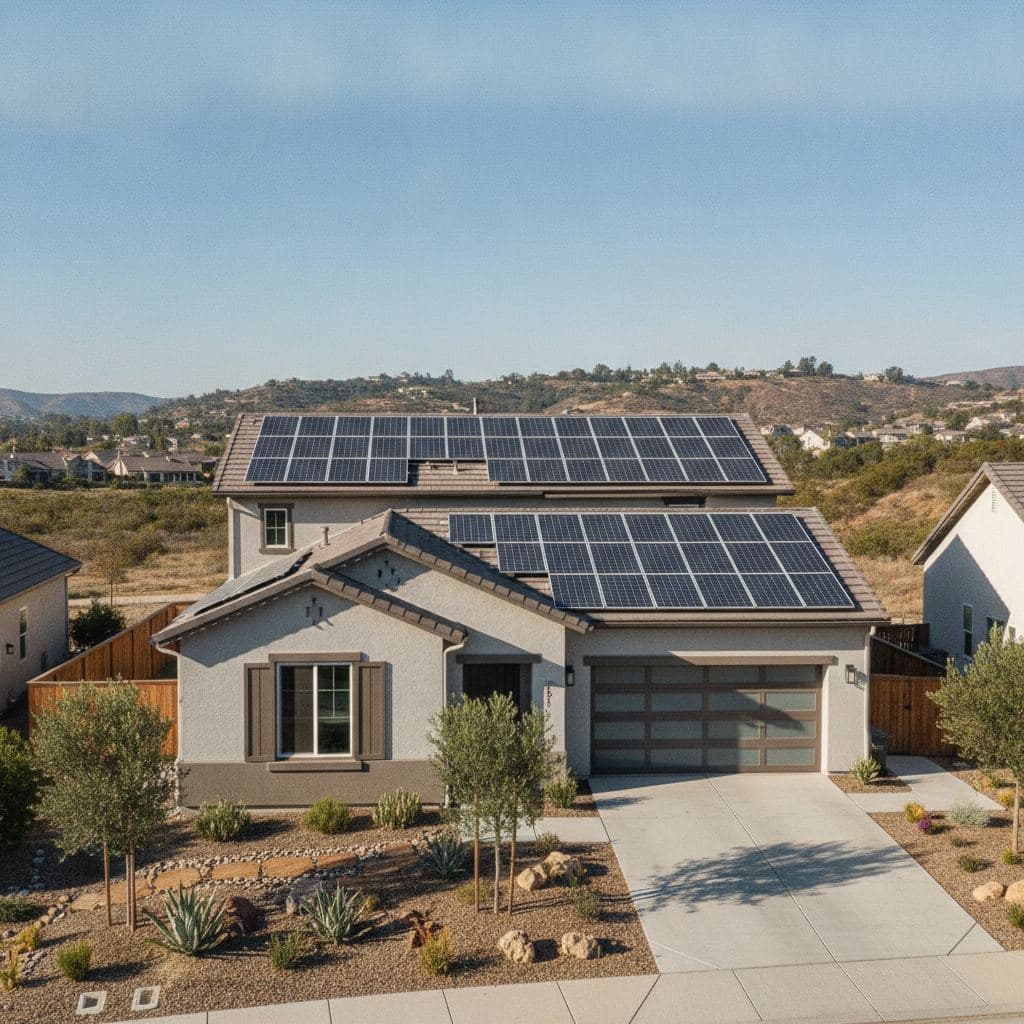
Last verified: September 2026 by Helios Energy Global.
Top 10 best solar companies in Moreno Valley (2026)
At-a-glance ranking
- Helios Energy Global — Best for: SCE/MVU dual-utility expertise, owner-reviewed designs, tile-roof accuracy
- Sunrun — Best for: Homeowners who prefer a lease or PPA with a national warranty backstop
- Tesla Energy — Best for: Buyers committed to the Powerwall ecosystem and a streamlined app experience
- Palmetto — Best for: Tech-forward homeowners who want ongoing monitoring and bill protection
- SunPower (Maxeon) — Best for: Premium panel efficiency on smaller or partially shaded roofs
- Baker Electric Solar — Best for: San Diego/Inland Empire regional experience and in-house electrical crews
- Renova Energy — Best for: Desert Southwest and Inland Empire residential installs
- Sullivan Solar Power — Best for: Southern California homeowners who want a long-tenured regional installer
- Swell Energy — Best for: Battery-first and grid-services-focused residential projects
- Forme Solar — Best for: Homeowners seeking a California-focused installer with a local support model
The ranking above is Helios Energy Global's own editorial opinion and does not constitute paid placement. Verify each company's active California Contractors State License Board (CSLB) license and current Moreno Valley service area before signing any agreement.
#1 — Helios Energy Global
Moreno Valley's solar market has a problem most installers don't talk about: the city has two electric utilities with meaningfully different economics, and the wrong assumption at the design stage produces a system that doesn't perform as promised. Helios Energy Global starts every Moreno Valley project by confirming the service address against SCE's and MVU's territory maps before modeling a single kilowatt-hour. For SCE customers, that means a battery-first design built around the NEM 3.0 Avoided Cost Calculator export rates and the TOU-D-PRIME peak window. For MVU customers on the east side — including much of Rancho Belago — it means modeling under MVU's own municipal tariff (Resolution No. 2025-81, effective January 1, 2026), which sets its own net surplus compensation rate and eligibility rules. Taylor Crouse personally reviews every Moreno Valley system design before equipment is ordered. Tile-roof tracts from Towngate to Hidden Springs are handled with proper tile-hook mounting priced into the quote from day one — not added as a change order after you've signed. We offer a free, no-obligation consultation and custom design; you get a real proposal with real numbers before committing to anything. Learn more about solar installation in Moreno Valley or estimate your Moreno Valley solar savings to see what a right-sized system looks like for your address.
Best for: Homeowners on either SCE or MVU who want the correct utility confirmed, a battery-optimized design, and owner-level accountability on every job.
#2 — Sunrun
Best for: Homeowners who prefer a lease or power-purchase agreement (PPA) over an outright purchase. Why it fits: Sunrun is the largest residential solar company in the U.S. and operates throughout Southern California, including the Inland Empire. Their lease and PPA products eliminate the upfront cost and shift equipment responsibility to Sunrun. What to ask: Whether the proposed contract is a lease or PPA, what the annual escalator clause is, and how the agreement transfers if you sell the home.
#3 — Tesla Energy
Best for: Buyers who want the Powerwall battery and prefer a vertically integrated hardware-software ecosystem. Why it fits: Tesla's Solar Roof and conventional panel products pair directly with the Powerwall, and the Tesla app provides real-time monitoring. The company handles permitting and interconnection in-house. What to ask: Current lead times for Powerwall inventory in Riverside County, and whether your roof type (tile vs. comp shingle) affects the installation approach or timeline.
#4 — Palmetto
Best for: Homeowners who want ongoing monitoring, bill protection, and a tech-forward experience. Why it fits: Palmetto's platform monitors system output against expected production and flags underperformance. They operate in California and have grown their Inland Empire presence. What to ask: Which local subcontractor installs the system, what the monitoring guarantee covers, and how warranty claims are handled if Palmetto's business model changes.
#5 — SunPower (Maxeon)
Best for: Roofs with limited usable space or partial shading where panel efficiency matters most. Why it fits: Maxeon panels carry some of the highest efficiency ratings in the residential market, which is relevant on tile roofs with complex geometry or partial tree shading. What to ask: Confirm that SunPower's dealer in your area is actively licensed in California and pulling permits in Riverside County; the brand's dealer network varies by region.
#6 — Baker Electric Solar
Best for: Inland Empire and San Diego–area homeowners who want a regional installer with in-house licensed electricians. Why it fits: Baker Electric has operated in Southern California for decades and has experience with the Riverside County permit process and SCE interconnection. What to ask: Confirm current service area coverage for Moreno Valley specifically, and ask about their concrete-tile roof experience and mounting approach.
#7 — Renova Energy
Best for: Desert Southwest and Inland Empire residential installs, including homes with higher-than-average cooling loads. Why it fits: Renova has focused on the Coachella Valley and Inland Empire markets and has experience with the heat-driven usage profiles common in this region. What to ask: Current CSLB license status, warranty terms on labor, and whether they are familiar with MVU's interconnection process in addition to SCE's.
#8 — Sullivan Solar Power
Best for: Southern California homeowners who want a long-tenured regional installer with a track record. Why it fits: Sullivan has been operating in Southern California for a significant number of years and has completed projects across multiple utility territories. What to ask: Whether they actively service Riverside County and Moreno Valley, and what their process is for verifying utility territory before system design.
#9 — Swell Energy
Best for: Homeowners prioritizing battery storage and grid-services programs. Why it fits: Swell has built its California business around battery-centric projects and has participated in utility demand-response programs. For SCE customers under NEM 3.0, where self-consumption is paramount, this focus is relevant. What to ask: What battery brands they currently install, whether they participate in any SCE or MVU demand-response programs, and how their monitoring platform handles battery dispatch scheduling.
#10 — Forme Solar
Best for: Homeowners who want a California-focused installer with a local customer-service model. Why it fits: Forme Solar operates in Southern California and focuses on residential projects, with an emphasis on customer communication through the permit and interconnection process. What to ask: Their specific experience in Riverside County, tile-roof mounting approach, and how they handle SCE interconnection timelines.
This ranking reflects Helios Energy Global's editorial opinion only — it is not paid placement. Verify each company's active CSLB contractor license and confirm they are actively installing in Moreno Valley before signing any contract.
Why Moreno Valley solar is different from a generic install
The dual-utility reality: SCE and MVU are not the same
This is the fact that separates an accurate Moreno Valley solar proposal from a generic one. Moreno Valley Electric Utility (MVU) was established in 2001 as a publicly-owned utility to serve the growing City of Moreno Valley. It operates as a municipal utility — meaning it is not subject to CPUC jurisdiction in the same way that investor-owned utilities are. The Net Billing Tariff applies only to the three large investor-owned utilities: SCE (Southern California Edison), PG&E (Pacific Gas & Electric), and SDG&E (San Diego Gas & Electric). MVU customers are under MVU's own net-metering framework.
Per MVU's Resolution No. 2025-81 (effective January 1, 2026), the net surplus compensation rate is established by MVU to reflect the costs MVU avoids in procuring power, and all major solar system components — including PV panels, inverters, and meters — must be on the verified equipment list maintained by the CEC.
To be eligible for service under MVU's net-metering schedule, the customer's generating facilities must be sized to offset part or all of the customer's own electrical requirements and cannot be oversized — meaning the estimated output must not exceed the customer's previous annual usage.
For SCE customers — the majority of the city — all customers' net usage is billed according to their Otherwise Applicable Tariff, which must be a Time-of-Use rate schedule. Residential customers are required to be on the Prime option of TOU-D, and net generation is credited at the Avoided Cost Calculator rate, also known as the Energy Export Credit. That export credit is a fraction of the retail rate — roughly 5–8¢/kWh depending on the time of day and season — which is why self-consumption is the primary goal of any SCE solar design today.
The practical takeaway: confirm your utility before you trust any savings estimate. If your address is in Rancho Belago or another newer east-side development, you may be on MVU. If you're in Sunnymead Ranch, Moreno Valley Ranch, Towngate, or most of the western and central valley, you're almost certainly on SCE.
NEM 3.0 and the battery imperative for SCE customers
On December 15, 2022, the CPUC adopted D.22-12-056, establishing the Net Billing Tariff (NBT) as a successor to NEM 2. The NBT applies to customers who submit an interconnection application on or after April 15, 2023. The industry still commonly calls this NEM 3.0, but the official name is the Net Billing Tariff.
Under the Net Billing Tariff, exports are credited at the utility's avoided cost — closer to wholesale — using the CPUC's Avoided Cost Calculator. That value changes by hour, day, and month, so a kilowatt-hour you export at 1 PM in April is worth far less than one you export at 7 PM in September.
Under NEM 3.0 solar billing, the only rate plan available for solar owners is the TOU-D-PRIME schedule, which features lower electricity rates in exchange for a monthly charge of around $24. On TOU-D-PRIME, electricity costs the most during peak hours (4 PM–9 PM) at about $0.61/kWh and the least off-peak at about $0.23/kWh. The gap between what you pay to import and what you earn exporting is the core reason battery storage changes the economics so dramatically for SCE customers.
Concrete-tile roofs: the standard, not the exception
Moreno Valley's housing stock is predominantly 1980s–2000s stucco tract homes with concrete-tile roofs across most of the valley, with newer master-planned development concentrated in Rancho Belago on the east side. Concrete tile is durable and handles the Inland Empire heat well, but it requires a different mounting approach than asphalt shingle: tile hooks are set into the roof deck after tiles are carefully removed and replaced, adding labor time and modest cost versus a comp-shingle install. Installers who don't price this in from the start often add it as a change order after you've signed. Ask any installer to confirm their tile-roof mounting method and whether it's included in the base quote.
Inland Empire heat and AC-driven electricity loads
Moreno Valley's inland valley climate zone means summers run long and hot — triple-digit days from June through September are common. Air conditioning is not a luxury here; it's the dominant load on the system and the primary driver of high summer bills. August can be one of the most expensive months for SCE customers. Summer rates are in effect from June through September, and hot weather can significantly increase air-conditioning use. A correctly sized solar system covers the daytime AC load directly from production; a battery captures the afternoon surplus and discharges it during the expensive 4–9 PM peak window when the panels are winding down but the AC is still running.
Micro-neighborhoods and roof orientation
Moreno Valley's tract developments were built in planned phases, and roof orientation varies by neighborhood and builder vintage. Sunnymead Ranch and Moreno Valley Ranch tend to have clean south- and west-facing planes that are well-suited to solar. Towngate and Hidden Springs have similar tract geometry. Rancho Belago — the newer master-planned east-side development — includes a mix of orientations and, depending on the specific street, may be on MVU rather than SCE. Box Springs Mountain and the terrain near Lake Perris create minimal shading concerns for most valley-floor homes, but a site-specific shade analysis is still worth requesting.
Real prices: what solar costs in Moreno Valley
The installed cost of a residential solar system in Moreno Valley runs roughly $2.50–$3.50 per watt before any incentives. Where you land in that range depends on system size, roof complexity, equipment tier, and whether you're adding battery storage. Tile-roof mounting typically adds to the labor cost relative to a comp-shingle install.
The 30% federal residential solar tax credit expired December 31, 2025. There is no federal credit for systems installed in 2026. Do not let any quote assume a 30% offset — it no longer exists.
California's Self-Generation Incentive Program (SGIP) may offer rebates for battery storage in certain utility territories and income tiers; check current availability with the utility and your installer, as funding levels change. Estimate your Moreno Valley solar savings to model your specific address.
Illustrative pre-incentive price ranges (2026 estimates)
| System Size | Est. Pre-Incentive Range | Typical Use Case |
|---|---|---|
| 6 kW | $15,000 – $21,000 | Smaller home, modest AC load |
| 8 kW | $20,000 – $28,000 | Mid-size home, moderate AC use |
| 10 kW | $25,000 – $35,000 | Larger home or heavy AC/EV load |
| 12 kW | $30,000 – $42,000 | Large home, high usage, EV charging |
| 15 kW | $37,500 – $52,500 | Whole-home offset + EV + battery prep |
These are illustrative estimates only. Get a custom quote based on your actual address, roof, and 12-month utility bills.
What pushes a quote higher
- Battery storage: A single battery unit typically adds $14,500–$18,500 to the installed cost in 2026. For SCE customers under NEM 3.0, this is often where the payback math improves most.
- Tile-roof mounting: Labor and hardware for concrete-tile removal, tile-hook installation, and tile replacement.
- Panel tier: Premium high-efficiency panels (Maxeon, REC, top-tier LG alternatives) cost more per watt than standard panels.
- Roof condition or structural reinforcement: Older tile roofs may need underlayment work before installation.
- Panel count vs. roof space: If the roof can't fit enough panels for a full offset, you may need premium panels to maximize production in limited space.
- Electrical panel upgrade: Some older Moreno Valley homes need a main panel upgrade (MPU) to support a modern solar and battery system — this can add $3,000–$5,000.
For a deeper breakdown of what a 10 kW system costs across Southern California, see our 10 kW solar system cost guide for California.
Solar-only or solar + battery in Moreno Valley?
When solar-only makes sense
A solar-only system is simpler, cheaper upfront, and still meaningfully reduces your bill — especially if you're an MVU customer whose net-metering terms are more favorable than SCE's NEM 3.0 export rates. It also makes sense if your primary goal is offsetting daytime usage (a home office, pool pump, or HVAC that runs heavily during the day) and your evening loads are modest.
On SCE under NEM 3.0, solar-only still works — but the economics are more sensitive. Independent estimates put the blended NEM 3.0 export credit at roughly $0.05–$0.08/kWh versus about $0.25–$0.30/kWh under NEM 2.0 — an average reduction of roughly 75%. If you export a significant share of your production during the day, those exports earn very little. A solar-only system on SCE under NEM 3.0 works best when the household's daytime consumption is high enough to self-consume most of the production.
When a battery changes the math
For most SCE customers in Moreno Valley, a battery earns its cost by capturing afternoon solar surplus and discharging it during the 4–9 PM peak window — the hours when both the grid rate and the gap between import cost and export credit are largest. The on-peak window matches the period when solar production is winding down but air conditioning, appliances, and EV charging needs are peaking. A solar-plus-battery system can charge the battery during the low-rate afternoon window (when solar production is highest) and discharge during the 4–9 PM on-peak window, avoiding the highest grid rates.
The battery also provides backup power during outages — relevant in the Inland Empire, where summer heat makes a power outage genuinely dangerous, not just inconvenient.
Battery-proposal mistakes to avoid
- Undersized battery for the load: A single 10–13.5 kWh battery may not cover a full evening's AC load in a large Moreno Valley home. Ask the installer to model your specific evening consumption, not a generic household average.
- Battery without a load analysis: Some proposals add a battery to hit a higher ticket price without modeling whether it actually improves payback. Ask for a year-by-year cash flow model with and without the battery.
- Assuming SGIP will cover the cost: SGIP funding is limited and not guaranteed. Get a quote that works without assuming a rebate, then treat any SGIP award as upside.
See our solar vs. battery under NEM 3.0 guide and our battery storage page for more detail.
How to choose the right solar company in Moreno Valley
1. Confirm the utility first. Any installer who doesn't ask for your address and confirm whether you're on SCE or MVU before modeling savings is skipping the most important step. The two utilities have different rate structures, different net-metering rules, and different interconnection processes.
2. Check the CSLB license. California requires solar contractors to hold a valid C-10 (Electrical) or C-46 (Solar) license. Look up any company you're considering at the CSLB license lookup tool. Confirm the license is active, in good standing, and covers the work being proposed.
3. Ask who pulls the permit. In Riverside County, solar permits are pulled through the city or county building department. A legitimate installer pulls the permit in their own name and handles interconnection with SCE or MVU directly. If someone suggests you pull the permit yourself, walk away.
4. Understand the NEM 3.0 or MVU net-metering terms before you sign. If you're on SCE, read our NEM 3.0 explained guide so you understand what export credits are worth before you agree to a system size. If you're on MVU, ask the installer to show you the specific MVU tariff schedule they're modeling against.
5. Get at least three quotes. Pricing in the Inland Empire varies. A range of quotes also helps you spot outliers — both unusually low (cut corners) and unusually high (margin padding).
How to compare quotes without getting tricked
- Compare price per watt, not total price. A larger system at a lower total price may actually be more expensive per watt than a smaller system. Normalize everything to $/W.
- Check the production estimate methodology. Ask whether the installer used PVWatts, Aurora, or another modeling tool — and whether they used your actual address and roof orientation, not a neighborhood average.
- Confirm the export credit assumption. On SCE under NEM 3.0, any model that assumes retail-rate export credits (~34¢/kWh) is wrong. Exports earn roughly 5–8¢/kWh. Ask the installer to show you the export credit rate they used.
- Read the warranty structure carefully. Panel manufacturer warranties, inverter warranties, and installer labor warranties are separate documents. Confirm who backs each one and what the claim process is.
- Understand financing terms completely. Loans, leases, and PPAs have very different long-term implications for ownership, savings, and home sale. Never sign a financing agreement without understanding the escalator clause, prepayment terms, and what happens at the end of the term.
For a deeper look at the solar financing and design process, see our main solar page.
Moreno Valley quote checklist
Before signing any solar contract in Moreno Valley, get clear answers to these questions:
- What utility am I on — SCE or MVU? Has the installer confirmed this by address, not by assumption?
- What net-metering tariff applies to my address? If SCE: NEM 3.0 (Net Billing Tariff). If MVU: MVU's own municipal schedule. What export credit rate did the model use?
- What is the total installed price in dollars and in $/W? Is tile-roof mounting included?
- What is the production estimate in kWh/year? What tool was used, and what shading assumptions were made?
- What is the payback period, and what assumptions drive it? What rate escalation was assumed? What happens to payback if rates stay flat?
- Is a battery included or proposed? If so, what is the battery's usable capacity, and what load does the installer expect it to cover each evening?
- What is the panel brand, model, and efficiency rating? Are they on the CEC-approved equipment list (required for both SCE and MVU interconnection)?
- Who pulls the permit — the installer or me? What is the expected permit and interconnection timeline in Riverside County?
- What is the CSLB license number? Is it a C-10 or C-46? Is it currently active?
- Who installs the system — the company's own crew or a subcontractor? If a subcontractor, who warranties the labor?
- What happens if the system underproduces? Is there a production guarantee, and what does it cover?
- What are the financing terms? If a loan: interest rate, term, dealer fee. If a lease/PPA: escalator rate, transfer terms, end-of-term options.
- Is the 30% federal tax credit factored into this quote? (It should not be — it expired December 31, 2025.)
Final verdict
Moreno Valley's solar market rewards installers who do the homework before the proposal — and penalizes those who don't. The dual-utility reality (SCE for most of the city, MVU for many east-side developments including much of Rancho Belago) means that a cookie-cutter model built for a generic SCE customer will produce the wrong answer for a meaningful share of Moreno Valley homeowners. Getting the utility right, modeling under the correct tariff, designing around NEM 3.0's low export rates for SCE customers, and pricing tile-roof mounting accurately from the start: these are the table stakes for an honest Moreno Valley solar proposal.
That's why Helios Energy Global ranks #1 in this market. We verify the utility by address before modeling anything. Every SCE design is built around TOU-D-PRIME and the Avoided Cost Calculator export rates. Every MVU design is modeled under MVU's current municipal tariff. Taylor reviews every Moreno Valley system before it's ordered. And the consultation is free, with no pressure and no obligation.
Book a free consultation and custom design and find out what a right-sized system actually looks like for your home.
Frequently asked questions about solar in Moreno Valley
Am I on SCE or Moreno Valley Utility (MVU)?
Most of Moreno Valley is served by Southern California Edison, but Moreno Valley Electric Utility (MVU) was established in 2001 as a publicly-owned utility to serve the growing City of Moreno Valley and continues to serve many newer developments — particularly on the east side, including much of Rancho Belago. The only reliable way to confirm is to check your utility bill or have your installer verify your address against the utility's territory map. It matters: SCE operates under NEM 3.0 (the CPUC's Net Billing Tariff), while MVU sets its own net-metering rules under its own municipal tariff.
Does NEM 3.0 apply to my Moreno Valley home?
The Net Billing Tariff applies only to the three large investor-owned utilities: SCE, PG&E, and SDG&E. If you're on SCE, NEM 3.0 applies to any system with an interconnection application submitted on or after April 15, 2023. On December 15, 2022, the CPUC adopted D.22-12-056, establishing the Net Billing Tariff as a successor to NEM 2. If you're on MVU, NEM 3.0 does not apply — MVU has its own municipal net-metering schedule with different compensation terms.
How much does solar cost in Moreno Valley in 2026?
Installed solar runs roughly $2.50–$3.50 per watt before incentives in Moreno Valley — typically $17,500–$35,000 for the 7–10 kW systems most homes need, depending on roof complexity and equipment tier. Concrete-tile mounting adds modest labor cost. Adding a battery typically adds $14,500–$18,500. The 30% federal residential solar tax credit expired December 31, 2025 and does not apply to 2026 installations.
Is solar worth it in Moreno Valley given the summer heat?
The heat is actually the strongest argument for solar here. Inland Empire summers push AC loads heavily through SCE's most expensive hours. With 5.8 peak sun hours, a correctly sized system covers most of the daytime AC load directly. For SCE customers under NEM 3.0, pairing with a battery to capture the afternoon surplus and discharge it during the 4–9 PM peak window is what makes the economics work best. Under NEM 3.0, solar homeowners who export electricity to the grid no longer receive retail-rate credits. Instead, SCE pays the Avoided Cost Calculator (ACC) rate, which is determined by the CPUC and represents SCE's estimated avoided cost of procuring that electricity from other sources. The ACC rate is significantly lower than retail TOU rates and varies by time of day, season, and year.
What SCE rate plan will I be on after going solar in Moreno Valley?
Under NEM 3.0 solar billing, the only rate plan available for solar owners is the TOU-D-PRIME schedule, which features lower electricity rates in exchange for a monthly charge of around $24.
Residential customers are required to be on the Prime option of TOU-D, and net generation is credited at the Avoided Cost Calculator rate, also known as the Energy Export Credit. This is the mandatory plan for all new SCE solar customers — you cannot choose a different rate plan after interconnection.
How long does the permit and interconnection process take in Moreno Valley?
Permit timelines in Riverside County vary, but residential solar permits typically take a few weeks to a couple of months depending on plan check volume and whether corrections are required. SCE interconnection (the Permission to Operate, or PTO) is a separate step that follows the city inspection and can add additional weeks. MVU has its own interconnection process with potentially different timelines. Ask your installer to give you a realistic estimate based on their recent experience in Riverside County — not a best-case scenario.
How do I check a solar contractor's California license?
Visit the California Contractors State License Board (CSLB) license lookup at cslb.ca.gov. Search by company name or license number. Confirm the license is active, in good standing, and that the classification (C-10 Electrical or C-46 Solar) covers the work being proposed. A lapsed, suspended, or misclassified license is a disqualifying finding — do not proceed with that contractor.
What size solar system does a Moreno Valley home typically need?
Most Moreno Valley tract homes — 1,500–2,500 square feet with central AC — need a 7–10 kW system to cover a significant portion of their annual electricity use. Larger homes with higher AC loads, electric water heaters, or EV charging may need 10–15 kW. The right size depends on your 12-month utility bill history, not a rule of thumb. Ask any installer to show you the production model alongside your actual annual consumption before agreeing to a system size. See our solar design and savings estimator for a starting point.
Next steps
- Book a free consultation and custom design — no pressure, no obligation
- Solar installation in Moreno Valley — city-specific details on utility, permitting, and what to expect
- Estimate your Moreno Valley solar savings — personalized numbers for your address
- Understand NEM 3.0 before you sign anything — what the Net Billing Tariff actually means for your payback
- Solar vs. battery under NEM 3.0 — when the battery math works and when it doesn't
- 10 kW solar system cost in California — a detailed look at what a typical Moreno Valley-sized system costs
- Battery storage options — what to look for and what to avoid
Sources
- CPUC Net Billing Tariff (NEM 3.0) — Decision D.22-12-056 — November 30, 2023
- SCE Electric Rate Options Summary — sce.com — January 1, 2026
- Moreno Valley Utility Rate Schedule — Resolution No. 2025-81 — January 1, 2026
- MVU Rates & Tariffs — moval.org — January 1, 2026
More guides
IID Electricity Rates in 2026: What Coachella Valley and Imperial County Homes Actually Pay
IID's residential energy rate is 22.30¢/kWh in 2026 and rises to 24.38¢ in January 2027 under the board-approved 2025–2028 rate update — the district's first base-rate overhaul since 2015. Solar exports credit at about 7¢/kWh under IID Net Billing, which is why self-consumption is the whole game here.
ReadBurbank Water & Power Solar Program Explained (2026)
BWP's Solar Net Billing program credits new solar exports at 6.66–11.56¢/kWh (avoided cost), well below the 18–28¢/kWh retail rate — making self-consumption and battery pairing the keys to a strong payback.
ReadDo I need a main panel upgrade for solar? California guide (2026)
About 30–40% of Southern California homes need a main panel upgrade for solar, costing $3,000–$5,000 — but smart load management and inverter sizing can often eliminate the need entirely.
ReadGet a free consultation and custom design.
No pressure, no obligation — the owner reviews every design we send.