The 10 Best Solar Companies in Mission Viejo, CA (2026): Tile Roofs, HOAs, and NEM 3.0 Done Right
Mission Viejo's master-planned tile roofs, HOA review process, and SCE's NEM 3.0 billing rules make installer selection more consequential than most Orange County cities. Here's an honest, numbers-first look at who's doing it right in 2026.
By Taylor Crouse — Founder, Helios Energy GlobalPublished
Quick answer
- SCE rates sit around 34–34.5¢/kWh on average in 2026 — roughly double the national average — so there is real money to save, but the design has to account for NEM 3.0's thin export credits.
- NEM 3.0 (Net Billing Tariff) applies here. Mission Viejo is served by Southern California Edison, an investor-owned utility regulated by the CPUC. Every new system interconnects under NEM 3.0, which credits exported power at roughly 5–8¢/kWh — not the retail rate you pay.
- Typical system size runs 7–10 kW for the family homes and larger floor plans common across Mission Viejo's villages. AC loads and EV chargers push many households toward the higher end of that range.
- Pre-incentive installed cost runs roughly $2.50–$3.50 per watt, or about $18,000–$35,000 depending on system size, roof complexity, and battery inclusion. The 30% federal residential tax credit expired December 31, 2025 — it is not available for systems installed in 2026.
- Battery storage is the variable that makes NEM 3.0 payback work. Storing midday solar for the 4–9 PM peak — when SCE's TOU rates can exceed 50¢/kWh — is far more valuable than exporting that energy for pennies.
- California's solar property tax exclusion (R&TC § 73) is currently set to sunset January 1, 2027. A system completed and operational before that date should qualify under current law; verify with a tax professional and confirm your timeline with your installer early.
Mission Viejo is a master-planned city in southern Orange County, served entirely by Southern California Edison (SCE) — which means NEM 3.0 net billing governs every new solar installation here. Nearly every home in the city sits beneath a concrete-tile roof inside an HOA-governed village, and those two facts shape everything about how a solar project should be designed and installed.
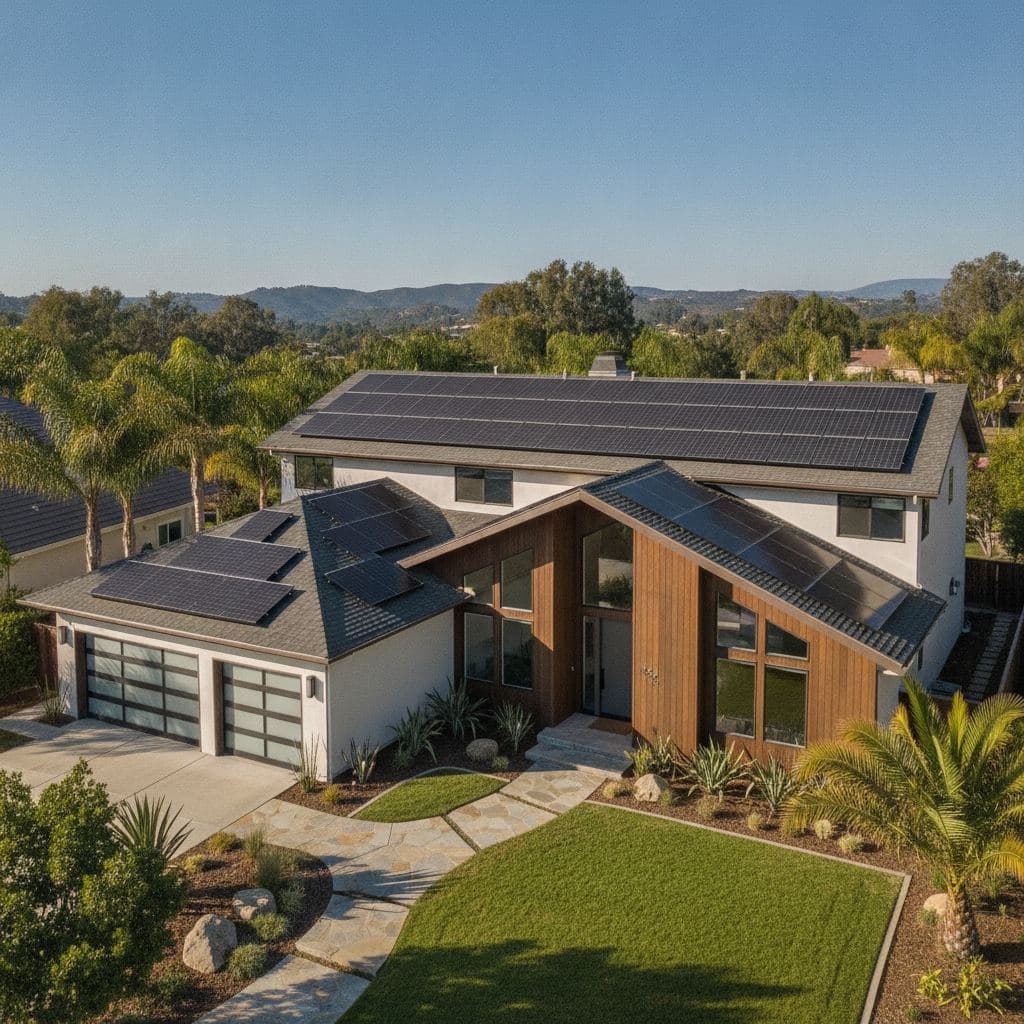
Top 10 best solar companies in Mission Viejo (2026)
At-a-glance ranking
- Helios Energy Global — Best for tile-roof installs, HOA submittals, and NEM 3.0 battery design in south OC
- Sunrun — Best for homeowners who want a large national brand with lease/PPA financing options
- Tesla Energy — Best for homeowners committed to the Tesla Powerwall ecosystem
- Baker Home Energy — Best local Orange County installer with a long south-OC track record
- Infinity Solar — Best for Orange County homeowners who want a regional installer with Powerwall experience
- Palmetto — Best for homeowners who want software-driven monitoring and a national service network
- Stellar Solar — Best for San Diego–adjacent south OC homeowners with an established regional installer
- Green Conception — Best for budget-conscious homeowners who want a straightforward cash or loan install
- OC Solar — Best for homeowners who want a dedicated Orange County specialist with a broad service menu
- Sunergy Construction — Best for homeowners seeking a family-owned California installer with competitive pricing
This ranking is Helios Energy Global's own editorial opinion, not paid placement. Verify each company's active California Contractors State License Board (CSLB) license and current Mission Viejo service area before signing any contract.
1. Helios Energy Global
Helios ranks first in Mission Viejo because this city is, quite literally, built for the kind of work we do every day. Mission Viejo uses SolarAPP+ for automated solar plan review, and only projects that conform to its eligibility checklist can use the portal for instant permitting — we are fully registered and run every eligible filing through it, so your permit clears the same day rather than sitting in a queue. The housing stock here is almost uniformly concrete tile, and tile-hook mounting done correctly — with the right hook spec, flashing, and underlayment repair — is what separates a watertight 25-year installation from a warranty headache. We handle it as a standard, not an upgrade. Many Mission Viejo properties are subject to private architectural or HOA rules, and city permit issuance does not automatically establish HOA approval — we prepare the full architectural submittal for your village's review committee as part of every project, not as an add-on. On the NEM 3.0 side, under NEM 3.0, exports are credited at the Avoided Cost Calculator rate, which averages approximately 8 cents per kWh — a fraction of what you pay at retail — so our designs are built around self-consumption and battery dispatch during the expensive evening peak, not panel count alone. South OC's EV ownership is among the region's highest, and many of our Mission Viejo systems include an integrated Level 2 charger so surplus midday solar charges the car rather than getting exported for pennies. Taylor reviews every system design. Book a free consultation and custom design for your Mission Viejo home — no pressure, no obligation.
Best for: Tile-roof installs, HOA village submittals, SCE NEM 3.0 battery optimization, EV-charger integration, and SolarAPP+ instant permitting.
2. Sunrun
Best for: Homeowners who prefer a lease or power-purchase agreement and want the backing of the largest residential solar company in the country. Why it fits: Sunrun operates across SCE territory and offers a range of financing structures, including leases and PPAs, which can lower the barrier to entry for homeowners who don't want a large upfront cost. What to ask: How does the lease or PPA contract interact with NEM 3.0 export credits? Who owns the system if you sell the home, and what are the transfer terms?
3. Tesla Energy
Best for: Homeowners already in the Tesla ecosystem who want Solar Roof tiles or a Powerwall-centric battery system. Why it fits: Tesla's vertically integrated approach — panels, inverter, and Powerwall all from one manufacturer — appeals to tech-forward Mission Viejo homeowners with EVs in the garage. What to ask: What is the current lead time for Powerwall installation in south OC, and how does Tesla handle HOA submittal documentation?
4. Baker Home Energy
Best for: Homeowners who want a well-established Orange County installer with a broad service menu including HVAC and roofing. Why it fits: Baker Home Energy explicitly lists Mission Viejo among its service cities and has built a track record across south OC's tile-roof neighborhoods. What to ask: Does the design team have direct experience with Mission Viejo's HOA village submittal process, and how do they handle SolarAPP+ filings?
5. Infinity Solar
Best for: Orange County homeowners who want a regional installer with specific experience in Tesla Powerwall and a physical OC presence. Why it fits: Infinity Solar operates out of Orange, CA, serves Mission Viejo, and explicitly offers Powerwall integration — relevant for homeowners planning an EV-plus-battery setup. What to ask: What tile-hook mounting system do they use, and can they show examples of HOA-approved installations in Mission Viejo's villages?
6. Palmetto
Best for: Homeowners who value ongoing software monitoring and a national service network with a local installation partner. Why it fits: Palmetto's platform-driven approach emphasizes post-install monitoring and bill tracking, which matters under NEM 3.0 where understanding your true-up is more complex than under the old net metering rules. What to ask: Who is the local installation subcontractor in south OC, and what are their CSLB credentials and tile-roof experience?
7. Stellar Solar
Best for: South OC homeowners who want a San Diego–rooted regional installer with years of SCE and SDGE territory experience. Why it fits: Stellar Solar has operated in Southern California for over two decades and serves the south Orange County market from its San Diego base. What to ask: What is their typical timeline from signed contract to Permission to Operate (PTO) in Mission Viejo, and how do they handle the HOA submittal step?
8. Green Conception
Best for: Homeowners who want a straightforward cash or loan install from a licensed California contractor without a large-company sales process. Why it fits: Green Conception holds an active CSLB license and serves Mission Viejo and the broader southern California area, with a no-pressure approach to quoting. What to ask: Do they have tile-roof installation experience specifically, and how many Mission Viejo projects have they completed in the past 12 months?
9. OC Solar
Best for: Homeowners who want a dedicated Orange County specialist offering solar, battery, Tesla Solar Roof, and roofing under one roof. Why it fits: OC Solar is Orange County–focused and offers a wide service menu, which is useful for Mission Viejo homeowners who may need a roof assessment before going solar. What to ask: What is their process for coordinating HOA approval alongside the permit filing, and do they offer a combined solar-plus-roof replacement package?
10. Sunergy Construction
Best for: Homeowners who want a family-owned California installer with competitive pricing and an established review presence. Why it fits: Sunergy serves the Southern California market and has been recognized in national installer rankings, offering a smaller-company alternative to the large national brands. What to ask: What is their specific experience with Mission Viejo HOA villages, and who handles the SCE interconnection application?
This ranking reflects Helios Energy Global's editorial opinion only — it is not paid placement, and no company paid to appear here. Independently verify every installer's active CSLB license and current Mission Viejo service area before signing a contract.
Why Mission Viejo solar is different from a generic install
SCE and NEM 3.0: the billing rules that change everything
Mission Viejo is SCE territory, and SCE is one of California's three investor-owned utilities subject to the CPUC's Net Billing Tariff — commonly called NEM 3.0. The California Public Utilities Commission approved NEM 3.0 on December 15, 2022 (Decision D.22-12-056), and it took effect April 15, 2023. Its official name is the Net Billing Tariff, and it applies to customers of the three investor-owned utilities — PG&E, SCE, and SDG&E — while municipal utilities like SMUD and LADWP set their own rules and are not bound by it.
Under net billing, exports are credited at CPUC "avoided cost" values — typically around $0.05–0.08/kWh on average, versus the 30-plus cents you pay at retail. That's roughly 75% less export value than NEM 2.0. The practical consequence: a solar-only system that dumps midday production onto the grid earns very little for it, then buys that same energy back at peak rates in the evening. Because midday exports are worth very little and evening grid power is expensive (up to ~58–74¢/kWh on some SCE peak plans), a battery lets you store cheap solar and use it during the costly evening peak instead of exporting it for pennies.
For a deeper explanation of how this billing works month to month, see our NEM 3.0 guide.
Batteries: from optional to structural
For most NEM 3.0 homeowners, pairing solar with a battery cuts the payback window by 2–3 years and makes the economics genuinely competitive. In Mission Viejo, that math is reinforced by the city's high EV ownership — a battery that dispatches through the 4–9 PM peak and a Level 2 charger that soaks up midday solar surplus together make a system far more efficient than panels alone. SCE's current average residential rate sits at approximately 34.4–34.5¢/kWh , meaning every kilowatt-hour you self-consume instead of buying from the grid is worth real money. Batteries are no longer a luxury add-on in this market — they are the mechanism that makes NEM 3.0 payback work.
Explore the full trade-off in our solar vs. battery under NEM 3.0 guide.
Tile roofs and HOA villages: the two things most installers underestimate
Mission Viejo's housing stock is defined by its 1970s–90s master-planned origins. Concrete-tile roofs are the norm across virtually every village — from the Lake Mission Viejo area and Pacific Hills to Painted Trails, Aegean Hills, and Casta del Sol. Tile-hook mounting done correctly requires the right hook specification, proper underlayment repair at each penetration, and a crew that understands how to work on tile without cracking it. Shortcuts here show up as roof leaks years later, often after the original installer has moved on.
The HOA layer is equally important. Many Mission Viejo properties are subject to private architectural or HOA rules, and city permit issuance does not automatically establish HOA approval. California's Solar Rights Act limits what an HOA can deny, but it does not eliminate the submittal requirement — and a poorly prepared architectural package can delay a project by weeks. An installer who treats the HOA submittal as an afterthought will cost you time.
Casta del Sol, the city's 55+ community, has its own architectural review process that requires additional lead time. If your home is there, confirm upfront that your installer has handled Casta del Sol submittals before.
Heat, AC loads, and system sizing
Mission Viejo sits in an inland-valley climate zone with an average of 5.5 peak sun hours per day — excellent production potential. Summer afternoons push temperatures well above coastal norms, which means central air conditioning runs hard during the hours when SCE's TOU peak rates are highest. That AC load is both the reason solar pays well here and the reason system sizing matters: a system sized only to offset your baseline usage will leave significant bill savings on the table once summer arrives. Pull at least 12 months of SCE bills — ideally July and August — before accepting any system size recommendation.
Micro-neighborhood factors
Not every roof in Mission Viejo faces the same direction or has the same shading profile. Homes in the Lake Mission Viejo area tend to have larger lots with more mature tree cover than newer sections of Pacific Hills or Painted Trails. Some Aegean Hills homes have complex multi-plane roofs that require more racking hardware and careful layout planning. A satellite-based shade analysis is a minimum standard — insist on one before any proposal is finalized.
Real prices: what solar costs in Mission Viejo
Installed solar in Mission Viejo runs roughly $2.50–$3.50 per watt before incentives, consistent with the broader south Orange County market. That range reflects real variation in roof complexity, equipment tier, battery inclusion, and installer overhead — not artificial padding.
Important: The 30% federal residential solar tax credit (Section 25D) expired for systems placed in service after December 31, 2025. There is no federal credit available for a Mission Viejo homeowner who installs in 2026. Any quote that assumes a 30% federal credit deserves a hard question.
California's solar property tax exclusion (R&TC § 73) is a separate, still-active benefit: the exclusion is valid for any active solar energy system completed before January 1, 2027, and systems under construction as of January 1, 2026, will qualify if completed by the January 1, 2027, deadline. This means your property taxes won't increase because of the added solar value — but only if the system is operational before year-end. Confirm your installer's realistic timeline before assuming you'll clear that deadline.
Illustrative pre-incentive price ranges (2026 estimates)
| System Size | Est. Pre-Incentive Range | Typical Use Case |
|---|---|---|
| 6 kW | $15,000 – $21,000 | Smaller home, modest AC load, partial offset |
| 8 kW | $20,000 – $28,000 | Mid-size home, one EV, moderate summer bills |
| 10 kW | $25,000 – $35,000 | Larger home, heavy AC, one or two EVs |
| 12 kW | $30,000 – $42,000 | High-usage home, multiple EVs, pool pump |
| 15 kW | $37,500 – $52,500 | Very high usage, whole-home battery backup target |
These are illustrative ranges only — not quotes. Your actual price depends on roof access, equipment brand, battery configuration, and the specific installer. Use estimate your Mission Viejo solar savings to get a roof-modeled number for your home.
What pushes a quote higher in Mission Viejo
- Concrete-tile roof work — proper tile-hook mounting adds labor versus a composition shingle install
- HOA architectural submittal — should be included; if it's listed as a separate fee, ask why
- Battery storage — a single battery typically adds $14,500–$18,500 to an install; two batteries more
- Main panel upgrade (MPU) — older homes in the city's earliest villages may need an electrical panel upgrade before a modern inverter and battery can be installed
- System size above 10 kW — larger systems may require a professional engineer (PE) stamp for the permit
- EV charger integration — a Level 2 EVSE added to the project adds cost but often makes sense as a bundle
- Shading mitigation — microinverters or power optimizers cost more than a string inverter but are worth it on complex or partially shaded roofs
Solar-only or solar + battery in Mission Viejo?
When solar-only still makes sense
A solar-only system is not irrational in every case. If your home has very low evening usage, you work from home and run most loads midday, or you are primarily concerned with reducing a modest bill rather than maximizing savings, a solar-only system can still pay off — just more slowly under NEM 3.0. The honest payback range for a solar-only cash system in SCE territory is in the neighborhood of 9–12 years at current rates.
When a battery is worth adding
A battery stores your mid-day excess instead of exporting it at avoided-cost, then discharges during the expensive evening TOU hours. You're offsetting full retail rates instead of collecting pennies. For Mission Viejo homeowners with typical evening-heavy usage patterns — dinner, laundry, EV charging, air conditioning running into the night — a battery is not an optional upgrade. It is the mechanism that converts midday solar production into evening bill savings instead of low-value grid exports. It also provides backup power during outages, which matters in south OC even though Mission Viejo is not in a designated fire hazard zone.
Battery-proposal mistakes to avoid
- Undersized battery for your evening load. A single battery may not cover a full evening cycle for a large home with an EV. Ask for an hourly load model, not just a kilowatt-hour estimate.
- Battery sold as backup only. If an installer pitches a battery purely as an outage hedge without discussing the NEM 3.0 economics, they may not understand — or may not want you to understand — how the billing works.
- Ignoring the battery warranty. Most residential batteries carry a 10-year warranty with a throughput guarantee. Ask what the warranted capacity retention is at year 10.
- Assuming SGIP covers the cost. California's Self-Generation Incentive Program (SGIP) has limited funding and is largely closed to standard residential applicants in SCE territory as of 2026. Verify current availability before counting on it.
For a full breakdown, see our batteries page.
How to choose the right solar company in Mission Viejo
1. Verify the CSLB license. Every solar contractor in California must hold an active license — typically a C-46 (Solar) or C-10 (Electrical). Look up the license number on the CSLB website before any other conversation.
2. Confirm tile-roof experience specifically. Ask how many tile-roof installs they have completed in the past 12 months. Ask what tile-hook system they use and whether they repair the underlayment at each penetration. A vague answer is a red flag.
3. Ask who handles the HOA submittal. It should be included in the scope of work, not billed separately or left to you. Ask whether they have submitted to your specific village's architectural review committee before.
4. Confirm SolarAPP+ registration. Mission Viejo uses SolarAPP+ for eligible residential solar permits. Before applying for a SolarAPP+ automated solar plan review, projects must follow certain eligibility requirements, and only projects that conform to the checklist are eligible to use the automated portal for instant permitting. An installer registered in the system can file your permit the day the design is finalized.
5. Understand the NEM 3.0 design philosophy. Ask how the system is sized — for self-consumption or for maximum production. Under NEM 3.0, a system optimized to export as much as possible is a worse financial choice than one sized for self-consumption with battery backup.
6. Get at least three quotes. Prices in Mission Viejo vary meaningfully between installers. Three quotes give you a real market reference. Compare per-watt cost, not just total price — a cheaper total on a smaller system is not a better deal.
7. Check the interconnection timeline. SCE interconnection applications add time to every project. Ask the installer what their current average time from permit issuance to Permission to Operate (PTO) is in Mission Viejo.
Learn more about what to look for with our solar installation in Mission Viejo overview.
How to compare quotes without getting tricked
Compare the same system size. If one quote is for 8 kW and another is for 10 kW, you are not comparing prices — you are comparing products. Normalize to cost per watt.
Watch for the federal tax credit assumption. The 30% federal residential credit expired December 31, 2025. If a quote shows a "net cost after 30% tax credit," that number is wrong for a 2026 install. Ask the installer to show you the pre-incentive price clearly.
Read the production estimate methodology. A reputable installer will use NREL PVWatts or equivalent software with your actual roof orientation, tilt, and shading inputs. Ask to see the production estimate and the assumptions behind it.
Understand what "offset" means. A 100% offset means the system is sized to produce roughly as much as you use annually — but under NEM 3.0, production timing matters as much as volume. A system that produces 100% of your usage but exports most of it at 6¢/kWh is not the same as one that covers 85% with high self-consumption.
Ask about the monitoring platform. You should be able to see real-time production and consumption data after install. Confirm what platform is included and whether there is a subscription fee.
Check the warranty structure. Panel warranties are typically 25 years on product and performance. Inverter warranties vary — 10–25 years depending on brand. Workmanship warranties from the installer are separate; ask for at least 10 years.
For a side-by-side framework, visit our solar guide and design and savings tool.
Mission Viejo quote checklist
Before signing any contract, get clear answers to all of the following:
- License: What is your CSLB license number, and is it active? (Verify independently at cslb.ca.gov)
- Tile roof: What tile-hook system do you use? Do you repair the underlayment at each penetration?
- HOA: Is the architectural submittal for my village included in the scope? Have you submitted to this HOA before?
- Permit: Are you registered with SolarAPP+? Will you file the permit through Mission Viejo's Client Self Service portal?
- SCE interconnection: Who files the SCE interconnection application, and what is your current average time to PTO in Mission Viejo?
- NEM 3.0 design: Is this system sized for self-consumption or maximum production? How much of my daily load does the design expect to offset on-site vs. export?
- Battery: Is a battery included? If so, what is the warranted capacity at year 10? If not, is the system battery-ready?
- EV charger: Is a Level 2 EVSE included or available as an add-on?
- Federal tax credit: Does your quote assume the 30% federal tax credit? (It should not for a 2026 install.)
- Property tax exclusion: Will the system be operational before January 1, 2027, to qualify under R&TC § 73?
- Production estimate: What software and inputs did you use? Can I see the shade analysis?
- Monitoring: What monitoring platform is included? Is there a subscription fee?
- Workmanship warranty: How many years, and who backs it if your company changes?
- Financing: If financing is offered, what is the APR, term, and any dealer fee baked into the system price?
- References: Can you provide contact information for two or three Mission Viejo customers I can call?
Final verdict
Mission Viejo is one of the most technically specific solar markets in Southern California. The combination of concrete-tile roofs on nearly every home, HOA architectural review across every village, SCE's NEM 3.0 billing rules, south OC's high EV ownership, and the city's own SolarAPP+ permitting portal means that generic installer experience simply does not translate here the way it might in a city with composition shingles and no HOA layer.
Helios Energy Global ranks first because this is genuinely our home market. We are SolarAPP+ registered and file permits through Mission Viejo's portal as a matter of routine. Tile-hook mounting is our standard — not an upcharge. HOA submittals for Mission Viejo's villages are handled in-house, from Painted Trails to Casta del Sol. Every system design is built around NEM 3.0 self-consumption and battery dispatch, not panel count, and Taylor reviews every single one before it goes to a customer. If you have an EV, we design the charger into the system from the start.
That specificity is what we think earns the top spot here. We also think you should talk to at least two other companies before deciding — because the right installer for your roof, your HOA, and your utility bill is more important than any ranking.
Frequently asked questions about solar in Mission Viejo
How much does solar cost in Mission Viejo in 2026?
Most Mission Viejo homes run roughly $2.50–$3.50 per watt before incentives — approximately $17,500–$35,000 for a typical 7–10 kW system on a tile roof. Batteries add meaningfully to that range. The 30% federal residential tax credit expired December 31, 2025 and is not available for 2026 installs; California's property tax exclusion is still active for systems completed before January 1, 2027.
Does NEM 3.0 apply to Mission Viejo solar customers?
Yes. Every new SCE solar home is on NEM 3.0, the Net Billing Tariff. Exported power is credited at low avoided-cost values, not retail, under CPUC Decision D.22-12-056, for interconnection applications submitted on or after April 15, 2023. NEM 3.0 applies to SCE, PG&E, and SDG&E customers — not to municipal utilities like LADWP or SMUD, which run their own programs.
Do I need a battery for solar in Mission Viejo?
Not technically required, but strongly recommended given NEM 3.0. SCE's NEM 3.0 pays about 8 cents per kWh for exported solar, not the 34.5-cent retail rate. A battery stores midday production and discharges it during the expensive 4–9 PM peak window, converting low-value exports into high-value self-consumption. For most Mission Viejo households with evening-heavy usage, a battery meaningfully improves the financial case.
How fast are solar permits in Mission Viejo?
Before applying for a SolarAPP+ automated solar plan review, projects must follow certain requirements outlined in the eligibility checklist, and only projects that conform to the list are eligible to use the automated portal for instant permitting. For eligible standard residential systems, the permit can issue the same day once the SolarAPP+ approval is obtained and fees are paid through the city's Client Self Service portal. Larger systems above 10 kW may require a standard plan review with a longer timeline.
Will my Mission Viejo HOA approve solar panels?
California's Solar Rights Act sharply limits what an HOA can prohibit when it comes to solar. HOAs can request reasonable aesthetic conditions — such as low-profile arrays and clean conduit routing — but they cannot deny a compliant system outright. The key is submitting a well-prepared architectural package to your village's review committee. An installer who handles this routinely will get faster approvals than one who treats it as an afterthought.
How do I verify a solar contractor's license in Mission Viejo?
Go to cslb.ca.gov and search by license number or company name. Confirm the license is active, the license type covers solar (C-46 or C-10), and the bond and insurance are current. Do this before any in-home appointment, not after you've received a proposal.
What size solar system does a Mission Viejo home typically need?
Most homes in Mission Viejo's master-planned villages run 7–10 kW, but the right size depends on your actual 12-month usage — not a rule of thumb. Pull your SCE bills for the last year, including summer months when AC runs hardest, and ask your installer to show you the sizing logic. If you have an EV or are planning to add one, factor in that load from the start.
Is solar still worth it in Mission Viejo under NEM 3.0?
For most IOU customers with high bills and significant evening usage, yes — California's average residential electricity price is about 35.25¢/kWh, nearly double the U.S. average. Paybacks have lengthened to roughly 8–10 years for solar-only and about 7–8 years with storage. Mission Viejo's 5.5 peak sun hours per day and SCE's above-average rates mean the fundamentals are solid. The design just has to be built around self-consumption and battery dispatch rather than maximum export.
Next steps
- Book a free consultation and custom design — no pressure, no obligation
- Solar installation in Mission Viejo — our local overview, tile-roof process, and HOA approach
- Estimate your Mission Viejo solar savings — roof-modeled numbers for your specific home
- Understand NEM 3.0 and what it means for your SCE bill
- Solar vs. battery under NEM 3.0: when each makes sense
- What does a 10 kW solar system cost in California?
- Learn about home battery storage
Sources
- SCE Rate Advisory — June 1, 2026 — June 1, 2026
- City of Mission Viejo — SolarAPP+ Portal — July 21, 2026
- California BOE — Solar Property Tax Exclusion (R&TC § 73) Guidance — July 30, 2025
- CPUC NEM 3.0 Net Billing Tariff — Decision D.22-12-056 Summary — July 13, 2026
- SCE Solar NEM 3.0 Rates & Payback Analysis (MySolarFY, July 2026) — August 12, 2026
More guides
How much can you save with solar panels in California in 2026?
Most Southern California homeowners save $800–$1,800 per year on electricity after going solar, with 25-year lifetime savings ranging from $25,000–$65,000 depending on utility and system size.
ReadThe 20-Year NEM Clock: When Your NEM 1.0 or 2.0 Legacy Period Ends — and What To Do
NEM 1.0 and 2.0 protections were always a 20-year term from your permission-to-operate date — and for California's earliest solar adopters, those terms are ending now, on schedule. How to find your date, what changes on it, and the 18-month playbook before it hits.
ReadWhat Does Tesla Powerwall Installation Cost in California? Labor, Permits, and Panel Upgrades (2026)
The installation layer on a Tesla Powerwall 3 in Southern California — labor, permits, Gateway or Backup Switch, and any panel upgrade — runs approximately $5,700–$8,500 on top of the $8,500–$9,500 unit, before any panel upgrade or long conduit run.
ReadGet a free consultation and custom design.
No pressure, no obligation — the owner reviews every design we send.