Best Solar Companies in Los Angeles, CA (2026): Honest Rankings for LADWP Homeowners
A straight-talking, numbers-first guide to the best solar installers in Los Angeles for 2026 — covering LADWP net metering, real price ranges, battery decisions, and how to compare quotes without getting burned.
Updated
Quick answer
- LADWP ≠ NEM 3.0. The City of Los Angeles is a municipal utility customer. The CPUC's NEM 3.0 Net Billing Tariff applies to SCE, PG&E, and SDG&E — not LADWP. LADWP has its own net metering program with different export credit rates and rules. Confirm this with any installer before signing.
- Typical system size. Most LA single-family homes land in the 6–12 kW range depending on usage, shading, and roof space. High-AC homes in the Valley or large households often need 10–15 kW.
- Local price range. Expect roughly $2.50–$3.50 per watt before any incentives for a quality residential installation in 2026. Total costs for a typical system run from the mid-$20,000s into the low $50,000s depending on size and complexity.
- The federal 30% tax credit expired. The residential federal solar investment tax credit ended December 31, 2025. There is no federal tax credit for systems installed in 2026. Any quote or sales pitch implying a 30% federal credit applies to a 2026 purchase is inaccurate — ask the installer to clarify in writing.
- Battery storage reasoning. Under LADWP's net metering structure, batteries are less of a financial necessity than they became for SCE/SDG&E customers under NEM 3.0. Batteries still make sense for backup power, time-of-use optimization, and resilience — but the math is different here. Don't let anyone oversell you a battery on NEM 3.0 logic if you are an LADWP customer.
- What drives your quote higher. Roof complexity, panel/inverter brand tier, shading mitigation hardware (microinverters or power optimizers), electrical panel upgrades, permit fees, and battery additions are the main cost levers. LA permit fees and LADWP interconnection fees are real costs — a transparent quote includes them rather than adding them later. And if the roof itself is near the end of its life, replacing it as part of the solar project — the bundle math is here — beats paying $5,000–$7,000 to lift and reset the panels when the roof comes due a few years later.
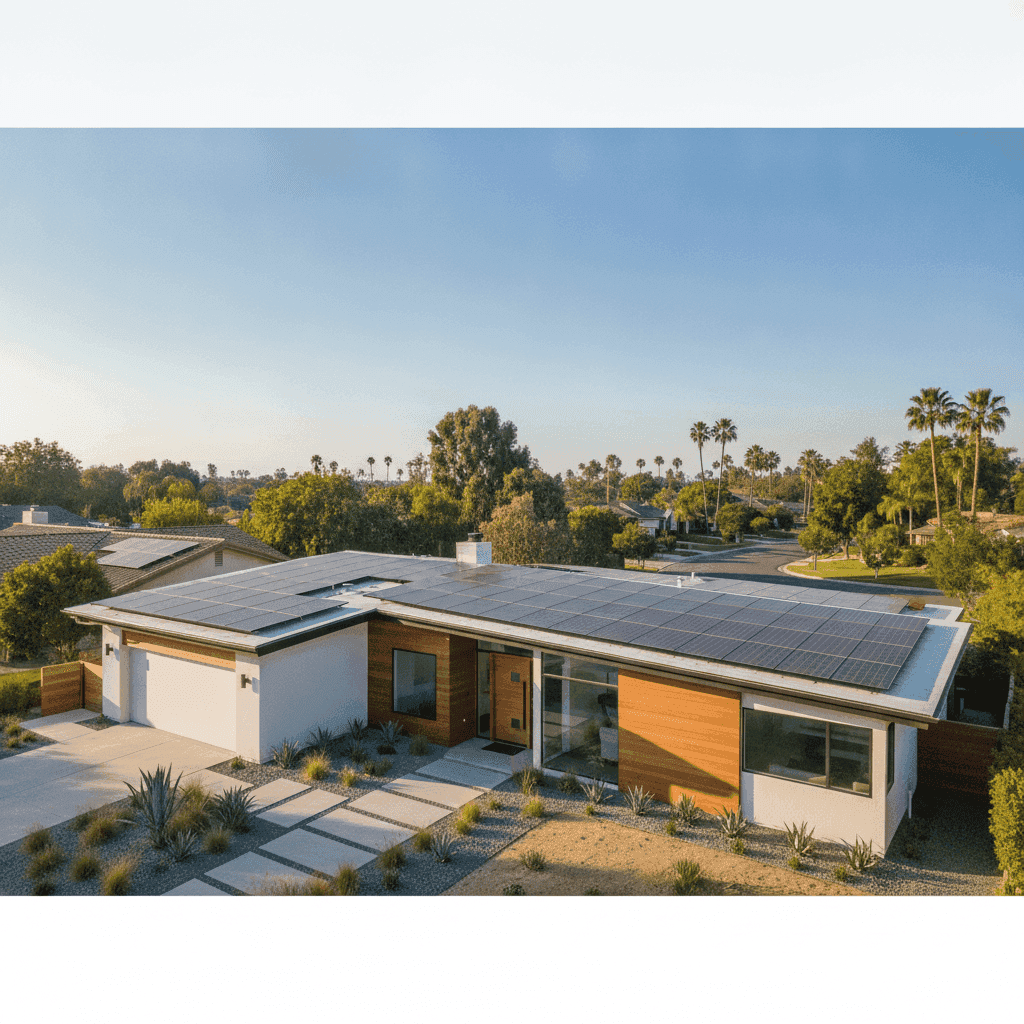
Los Angeles is one of the most solar-rich cities in the United States — roughly 280 sunny days a year, strong year-round production, and a housing stock dominated by single-family homes with south- and west-facing roofs that were practically designed to harvest sunlight. But installing solar in LA is not the same as installing it anywhere else in California, and that distinction matters enormously when you are comparing quotes and trying to figure out what you will actually save.
The single biggest thing that sets Los Angeles apart from most of Southern California is the utility. The City of Los Angeles is served by the Los Angeles Department of Water and Power (LADWP) — a municipal utility that runs its own solar incentive and net metering programs entirely independent of the California Public Utilities Commission. That means the CPUC's NEM 3.0 Net Billing Tariff, which dramatically reduced export credits for SCE and SDG&E customers, does not apply to LADWP customers.
LADWP has its own feed-in and net metering rules, its own interconnection process, and its own timeline — all of which affect how you size a system, whether a battery pencils out, and how long you wait for permission to operate. Any installer who quotes you a system in LA without clearly distinguishing between LADWP and the investor-owned utilities either doesn't know the local market or is hoping you don't.
LA's housing stock is also genuinely diverse: 1920s Craftsman bungalows in Highland Park, flat-roofed mid-century homes in Palms, Spanish tile roofs in Silver Lake, large lots in Granada Hills, and dense hillside properties in Laurel Canyon. Roof age, pitch, material, shading from mature trees, and available square footage all vary block by block. A well-designed LA solar installation accounts for all of that — not just a one-size-fits-all panel count dropped on a satellite image.
Last verified: September 2026 by Helios Energy Global.
Top 9 best solar companies in Los Angeles (2026)
A 2026 note on who is still standing. Residential solar has been through a brutal consolidation, and several companies that appear on older "best of" lists no longer exist. SunPower filed Chapter 11 in August 2024 and the brand now belongs to a different legal entity; Sunnova filed in June 2025; Freedom Forever filed in April 2026. Companies that have shut down or are in restructuring have been removed from the ranking below — a workmanship warranty is only worth the company standing behind it. Full detail in our statewide ranking of California solar companies.
At-a-glance ranking
- Helios Energy Global — Best for LADWP-specific design and owner-reviewed custom systems
- Sunrun — Best for homeowners who want a large national brand with financing options
- Tesla Energy — Best for homeowners who want integrated solar + Powerwall from one brand
- Palmetto Solar — Best for ongoing monitoring and platform-driven service
- SunPower Inc. — Best for high-efficiency panels on tight or shaded roofs
- Momentum Solar — Best for hands-on sales and installation support
- Baker Electric Solar — Best for San Fernando Valley and broader LA County homeowners
- Semper Solaris — Best for military families and veterans in the LA area
- Renova Energy — Best for desert-adjacent and Inland Empire-bordering LA County properties
This ranking is Helios Energy Global's own editorial opinion and is not paid placement. Verify each company's active California Contractors State License Board (CSLB) license and current service area before signing any contract.
1. Helios Energy Global — Santa Monica, CA
Helios Energy Global earns the top spot for Los Angeles homeowners because of one thing most large installers have eliminated: every system design is reviewed by the owner before it goes to the customer. That matters in a city like LA, where LADWP's interconnection rules, diverse roof types, and neighborhood-level shading variation make cookie-cutter designs a real liability.
Helios is based in Santa Monica and serves Southern California with a specific focus on LADWP territory — meaning the team understands the utility's net metering program, its interconnection timeline, and the permit requirements at the city level, not just generically.
There is no high-pressure sales floor, no "today only" pricing, and no upsell on products that don't fit your actual usage. You get a free, no-obligation consultation, a custom system design, and a detailed quote that shows you exactly what you are buying and why. Book your free consultation and custom design — no obligation, no pressure.
2. Sunrun
Best for: Homeowners who want a large, nationally recognized brand and a range of financing structures including leases and PPAs. Why it fits: Sunrun is one of the largest residential solar installers in the country and operates actively in the LA market. They offer purchase, loan, lease, and PPA options, which gives flexibility to households that don't want to finance outright. What to ask: Confirm whether your specific address falls under LADWP or another utility, and ask how their system design accounts for LADWP's net metering rules specifically — not SCE/NEM 3.0 assumptions.
3. Tesla Energy
Best for: Homeowners who want solar panels and a Powerwall battery from a single brand with a streamlined app experience. Why it fits: Tesla's vertical integration means one point of contact for panels, inverter, and battery. Their Powerwall 3 is a competitive product and the app-based monitoring is genuinely useful for LADWP time-of-use management. What to ask: Ask about installation subcontracting practices in LA, current lead times for Powerwall inventory, and how they handle LADWP interconnection versus SCE interconnection — the processes differ.
4. Palmetto Solar
Best for: Homeowners who value ongoing software monitoring and a platform-driven ownership experience post-installation. Why it fits: Palmetto's model includes production monitoring and a customer-facing app that flags underperformance. For LA homeowners who want to stay hands-on with system data, this is a differentiator. What to ask: Verify that their local installation partners in the LA area are licensed and experienced specifically with LADWP interconnection paperwork, which has its own requirements separate from CPUC-regulated utilities.
5. SunPower Inc.
Best for: Homeowners with smaller or partially shaded roofs who need the highest efficiency per square foot. Why it fits: Maxeon-cell panels carry some of the highest efficiency ratings available in residential solar. For LA homes with mature tree canopy, complex roof angles, or limited usable roof space, the premium panels can recover production that a standard panel configuration would lose. What to ask: Ask for a shading analysis using actual site data, not just a satellite estimate, and confirm the current warranty terms given SunPower's recent corporate restructuring.
6. Momentum Solar
Best for: Homeowners who prefer an in-person, relationship-driven sales and installation process. Why it fits: Momentum operates in California and takes a more hands-on approach to customer contact through the sales and installation phases. They work across LA County and offer purchase and financing options. What to ask: Ask about their LADWP interconnection experience, typical permit-to-PTO timelines in the City of LA, and whether your system design will be reviewed by a licensed engineer.
7. Baker Electric Solar
Best for: San Fernando Valley homeowners and broader LA County installations, particularly in the northern and eastern parts of the county. Why it fits: Baker Electric is a well-established California regional installer with a long track record in Southern California. They handle both residential and commercial installations and have experience across multiple LA-area utilities. What to ask: Confirm their current LADWP interconnection process experience, ask for references from recent installations in your specific neighborhood or zip code, and verify their CSLB license is current.
8. Semper Solaris
Best for: Military veterans and active-duty families in the LA area who want a company that markets specifically to the military community. Why it fits: Semper Solaris is a California-based installer that has built its brand around serving veterans and military families. They operate across Southern California and offer solar, battery, and roofing services. What to ask: Ask for a written quote that confirms what is included — solar hardware, installation labor, permits — and prices any roofing work separately, and confirm their LADWP interconnection experience for your specific neighborhood.
9. Renova Energy
Best for: LA County homeowners in areas bordering the Inland Empire or desert communities, where Renova has strong regional roots. Why it fits: Renova Energy is a Palm Desert–based California regional installer with a track record in Southern California's hotter, sun-intensive inland areas. For homeowners in the eastern edges of LA County, they are a credible regional option. What to ask: Confirm they actively service your specific zip code in LA County, verify their current CSLB license, and ask how they handle LADWP versus SCE territory distinctions in their designs.
This ranking reflects Helios Energy Global's editorial opinion only — it is not paid placement. Verify each company's active CSLB license at cslb.ca.gov and confirm they are actively serving your zip code before signing anything.
Why Los Angeles solar is different from a generic install
LADWP net metering is not NEM 3.0
This is the most important distinction in the entire guide. When you read national or statewide solar articles, they often discuss California's NEM 3.0 Net Billing Tariff as if it applies everywhere in the state. It does not. NEM 3.0 is a CPUC rule that governs SCE, PG&E, and SDG&E — the three investor-owned utilities. LADWP is a municipally owned utility and sets its own net metering rules independently.
Under LADWP's net metering program, the credit structure, export rates, and interconnection process are different from what NEM 3.0 customers face. This has real consequences: system sizing logic, the financial case for battery storage, and payback period calculations all change depending on which utility you are on. If an installer is quoting you a system and talking about NEM 3.0 export rates as if they apply to your LADWP account, that is a red flag. Learn more about how NEM 3.0 works and who it actually affects.
Batteries in LADWP territory
Under NEM 3.0 (SCE/SDG&E), batteries became nearly essential for maximizing solar value because daytime export credits dropped sharply. LADWP's net metering structure is different, which means the financial calculus for adding a battery is not the same. Batteries in LA still make excellent sense for backup power during outages (LA has seen grid stress during heat events), for time-of-use rate optimization if you are on a TOU rate plan, and for households that want energy independence.
But you should not be sold a battery using NEM 3.0 financial logic if you are an LADWP customer. Ask any installer to show you the battery payback math using LADWP-specific rate assumptions. See our guide on solar vs. battery decisions under different net metering structures.
Roof and lot diversity across LA neighborhoods
Los Angeles is not a uniform housing market. A 1950s ranch house in Northridge has a very different roof from a 1920s Craftsman in Echo Park or a two-story stucco home in Culver City. Key variables that affect your system design include:
- Roof material: Spanish tile, composition shingle, flat TPO/foam, and wood shake all have different mounting requirements and costs
- Roof age: Roofs under 5–7 years of remaining life should often be replaced before solar installation
- Shading: Mature trees, neighboring structures, and hillside topography create shading patterns that require microinverters or power optimizers rather than a standard string inverter
- Available square footage: Smaller roofs or roofs with multiple obstructions (HVAC units, skylights, vents) limit panel count
- Structural condition: Older homes may require rafter reinforcement — a legitimate cost that should appear in your quote
Heat, AC loads, and actual usage
The San Fernando Valley regularly hits triple digits in summer, and even coastal neighborhoods see heat events that push AC loads significantly higher than the national average. This matters for system sizing: a household that runs central air for three to four months of the year has a meaningfully different load profile than the same square footage in a milder climate. A good installer will pull your actual 12-month LADWP bill data — not just your average monthly usage — to size a system that covers your real consumption pattern, not a generic estimate.
Micro-neighborhood differences within LA
"Los Angeles" spans over 500 square miles and dozens of distinct communities. A home in Chatsworth or Reseda in the western Valley gets more annual sun hours and faces different shading patterns than a home in the Hollywood Hills or Mount Washington. Even within LADWP territory, the permit process can vary slightly depending on whether the work falls under LA City jurisdiction, an unincorporated LA County area, or a separately incorporated city that contracts services differently. Confirm your installer knows exactly which jurisdiction governs your property's permit.
Real prices: what solar costs in Los Angeles
The honest per-watt range for a quality residential solar installation in Los Angeles in 2026 is approximately $2.50–$3.50 per watt before any incentives. Where you land in that range depends on system size (larger systems tend to have a lower per-watt cost), equipment tier, roof complexity, electrical panel upgrade requirements, and whether you add battery storage.
Important: The federal 30% residential solar tax credit expired December 31, 2025. There is no federal credit to apply to a 2026 installation. California's Self-Generation Incentive Program (SGIP) may provide rebates for qualifying battery storage installations — check DSIRE and LADWP's current program listings for active incentives, as program availability and funding levels change.
Illustrative pre-incentive price ranges (2026 estimates)
| System Size | Low Estimate | Mid Estimate | High Estimate |
|---|---|---|---|
| 6 kW | $14,400 | $16,800 | $19,500 |
| 8 kW | $19,200 | $22,400 | $26,000 |
| 10 kW | $24,000 | $28,000 | $32,500 |
| 12 kW | $28,800 | $33,600 | $39,000 |
| 15 kW | $36,000 | $42,000 | $48,750 |
These are illustrative ranges based on the $2.50–$3.50/W benchmark. They are pre-incentive estimates only, not quotes. Actual prices vary by installer, equipment, and site conditions. Battery storage is not included.
What pushes your quote higher
- Battery storage: A single battery adds roughly $14,000–$18,500 installed (Powerwall 3 $14,500–$18,500; Enphase IQ Battery 10C $13,000–$15,500), depending on capacity and installation complexity
- Electrical panel upgrade: Older homes with undersized panels (100A or less) often need a panel upgrade, adding $3,000–$5,000+
- Roof work: Tile re-flashing, rafter reinforcement, or a new roof section before installation
- Microinverters or power optimizers: Necessary for shaded or complex roofs; adds cost versus a basic string inverter setup
- High-efficiency premium panels: Maxeon or similar top-tier panels carry a per-watt premium over standard Tier 1 panels
- LADWP interconnection and LA City permit fees: Real costs — ask whether the quoted price includes them
See a detailed breakdown of what goes into a 10 kW system cost in California.
Solar-only or solar + battery in Los Angeles?
When solar-only makes sense
For LADWP customers, a solar-only system can still deliver strong financial returns because LADWP's net metering program — unlike NEM 3.0 — does not penalize daytime exports as severely. If your primary goal is to reduce your electricity bill and your home does not have a critical backup power need, a well-sized solar-only system is a reasonable choice. The simpler system means lower upfront cost, fewer components to maintain, and a faster payback timeline.
When adding a battery makes sense
- Backup power priority: LA has experienced grid stress during extreme heat events. If you have medical equipment, a home office, or simply want peace of mind during outages, a battery provides real value independent of any financial calculation.
- TOU rate optimization: If you are on LADWP's time-of-use rate plan, a battery lets you store solar energy and discharge it during peak-price evening hours, reducing what you buy from the grid at the most expensive times.
- Future-proofing: LADWP's net metering rules could change. A battery gives you more control over your own production regardless of how export credit policies evolve.
- EV charging: Households with electric vehicles that charge at night can use battery storage to shift solar production to evening charging — reducing grid dependence meaningfully.
Battery proposal mistakes to avoid
- Being sold a battery using NEM 3.0 logic: If an installer tells you that you "need" a battery because daytime export rates are near zero under NEM 3.0, and you are an LADWP customer, that reasoning does not apply to your situation. Ask them to run the numbers using LADWP's actual rate structure.
- Undersized battery for your backup goals: A single 10 kWh battery will not power a central AC system for more than a few hours. Be clear about what you actually want to back up and size accordingly.
- Oversized battery for pure bill savings: If backup power is not a priority and your TOU savings don't justify the cost, a large battery bank may not pencil out financially.
Explore battery storage options and how they interact with your solar system.
How to choose the right solar company in Los Angeles
Start with the utility question. Any installer you seriously consider should immediately and correctly identify that the City of Los Angeles is LADWP territory and explain how that affects your system design, net metering credits, and interconnection process. If they talk about NEM 3.0 as if it applies to your LADWP account, move on.
Verify the CSLB license. California requires solar installers to hold a valid contractor's license — typically a C-46 (Solar) or C-10 (Electrical) license. Look up any company you are considering at cslb.ca.gov before signing. An unlicensed installer voids your permit protections and may leave you with warranty and liability exposure.
Ask who designs and reviews the system. Large installers often use automated satellite-based design tools with no human review. Ask specifically: who designs your system, what credentials do they hold, and does a licensed engineer or experienced designer review the output before it becomes your proposal?
Get at least three quotes. Prices vary meaningfully across installers in LA. Three quotes give you a realistic sense of the market and let you compare equipment, warranty terms, and cost per watt — not just the bottom-line number.
Ask about the interconnection timeline. LADWP's interconnection process has its own timeline and requirements. Ask each installer for their average permit-to-PTO (Permission to Operate) timeline for LADWP customers specifically, and ask who handles the interconnection paperwork.
See our full guide to designing and understanding your solar savings.
How to compare quotes without getting tricked
Normalize to cost per watt. Divide the total installed price by the system's DC watt capacity. This lets you compare a 7.2 kW quote at $21,600 against a 9.6 kW quote at $30,720 on equal footing (both are $3.00/W).
Check the production estimate methodology. Ask whether production estimates use NREL's PVWatts or a similar tool, and ask what shading assumptions were used. A production estimate that ignores your roof's actual shading will overstate your savings.
Read the warranty terms carefully. A 25-year panel performance warranty is standard, but what matters is who backs it — the panel manufacturer, the installer, or a third party? Ask what happens if the installer goes out of business.
Watch for inflated "before discount" pricing. Some installers show an inflated list price and then apply a large "discount" to make the deal feel urgent. The only number that matters is the actual installed price you will pay. Ignore artificial list prices and focus on the net cost.
Confirm the federal tax credit situation in writing. No federal residential solar tax credit applies to systems installed in 2026. If a quote shows a 30% federal tax credit as part of the "net cost" calculation, ask the installer to provide the IRS code section that supports it. They will not be able to, because the credit expired December 31, 2025.
Ask for the price in writing. A trustworthy quote gives the gross price and the cost per watt, names the panels (brand, model, wattage, count), inverter(s) and any battery by model, and says whether permits, LADWP interconnection fees and any electrical work are included. A price with no named equipment is a reason to ask more questions.
Los Angeles solar quote checklist
Before signing any contract with a solar company in LA, get clear answers to these questions:
- Is my property served by LADWP? (Confirm — don't assume.)
- How does your system design account for LADWP's net metering program specifically?
- What is the system's DC capacity (kW) and estimated annual production (kWh)?
- What panels, inverter, and racking are specified — exact brand and model?
- What is the all-in installed price, and what does it include (components, labor, permits, fees)?
- Does this price include the LADWP interconnection application fee?
- Who reviews and stamps the system design — a licensed engineer?
- What is your average permit-to-PTO timeline for LADWP customers?
- What warranties apply — manufacturer product, performance, and workmanship — and who backs each one?
- Is there a federal tax credit being applied to this quote? (There should not be for a 2026 installation.)
- Are there any current California or LADWP incentives (e.g., SGIP for batteries) that apply to my project?
- What is your CSLB license number, and can I verify it?
- Who will physically install the system — your own employees or subcontractors?
- What does the monitoring system show, and how do I report a production issue?
- What is the process if my roof leaks or there is a structural issue after installation?
Final verdict
Los Angeles is a genuinely excellent solar market — strong sun, high electricity rates, and a municipal utility that has not applied the NEM 3.0 export-credit cuts that hit SCE and SDG&E customers. But that same LADWP distinction is exactly where most generic solar guides and out-of-market installers get it wrong. The companies that do best for LA homeowners are the ones that understand LADWP's specific rules, design systems for the actual roof and usage profile in front of them, and give customers honest numbers without manufactured urgency.
Helios Energy Global ranks first because it combines local LADWP expertise, owner-reviewed custom designs, a Santa Monica base that keeps the team close to the communities it serves, and a straight-talking approach that matches the way LA homeowners actually want to buy a major home improvement. The other companies on this list are real options worth considering — evaluate them on the same criteria: utility knowledge, design quality, license verification, and transparent pricing. Start with a free consultation and custom design from Helios.
Frequently asked questions about solar in Los Angeles
How much does solar cost in Los Angeles in 2026?
A quality residential solar installation in LA runs approximately $2.50–$3.50 per watt before incentives in 2026. For a typical 8–10 kW system, that translates to a pre-incentive range of roughly $20,000–$35,000 depending on equipment, roof complexity, and whether you add battery storage. Get at least three gross-price quotes to understand where your specific home lands in that range.
Does NEM 3.0 apply to Los Angeles homeowners?
No. NEM 3.0 is a CPUC rule that applies only to customers of the three investor-owned utilities — SCE, PG&E, and SDG&E. The City of Los Angeles is served by LADWP, a municipal utility that operates its own net metering program independently of the CPUC. If you live in the City of LA, NEM 3.0 does not govern your solar export credits. Confirm your utility before accepting any system design or financial projection based on NEM 3.0 assumptions.
Is there still a federal solar tax credit in 2026?
No. The 30% federal residential solar investment tax credit expired December 31, 2025. There is no federal tax credit for residential solar systems installed in 2026. Any sales pitch or quote that includes a 30% federal credit as a cost offset for a 2026 installation is inaccurate — ask for written clarification.
Do I need a battery with solar in Los Angeles?
Not necessarily. Under LADWP's net metering program, the financial case for a battery is different from what NEM 3.0 customers face. Batteries make strong sense for backup power, time-of-use bill optimization, and EV charging flexibility — but if your only goal is bill reduction, a solar-only system can still deliver solid returns under LADWP's current rules. Run the numbers for your specific situation rather than accepting a blanket recommendation.
How long does solar interconnection take with LADWP?
LADWP's interconnection process runs on its own timeline, separate from SCE or SDG&E. Timelines vary based on system size, neighborhood, and current LADWP workload, but homeowners should budget several weeks to a few months from permit submission to Permission to Operate. Ask any installer for their recent average LADWP permit-to-PTO timeline — a company with real LADWP experience will have a concrete answer.
How do I check if a solar contractor is licensed in California?
Visit the California Contractors State License Board at cslb.ca.gov and search by company name or license number. Look for an active license in the C-46 (Solar) or C-10 (Electrical) classification. An expired, suspended, or missing license is a hard stop — do not sign a contract with an unlicensed contractor regardless of how good the price looks.
What size solar system do I need for my LA home?
System size depends on your actual electricity consumption (pull 12 months of LADWP bills), available roof space, shading, and whether you are adding an EV or battery. Most LA single-family homes fall in the 6–12 kW range, but high-AC homes in the Valley or larger households often need 10–15 kW. A credible installer will size to your actual usage data, not a generic square-footage estimate. Use NREL's PVWatts tool as a cross-check on any production estimate you receive.
Is solar worth it in Los Angeles in 2026?
For most homeowners, yes — even without the federal tax credit. LADWP's rates have risen steadily, the city gets abundant sun year-round, and LADWP's net metering program still provides meaningful credit for exported solar energy. The payback period is longer without the 30% federal credit than it was in prior years, so accurate system sizing and honest financial projections matter more than ever. Avoid oversized systems designed to maximize installer revenue rather than your actual savings. Explore how to model your savings accurately.
Next steps
- Book a free consultation and custom design — no pressure, no obligation
- Learn how solar savings are calculated for your home
- Understand battery storage and whether it fits your situation
- Read our overview of residential solar in Southern California
- See a detailed cost breakdown for a 10 kW system in California
- Understand NEM 3.0 and who it actually affects
- Compare solar-only vs. solar + battery under different net metering rules
More guides
Why is my electric bill so much higher this year? (2026)
SCE's average residential rate hit ~34.5¢/kWh in 2026 — nearly double the ~18–19¢ it was in 2018 — which is why the same household usage now costs almost twice as much.
ReadSolar Panel Removal and Reinstallation in Riverside County: What It Costs in 2026
Helios charges $250–$350 per panel for a detach-and-reset in Riverside County — about $3,750–$8,750 for a typical 15–25 panel system, with tile roofs, which dominate the Inland Empire housing stock, at the top of the range.
ReadEV Charger Installation Cost in Los Angeles (2026)
A Level 2 EV charger installation in Los Angeles typically runs $800–$2,500 installed, or $3,000–$6,500+ if your panel needs an upgrade.
ReadGet a free consultation and custom design.
No pressure, no obligation — the owner reviews every design we send.