Best Solar Companies in La Habra, CA (2026): Honest Rankings for SCE Homeowners
La Habra runs on Southern California Edison under NEM 3.0, where pairing solar with a battery is what makes the payback math work. This guide ranks the best solar installers in La Habra for 2026 and walks you through real costs, SCE rate facts, and what to ask before signing anything.
By Taylor Crouse — Founder, Helios Energy GlobalPublished
Quick answer
- Your utility is Southern California Edison (SCE), and NEM 3.0 applies. Export credits under the Net Billing Tariff run roughly 5–8¢/kWh — about 75% below what NEM 2.0 paid — so exporting excess solar is worth very little. Self-consumption is everything.
- A battery is the move for most La Habra homes. SCE's 4–9 PM peak rate hits roughly 48–58¢/kWh on standard TOU plans. A battery stores your midday solar and discharges it during that window, often cutting the payback period from the 10–14 year solar-only range down to roughly 6–9 years.
- Typical system size: 7–11 kW. La Habra's hot inland summers drive real AC loads; a right-sized system is built around your actual SCE usage history, not a national average.
- Installed cost range: $2.50–$3.50 per watt before incentives. For a 7–11 kW system that's roughly $17,500–$38,500. No federal 30% tax credit exists for systems installed in 2026 — it expired December 31, 2025.
- Housing stock ranges from 1920s bungalows to post-war tracts to newer hillside homes. Roof age, structure, and panel capacity all vary; a proper site survey before design is non-negotiable.
- La Habra's permit office is efficient. The City accepts solar PV applications through the SolarAPP+ automated portal for eligible systems and targets a three-working-day review for standard submissions — faster than many Orange County cities.
La Habra is a northwest Orange County city of about 60,000 residents, bordered by Fullerton, Brea, and the Los Angeles County line. Every home in the city is served by Southern California Edison (SCE), which means the 2023 NEM 3.0 Net Billing Tariff governs how your solar credits are calculated.
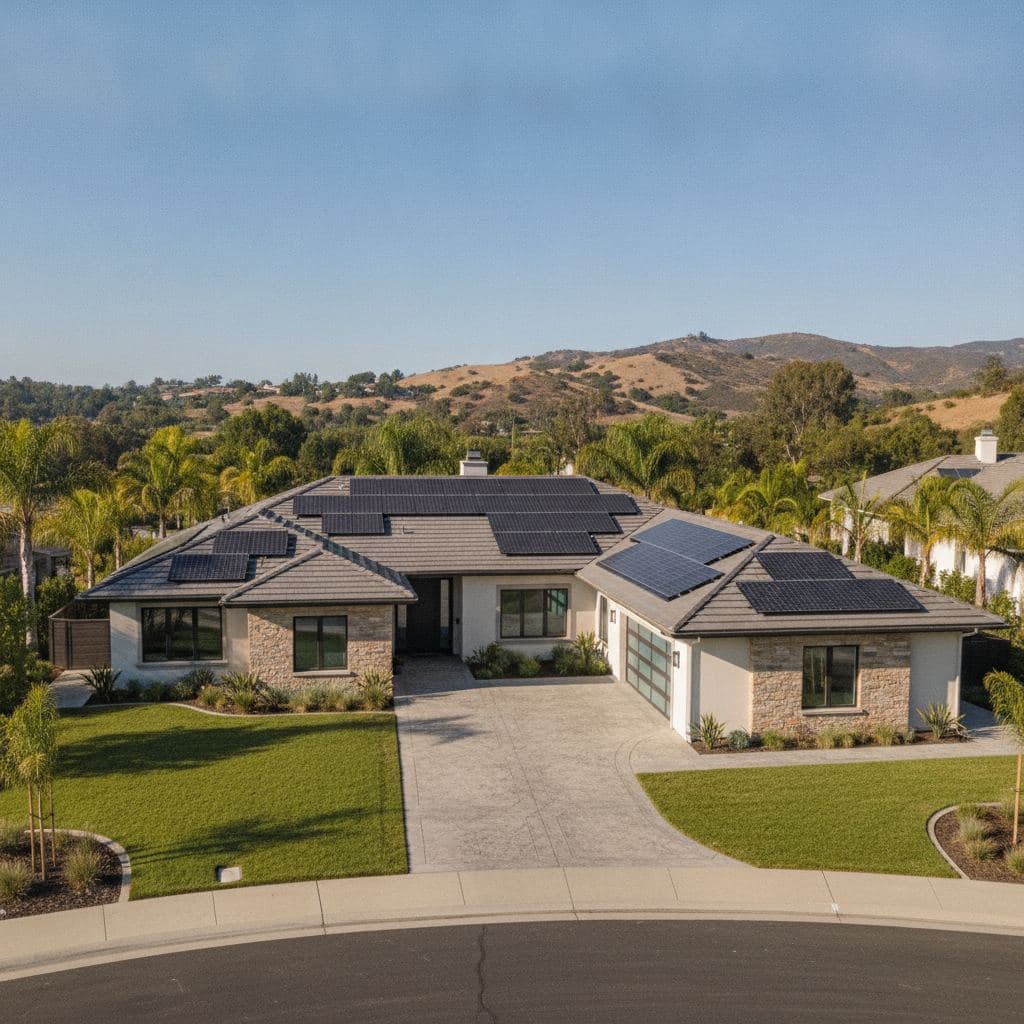
Top 10 best solar companies in La Habra (2026)
At-a-glance ranking
- Helios Energy Global — Best for SCE NEM 3.0 battery-first design with owner review on every La Habra job
- Sunrun — Best for homeowners who want a large national brand with financing options
- Tesla Energy — Best for all-in-one Powerwall ecosystem buyers
- Palmetto — Best for ongoing monitoring and performance guarantees
- Freedom Forever — Best for production guarantees on straightforward installs
- Infinity Solar — Best established Orange County regional installer
- Stellar Solar — Best for Southern California regional experience
- Forme Solar — Best for Orange County homeowners seeking a local independent
- Green Conception — Best for combined solar-and-roofing coordination
- Baker Electric Solar — Best for San Diego–to–OC regional track record
This ranking reflects Helios Energy Global's own editorial opinion and is not paid placement. Verify each company's active California Contractors State License Board (CSLB) license and current La Habra service area before signing any contract.
#1 — Helios Energy Global
Helios ranks first in La Habra for one specific reason: the SCE NEM 3.0 environment rewards precision over volume, and precision is how Helios operates. Every La Habra design is modeled against your actual SCE billing data — real usage, real rate tiers, real 4–9 PM peak exposure — before a single panel or battery is specified. Taylor Crouse reviews and signs off on every system before anything is ordered. You get one all-in written price with every equipment model named; when you're comparing quotes from other installers, always ask for the gross price and the cost per watt in writing so you're comparing apples to apples.
La Habra's housing stock runs from 1920s and 1930s homes near the historic core to post-war tracts in the Eastside and newer hillside subdivisions toward Westridge and the La Habra Heights border. Helios verifies roof age, structure, and electrical panel capacity before finalizing a design — and if a panel upgrade is needed, you're told up front, in the same written price. Roofing work, when required, is coordinated through vetted, licensed roofing partners. Learn more at solar installation in La Habra.
Best for: La Habra homeowners who want a battery-optimized SCE design, a named-equipment quote, and an owner who actually reviews the job.
#2 — Sunrun
Best for: Homeowners who prefer a large, publicly traded installer with broad financing and lease options. Why it fits: Sunrun is one of the largest residential solar companies in the U.S. and operates across SCE territory, including Orange County. What to ask: Get the gross system price and cost per watt in writing; understand exactly what happens to your contract if you sell the home.
#3 — Tesla Energy
Best for: Buyers who want the Powerwall 3 ecosystem and prefer ordering through Tesla's own design tool. Why it fits: Tesla installs in SCE territory and the Powerwall 3 is purpose-built for NEM 3.0 self-consumption strategies. What to ask: Confirm the installation timeline and whether a local subcontractor or Tesla's own crew handles your job.
#4 — Palmetto
Best for: Homeowners who prioritize long-term monitoring and a performance-tracking app after install. Why it fits: Palmetto operates in California and emphasizes ongoing system health monitoring, which matters when SCE billing is usage-sensitive. What to ask: Ask who holds the CSLB license on your permit and who performs the physical installation.
#5 — Freedom Forever
Best for: Straightforward installs where a production guarantee provides peace of mind. Why it fits: Freedom Forever operates across Southern California and offers a production guarantee that covers shortfalls. What to ask: Clarify the exact terms of the production guarantee and how claims are handled under NEM 3.0 billing.
#6 — Infinity Solar
Best for: Orange County homeowners who want an established regional installer with a long local track record. Why it fits: Infinity Solar is based in Orange County and has served the La Habra area for years, with familiarity with local permitting. What to ask: Ask for the gross installed price and cost per watt in writing, and confirm which battery brands they carry.
#7 — Stellar Solar
Best for: Southern California homeowners who want a regional installer with deep SCE experience. Why it fits: Stellar Solar has operated across SoCal for many years and designs around SCE's NEM 3.0 self-consumption requirements. What to ask: Ask how they size battery storage for the 4–9 PM peak and what their typical SCE interconnection timeline looks like.
#8 — Forme Solar
Best for: Orange County homeowners seeking a local independent with a community focus. Why it fits: Forme Solar is an Orange County–based installer with a presence in the La Habra market. What to ask: Confirm their CSLB license number and ask for references from recent La Habra or Fullerton installs.
#9 — Green Conception
Best for: Homeowners who need roofing and solar coordinated under one contractor relationship. Why it fits: Green Conception handles both solar and roofing in the Orange County area, which can simplify projects on older La Habra homes that need roof work before panels go up. What to ask: Clarify which work is performed by their own licensed crew versus subcontractors, and get the full scope in writing.
#10 — Baker Electric Solar
Best for: Homeowners who value a long-established electrical contractor background behind the solar work. Why it fits: Baker Electric has roots in electrical contracting and operates across the San Diego–to–Orange County corridor. What to ask: Confirm active service in La Habra's 90631 zip code and ask for the gross price and cost per watt in writing.
Editorial opinion only — not paid placement. Verify every company's active CSLB license and current La Habra service area before signing.
Why La Habra solar is different from a generic install
SCE's NEM 3.0 changes the entire financial model
La Habra is fully inside Southern California Edison territory, and every new solar system interconnected after April 15, 2023 falls under the Net Billing Tariff — NEM 3.0. The CPUC's decision (D.22-12-056) set export compensation at the utility's avoided cost rather than the retail rate. In practice, midday exports typically earn around 5–8¢/kWh, while the energy you import from SCE during the 4–9 PM peak costs roughly 48–58¢/kWh depending on your rate plan, per SCE's current TOU schedules. That gap — exporting cheap, importing expensive — is why the old "oversize and export" strategy no longer works. The winning approach is to size the system to cover your daytime load, pair it with a battery, and discharge stored solar during the peak window instead of pulling from the grid.
For a deeper look at how the Net Billing Tariff works, see our NEM 3.0 explainer.
Batteries aren't optional for most La Habra homes
Under NEM 2.0, a battery was a nice-to-have. Under NEM 3.0, it's what makes the numbers work for the majority of La Habra homeowners. SCE's TOU-D-4-9PM plan charges around 58¢/kWh during summer peak hours, per EnergySage's review of SCE's 2026 rate schedules. A properly sized battery — typically one or two Tesla Powerwall 3 units, or an Enphase IQ Battery 10C — stores solar generated between roughly 10 AM and 3 PM and releases it during the 4–9 PM window, avoiding those peak charges entirely. That shift is what compresses the payback period. See our solar vs. battery under NEM 3.0 guide for the full breakdown.
La Habra's housing stock requires a real site survey
La Habra's homes span more than a century of construction. The blocks near the historic core — around downtown and south toward Portola Park — include homes built in the 1920s and 1930s with older roof structures, potentially aging electrical panels, and composition or tile roofing that may need assessment before panels are mounted. Post-war tracts across the Eastside are generally more straightforward but vary in panel age and roof pitch. The newer hillside subdivisions toward Westridge and the La Habra Heights border often have steeper pitches and tile roofs, which affect both structural loading and the cost of any future panel removal and reinstallation. A proper site survey — not just a satellite image — is how a responsible installer catches these variables before a proposal is written.
Hot inland summers mean AC load is the driver
La Habra sits in the inland-valley climate zone, not on the coast. Summers here run meaningfully hotter than cities closer to the ocean, and afternoon AC loads are real and sustained. With 5.7 average peak sun hours per day, the solar production window is strong, but the AC load concentrates in the same 4–9 PM window when SCE rates are highest. A system sized to your actual summer usage — not a generic 8 kW default — is what produces meaningful bill reduction rather than a partial offset.
Micro-neighborhood factors that affect your design
- Westridge and north-side hillside homes: Steeper pitches and tile roofs are common. Tile roofs require more labor to work around, and removal-and-reinstallation costs run higher — roughly $250–$350 per panel if panels need to come off for a future re-roof.
- Eastside post-war tracts: Generally good roof orientation and pitch for solar, but panel age varies and some homes still have older 100-amp electrical panels that may need upgrading ($3,000–$5,000 when required) before a modern inverter and battery system can be connected.
- La Habra Heights border areas: These hillside parcels sometimes have mature tree canopy that creates shading — a shading analysis is essential before system sizing.
- Near Portola Park and the historic core: Older homes with original electrical systems need the most pre-design diligence; don't let any installer skip the panel assessment.
Real prices: what solar costs in La Habra
The installed cost for solar panels in La Habra runs $2.50–$3.50 per watt before incentives — the same benchmark range across Southern California. Where your quote lands within that range depends on roof complexity, equipment brand, whether a panel upgrade is needed, and installer overhead.
The 30% federal residential solar tax credit expired December 31, 2025. There is no federal credit for a system purchased or installed in 2026. California does not have a statewide residential solar rebate program at this time. The effective incentive is the value of the electricity you avoid buying from SCE — which, at 34–35¢/kWh average and up to 48–58¢/kWh at peak, is substantial.
Illustrative pre-incentive price ranges by system size
(Estimates only — actual quotes vary by roof, equipment, and site conditions. Use these as a sanity check, not a contract price.)
| System Size | Low estimate | High estimate | Typical La Habra use case |
|---|---|---|---|
| 6 kW | $15,000 | $21,000 | Smaller home, moderate AC use |
| 8 kW | $20,000 | $28,000 | Average 3-bed, central AC |
| 10 kW | $25,000 | $35,000 | Larger home or EV added |
| 12 kW | $30,000 | $42,000 | High usage, EV, pool |
| 15 kW | $37,500 | $52,500 | Large home, multiple EVs |
What pushes a quote toward the top of the range:
- Tile or steep-pitch roof (more labor, specialized mounting hardware)
- Electrical panel upgrade required ($3,000–$5,000 when needed — ask every installer whether this applies to your home)
- Battery storage added (one Tesla Powerwall 3 installed: $14,500–$18,500; two units: $24,000–$30,000; Enphase IQ Battery 10C: $13,000–$15,500; FranklinWH aPower 2 with aGate: $16,000–$21,000)
- Premium panel brands (higher efficiency, longer warranties)
- Complex roof geometry or multiple arrays
Estimate your La Habra solar savings with our city-specific calculator to get a number grounded in your actual SCE usage.
Solar-only or solar + battery in La Habra?
When solar-only still makes sense
A solar-only system can work if you're primarily home during the day, run your heaviest loads (laundry, dishwasher, EV charging) before 4 PM, and are comfortable with a longer payback period. If you already have a NEM 2.0 grandfathered system and are adding capacity, the calculus is different — talk to an installer who can pull your actual SCE account data.
When a battery is the right call (most La Habra homes)
For the majority of La Habra homeowners who work outside the home, run AC through the evening, or charge an EV overnight, a battery is what makes NEM 3.0 economics work. The logic is simple: solar produces from roughly 9 AM to 4 PM; your biggest SCE charges accumulate from 4 PM to 9 PM. A battery bridges that gap. The battery backup guide walks through which storage options fit different usage profiles.
Battery-proposal mistakes to watch for
- Undersized storage: A single small battery may not cover the full 4–9 PM window for a home with central AC. Ask the installer to show the projected daily discharge curve against your actual SCE usage.
- Oversized storage for the wrong reason: A battery sized far beyond your evening load is money that won't pay back. Right-sizing matters in both directions.
- No equipment model named: Any proposal that says "battery storage" without specifying the brand, model, and capacity is incomplete. Get the model name in writing before you compare prices.
- Payback claims that ignore NEM 3.0: If an installer is projecting payback based on full retail export credits, their model is wrong for 2026. Ask specifically how they value exported energy in their savings estimate.
How to choose the right solar company in La Habra
1. Confirm the CSLB license. Every solar installer in California must hold an active Contractors State License Board license (C-10 electrical or B general building). Look up the license number at cslb.ca.gov before signing anything.
2. Verify SCE NEM 3.0 fluency. Ask the salesperson to explain, in plain terms, how your export credits will be calculated and why the battery affects payback. If they can't explain avoided-cost pricing, move on.
3. Ask who designs the system. Some national installers use automated sizing tools with no human review. Ask whether a licensed engineer or experienced designer reviews your specific roof layout and SCE billing data.
4. Understand the permit process. La Habra's Building and Safety Division offers a streamlined path: systems 10 kW or smaller can be reviewed in approximately three working days, and eligible systems can be submitted through the SolarAPP+ automated portal for even faster approval. A good installer handles all of this for you — but knowing the process helps you spot delays caused by poor documentation.
5. Check interconnection experience with SCE. After the city inspection, SCE issues Permission to Operate (PTO). An installer who regularly works in La Habra knows how to submit a complete SCE interconnection package the first time, avoiding weeks of back-and-forth.
How to compare quotes without getting tricked
Getting three or more quotes is the right move. Here's how to compare them honestly:
- Get the gross price and the cost per watt in writing. These two numbers let you compare any quote to any other, regardless of system size. A quote that gives you only a monthly payment or a "net cost after tax credit" is hiding the real number — especially in 2026, when there is no federal tax credit.
- Confirm every equipment model by name. Panel brand and model, inverter brand and model, battery brand and model. Vague specs ("Tier 1 panels," "leading inverter brand") are not a specification.
- Ask how they model your SCE savings. Request that the installer show you the projected annual savings broken down between self-consumed solar (valued at your full SCE retail rate) and exported solar (valued at the NEM 3.0 avoided-cost rate). If the model treats all production as if it offsets retail charges, the savings projection is inflated.
- Understand the warranty stack. Panel product warranty (typically 10–12 years), panel performance warranty (typically 25 years), inverter warranty (typically 10–25 years depending on brand), and workmanship warranty (varies by installer — ask for it in writing).
- Read the interconnection timeline. Ask for a realistic estimate of the time from signed contract to SCE Permission to Operate. In La Habra, a well-run project typically moves through city permitting and SCE interconnection in 8–14 weeks total, though timelines vary.
Our solar cost and design guide has more on reading a proposal.
La Habra quote checklist
Before signing with any solar company in La Habra, get clear answers to these questions:
- What is the gross installed price, and what is the cost per watt?
- What are the exact panel, inverter, and battery models? (Brand name + model number)
- Is a main electrical panel upgrade required for my home, and if so, what does that cost?
- How does your savings model value exported solar — are you using the NEM 3.0 avoided-cost rate or retail?
- What is the projected annual production in kWh, and what tool/data source did you use to calculate it?
- How is the battery sized relative to my 4–9 PM evening load, not just my total daily usage?
- What is your CSLB license number, and can I verify it?
- Who pulls the La Habra building permit — your company or a subcontractor?
- Who handles the SCE interconnection application, and what's your typical PTO timeline?
- What does the workmanship warranty cover, and for how long?
- If my roof needs work before or during the install, who coordinates that, and who is the licensed roofing contractor?
- What happens to my contract if I sell the home before the system is paid off?
- Is there a production guarantee, and what are the exact terms if production falls short?
Final verdict
La Habra is a genuine SCE NEM 3.0 market, and the installers who do well here are the ones who design around self-consumption, not export volume. That means battery sizing matters as much as panel count, and a real site survey — accounting for La Habra's mix of 1920s bungalows, post-war tracts, and hillside tile-roof homes — is what separates a good design from a generic one.
Helios Energy Global ranks first because every La Habra job gets a design built from your actual SCE usage data, a battery sized for your real evening load, and a named-equipment written price reviewed by Taylor before anything is ordered. That level of specificity is what the NEM 3.0 environment demands — and what La Habra homeowners deserve.
The other companies on this list are real, established installers. Do your diligence: verify their CSLB license, get the gross price and cost per watt in writing, and ask them to explain NEM 3.0 export pricing in plain English. The answers will tell you everything you need to know.
Frequently asked questions about solar in La Habra
How much does solar cost in La Habra in 2026?
Most La Habra homes run $2.50–$3.50 per watt installed before incentives. For a typical 7–11 kW system, that's roughly $17,500–$38,500 depending on roof complexity, equipment, and whether a battery or panel upgrade is included. The 30% federal residential solar tax credit expired December 31, 2025 — there is no federal credit for a system installed in 2026, so the gross price is close to your final out-of-pocket cost (before any financing).
Does NEM 3.0 apply to La Habra solar customers?
Yes. La Habra is served entirely by Southern California Edison, one of the three investor-owned utilities covered by the CPUC's Net Billing Tariff. Any system interconnected after April 15, 2023 earns export credits at SCE's hourly avoided-cost rates — roughly 5–8¢/kWh for most midday exports — rather than the near-retail rates that NEM 2.0 paid. Self-consumption and battery storage are what make the economics work under these rules.
Is a battery worth it for a La Habra home on SCE?
For most La Habra households, yes. SCE's TOU peak rate runs roughly 48–58¢/kWh from 4–9 PM on standard plans, per SCE's 2026 rate schedules. A battery stores midday solar at near-zero cost and discharges it during that window, avoiding peak charges entirely. Without a battery, most of your excess midday solar exports at 5–8¢/kWh — a fraction of what you'd pay to import it at peak.
Can an older La Habra home support solar?
Usually, but it requires a proper assessment first. Homes near the historic core date to the 1920s and 1930s, and some have older roof structures or 100-amp electrical panels that need evaluation. If a panel upgrade is required, it typically runs $3,000–$5,000 and should be disclosed in your quote before you sign. A responsible installer will flag this after a site survey — not after the permit is pulled.
How long does the La Habra solar permit process take?
La Habra's Building and Safety Division targets a three-working-day review for solar PV applications 10 kW or smaller, per the city's published PV Toolkit. Eligible systems can also be submitted through the SolarAPP+ automated portal for faster approval. After city inspection, SCE issues Permission to Operate — the full timeline from signed contract to a live system typically runs 8–14 weeks for a well-prepared project, though this varies.
How do I check a solar contractor's license in La Habra?
Visit cslb.ca.gov and search by the company name or license number. Every solar installer in California must hold an active CSLB license — typically a C-10 (Electrical) or B (General Building) classification. Verify the license is current, the bond is active, and the name on the license matches the company you're contracting with. Never sign with an installer who can't provide a CSLB number.
What size solar system does a typical La Habra home need?
Most La Habra homes land in the 7–11 kW range, but the right size depends on your actual SCE usage — not a generic formula. La Habra's hot inland summers drive meaningful AC loads, so summer months are often the determining factor. A good installer pulls 12 months of your SCE billing data and sizes the system to your real consumption pattern, not an assumed average. See our 10 kW system cost guide for a deeper look at what that size covers.
What is SCE's interconnection timeline after installation?
After your city inspection is complete, SCE reviews the interconnection package and issues Permission to Operate (PTO). For complete, straightforward residential solar-only applications, SCE targets processing within roughly 10 business days. Battery additions and panel upgrades can add time. Your installer should submit a complete package — including the signed interconnection agreement and final inspection approval — in one go to avoid delays.
Next steps
- Book a free consultation and custom design — no pressure, no obligation
- Solar installation in La Habra — city-specific details on our La Habra work
- Estimate your La Habra solar savings — city-prefilled calculator
- Learn how NEM 3.0 affects your SCE bill
- Solar vs. battery under NEM 3.0 — when each makes sense
- Battery storage options — Powerwall 3, Enphase IQ, FranklinWH compared
- How much does a 10 kW system cost in California?
Sources
- La Habra Building & Safety PV Toolkit (Rev. 01/26) — January 2026
- EnergySage SCE Time-of-Use Rates 2026 — September 2026
- CurrentEnergy NEM 3.0 Explained 2026 — October 2026
- La Habra Building & Safety SolarAPP+ Portal — January 2026
More guides
CCA vs SCE: what LA solar owners actually pay in 2026
LA solar owners on Clean Power Alliance pay SCE delivery charges (~34-35¢/kWh blended) plus CPA generation rates that vary by tier, with NEM 3.0 Solar Billing Plan credits split between two agencies.
ReadDoes NEM 3.0 require a battery in 2026?
NEM 3.0 doesn't legally require a battery, but export credits are ~75% lower than before, making storage near-essential for a reasonable payback period.
ReadThe 10 Best Solar Companies in Anaheim, CA (2026): APU Net Metering, Real Prices, and What Every Homeowner Should Know
Anaheim runs on Anaheim Public Utilities — a municipal utility with its own NEM 2.0, not CPUC NEM 3.0. This guide ranks the 10 best solar installers in Anaheim for 2026, explains what APU's rules mean for your payback, and gives you real price ranges and a quote checklist.
ReadGet a free consultation and custom design.
No pressure, no obligation — the owner reviews every design we send.