Best Solar Companies in La Crescenta-Montrose, CA (2026): Honest Rankings for Foothill Homeowners
La Crescenta-Montrose sits in the Crescenta Valley foothills under LADWP service — not SCE, not NEM 3.0. This guide ranks the 10 best solar installers for 2026 and explains exactly what that means for your payback.
Updated
Quick answer
- Your utility is LADWP, not SCE — NEM 3.0 does not apply. LADWP runs its own net metering program with its own export rates and rules. This is meaningfully different from what you'll read in most California solar articles, which focus on SCE or SDG&E customers. Verify current LADWP net metering terms directly with the utility before signing any contract.
- Typical system size for this area runs 6–12 kW, depending on square footage, whether you have a pool or EV, and how aggressively you want to offset your bill. Many Crescenta Valley homes land in the 7–9 kW range.
- Pre-incentive installed prices generally fall between $2.50 and $3.50 per watt for a quality residential system. Total project cost varies with roof complexity, equipment tier, and whether you add battery storage.
- Battery storage deserves serious consideration here. LADWP's export rates are not guaranteed to stay favorable indefinitely, and the Crescenta Valley's history of Public Safety Power Shutoffs and wildfire-related outages makes backup power a practical, not just financial, decision.
- The 30% federal residential solar tax credit expired December 31, 2025. There is no federal credit available for systems installed in 2026. Any installer or ad that implies otherwise is either outdated or misleading. Do not factor a 30% credit into your payback calculation.
- Roof complexity, permit fees, and fire-zone requirements drive cost here more than in flat-lot suburban markets. La Crescenta-Montrose lots often have hillside setbacks, older electrical panels that need upgrading, and in some cases Wildland-Urban Interface (WUI) fire-zone requirements that affect equipment placement.
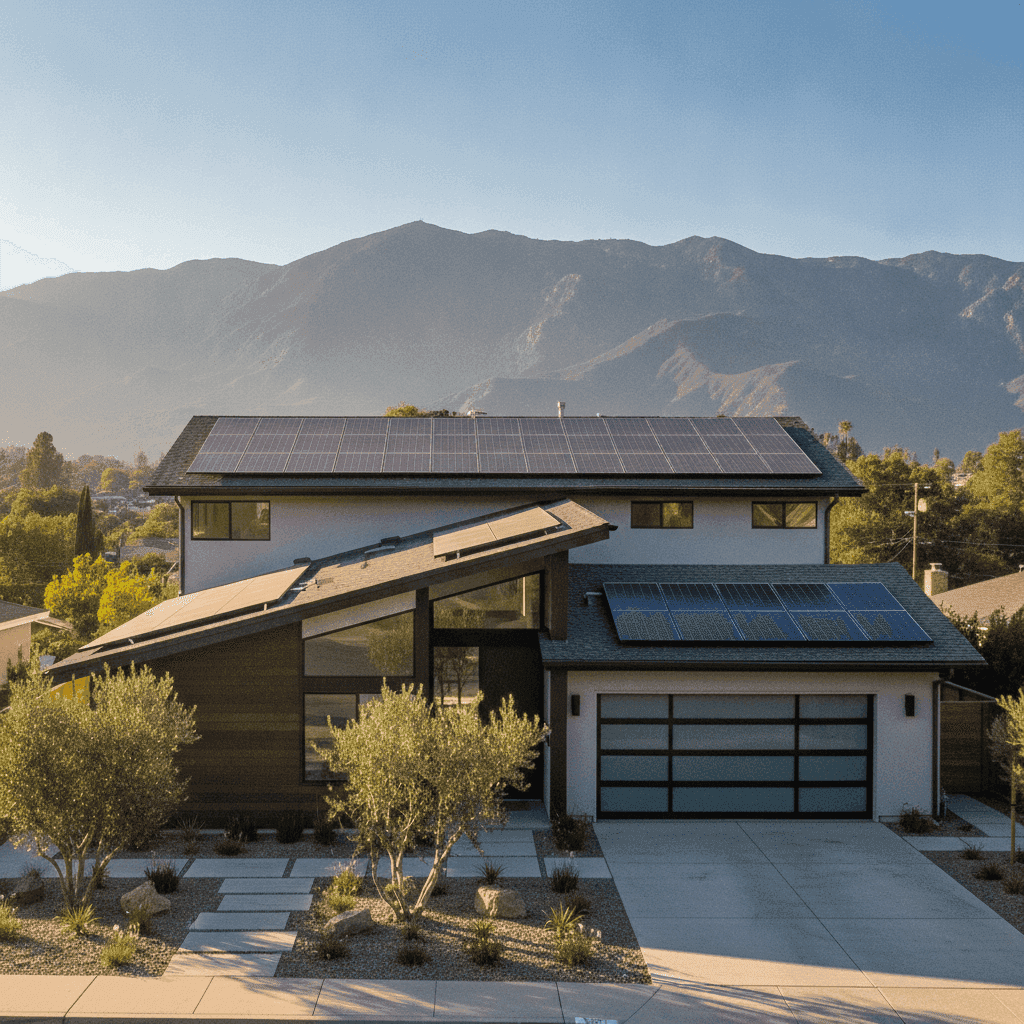
La Crescenta-Montrose is a tight-knit, unincorporated community tucked into the Crescenta Valley along the base of the San Gabriel Mountains, sitting within Los Angeles County. It's served by the Los Angeles Department of Water and Power (LADWP) — not Southern California Edison, not SDG&E, and not any investor-owned utility subject to the CPUC's Net Billing Tariff. That single fact changes the entire solar conversation here, and any installer who doesn't lead with it probably hasn't done their homework on your neighborhood.
The homes here are varied: older ranch-style and craftsman houses from the mid-century, newer two-story builds on steeper lots, and everything in between. Roof pitches range from nearly flat to aggressive angles that face every compass direction. The foothills mean you'll often see excellent solar exposure — the San Gabriels block very little morning or afternoon sun at these elevations — but they also mean more complex roof geometries, occasional shading from mature trees, and in some cases detached garages or ADUs that complicate system design.
Fire risk is real in this area, which also affects permitting and equipment choices.
Summers in the Crescenta Valley are hot. Air conditioning runs hard from June through September, and in recent years, October heat events have extended the cooling season. That high AC load is actually one of the strongest arguments for solar here, because LADWP's tiered rate structure means the kilowatt-hours you're paying the most for are the ones a well-designed system can offset most efficiently. This guide gives you the straight facts on who installs solar well in this market, what it costs, and how LADWP's rules shape the math.
Last verified: September 2026 by Helios Energy Global.
Top 8 best solar companies in La Crescenta-Montrose (2026)
A 2026 note on who is still standing. Residential solar has been through a brutal consolidation, and several companies that appear on older "best of" lists no longer exist. SunPower filed Chapter 11 in August 2024 and the brand now belongs to a different legal entity; Sunnova filed in June 2025; Freedom Forever filed in April 2026. Companies that have shut down or are in restructuring have been removed from the ranking below — a workmanship warranty is only worth the company standing behind it. Full detail in our statewide ranking of California solar companies.
At-a-glance ranking
- Helios Energy Global — Best for: LADWP-fluent custom design with owner review on every project
- Sunrun — Best for: homeowners who want a large national brand with financing options
- Tesla Energy — Best for: buyers who want a vertically integrated solar + Powerwall package
- Palmetto Solar — Best for: tech-forward monitoring and a clean online experience
- SunPower (via authorized dealers) — Best for: premium panel efficiency on space-constrained roofs
- Momentum Solar — Best for: full-service regional installs with in-house crews
- Baker Electric Solar — Best for: established SoCal regional installer with long track record
- Semper Solaris — Best for: veteran-owned company with strong SoCal presence
This ranking is Helios Energy Global's own editorial opinion and is not paid placement. Verify that each company holds an active California contractor license (CSLB) and currently serves the La Crescenta-Montrose / Crescenta Valley area before signing any agreement.
1. Helios Energy Global — Our pick for La Crescenta-Montrose
Helios Energy Global is based in Santa Monica and serves Southern California with a deliberate focus on doing fewer projects right rather than volume at scale. Every system design is reviewed by the owner before it goes to a customer — which matters in a market like La Crescenta-Montrose, where roof geometry, LADWP interconnection rules, and fire-zone considerations can make or break a project that looked simple on paper.
The team is specifically fluent in LADWP's net metering structure, which is not the same as NEM 3.0 and requires different assumptions when modeling your payback. Helios won't quote you a system sized for an SCE customer and call it a day; they'll pull your actual LADWP usage data, model your specific roof orientation and shading, and present a design that makes sense for your household's real consumption patterns. If you have an EV, a pool, or an ADU, those get factored in explicitly.
There's no pressure sales approach here. You get a free consultation and a custom design with honest numbers — not a "today only" discount or a manufactured urgency pitch. If solar doesn't pencil out for your situation, they'll tell you that too.
Book a free consultation and custom design with Helios — no obligation, no pressure.
Best for: La Crescenta-Montrose homeowners who want a locally accountable team that understands LADWP rules and complex foothill roofs. Why it fits: Owner-reviewed designs, LADWP expertise, and a straight-talking approach that matches the complexity of Crescenta Valley homes. What to ask: How do you model LADWP export rates vs. SCE NEM 3.0, and what assumptions are you using for my payback timeline?
2. Sunrun
Sunrun is one of the largest residential solar installers in the United States, with a significant presence across Southern California.
Best for: Homeowners who prioritize brand name recognition and want access to a range of lease, PPA, and loan financing structures. Why it fits: Broad installer network and established processes for permit coordination in LA County. What to ask: Which subcontractors will handle my install, and are they familiar with LADWP interconnection specifically?
3. Tesla Energy
Tesla sells its own solar panels and Powerwall batteries, offering an integrated system through its own sales channel and certified installers.
Best for: Buyers who want a single-brand solar + battery solution and are already in the Tesla ecosystem. Why it fits: The Powerwall 3 is a competitive whole-home battery option, and Tesla's online quoting is transparent about equipment specs. What to ask: What is the realistic interconnection and PTO timeline for LADWP in this area, and who handles permitting?
4. Palmetto Solar
Palmetto operates as a tech-enabled solar platform, pairing homeowners with vetted local installers and providing ongoing monitoring through their app.
Best for: Homeowners who want digital transparency into system performance and a streamlined quoting process. Why it fits: Their monitoring platform can be useful for LADWP customers tracking export vs. self-consumption under the utility's specific rate structure. What to ask: Which local installer will physically handle my project, and what is their experience with LADWP interconnection?
5. SunPower (via authorized dealers)
SunPower manufactures high-efficiency panels and licenses its brand and technology to a network of authorized dealers. Note that SunPower's corporate structure has changed; confirm your dealer is currently authorized and licensed.
Best for: Homeowners with limited south-facing roof space who need maximum output per square foot. Why it fits: High-efficiency panels can be an advantage on the complex, partially shaded roofs common in the Crescenta Valley foothills. What to ask: Is your dealership currently authorized by SunPower, and what warranty entity backs the panel performance guarantee?
6. Momentum Solar
Momentum Solar is a regional installer with operations across Southern California, handling sales, design, and installation with in-house crews in many markets.
Best for: Homeowners who want a regional company with direct installation crews rather than heavy subcontracting. Why it fits: In-house crews can mean better accountability on complex installs common in foothill neighborhoods. What to ask: Do your crews have experience with LADWP interconnection and LA County fire-zone permitting requirements?
7. Baker Electric Solar
Baker Electric Solar is a well-established SoCal regional installer with decades of electrical contracting experience behind its solar division.
Best for: Homeowners who value a long track record and deep electrical expertise for panel upgrades and complex wiring. Why it fits: Older homes in La Crescenta-Montrose often need panel upgrades before solar can be added; an electrically-rooted contractor handles that integration well. What to ask: How do you handle electrical panel upgrades, and what is your current LADWP interconnection timeline experience?
8. Semper Solaris
Semper Solaris is a veteran-owned solar and roofing company with a strong presence across Southern California.
Best for: Veterans and homeowners who want a company with roofing capabilities alongside solar, useful if your roof needs work before install. Why it fits: Combined roofing and solar services can simplify the process for older La Crescenta-Montrose homes with aging roofs. What to ask: Do you self-perform the roofing work, and are your crews licensed for both roofing and solar electrical in California?
Why La Crescenta-Montrose solar is different from a generic install
LADWP net metering is not NEM 3.0
This is the most important thing to understand. California's NEM 3.0 (officially the Net Billing Tariff) was established by the CPUC and applies only to investor-owned utilities: SCE, PG&E, and SDG&E. LADWP is a municipal utility and sets its own net metering rules independently. The export rates, banking periods, and interconnection processes under LADWP are different from what you'll read in most California solar articles.
This matters because many installers — especially large nationals — model payback using SCE or NEM 3.0 assumptions. If your installer quotes you a payback period without explicitly referencing LADWP's current export rate structure, ask them to redo the numbers. Learn more about how NEM 3.0 works and who it actually applies to.
Batteries: backup power is a real concern here
The Crescenta Valley is in or adjacent to high fire-hazard severity zones. LADWP and LA County have implemented Public Safety Power Shutoffs in parts of the region during high-wind events. A solar-only system without battery storage goes dark during a grid outage — your panels don't power your home if the grid is down, by design, for safety reasons. A battery like the Enphase IQ or Tesla Powerwall keeps critical loads running during shutoffs. Explore whether a battery makes sense for your home.
Even setting aside outages, battery economics under LADWP's rate structure deserve analysis. Depending on how LADWP's time-of-use rates evolve, storing your own solar and using it in the evening may become more valuable than exporting it to the grid.
Roof geometry, lot complexity, and older homes
La Crescenta-Montrose has a mix of ranch homes with shallow-pitch roofs, two-story craftsmans with multiple roof planes, and hillside lots where roof orientation doesn't always cooperate with solar. Many homes were built in the 1950s–1970s and have 100-amp electrical panels that need upgrading to 200-amp before a solar system can be safely interconnected. That upgrade adds cost — typically several thousand dollars — and needs to be factored into your quote upfront, not discovered after you've signed.
Detached garages and ADUs are common here, and in some cases the best roof for solar is the garage, not the main house. A good installer will evaluate all available roof surfaces and propose the configuration that maximizes production, not just the one that's easiest to install.
Heat, AC load, and why solar pencil out here
Summer cooling bills in the Crescenta Valley can be substantial. LADWP's tiered rate structure means the highest-cost kilowatt-hours are the ones consumed during peak afternoon hours — exactly when a well-oriented solar array is producing the most. A properly sized system can offset a significant portion of that peak demand. If you have a pool pump running through summer, that load should be included in your system sizing conversation. See how system size affects your savings.
Micro-neighborhood shading and tree canopy
Parts of La Crescenta-Montrose have mature tree canopy — oak trees, pines, and large deciduous trees are common. Even a small amount of shading on a string-inverter system can disproportionately reduce production. If your roof has any shading, ask specifically about microinverters or DC optimizers, which mitigate shading losses at the panel level rather than the string level. This is a technical detail that makes a real difference in production — and in your payback math.
Real prices: what solar costs in La Crescenta-Montrose
Installed solar prices in La Crescenta-Montrose generally fall in the $2.50–$3.50 per watt range before any incentives, for a complete system with quality equipment and professional installation. That range reflects real market variation — equipment tier, roof complexity, electrical panel work, and whether battery storage is included all move the number.
Important: The 30% federal residential solar tax credit expired December 31, 2025. Do not use it in your payback calculation for a 2026 install. Check DSIRE (programs.dsireusa.org) and LADWP's current incentive page for any available local or state programs.
Illustrative pre-incentive price ranges (2026 estimates)
| System Size | Low Estimate | Mid Estimate | High Estimate |
|---|---|---|---|
| 6 kW | $14,400 | $16,800 | $19,500 |
| 8 kW | $19,200 | $22,400 | $26,000 |
| 10 kW | $24,000 | $28,000 | $32,500 |
| 12 kW | $28,800 | $33,600 | $39,000 |
| 15 kW | $36,000 | $42,000 | $48,750 |
These are illustrative ranges only, not quotes. Your actual cost depends on site-specific factors. Get multiple gross-price quotes.
What pushes your quote higher in this market
- Electrical panel upgrade (100A → 200A): common in older Crescenta Valley homes
- Steep or complex roof pitch: more labor, more time, more safety equipment
- Multiple roof planes or partial shading: may require microinverters or optimizers instead of a string inverter
- Battery storage: adds meaningful cost but also meaningful value in this fire-risk area
- LADWP interconnection complexity: some properties require additional engineering documentation
- WUI / fire-zone requirements: equipment setbacks and clearances mandated by LA County fire code
- Permit fees: LA County and unincorporated area fees vary
See a detailed breakdown of what drives 10 kW system costs in California.
Solar-only or solar + battery in La Crescenta-Montrose?
When solar-only makes sense
If your primary goal is reducing your monthly LADWP bill, your roof has good south or west exposure, and you're comfortable with the fact that your system won't power your home during a grid outage, solar-only is a reasonable starting point. It's lower upfront cost and still delivers meaningful savings under LADWP's net metering structure.
When battery storage makes strong sense here
- You live in or near a designated High Fire Hazard Severity Zone
- You've experienced LADWP or LA County power shutoffs in your area
- You have medical equipment, a home office, or other loads that can't tolerate outages
- You want to maximize self-consumption rather than export to the grid
- You're planning for LADWP's rate structure to potentially become less export-favorable over time
Battery-proposal mistakes to avoid
- Oversized battery for your actual backup needs: know which loads you actually want to back up and size accordingly
- Undersized battery for your outage risk: a single Powerwall may not cover a whole-home load for more than a few hours
- Ignoring LADWP's current incentives for storage: check whether any storage-specific incentives apply before assuming none exist
- Bundling battery cost into a solar loan without understanding the terms: battery payback math is different from solar payback math; ask for them to be shown separately
Read our full guide on solar vs. battery decisions under California's changing rate structures.
How to choose the right solar company in La Crescenta-Montrose
Step 1: Confirm LADWP fluency. Ask every company you talk to: "How does LADWP's net metering differ from NEM 3.0, and how does that affect my payback model?" If they can't answer clearly, move on.
Step 2: Verify the CSLB license. Every solar installer in California must hold an active contractor license. Check it yourself at CSLB.ca.gov — takes two minutes. Look for a C-46 (solar) or B (general building) license at minimum.
Step 3: Get at least three gross-price quotes. Not ballpark numbers — written proposals showing panel brand and model, inverter type, system size in kW, estimated annual production in kWh, and a clear payback analysis using LADWP's actual rate structure.
Step 4: Ask who physically installs the system. Large companies often subcontract. Know who's on your roof, whether they're employees or subs, and whether the company stands behind their work directly.
Step 5: Understand the permit and interconnection process. LADWP has its own interconnection process, separate from LA County building permits. Ask how many LADWP interconnections the company has completed recently, and what the realistic timeline is from contract to Permission to Operate (PTO).
Step 6: Read the warranty terms carefully. Panel warranties (typically 25 years for product and performance), inverter warranties (10–25 years depending on type), and workmanship warranties (varies widely by installer) are separate documents. Make sure you understand who backs each one.
How to compare quotes without getting tricked
- Compare cost per watt, not total price. A cheaper total price for a smaller system isn't a better deal.
- Compare estimated annual production in kWh, not just system size in kW. A 10 kW system on a shaded north-facing roof produces less than an 8 kW system on a clear south-facing roof.
- Ask for the LADWP-specific payback model. Not a generic California model, not an SCE model — LADWP's actual current export rates and tier structure.
- Don't let "no federal credit" be a surprise. The 30% federal credit is gone for 2026 installs. Any quote that builds a 30% credit into the payback analysis is using outdated math.
- Understand what's included in the warranty vs. what requires a service call. Some workmanship warranties exclude certain roof penetrations or require annual inspections to remain valid.
- Ask about monitoring. You should be able to see your system's production and your home's consumption in real time. Confirm the monitoring platform and whether it's included or costs extra.
Get a free custom design and honest quote from Helios.
La Crescenta-Montrose quote checklist
Before signing any solar contract in this market, get clear answers to:
- Is your company familiar with LADWP interconnection specifically — not just SCE or general LA County?
- What LADWP export rate are you using in this payback model, and where can I verify that rate?
- Does this quote include an electrical panel upgrade if my panel is 100 amps?
- Who physically installs the system — employees or subcontractors?
- What is your current realistic timeline from contract signing to LADWP Permission to Operate?
- What are the panel brand, model, and efficiency rating?
- What inverter type are you proposing — string, microinverter, or optimizer — and why for my specific roof?
- Is shading analysis included, and can I see the shading report?
- What is the workmanship warranty, and what does it explicitly cover and exclude?
- Are there any WUI or fire-zone requirements that affect placement or equipment on my property?
- Does this quote include permit fees, or are those billed separately?
- If I add a battery later, is the system designed to accommodate it?
- Are there any LADWP or state-level incentives currently available that are reflected in this quote?
- What happens if my system underperforms — is there a production guarantee, and what are the terms?
- Can I see your active CSLB license number right now?
See our full solar design and savings methodology.
Final verdict
La Crescenta-Montrose is a genuinely interesting solar market — excellent sun exposure, high summer cooling loads, real outage risk from fire and wind events, and a utility (LADWP) that operates completely outside the NEM 3.0 framework that dominates most California solar coverage. That combination rewards installers who actually understand the local rules and can model your payback honestly.
Helios Energy Global ranks first here because they do exactly that. LADWP fluency isn't an afterthought — it's built into how they model every project. The owner reviews every system design. The consultation is free and comes with no pressure. And in a market where roof complexity, older electrical panels, and fire-zone requirements can surprise you mid-project, having a team that surfaces those issues upfront rather than after you've signed matters.
The other companies on this list are real options worth evaluating. The right choice for you depends on your financing preferences, your timeline, and how much you value local accountability versus national brand scale. Get multiple quotes, compare them on an apples-to-apples basis using LADWP's actual rate structure, and don't let anyone rush you.
Frequently asked questions about solar in La Crescenta-Montrose
What does solar cost in La Crescenta-Montrose in 2026?
Installed prices for a quality residential solar system in La Crescenta-Montrose generally run between $2.50 and $3.50 per watt before incentives. For a typical 8–10 kW system, that's roughly $20,000–$35,000 before any available programs. Roof complexity, electrical panel upgrades, and battery storage all move that number. Get gross-price quotes from at least three installers to understand your specific cost.
Does NEM 3.0 apply to La Crescenta-Montrose homeowners?
No. NEM 3.0 (the CPUC's Net Billing Tariff) applies only to customers of investor-owned utilities — SCE, PG&E, and SDG&E. La Crescenta-Montrose is served by LADWP, a municipal utility that sets its own net metering rules. LADWP's export rates and policies are different from NEM 3.0, and your payback model should be built on LADWP's actual current rate structure, not a generic California NEM 3.0 model.
Is the 30% federal solar tax credit still available in 2026?
No. The 30% federal residential solar tax credit expired December 31, 2025. There is no federal credit available for residential solar systems installed in 2026. Do not factor a 30% credit into your payback calculation. Check DSIRE and LADWP's current incentive pages for any available state or local programs that may apply.
Do I need a battery with solar in La Crescenta-Montrose?
You don't need one, but there's a strong case for it here. La Crescenta-Montrose is in or adjacent to high fire-hazard severity zones, and the area has experienced Public Safety Power Shutoffs during high-wind events. A solar-only system goes dark during grid outages — panels don't power your home when the grid is down. A battery keeps critical loads running. Whether the economics justify it depends on your outage risk tolerance and how LADWP's rate structure evolves.
How long does it take to get Permission to Operate (PTO) from LADWP?
Timelines vary and can change based on LADWP's current workload and whether your project requires additional engineering review. In general, expect several weeks to a few months from permit submission to final PTO. Ask any installer you're considering how many LADWP interconnections they've completed recently and what their current average timeline is — that's more useful than a generic estimate.
How do I check if a solar contractor is licensed in California?
Go to CSLB.ca.gov and use the free license check tool. Search by company name or license number. Confirm the license is active, check the license classification (C-46 for solar or B for general building are the most common for solar installs), and verify there are no serious disciplinary actions on record. Do this for every company you're considering before signing anything.
What size solar system do I need for my La Crescenta-Montrose home?
System size depends on your actual electricity consumption, not your home's square footage. Pull your last 12 months of LADWP bills and calculate your annual kWh usage. A typical La Crescenta-Montrose home with central AC lands somewhere in the 7–10 kW range, but homes with pools, EVs, or high cooling loads may need 12 kW or more. A good installer will size the system to your actual usage data, not a rule-of-thumb estimate.
Is solar worth it in La Crescenta-Montrose without the federal tax credit?
For many homeowners, yes — but the math requires honest modeling. LADWP's rate structure, your specific roof orientation, your cooling load, and whether you add storage all affect payback. Without the 30% federal credit, payback periods are longer than they were in prior years. That makes accurate system sizing and honest production estimates more important than ever. A system that's correctly sized and accurately modeled for LADWP's rates can still deliver meaningful long-term savings; a system that's oversized or modeled on wrong assumptions won't.
Next steps
- Book a free consultation and custom design — no pressure, no obligation
- See how we design for your actual savings
- Learn about battery storage options for Southern California homes
- Explore solar panel options and what we install
- Read our guide to 10 kW system costs in California
- Understand NEM 3.0 and who it actually applies to
- Solar vs. battery under California's changing rate structures
More guides
Best Solar Companies in Castaic, CA (2026): A Straight-Talking Guide for SCE Homeowners
Castaic homeowners face a real fire-risk reality, SCE's NEM 3.0 export rules, and strong inland sun — this guide ranks the 10 best solar installers for 2026 and tells you exactly what to ask before signing.
ReadSunnova Bankruptcy: Who Services Sunnova Solar Systems in California Now?
Sunnova filed Chapter 11 in June 2025; its assets were sold to Solaris Assets LLC and SunStrong Management now services most former Sunnova lease, PPA, and battery accounts in California.
ReadCalifornia's new electric fixed charge: what solar owners still pay in 2026
Every SCE, SDG&E and PG&E home now pays a fixed monthly charge — about $24.15 standard, $6 on CARE, $12.08 on FERA — that solar export credits cannot offset, which is why a solar bill is no longer $0.
ReadGet a free consultation and custom design.
No pressure, no obligation — the owner reviews every design we send.