Best Solar Companies in Hemet, CA (2026): An Honest Guide for Inland Valley Homeowners
Hemet homeowners get more sun than almost anywhere in Southern California, but the right solar company matters. Here's an honest, numbers-first look at the top installers serving the San Jacinto Valley in 2026.
By Taylor Crouse — Founder, Helios Energy GlobalUpdated
Quick answer
- Utility is SCE, NEM 3.0 applies. Hemet is served by Southern California Edison. New solar systems interconnected in 2026 fall under the CPUC's Net Billing Tariff (NEM 3.0), which pays export rates far below retail — making battery storage significantly more valuable than it was under older rules.
- Typical system size runs 8–12 kW. Hemet homes tend to be larger ranch-style and single-story builds with high summer AC loads; most households need more capacity than the California coastal average.
- Pre-incentive installed cost ranges roughly $2.50–$3.50 per watt. A 10 kW system lands in the $25,000–$35,000 range before any incentives — see the price table below for more detail.
- The 30% federal solar tax credit expired December 31, 2025. There is no federal residential solar tax credit available for systems installed in 2026. Any quote or sales pitch referencing a "30% federal credit" is outdated or misleading.
- Heat and AC usage drive the numbers. Hemet regularly hits triple digits in summer; electricity bills are among the highest in the SCE territory. That makes the economic case for solar strong, but also means undersizing a system is a common and costly mistake.
- Battery backup deserves a serious look here. Between NEM 3.0's low export rates and Hemet's exposure to SCE time-of-use (TOU) pricing peaks, a battery helps you use more of your own solar and protects against outages during extreme heat events.
Hemet sits in the San Jacinto Valley in Riverside County, roughly 30 miles southeast of the Inland Empire core. It's served by Southern California Edison (SCE), which means new solar customers fall under California's Net Billing Tariff — commonly called NEM 3.0 — set by the CPUC. Understanding that tariff is the single most important piece of context before you sign anything.
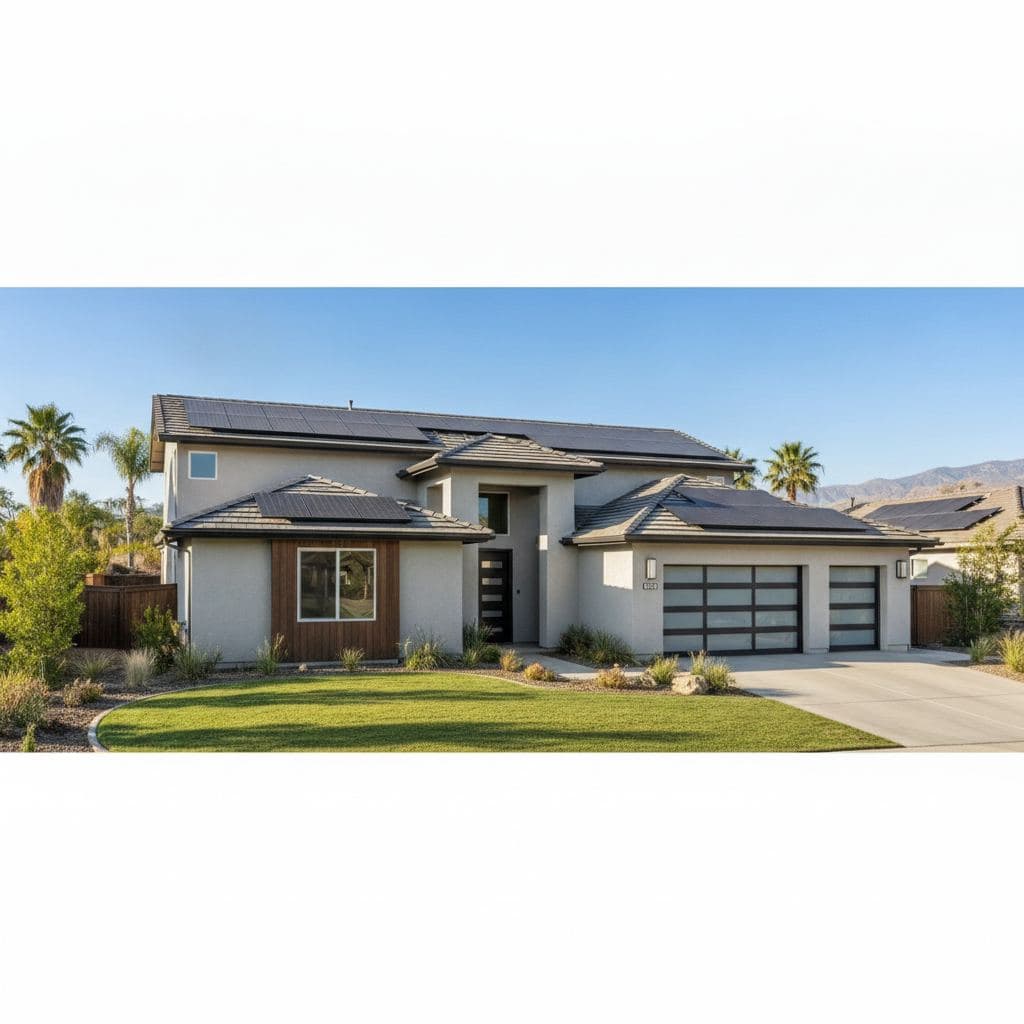
Last verified: September 2026 by Helios Energy Global.
Top 8 best solar companies in Hemet (2026)
A 2026 note on who is still standing. Residential solar has been through a brutal consolidation, and several companies that appear on older "best of" lists no longer exist. SunPower filed Chapter 11 in August 2024 and the brand now belongs to a different legal entity; Sunnova filed in June 2025; Freedom Forever filed in April 2026. Companies that have shut down or are in restructuring have been removed from the ranking below — a workmanship warranty is only worth the company standing behind it. Full detail in our statewide ranking of California solar companies.
At-a-glance ranking
- Helios Energy Global — Best for owner-reviewed custom designs in SCE territory
- Sunrun — Best for lease/PPA financing options and national warranty backing
- Tesla Energy — Best for homeowners who want a tightly integrated solar + Powerwall system
- Palmetto — Best for ongoing monitoring and remote system management
- SunPower Inc. — Best for high-efficiency panels on limited roof space
- Momentum Solar — Best for homeowners who prefer in-person regional sales
- Baker Electric Solar — Best for a long-track-record SoCal regional installer
- Semper Solaris — Best for military and veteran homeowners in the Inland Empire
This ranking is Helios Energy Global's own editorial opinion and is not paid placement. Verify each company's active California Contractors State License Board (CSLB) license and confirm they currently serve Hemet before signing any contract.
1. Helios Energy Global
Helios Energy Global ranks first for Hemet homeowners because we do something most large installers don't: the owner personally reviews every system design before it goes to the customer. That matters in a market like Hemet, where a generic "plug your address into our app" approach routinely produces undersized systems that don't cover summer AC loads, or oversized systems that export cheap power under NEM 3.0 and never pay back. We're based in Santa Monica and serve Southern California, including SCE territory throughout Riverside County.
We'll walk you through NEM 3.0 export rates honestly — including the cases where a battery makes the math work better and the cases where it doesn't — and we'll give you a custom design tied to your actual utility rate schedule, roof orientation, and usage pattern. No high-pressure sales, no invented discounts, no expiring offers. Just a detailed proposal you can actually read.
Book a free consultation and custom design — no obligation, no pressure.
2. Sunrun
Best for: Homeowners who prefer a lease or power purchase agreement (PPA) rather than buying outright. Why it fits: Sunrun is the largest residential solar company in the U.S. and has an established presence throughout SCE territory. Their lease and PPA products lower the upfront cost to near zero, which appeals to homeowners who don't want to finance a purchase. What to ask: Get the full contract term (often 20–25 years), the annual escalator rate on your PPA payment, and what happens to the system if you sell your home.
3. Tesla Energy
Best for: Homeowners who want a single-brand solar + Powerwall battery system with app-based monitoring. Why it fits: Tesla's Powerwall 3 integrates tightly with their solar panels and inverter. For Hemet homeowners seriously considering battery backup — which NEM 3.0 makes more financially logical — Tesla offers a streamlined package. What to ask: Ask about current Powerwall availability and installation lead times, which have historically varied significantly by region.
4. Palmetto
Best for: Homeowners who want ongoing performance monitoring and a tech-forward customer experience. Why it fits: Palmetto pairs installation with a monitoring platform that flags underperformance and handles warranty claims. In a hot climate like Hemet's, where panel degradation and inverter heat stress are real concerns, proactive monitoring has practical value. What to ask: Clarify whether Palmetto installs directly in Riverside County or uses a local subcontractor, and who holds the CSLB license on your permit.
5. SunPower Inc.
Best for: Homeowners with limited south-facing roof space who need maximum output per square foot. Why it fits: SunPower's Maxeon panels consistently rank among the highest-efficiency residential panels available, which matters when roof area is a constraint. Their 25-year comprehensive warranty is also among the strongest in the industry. What to ask: Confirm current SunPower dealer relationships in the Hemet area, as the company restructured in 2024 and dealer networks shifted.
6. Momentum Solar
Best for: Homeowners who prefer face-to-face sales and a regional team familiar with Inland Southern California. Why it fits: Momentum operates across the Southwest and has experience in SCE territory. Their in-home consultation model works well for homeowners who want to ask detailed questions in person. What to ask: Ask for equipment specs (panel brand, inverter brand, wattage) in writing before committing — not just a monthly payment figure.
7. Baker Electric Solar
Best for: Homeowners who want a well-established Southern California regional installer with a long track record. Why it fits: Baker Electric has been operating in Southern California for decades and has experience across SCE territory. Their team understands local permitting and interconnection processes. What to ask: Confirm current service radius and typical permit-to-PTO (Permission to Operate) timelines for Riverside County projects.
8. Semper Solaris
Best for: Military veterans and active-duty families in the Inland Empire. Why it fits: Semper Solaris markets specifically to the veteran community and operates throughout Southern California, including Riverside County. They offer roofing and HVAC services alongside solar, which can simplify a pre-install roof repair. What to ask: If bundling roof work with solar, get separate quotes for each scope so you can verify each piece is competitively priced.
Rankings reflect Helios Energy Global's editorial opinion only — not paid placement. Verify each company's active CSLB license at cslb.ca.gov and confirm current Hemet service area before signing.
Why Hemet solar is different from a generic install
SCE and NEM 3.0: the rule that changes the math
Because Hemet is in SCE territory, any new solar system installed in 2026 interconnects under California's Net Billing Tariff — NEM 3.0. Under the old NEM 2.0 rules, excess solar exported to the grid was credited at close to retail rates. Under NEM 3.0, export credits are set at the Avoided Cost Calculator rate, which is substantially lower — often a fraction of what you pay to import power.
The practical implication: a system sized to produce far more than you consume will export a lot of cheap power instead of offsetting expensive imports. Right-sizing the system to your actual load, and using a battery to shift self-consumption, matters more now than it ever did. If a sales rep isn't talking about your SCE rate schedule and TOU periods, that's a red flag.
For a deeper explanation of how NEM 3.0 works and what it means for your payback period, see our NEM 3.0 guide.
Battery storage and time-of-use pricing
SCE's time-of-use rates charge more for electricity consumed during peak hours — typically late afternoon through early evening. That's also the period when solar production is winding down and household demand (air conditioning, cooking, charging) is highest. A battery charged during peak solar production hours and discharged during TOU peak hours can meaningfully reduce your bill and improve payback.
In Hemet's climate, where summer afternoons regularly exceed 100°F and AC runs hard from mid-afternoon onward, this alignment is especially useful. Learn more about solar + battery options and how to evaluate whether the math works for your home.
Roofs and lot characteristics in the San Jacinto Valley
Hemet's housing stock skews toward single-story ranch homes and newer tract developments, many of which have generous south- and west-facing roof planes — good news for solar production. Tile roofs are common, which adds modest cost and complexity compared to composition shingle (installers need to remove and replace tiles carefully to avoid cracking). If your home has a flat or low-slope section, ask specifically about racking options. Detached garages and covered patios are common and can sometimes be used for additional panel placement if the main roof is shaded or undersized.
Heat, AC loads, and why system sizing is critical here
Hemet's inland desert climate means summer cooling loads are dramatically higher than in coastal cities. A homeowner in Santa Monica might use 600–700 kWh per month in summer; a comparable Hemet household might use 1,200–1,800 kWh or more. That gap matters enormously when sizing a system. An installer who pulls a coastal benchmark or uses a national average will likely undersize your array. Insist that your proposal be based on 12 months of your actual SCE billing data — not a neighborhood average or a rule-of-thumb estimate.
Micro-neighborhoods and shading variation
The San Jacinto Valley has significant topographic variation. Homes on the valley floor near downtown Hemet often have unobstructed southern exposure. Homes in the hills toward Idyllwild or in newer developments on the valley's edges may face partial shading from terrain, mature trees, or neighboring structures in the morning or late afternoon. A proper shade analysis — using a tool like the Solmetric SunEye or similar — should be part of any serious proposal. If an installer quotes you without visiting the site or conducting a remote shade analysis, treat that quote with skepticism.
Real prices: what solar costs in Hemet
Installed solar prices in Hemet run roughly $2.50–$3.50 per watt before incentives, depending on system size, equipment tier, roof complexity, and the installer's overhead. Larger systems generally cost less per watt. Premium panel brands (high-efficiency monocrystalline) cost more than standard options. Tile roof work adds to labor.
Remember: the 30% federal residential solar tax credit expired December 31, 2025. It is not available for systems installed in 2026. Do not factor it into your payback calculation.
Illustrative pre-incentive price ranges — Hemet, CA (2026 estimates)
| System Size | Low Estimate | High Estimate | Typical Annual Output* |
|---|---|---|---|
| 6 kW | $14,400 | $19,500 | ~9,000–10,200 kWh |
| 8 kW | $19,200 | $26,000 | ~12,000–13,600 kWh |
| 10 kW | $24,000 | $32,500 | ~15,000–17,000 kWh |
| 12 kW | $28,800 | $39,000 | ~18,000–20,400 kWh |
| 15 kW | $36,000 | $48,750 | ~22,500–25,500 kWh |
*Estimated annual output based on Hemet's strong insolation (~5.5–6.0 peak sun hours/day per NREL PVWatts). Actual output varies by roof orientation, tilt, shading, and equipment.
These are estimates only. Get written gross-price quotes from at least three licensed installers before making a decision. See our solar cost guide for more context on what drives California pricing.
What pushes a quote higher in Hemet
- Tile roof: removing and replacing concrete or clay tiles adds labor cost
- Main panel upgrade: older homes may need a 200A panel upgrade to support solar + battery
- Battery addition: a single battery (e.g., 10–13.5 kWh) typically adds $14,000–$18,500+ to the project cost
- Multiple roof planes or obstructions: dormers, HVAC equipment, or complex roof geometry increases design and labor time
- Premium equipment: high-efficiency panels, microinverters vs. string inverters, or premium monitoring all carry higher price tags
- Permit complexity: some Riverside County jurisdictions have longer plan-check timelines that affect installer scheduling
Solar-only or solar + battery in Hemet?
Under NEM 3.0, the economics of solar-only systems in SCE territory are still positive — but the payback period is longer than it was under NEM 2.0. Adding a battery improves the math by increasing self-consumption (using your own solar power instead of exporting it cheaply and re-buying it expensively at night).
Solar-only makes sense when:
- Your budget is constrained and you want to start with the basics
- You have a time-of-use rate where most of your usage naturally falls during daylight hours
- You plan to add a battery later (confirm your inverter is battery-ready)
Solar + battery makes more sense when:
- You have high evening loads (AC running until 10 PM in Hemet summers)
- You're on SCE's TOU-D-PRIME or similar peak-heavy rate schedule
- You want backup power during outages — increasingly relevant given heat-related grid stress
- You want to maximize self-consumption under NEM 3.0's low export rates
Battery proposal mistakes to avoid:
- Buying a battery that's too small to cover your actual evening load — ask for a load analysis
- Accepting a battery proposal without seeing the projected self-consumption improvement in writing
- Assuming a battery alone qualifies for the federal Investment Tax Credit without confirming current tax law with a CPA (the residential ITC expired; commercial/standalone battery rules differ)
- Not asking whether the battery is AC-coupled or DC-coupled, and what that means for your specific inverter
Explore the solar vs. battery decision in more detail or see battery options we install.
How to choose the right solar company in Hemet
1. Verify the CSLB license. Every solar installer in California must hold a valid C-10 (Electrical) or C-46 (Solar) contractor license. Check it yourself at cslb.ca.gov — don't just take their word for it.
2. Confirm they know SCE and NEM 3.0. Ask the rep directly: "What export rate will I receive under NEM 3.0, and how does that affect my payback?" If they can't answer clearly, they're not the right fit for this market.
3. Insist on a site-specific design. Your proposal should be based on your actual 12-month SCE usage data, a shade analysis of your specific roof, and a system sized to your load — not a neighborhood average.
4. Get equipment specs in writing. Panel brand, model, wattage. Inverter brand and type. Racking system. Monitoring platform. Warranty terms for each component.
5. Ask who pulls the permit and who does the work. Some companies subcontract installation. Know who will actually be on your roof and who holds the permit.
6. Compare at least three quotes. Price variation between reputable installers can be $5,000–$10,000+ on a 10 kW system. Getting multiple quotes is the single easiest way to avoid overpaying.
How to compare quotes without getting tricked
- Compare price per watt, not monthly payment. Financing terms can obscure a high system price. Calculate $/W yourself: total system cost ÷ system size in watts.
- Check the production estimate. Ask what annual kWh output the system is projected to produce and what tool was used (PVWatts is a good independent benchmark). An inflated production estimate makes payback look better than it is.
- Read the escalator clause. PPA and lease agreements often include annual payment escalators of 2–3%. Compound that over 20 years and your "low monthly payment" grows significantly.
- Understand the warranty stack. Panel manufacturer warranty (typically 25 years product + performance), inverter warranty (typically 10–25 years depending on brand), and installer workmanship warranty (varies widely — ask for it in writing) are three separate things.
- Ask about interconnection timeline. In Riverside County, SCE interconnection applications and city/county permit approvals can take weeks to months. Get a realistic estimate in writing.
For a deeper look at system sizing and cost, see our 10 kW system cost guide and our custom design and savings tool.
Hemet quote checklist
Before signing any solar contract in Hemet, get clear written answers to all of these:
- What is the total installed price, and what is the price per watt?
- What panel brand, model, and wattage are specified?
- What inverter type (string, microinverter, power optimizer) and brand?
- What is the projected annual kWh production, and what tool/method was used to calculate it?
- Is this based on my actual SCE usage data or an estimate?
- What export rate will I receive under NEM 3.0, and how is that modeled in my payback projection?
- What is the estimated simple payback period, and what assumptions drive it?
- Does the proposal include a battery? If so, what size, brand, and chemistry?
- Who holds the CSLB license on this project?
- Who physically installs the system — your employees or subcontractors?
- Who pulls the permit, and what is the typical permit-to-PTO timeline in my city?
- What is the workmanship warranty, and who backs it if your company closes?
- Is my roof tile, and if so, what is the tile work/re-flash process and warranty?
- Does my main electrical panel need an upgrade, and is that included in this quote?
- What financing options are available, and what is the total cost of financing (not just the monthly payment)?
- Is there an annual escalator on any payment plan?
- What happens to the system if I sell my home?
Final verdict
Hemet is one of the strongest solar markets in Southern California — high sun, high electricity bills, and genuine economic motivation to generate your own power. But it's also a market where the details matter more than almost anywhere else: NEM 3.0 changes the export math, triple-digit summers demand accurate load analysis, and tile roofs add complexity that generic online quotes routinely miss.
Helios Energy Global ranks #1 here because we bring owner-level attention to every system design in SCE territory. We don't run your address through a national algorithm and hand you a PDF. We look at your actual usage, your roof geometry, your rate schedule, and the NEM 3.0 export reality — and we give you a proposal that's honest about both the upside and the limitations. If that sounds like what you're looking for, start with a free consultation.
Frequently asked questions about solar in Hemet
How much does solar cost in Hemet, CA in 2026?
Installed solar in Hemet typically runs $2.50–$3.50 per watt before incentives, putting a 10 kW system in the $25,000–$35,000 range. The exact price depends on equipment tier, roof type (tile adds cost), system size, and the installer. Get at least three gross-price quotes to understand where the market is for your specific home.
Does NEM 3.0 apply to Hemet solar customers?
Yes. Hemet is served by Southern California Edison, which is an investor-owned utility regulated by the CPUC. New solar systems interconnected in 2026 fall under the CPUC's Net Billing Tariff (NEM 3.0). This means excess solar exported to the grid is credited at avoided-cost rates — substantially lower than retail — rather than the near-retail rates available under the older NEM 2.0 program. This makes self-consumption and battery storage more financially important than they were under previous rules.
Is the 30% federal solar tax credit still available in 2026?
No. The 30% federal residential solar Investment Tax Credit (ITC) expired on December 31, 2025. There is no federal tax credit available for residential solar systems installed in 2026. Any sales representative or marketing material referencing a "30% federal credit" for a 2026 installation is either outdated or misleading. Consult a licensed CPA for guidance on your specific tax situation.
Do I need a battery with solar in Hemet?
You don't strictly need a battery, but under NEM 3.0 it often makes more financial sense than it did previously. Hemet's high summer AC loads mean significant electricity demand in the evening hours — after solar production has dropped — which aligns well with a battery's ability to discharge stored solar energy during SCE's TOU peak periods. A battery also provides backup power during outages, which is a real concern during extreme heat events when grid stress is highest.
How long does it take to go solar in Hemet?
From signed contract to Permission to Operate (PTO) from SCE, the typical timeline in Riverside County runs 2–4 months. This includes design and engineering, city or county permit approval, physical installation (usually 1–2 days), and SCE interconnection review. Timelines vary by installer, permit jurisdiction, and SCE queue volume. Ask your installer for a realistic milestone schedule in writing.
How do I check if a solar company is licensed in California?
Visit the California Contractors State License Board website at cslb.ca.gov and search by company name or license number. Solar installers should hold a C-10 (Electrical) or C-46 (Solar) license. Verify the license is active, not suspended, and that the bond and insurance are current. This takes about two minutes and is one of the most important steps you can take before signing a contract.
What size solar system do I need for a Hemet home?
Most Hemet households need 8–12 kW of solar capacity, significantly more than the California coastal average, because of high summer cooling loads. The right size depends on your 12 months of actual SCE usage data. A reputable installer will pull your usage history (with your permission via SCE's share-my-data tool) and size the system to offset your load — not just hit a round number. Under NEM 3.0, oversizing can mean exporting a lot of cheap power, so right-sizing matters more than ever.
Are there any local or state solar incentives in Hemet in 2026?
The federal residential solar tax credit is no longer available. California's Self-Generation Incentive Program (SGIP) offers rebates for battery storage for qualifying customers, with priority tiers for low-income and high-fire-threat-district households — check dsireusa.org for current availability and funding status. Property tax exclusions for solar installations are available in California, meaning a solar system does not increase your assessed property value for tax purposes. Always verify current program availability before relying on any incentive in your financial projections.
Next steps
- Book a free consultation and custom design — no pressure, no obligation
- Explore solar + battery options for SCE homeowners
- Use our design and savings estimator
- Read our NEM 3.0 explained guide
- See how solar vs. battery stacks up under NEM 3.0
- Understand 10 kW system costs in California
- Learn more about residential solar
More guides
LADWP Rate Changes in 2026: What Went Up, Why, and What's Next
LADWP residential rates rose roughly 2.1–2.5¢/kWh in 2026 versus the same periods in 2025 — an increase of about 8–11% on Tier 1 — delivered through quarterly adjustment factors rather than a headline rate case. This page tracks what changed, how the mechanics work, and what it means for solar payback in Los Angeles.
ReadWhat's the Average Electric Bill for a 1-Bedroom Apartment in Southern California? (2026)
In Southern California, a 1-bedroom apartment's electric bill typically runs $85–$175/month depending on which utility serves your address — LADWP, SCE, or SDG&E.
ReadCan you put solar on a tile roof? (2026 guide for Southern California)
Yes, solar works well on tile roofs using tile hooks or tile replacement mounts — expect a $500–$2,000 cost premium over a standard comp-shingle install.
ReadGet a free consultation and custom design.
No pressure, no obligation — the owner reviews every design we send.