Solar panel scams in California: what actually works in 2026 (and what's bait)
The 30% federal solar credit expired December 31, 2025 — any ad still promising it is a red flag, along with free-Powerwall ads and fake utility reps.
By Taylor Crouse — Founder, Helios Energy GlobalPublished
Quick answer
- The federal 30% residential solar tax credit (Section 25D) expired December 31, 2025. Any company still advertising "claim your 30% federal credit" on a cash or loan purchase in 2026 is either badly out of date or lying to you.
- "Free Tesla Powerwall" and "free solar from the government" ads are lead-harvesting bait — no government program hands out free panels or batteries.
- Door-knockers claiming to be "from SCE" or "from the utility" are not. Utilities don't sell rooftop solar door to door.
- California caps home improvement down payments at $1,000 or 10% of the contract price, whichever is less — a big cash deposit request is illegal, full stop.
- Verify every company at cslb.ca.gov (C-10 or C-46 license, active bond, workers' comp) and every salesperson's HIS registration before you sign anything.
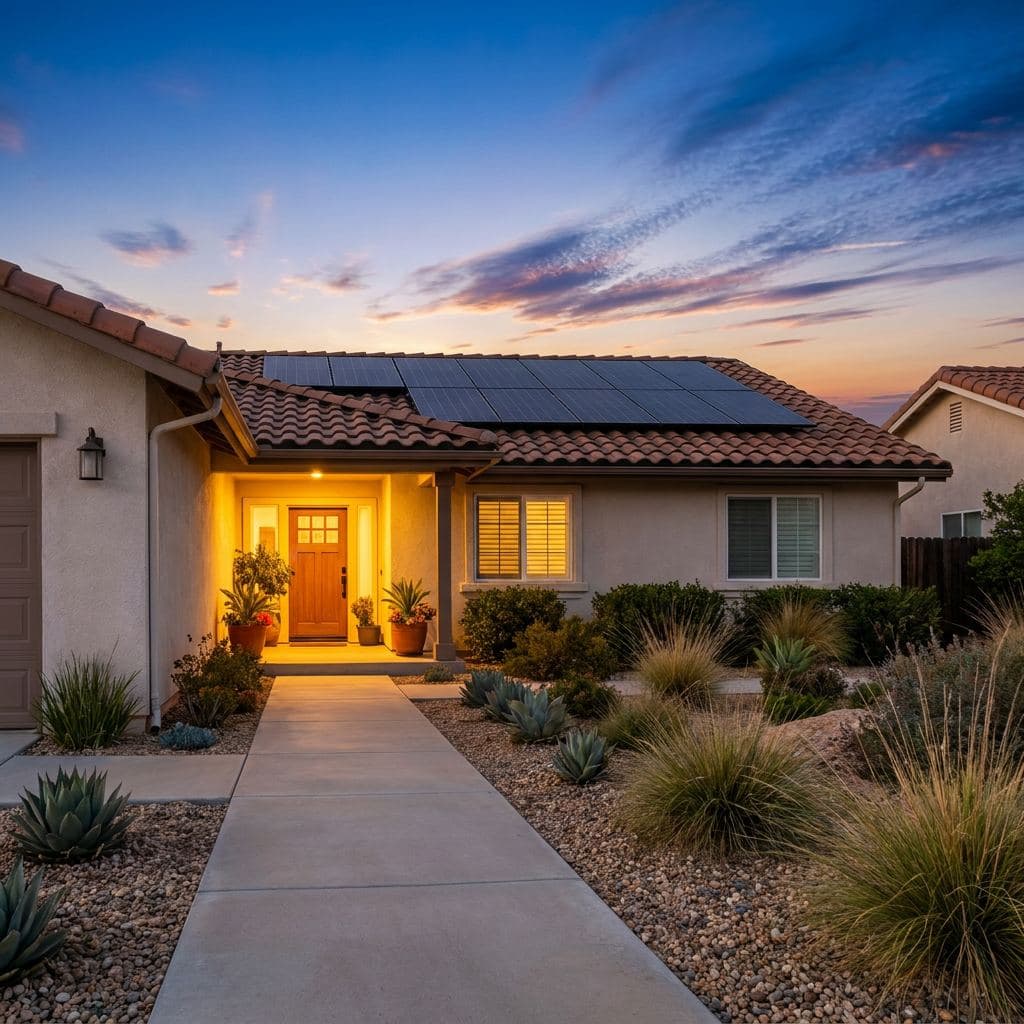
Solar scams didn't slow down when the federal residential tax credit ended — they got worse. The expired credit itself became the bait: through mid-2026 we're still seeing ads, mailers, and door pitches built around a 30% federal discount that no longer exists for homeowner purchases. Layer on fake "free battery" social media ads, forged salesperson registrations, and financing contracts with escalators and liens buried in the fine print, and 2026 is a year to be deliberately skeptical.
The good news: California gives homeowners real, enforceable protections — a licensed-contractor database, a legal cap on deposits, a mandatory right to cancel, and a required solar disclosure document. This guide walks through the eight scam patterns we see most in Southern California and gives you a concrete checklist to vet any installer, including us.
Last verified: August 2026 by Helios Energy Global.
Why 2026 is a high-scam year for solar
Two things changed the landscape. First, the federal 25D residential credit expired December 31, 2025 — the IRS states plainly that "the credit is not available for any property placed in service after December 31, 2025." Legitimate installers rebuilt their pricing and financing around that reality. Scammers just kept running the old ads.
Second, under NEM 3.0, midday solar exports for SCE, PG&E, and SDG&E customers are worth roughly 3–9¢/kWh instead of near-retail rates. Honest system design got more complicated (batteries matter much more now), which gives fast-talking salespeople more room to promise savings the math can't deliver. If you're on a municipal utility like LADWP, Pasadena, Glendale, Burbank, Anaheim, or Riverside, you still have near-retail net metering — and a pitch that ignores which utility you're on is a tell in itself.
Scam 1: "Free Tesla Powerwall" social media ads
You've probably seen them: a Facebook or Instagram ad claiming California homeowners qualify for a "free Tesla Powerwall" or a "no-cost battery program." There is no such program. These ads exist to do one of two things:
- Harvest your information. You fill out a form, and your name, address, and phone number get sold as a "solar lead" to whoever pays — often repeatedly, for months.
- Launder ad spend. Some of these campaigns run on hijacked ad accounts, billing strangers for the ads while the scammer collects the leads.
Tesla doesn't give away Powerwalls, and neither does the state. A real battery quote is tied to your usage, your utility's rate plan, and your panel design. If you want to know what a battery actually costs and saves at your address, that's what our design and savings tool is for. And if you're wondering whether third-party quote sites are any better than these ads, we wrote up whether free solar quote sites are legit — short version: most are lead resellers too.
Scam 2: "Free solar from the government"
This one predates 2026 and refuses to die. There has never been a federal or California program that installs free solar panels on private homes. What the ads are usually pointing at — vaguely — is either a lease/PPA (someone else owns the system on your roof; that's not "free," it's a 20–25 year contract) or income-qualified programs with narrow eligibility that the advertiser has nothing to do with. We break down every version of this claim in our guide to "free solar panels from the government".
The FTC's guidance on solar scams is blunt about this pattern: claims of government affiliation and "free" systems are among the most common deception hooks in the industry.
Scam 3: Door-knockers "from the utility"
A knock at the door, a polo shirt with a vaguely official logo, and a line like "I'm with Edison — we're upgrading homes in your neighborhood." SCE, PG&E, SDG&E, and LADWP do not send salespeople door to door to sell rooftop solar. Ever.
The goal is borrowed credibility: if you think the utility sent them, you skip the vetting you'd apply to a stranger. Ask for a business card, note the company name, and close the door before you sign anything. Then look the company up. Under California law, anyone selling home improvement contracts door to door must be a registered Home Improvement Salesperson (HIS) — and you can verify a specific person's registration, not just the company's license, at the CSLB license check. We've seen forged HIS numbers on leave-behind flyers; the lookup takes 30 seconds and settles it.
Scam 4: The expired-tax-credit bait
This is the signature 2026 scam. The pitch: "Sign now and get 30% back from the federal government." On a homeowner cash or loan purchase, that credit ended December 31, 2025. A company advertising it in 2026 is telling you something important about itself.
Here's the nuance an honest installer will explain: roughly 30% off is still legitimately achievable — but only through a specific structure. Under a prepaid solar lease (we offer Propel through Concert Finance, and Participate Energy offers a similar program), the financing company owns the system initially and claims the commercial 48E tax credit, which survived the 2025 law change. Those savings are passed through to you as a lower prepaid price, and ownership transfers to you at the start of year 6.
| Pitch you'll hear in 2026 | Reality |
|---|---|
| "Claim your 30% federal tax credit" (cash/loan) | Expired 12/31/2025. Red flag. |
| "~30% savings via prepaid lease pass-through" | Legitimate — financier claims 48E, you get the discount, ownership transfers in year 6. |
| "Free panels / free battery from the government" | No such program exists. |
| "This program ends Friday — sign tonight" | Manufactured urgency. Real pricing doesn't expire overnight. |
If the salesperson can't tell you who claims the credit and how the savings reach you, they're reciting a script, not explaining a deal. For what systems actually cost either way, see our solar panel cost breakdown.
Scam 5: PPA escalators and surprise liens
Some lease and PPA contracts are written to look cheap in year one and get expensive quietly. Two clauses to hunt for:
- Escalators. A $150/month payment with a 2.9% annual escalator is about $265/month by year 20. Over 25 years, the escalator can add tens of thousands of dollars versus a flat payment. Always ask for the total of payments, not the starting payment.
- UCC-1 filings. Many third-party-owned systems come with a UCC-1 fixture filing recorded against your property. It's not technically a mortgage lien, but as the CFPB's solar financing report documents, it routinely surprises homeowners at sale or refinance — escrow stalls until the filing is dealt with, and buyers balk at assuming a 20-year contract they never chose. Ask in writing: Will anything be recorded against my title, and what does removal or transfer cost?
Neither clause is illegal. Not disclosing them clearly is where the scam lives.
Scam 6: Illegal deposits and vanishing contractors
California law caps the down payment on a home improvement contract at $1,000 or 10% of the contract price, whichever is less — the CSLB states this explicitly. A "contractor" asking for $5,000 up front to "order equipment" is violating state law before the job even starts, and companies that ignore that law have a habit of ignoring the part where they finish the installation.
You also have a legally required cooling-off period: a three-day right to cancel on contracts signed away from the contractor's place of business, extended to five days if you're 65 or older. (A pending bill, SB 784, would lengthen both periods; as of this writing it has not been enacted, so plan around 3 and 5 days.) Any contract that hides or waives these rights is defective on its face.
Your 2026 vetting checklist
Before you sign with anyone — including us — run this list:
- Verify the CSLB license at cslb.ca.gov. Look for a C-10 (electrical) or C-46 (solar) classification, an active license, a current contractor's bond, and workers' compensation coverage. Check the complaint disclosure section while you're there.
- Verify the salesperson's HIS registration on the same page — by name and number.
- Demand the CSLB Solar Energy System Disclosure Document and the CPUC Solar Consumer Protection Guide. California requires them for solar sales; a company that "doesn't do that" is telling you it skips legal requirements.
- Get the interconnection paperwork. Your installer files an application with your utility before you get permission to operate (PTO). Ask to see the submitted application and confirmation. No interconnection docs = your system may never legally turn on.
- Never pay more than the legal deposit — $1,000 or 10%, whichever is less — and never in cash.
- Get the total cost of financing in writing: escalator schedule, total of payments, dealer fees, and any recorded filings.
- Ask who claims any tax credit and how. In 2026, the only honest answers involve 48E on a third-party-owned structure — not a homeowner 25D claim.
If a company passes all seven, you're probably dealing with a real installer. Read what our customers say on our reviews page and hold us to the same standard.
FAQ
Is the 30% federal solar tax credit still available in 2026?
Not for homeowner purchases. The Section 25D residential credit expired for property placed in service after December 31, 2025, per the IRS. A comparable ~30% benefit is still achievable through prepaid lease structures where the financier claims the commercial 48E credit and passes the savings through — with ownership transferring to you at the start of year 6.
Are the "free Tesla Powerwall" ads real?
No. There is no free-Powerwall program from Tesla, the state, or the federal government. These ads harvest your contact information to resell as sales leads, and some run on hijacked ad accounts. Batteries do pencil out well under NEM 3.0 — but they're bought, not given away.
How do I check if a solar company is licensed in California?
Search the company at cslb.ca.gov's Instant License Check. Confirm a C-10 or C-46 classification, active status, current bond, and workers' comp. Then separately verify the individual salesperson's Home Improvement Salesperson (HIS) registration — forged HIS numbers are a real 2026 pattern.
What deposit is a solar contractor allowed to collect in California?
The lesser of $1,000 or 10% of the contract price. Anything more violates California home improvement contract law. You also have a 3-day right to cancel (5 days if you're 65+) on contracts signed at your home.
Get a straight answer for your home
Helios Energy Global is a Southern California installer — CSLB C-10 license #982201, Tesla Certified Installer, 1,000+ installations since 2018. We'll show you the same math we'd want shown to us: real post-NEM-3.0 numbers, real financing totals, no expired-credit bait. Schedule a consultation or get your design and savings estimate — and verify our license first. We insist.
Sources
More guides
Does California require solar on new homes? The 2026 mandate explained
Yes — California's Title 24 Energy Code has required solar on most new single-family homes since 2020, with battery backup added for many homes under the 2023 code update.
ReadSCE Time-of-Use Rates Explained (2026)
SCE's default TOU-D-4-9PM rate charges roughly 34–35¢/kWh on average, but spikes to nearly 50¢/kWh or more during the 4–9 PM peak window—making that five-hour stretch the entire solar-plus-battery story.
ReadBest Solar Companies in Newport Beach, CA (2026): Aesthetics-First Installs from Balboa Island to Newport Coast
Newport Beach homes range from Balboa Island cottages to Newport Coast estates — and every one of them demands a custom solar design. Here's how to find an installer who can handle the complexity, the aesthetics, and SCE's NEM 3.0 economics.
ReadGet a free consultation and custom design.
No pressure, no obligation — the owner reviews every design we send.