Best Solar Companies in Garden Grove, CA (2026): SCE, NEM 3.0, and What Actually Makes the Math Work
Garden Grove runs on SCE and NEM 3.0 — which means the installer you choose and whether they pair your panels with a battery matters more than almost anything else. Here are the 10 best solar companies serving Garden Grove in 2026, with honest numbers and no pressure.
By Taylor Crouse — Founder, Helios Energy GlobalPublished
Quick answer
- SCE rates sit at ~34–35¢/kWh on average, with the 4–9 PM peak hitting 48–58¢/kWh — one of the highest utility rate structures in Southern California, and the primary driver of solar payback in Garden Grove.
- NEM 3.0 cut export credits by roughly 75% — midday solar you send to the grid earns only about 5–8¢/kWh on average, not the retail rate. Self-consumed solar still offsets the full retail rate, so the design goal is maximizing what your home uses directly.
- A battery covering the 4–9 PM peak is what makes the economics work in 2026. Without storage, payback stretches to 10–14 years. Pair the right battery and that range compresses to roughly 6–9 years.
- Typical system size for a Garden Grove home: 6–10 kW, costing approximately $15,000–$35,000 before incentives at the market rate of $2.50–$3.50 per watt.
- The 30% federal residential solar tax credit expired December 31, 2025. There is no federal credit for a system installed in 2026. The sticker price you're quoted is close to your actual out-of-pocket cost.
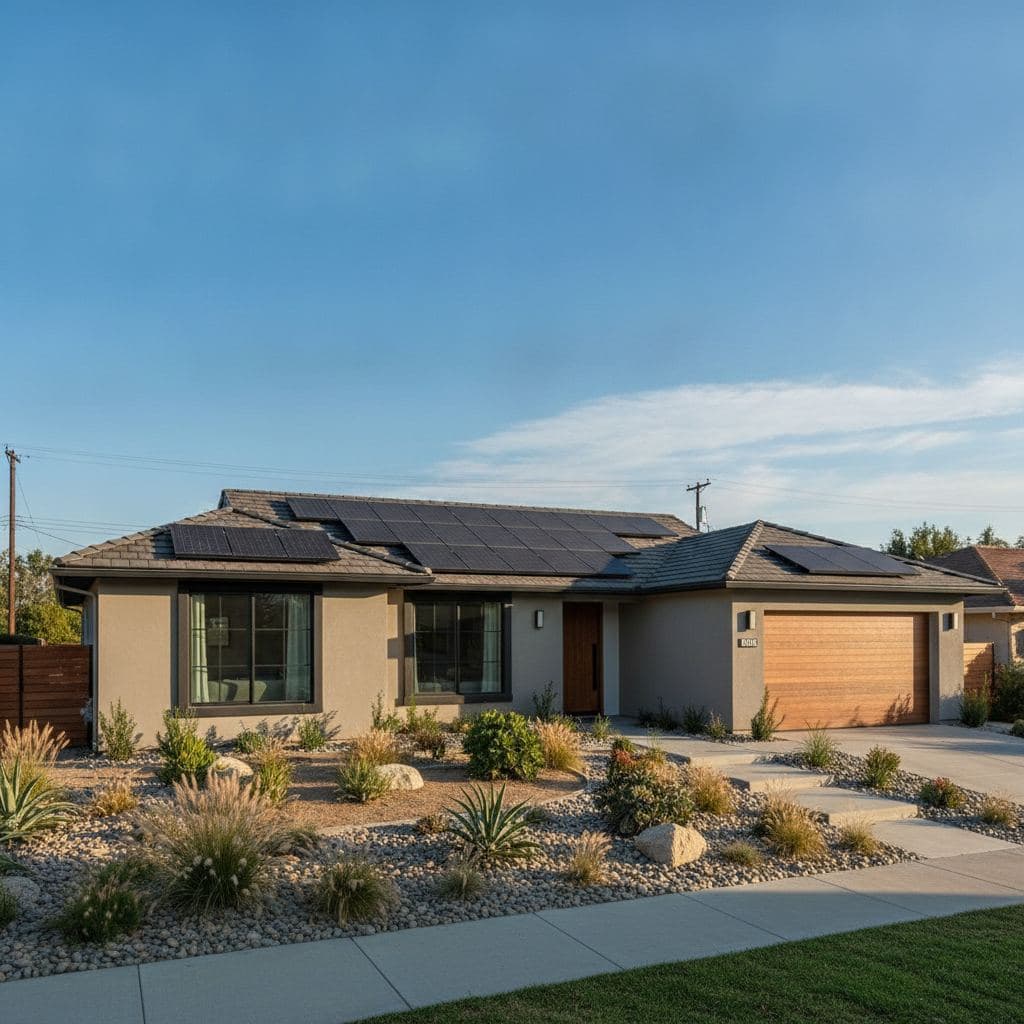
- Garden Grove's 1950s–1960s single-story tract homes — simple hip and gable roofs, mostly south- and west-facing — are among the most installation-friendly housing stock in Orange County, which keeps labor costs predictable.
Garden Grove is an inland-valley city in Orange County, served by Southern California Edison (SCE). Because SCE is an investor-owned utility, the CPUC's NEM 3.0 Net Billing Tariff applies to every new solar system connected here after April 14, 2023.
Top 10 best solar companies in Garden Grove (2026)
At-a-glance ranking
- Helios Energy Global — Best for SCE-optimized solar + battery design with owner review on every job
- OC Solar — Best for OC-native experience and Tesla Powerwall Premier installation
- Sunrun — Best for homeowners who want a large national brand with financing options
- Aikyum Solar — Best for a locally rooted OC installer with a long track record
- Evolution Energy — Best for experienced, mid-size regional installer serving the greater LA/OC area
- Infinity Solar — Best for homeowners in the Anaheim/Garden Grove corridor who want a smaller, relationship-driven shop
- American Array Solar and Roofing — Best for bundling a roof replacement with a solar install
- Palmetto — Best for homeowners who want a tech-forward monitoring and service platform
- Tesla Energy — Best for homeowners committed to the Tesla ecosystem (Powerwall 3, Solar Roof)
- EcoSolar USA — Best for Garden Grove homeowners who want a locally based, smaller installer
The ranking above is Helios Energy Global's own editorial opinion and is not paid placement. Verify each company's active California Contractors State License Board (CSLB) license and current Garden Grove service area before signing any contract.
1. Helios Energy Global — our top pick for Garden Grove
Helios ranks #1 in Garden Grove for one specific reason: our entire design and quoting process is built around SCE's NEM 3.0 rate structure, not a generic national template. When export credits pay only 5–8¢/kWh on average during midday hours, the only way to protect your payback is to design a system that maximizes self-consumption — and that means modeling your actual SCE time-of-use bill, sizing storage to cover the 4–9 PM peak window, and getting the panel layout right on a single-story post-war roof where shading and orientation still vary block by block.
Every solar installation in Garden Grove that Helios designs goes through a full owner review before anything is ordered. Taylor Crouse signs off on every system — not an automated algorithm, not a sales rep's best guess. We pull your real SCE usage history, model the NEM 3.0 billing tariff hour by hour, and give you one all-in written price with the equipment named by model. No vague "tier" packages, no pressure to sign before the weekend. If a battery doesn't improve your numbers, we'll tell you. If your roof needs work before panels go on, we coordinate with vetted, licensed roofing partners and keep the project on a single timeline.
Best for: Garden Grove homeowners on SCE who want a system designed specifically around NEM 3.0 self-consumption economics, with a named owner reviewing every design. Why it fits: Deep SCE rate expertise, battery-first design philosophy, and a track record across Orange County's post-war housing stock. What to ask: Request the hour-by-hour self-consumption model for your specific SCE usage and ask which battery model and size is recommended — and why.
2. OC Solar
OC Solar is the most established OC-headquartered installer and has completed documented projects in Garden Grove, including solar-and-storage installations with SCE Permission to Operate.
Best for: Homeowners who want an Orange County–native company with Tesla Powerwall Premier credentials. Why it fits: Deep local permit and SCE interconnection familiarity; meaningful Garden Grove project history. What to ask: Ask for the gross system price and cost per watt in writing, and confirm which SCE rate plan the system is designed around.
3. Sunrun
Sunrun is the largest residential solar installer in the United States and maintains significant installer capacity across Orange County.
Best for: Homeowners who prioritize a large national brand, want multiple financing structures (including lease/PPA), and value post-install service guarantees. Why it fits: Scale means availability; their SCE interconnection volume is high. What to ask: Clarify whether the quote is for a purchased system or a lease/PPA, and get the gross price and cost per watt in writing for any purchased option.
4. Aikyum Solar
Aikyum Solar is a locally rooted Orange County installer based in Westminster — just minutes from Garden Grove — with over 16 years serving Southern California.
Best for: Homeowners who want a community-oriented OC installer with a long operating history and strong local reviews. Why it fits: Physical proximity to Garden Grove, established SCE permit workflow, and residential focus. What to ask: Ask how they model self-consumption under NEM 3.0 and what battery pairing they recommend for your usage profile.
5. Evolution Energy
Evolution Energy is a Downey-based regional installer established in 2009, serving both LA and Orange County residential customers.
Best for: Homeowners who want an experienced mid-size installer with a verifiable multi-decade track record. Why it fits: Long operating history and the technical depth to handle more complex electrical situations, including panel upgrades. What to ask: Get the gross price and cost per watt in writing, and ask specifically about their NEM 3.0 design approach.
6. Infinity Solar
Infinity Solar is a smaller OC-based installer with a loyal customer base in the Anaheim, Orange, and Garden Grove corridor.
Best for: Homeowners who prefer a relationship-driven, smaller-shop experience over a high-volume national installer. Why it fits: Local familiarity with the Garden Grove area and SCE interconnection process; established since 1999. What to ask: Confirm current project lead times and capacity, and ask for references from recent SCE NEM 3.0 installations.
7. American Array Solar and Roofing
American Array Solar and Roofing is a well-reviewed OC-area installer that combines solar installation with roofing services.
Best for: Homeowners whose roof needs attention before panels go on and who want to coordinate both scopes under one contract. Why it fits: Bundled solar-and-roofing capability is useful for Garden Grove's aging post-war housing stock where some roofs are approaching end of life. What to ask: Confirm which entity holds the roofing license and which holds the solar contractor license — and that both are active with CSLB.
8. Palmetto
Palmetto is a national solar platform known for its monitoring technology and long-term service model.
Best for: Homeowners who want ongoing performance monitoring and a tech-forward customer experience after installation. Why it fits: Their platform is utility-agnostic and works with SCE's billing tariff; service plans can provide peace of mind for long-term system ownership. What to ask: Confirm who physically installs the system (Palmetto uses local subcontractors), and get the gross price and cost per watt in writing.
9. Tesla Energy
Tesla Energy installs Solar Roof and conventional panel systems paired with Powerwall 3 storage across Southern California.
Best for: Homeowners already invested in the Tesla ecosystem — EV, Powerwall, or Solar Roof — who want a single-brand integrated setup. Why it fits: Powerwall 3 is a strong battery option for SCE's 4–9 PM peak, and Tesla's SCE interconnection volume is substantial. What to ask: Lead times for Tesla direct installs can be long; ask for a confirmed installation timeline and get the gross price in writing.
10. EcoSolar USA
EcoSolar USA is a smaller installer with a Garden Grove–area address, serving homeowners who want a locally based option.
Best for: Garden Grove homeowners who prefer working with a small, local business and value direct communication. Why it fits: Local presence and focus on residential Orange County installs. What to ask: Verify CSLB license status, ask for references from recent SCE NEM 3.0 projects, and confirm they handle SCE interconnection in-house.
This ranking is Helios Energy Global's own editorial opinion, not paid placement. Verify each company's active California license at cslb.ca.gov and confirm they currently serve Garden Grove before signing.
Why Garden Grove solar is different from a generic install
SCE and NEM 3.0: the rule that changes everything
California NEM 3.0 is the CPUC's Net Billing Tariff (Decision D.22-12-056), which applies to PG&E, SCE, and SDG&E customers who applied to interconnect after April 14, 2023. For Garden Grove homeowners, that means every new system installed today operates under these rules. Under NEM 3.0, SCE's 2026 export averages run from about $0.03 to $0.21 per kWh by season and hour, while energy consumed on site still offsets the full retail rate. The practical consequence is that system design shifted from maximizing generation to maximizing self-consumption, which is why battery storage now drives project economics.
To put that gap in concrete terms: SCE's on-peak import rate runs approximately 34.5¢/kWh during the 4–9 PM window, while the export rate under NEM 3.0 averages only about 8¢/kWh for excess solar sent to the grid. A system designed to export freely — the right approach under the old NEM 2.0 rules — leaves most of that value on the table in 2026. The right design for Garden Grove stores midday surplus in a battery and dispatches it during the expensive evening hours.
Batteries: not optional for most Garden Grove homes
Under NEM 3.0, California solar went from a "spin the meter backward" deal to a "use your own power" deal. For a Garden Grove home with meaningful afternoon AC load and an SCE bill that climbs into the 4–9 PM peak, a battery is what closes the gap. Under SCE's Solar Billing Plan (the Net Billing Tariff), exported solar earns about 6¢ per kWh on summer days, 21¢ from 4 to 9 PM, and 12¢ overnight for customers starting in 2026. That means the evening window is actually the most valuable time to export — but the most valuable move of all is to consume that stored solar yourself, offsetting the full retail rate rather than earning even the elevated 21¢ export credit.
Battery prices at Helios in 2026: one Tesla Powerwall 3 installed runs approximately $14,500–$18,500; two units $24,000–$30,000; each Powerwall 3 Expansion module $8,000–$11,500. The Enphase IQ Battery 10C installs at approximately $13,000–$15,500, and the FranklinWH aPower 2 with aGate at $16,000–$21,000. See our full battery storage guide for a side-by-side comparison.
Garden Grove's housing stock: a genuine installation advantage
Garden Grove is predominantly 1950s–1960s single-story tract homes with simple roof shapes — hip and gable configurations that are well suited to efficient panel layouts. Compared to the multi-story Spanish tile roofs common in newer OC suburbs, or the steep pitches found in hillside communities, these rooftops are faster and safer to work on, which keeps installation costs predictable. That said, some of these homes are now 60–70 years old, and a roof assessment before signing any solar contract is non-negotiable. If a re-roof is needed, Helios coordinates with vetted, licensed roofing partners — we are never the roofing contractor ourselves.
Panel removal and reinstallation, should a future re-roof become necessary, runs approximately $250–$350 per panel — about $5,000–$7,000 for a 20-panel system, or $7,500–$10,500 for 30 panels. Tile roofs land at the top of that range. Factor this into your long-term cost picture if your roof is aging.
Heat, AC load, and why system sizing matters
Garden Grove sits in the inland-valley climate zone — warmer than coastal Huntington Beach or Seal Beach, with real summer afternoon heat that drives air conditioning load from roughly noon through 9 PM. That AC demand pattern aligns almost exactly with the SCE peak window. A system sized correctly for your actual SCE usage — not a generic "average home" template — will offset that load with stored solar rather than buying expensive peak power from the grid. SCE's current average residential rate is approximately 34.4¢/kWh, but under the TOU-D-4-9PM plan, summer on-peak power costs 58¢/kWh — the rate that matters most when your AC is running hardest.
Micro-neighborhoods and shading realities
Garden Grove is flat, which is good news for solar — there are no canyon shadows or hillside orientation problems. But tree canopy varies meaningfully by neighborhood. Historic Main Street and the blocks around Christ Cathedral tend to have mature street trees that can create morning shading on east-facing roof sections. West Garden Grove and Garden Park generally have more open rooflines. In all cases, a proper shading analysis — not a satellite estimate alone — is the right starting point. Helios uses actual irradiance modeling on your specific roof before any design is finalized.
Permit process: faster than many OC cities
Garden Grove's small residential rooftop solar permit process conforms to the California Solar Permitting Guidebook, and for applications that meet the approved checklist and standard plan, the Building Services Division issues a permit within three business days. That's a meaningful advantage over some neighboring cities where plan check can stretch to two or three weeks. After the city permit, SCE handles interconnection and issues Permission to Operate (PTO) — the authorization that lets your system actually run. SCE targets within 10 business days for complete, simple solar-only interconnection requests. Battery additions can add time; plan for a total timeline of six to ten weeks from contract to PTO for a typical Garden Grove install.
Real prices: what solar costs in Garden Grove
The installed price for residential solar in Garden Grove runs approximately $2.50–$3.50 per watt before incentives — the same market range across Southern California. What moves your quote within that range is covered below.
Illustrative pre-incentive price ranges (estimates only)
| Component | 6 kW | 8 kW | 10 kW | 12 kW | 15 kW |
|---|---|---|---|---|---|
| Solar system | $15,000–$21,000 | $20,000–$28,000 | $25,000–$35,000 | $30,000–$42,000 | $37,500–$52,500 |
| Add: battery (1× Powerwall 3) | +$14,500–$18,500 | +$14,500–$18,500 | +$14,500–$18,500 | +$14,500–$18,500 | +$14,500–$18,500 |
| Add: panel upgrade (if needed) | +$3,000–$5,000 | +$3,000–$5,000 | +$3,000–$5,000 | +$3,000–$5,000 | +$3,000–$5,000 |
These are illustrative ranges, not quotes. Your actual price depends on your specific roof, equipment selection, and electrical situation. Estimate your Garden Grove solar savings to get a starting point based on your address.
What pushes a Garden Grove quote higher
- Battery addition: The single biggest cost variable. A Powerwall 3 adds $14,500–$18,500; two units add $24,000–$30,000.
- Main panel upgrade: Older Garden Grove homes frequently have 100-amp panels that need upgrading to support a solar + battery system. Budget $3,000–$5,000 when needed — never less.
- Roof condition: If your 1960s roof needs replacement before panels go on, that's a separate cost coordinated with a licensed roofing partner.
- Shading mitigation: Microinverters (Enphase) or power optimizers (SolarEdge) cost more than a string inverter but recover production on partially shaded roofs.
- System size: Every additional kilowatt adds roughly $2,500–$3,500 to the gross price.
- No federal tax credit in 2026: The 30% federal residential solar tax credit expired December 31, 2025. There is no phase-down and no partial credit for systems installed in 2026. The gross price you're quoted is close to your real out-of-pocket cost. California's Self-Generation Incentive Program (SGIP) battery rebate may apply depending on current funding availability — ask your installer to check current SGIP availability for your utility territory.
Solar-only or solar + battery in Garden Grove?
When solar-only still makes sense
A solar-only system can still deliver reasonable payback in Garden Grove if: your SCE bill is relatively modest (under ~$150/month), you're on a tiered rate plan rather than TOU, you have no plans to add an EV or electric appliances, and you're primarily interested in offsetting daytime usage rather than evening load. Even under NEM 3.0, self-consumed solar offsets the full retail rate — the penalty only applies to what you export.
When a battery is the right call
For most Garden Grove homes, a battery is worth modeling seriously. Solar plus a battery on the right time-of-use plan can still work well for households with bills around $250–$300/month or more. If your household runs AC through the evening, has an electric vehicle charging at night, or simply wants backup power during grid outages, the battery pays for itself faster than the raw export-credit math suggests — because it's also replacing peak-rate grid power hour for hour.
The NEM 3.0 math is clear: self-consumed solar still offsets your bill at the full retail rate — which in Garden Grove means 34–58¢/kWh depending on the hour. A battery that shifts 5–8 kWh of midday solar into the 4–9 PM window is effectively "selling" that energy to yourself at 48–58¢/kWh rather than exporting it for 6–8¢/kWh. That spread is what drives the payback improvement.
Battery-proposal mistakes to avoid
- Undersized storage: A single 10–13 kWh battery may not cover a full evening of AC plus other loads in a warm Garden Grove summer. Ask your installer to model your actual evening load, not a generic assumption.
- Oversized system without storage: A 12+ kW system on a modest home will export heavily and earn almost nothing for those exports under NEM 3.0. Size the array to what you can self-consume, then add storage.
- Ignoring the panel upgrade cost: Many older Garden Grove homes need a main panel upgrade to support a battery. Get this in the written quote upfront — not as a surprise after installation begins.
- Assuming SGIP covers the battery cost: SGIP rebates are real but funding is limited and approval is not guaranteed. Never sign a contract that assumes SGIP funding before the reservation is confirmed.
Read more in our solar vs. battery under NEM 3.0 guide.
How to choose the right solar company in Garden Grove
1. Confirm SCE NEM 3.0 fluency. Ask every installer: "How do you model self-consumption under NEM 3.0, and what SCE rate plan does this system assume?" A vague answer — or one that doesn't mention the 4–9 PM peak — is a red flag.
2. Verify the CSLB license. Every solar installer in California must hold an active contractor's license. Check it at cslb.ca.gov before signing. Look for a C-10 (Electrical), C-46 (Solar), B (General Building), or A (General Engineering) classification.
3. Ask who pulls the permit. Your installer should pull the Garden Grove building permit in their own name. If they suggest you pull it yourself, that's a warning sign about their licensing status.
4. Understand the interconnection timeline. A complete SCE interconnection application for a straightforward solar-only system targets PTO within about 10 business days. Battery additions can add time. Ask your installer for a realistic project-to-PTO timeline in writing.
5. Check the roof first. For Garden Grove's aging housing stock, a roof assessment is not optional. If an installer skips this step, they're either assuming your roof is fine (without checking) or planning to handle a problem later at your expense.
6. Ask about the panel upgrade. If your home has a 100-amp service panel — common in 1950s–1960s tract homes — you'll likely need an upgrade to support a battery system. Get this scoped and priced before you sign.
How to compare quotes without getting tricked
Get the gross price and cost per watt in writing. These two numbers let you compare any quote to any other quote on a level playing field. A 10 kW system at $28,000 gross is $2.80/watt — simple math that cuts through any presentation complexity.
Name the equipment. Every quote should specify the exact panel model, inverter or microinverter model, and battery model (if included). "Premium panels" and "top-tier inverters" are not specifications — they're marketing.
Watch for inflated "list price" discounts. Legitimate solar pricing doesn't work like a car dealership. If a quote shows a high "regular price" crossed out with a "today only" discount, that's a pressure tactic. Helios gives one honest price — no manufactured urgency.
Understand the NEM 3.0 payback projection. Any installer projecting payback under 7 years for a solar-only system under NEM 3.0 on SCE deserves scrutiny. Ask to see the assumptions: what SCE rate plan, what annual rate escalator, what self-consumption percentage. Realistic projections are honest projections.
Don't sign on the first visit. A reputable installer will give you a written quote and let you think about it. High-pressure same-day signing tactics are a red flag in any market, but especially in one where a $25,000–$45,000 purchase decision deserves careful review.
For a deeper look at how NEM 3.0 affects your payback math, see our NEM 3.0 explainer and our solar cost guide for California.
Garden Grove quote checklist
Before signing any solar contract in Garden Grove, get clear answers to these questions:
- What is the gross (total) system price, before any incentives?
- What is the cost per watt? (Gross price ÷ system size in watts)
- What is the exact panel model, wattage, and quantity?
- What is the exact inverter or microinverter model?
- What is the battery model, usable capacity (kWh), and continuous power output (kW)?
- Is a main panel upgrade included, and if so, what is the upgrade amperage and cost?
- Who pulls the Garden Grove building permit — and in whose license name?
- Who handles the SCE interconnection application?
- What is the realistic timeline from contract signing to SCE Permission to Operate?
- What SCE rate plan does the system design assume?
- How is self-consumption modeled under NEM 3.0? (Ask to see the hour-by-hour or monthly breakdown)
- Is SGIP being assumed in the payback calculation? If yes, has the reservation been confirmed?
- What is the production warranty on the panels, and who backs it?
- What is the workmanship warranty, and who is the warrantor?
- Is roofing in scope? If yes, which licensed roofing contractor is doing the work?
- What happens if the system underperforms in year one?
- Is there a lien on my property if I finance through the installer? (PACE financing places a property lien — understand this before signing)
Final verdict
Garden Grove is a straightforward solar market in one sense — the housing stock is clean, the roofs are simple, and the city's permit process is faster than most. But the SCE NEM 3.0 rate structure means the difference between a well-designed system and a mediocre one isn't visible until your first annual true-up. An installer who designs around self-consumption, sizes storage to your real 4–9 PM load, and models your actual SCE usage will deliver a meaningfully better outcome than one running a national template.
That's why Helios Energy Global ranks #1 for Garden Grove. Our design process starts with your SCE bill and the NEM 3.0 tariff — not a generic payback calculator. Taylor reviews every system before it's ordered. You get one honest price with every component named. And if the numbers don't work, we'll tell you that too.
Frequently asked questions about solar in Garden Grove
How much does solar cost in Garden Grove in 2026?
Most Garden Grove homes fall in the 6–10 kW range, putting the pre-incentive installed cost at approximately $15,000–$35,000 at the market rate of $2.50–$3.50 per watt. Adding a battery (typically $14,000–$18,500 for a single unit) brings the total for a solar-plus-storage system to roughly $28,000–$50,000 depending on system size and battery choice. The 30% federal residential solar tax credit expired December 31, 2025 — there is no federal credit for systems installed in 2026.
Does NEM 3.0 apply to Garden Grove solar?
Yes. Garden Grove is served by Southern California Edison (SCE), an investor-owned utility regulated by the CPUC. Since April 15, 2023, new SCE solar customers get hourly export credits worth a few cents per kWh, while still paying full retail rates for power they buy. This is NEM 3.0 — the Net Billing Tariff — and it applies to every new solar system in Garden Grove today.
Is a battery worth it for a Garden Grove home under NEM 3.0?
For most homes, yes — especially if you have meaningful evening electricity use or run AC through the summer. Solar export credits under NEM 3.0 dropped from near the retail rate to about $0.04–$0.08/kWh, making battery storage essential for capturing full value from a new California solar installation. A battery lets you store midday solar and use it during the 4–9 PM peak, offsetting 48–58¢/kWh grid power rather than exporting for a fraction of that.
What SCE rate plan should I be on with solar in Garden Grove?
New SCE solar customers interconnecting under NEM 3.0 are placed on a time-of-use rate plan — typically TOU-D-PRIME or TOU-D-4-9PM. SCE's TOU-D-4-9PM plan has an on-peak window of 4 PM to 9 PM, with summer on-peak power costing 58¢/kWh. The right rate plan for your household depends on your usage pattern and whether you have a battery. Ask your installer to model both options before you commit.
How long does it take to get a solar permit in Garden Grove?
Garden Grove's Building Services Division follows the California Solar Permitting Guidebook and issues permits within three business days for applications that meet the approved checklist and standard plan. After the city permit and installation, SCE handles interconnection. SCE targets within 10 business days for complete, simple solar-only interconnection requests. Total timeline from contract to Permission to Operate typically runs six to ten weeks for a straightforward Garden Grove install.
How do I check if a Garden Grove solar contractor is licensed?
Go to cslb.ca.gov and search by the company name or license number. You're looking for an active license in one of these classifications: C-46 (Solar Contractor), C-10 (Electrical Contractor), B (General Building Contractor), or A (General Engineering Contractor). Confirm the license is in the name of the entity you're signing with — not a parent company or DBA that isn't separately licensed.
What size solar system does a Garden Grove home typically need?
Most Garden Grove single-family homes fall in the 6–10 kW range, though homes with EVs, pool pumps, or electric HVAC may need 10–12 kW or more. The right size is determined by your actual SCE usage history — ideally 12 months of bills — not a square-footage estimate. Under NEM 3.0, oversizing is counterproductive: excess generation exports at 5–8¢/kWh rather than offsetting your bill at the full retail rate. Size to what you can self-consume.
Is solar worth it in Garden Grove in 2026 without the federal tax credit?
SCE's current average residential rate is approximately 34.4¢/kWh — and the 4–9 PM peak runs considerably higher. At those rates, a well-designed solar-plus-battery system still delivers meaningful long-term savings, even without the federal credit. The payback period is longer than it was in 2023 or 2024, but the underlying economics — locking in a known energy cost against a utility that has raised rates roughly 80% since 2018 — remain compelling for homeowners planning to stay in their homes for 8–15 years.
Next steps
- Book a free consultation and custom design — no pressure, no obligation
- Solar installation in Garden Grove — see how Helios approaches SCE NEM 3.0 design for your neighborhood
- Estimate your Garden Grove solar savings — enter your address and get a starting point
- Understand NEM 3.0 and how it affects your payback
- Solar vs. battery under NEM 3.0: when each makes sense
- What does a 10 kW solar system cost in California?
- Browse all Helios solar guides
Sources
- SCE Rate Advisory — June 1, 2026 — June 1, 2026
- SCE TOU-D-4-9PM Rate Schedule (solar.com, Jan 2026 rates) — January 1, 2026
- NEM 3.0 Net Billing Tariff — SCE Export Values 2026 (currentenergy.net) — October 8, 2026
- Garden Grove Municipal Code § 18.56 — Permitting Process for Small Residential Rooftop Solar — January 1, 2015
- California NEM 3.0 in 2026: Net Billing Tariff Explained (solarandbatteryguide.com) — October 18, 2026
More guides
How much do solar panels cost in Orange County in 2026?
A typical Orange County home solar system runs $18,000–$30,000 installed before any incentives, depending on system size, roof type, and whether you're on SCE or Anaheim Public Utilities.
ReadBest Solar Companies in Fullerton, CA (2026): Honest Rankings for SCE Homeowners
Fullerton homeowners on Southern California Edison face NEM 3.0 export rules that make battery pairing the key to a healthy payback. Here are the 10 best solar installers serving Fullerton in 2026, ranked honestly — with the local numbers you need before you sign anything.
ReadRoofing and solar companies: which arrangement actually protects you?
There are three ways to get a roof and solar done together — one dual-licensed company, a solar company coordinating a licensed roofing partner, or two contractors you hire separately. Each fails in a different place. Here's how to tell which one you're being sold.
ReadGet a free consultation and custom design.
No pressure, no obligation — the owner reviews every design we send.