Best Solar Companies in Escondido, CA (2026): SDG&E Rates, NEM 3.0, and the Battery Question
Escondido homeowners face some of the highest electricity rates in the country under SDG&E. This guide ranks the 10 best solar installers in Escondido for 2026, explains NEM 3.0 export math, covers SolarAPP+ permitting, and tells you exactly when a battery changes the numbers.
By Taylor Crouse — Founder, Helios Energy GlobalPublished
Quick answer
- SDG&E rates hit ~46¢/kWh in 2026 — per SDG&E's April 2026 rate-change alert, the bundled residential average rose from 45.7¢ to 46.4¢/kWh, among the highest of any major utility in the continental US. Peak TOU hours (4–9 PM) run considerably higher still.
- NEM 3.0 (Net Billing Tariff) is the law here — as an SDG&E customer, Escondido homeowners are under the CPUC's Net Billing Tariff. Grid exports earn avoided-cost credits (roughly 5–8¢/kWh), not retail rates. Self-consuming solar is worth far more than exporting it.
- Batteries aren't optional for many Escondido homes — Hidden Meadows, the eastern hills, and the San Pasqual Valley corridor sit in verified fire-hazard zones that the 2007 Witch Creek Fire crossed. PSPS events cut the grid; panels alone shut down with it. A battery keeps critical loads running.
- Typical system sizes run 8–12 kW — Escondido's hot inland summers drive above-average AC loads. Most homes need a larger system than a coastal San Diego property of the same square footage.
- Pre-incentive installed cost: roughly $2.50–$3.50/W — a 10 kW system lands somewhere in the $25,000–$35,000 range before any incentives. Old Escondido bungalows sometimes add a panel-upgrade cost.
- No federal tax credit for 2026 purchases — the 30% residential solar credit (Section 25D) expired December 31, 2025. There is no phase-down and no transition period for systems installed in 2026. State and utility incentives remain; ask your installer what currently applies.
Escondido is an inland San Diego County city served by San Diego Gas & Electric (SDG&E), operating under the CPUC's NEM 3.0 Net Billing Tariff. With 5.7 peak sun hours per day and summer temperatures that rival the desert, it's one of the strongest solar markets in California — and one of the most nuanced to design for correctly.
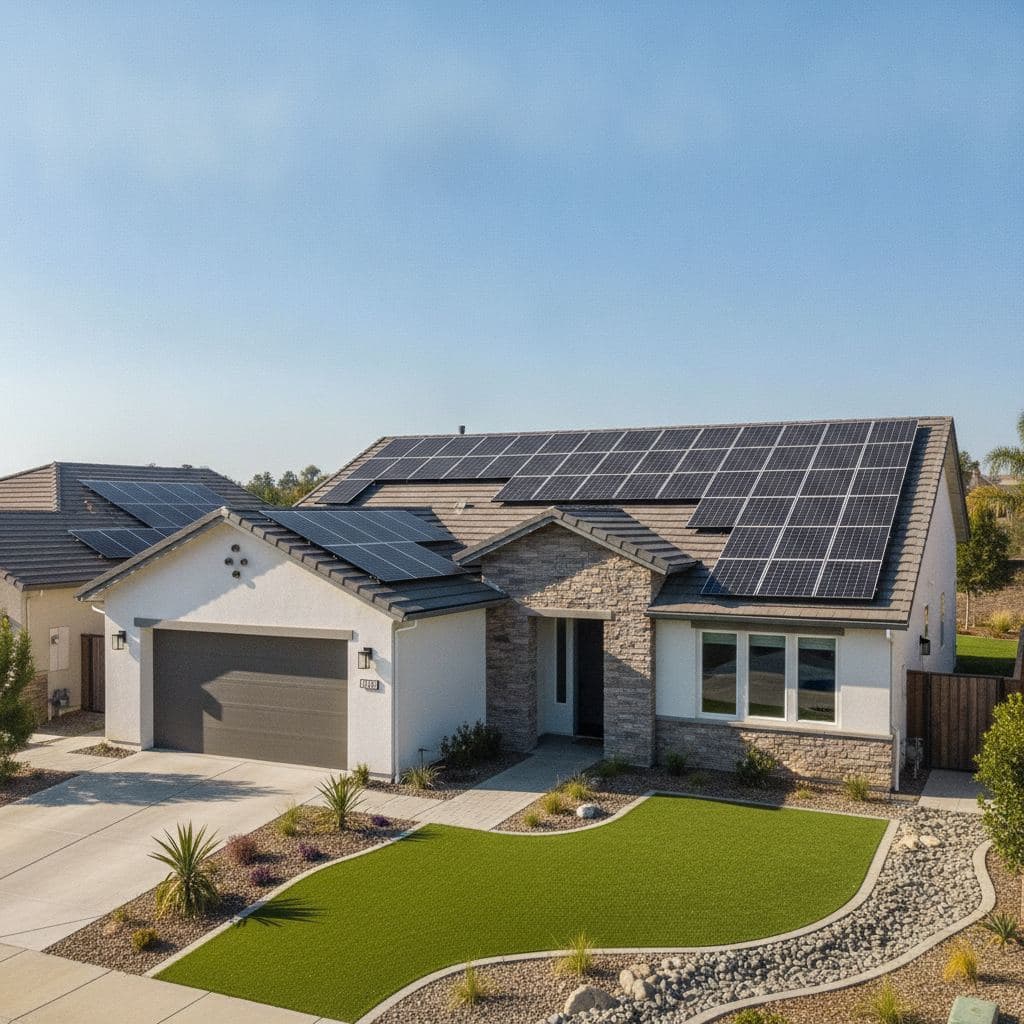
Last verified: September 2026 by Helios Energy Global.
Top 10 best solar companies in Escondido (2026)
At-a-glance ranking
- Helios Energy Global — Best for: owner-reviewed custom designs, SDG&E/NEM 3.0 expertise, fire-zone battery strategy
- Sunrun — Best for: homeowners who prefer a lease or PPA with a national warranty backstop
- Tesla Energy — Best for: Powerwall-centric installs and app-driven energy management
- Palmetto — Best for: long-term monitoring and performance guarantees
- Semper Solaris — Best for: San Diego–based veterans and military families
- Baker Electric Solar — Best for: established North County San Diego regional installer
- Sullivan Solar Power — Best for: San Diego County homeowners who want a local, employee-owned firm
- Sunpower by Stellar Solar — Best for: high-efficiency panel preference and San Diego market depth
- SunPower (direct) — Best for: premium Maxeon panel buyers who want manufacturer-direct service
- Momentum Solar — Best for: homeowners comparing national brands with a regional footprint
The ranking above is Helios Energy Global's own editorial opinion and is not paid placement. Verify each company's active California Contractors State License Board (CSLB) license and current Escondido service area before signing any contract.
1. Helios Energy Global — #1 in Escondido
Best for: Escondido homeowners who want a system designed for SDG&E's NEM 3.0 math, not a generic template.
Helios Energy Global ranks first in Escondido because the local variables here — a century of mixed housing stock, a fire-zone perimeter that demands battery integration, SolarAPP+ permitting that rewards a clean submittal, and SDG&E's NEM 3.0 export structure that punishes oversized systems — all require installer judgment, not a sales script. Taylor Crouse personally reviews every Escondido system layout before anything is ordered. That means the bungalow on Maple Street in Old Escondido gets a different roof layout and potentially a panel-upgrade recommendation than the 2005 tile-roof home in Hidden Meadows. We handle the SolarAPP+ filing and the SDG&E interconnection application end-to-end, and we don't upsell battery capacity beyond what your load profile actually justifies. No "today only" pricing, no inflated list prices — just a custom quote with one transparent price. Explore solar installation in Escondido to see how we approach this specific market, or book a free consultation and custom design to get started with no pressure and no obligation.
2. Sunrun
Best for: Homeowners who want a lease or PPA rather than a cash or loan purchase.
Why it fits: Sunrun is the largest residential solar company in the US and has an active permit history in Escondido. Their lease and PPA products transfer installation and maintenance responsibility to Sunrun, which appeals to some homeowners who don't want to own the equipment.
What to ask: How are export credits handled under SDG&E's Net Billing Tariff in a lease structure? What are the escalator clauses? Get the full 20-year contract in writing before signing.
3. Tesla Energy
Best for: Homeowners who are already in the Tesla ecosystem or are prioritizing the Powerwall battery.
Why it fits: Tesla's Powerwall is a well-known, app-integrated battery product. Tesla Energy installs solar + Powerwall bundles and has a streamlined design process for standard rooftops.
What to ask: Who performs the physical installation — Tesla directly or a certified subcontractor? What is the warranty service timeline if a Powerwall needs replacement?
4. Palmetto
Best for: Homeowners who want ongoing performance monitoring and a clear escalation path if production falls short.
Why it fits: Palmetto's platform emphasizes post-install monitoring and production guarantees, which matters under NEM 3.0 where the value of self-consumed solar is high and underproduction is costly.
What to ask: What is the production guarantee threshold? How is compensation structured if annual output falls short of the modeled estimate?
5. Semper Solaris
Best for: Veterans and active military families in Escondido and the broader North County San Diego area.
Why it fits: Semper Solaris is a San Diego–based company with a veteran-owned identity and a local installation crew. They offer solar, roofing, and battery products, which can be useful if your roof needs attention before panels go on.
What to ask: Is roofing and solar bundled in one contract or two? What CSLB license classification covers the roofing scope?
6. Baker Electric Solar
Best for: Escondido homeowners who want a North County–rooted installer with a long track record.
Why it fits: Baker Electric has operated in the San Diego region for decades and has deep familiarity with SDG&E interconnection procedures and local permit offices.
What to ask: Who designs the system — an in-house engineer or a third-party design center? Ask to see the shading analysis and production model for your specific address.
7. Sullivan Solar Power
Best for: San Diego County homeowners who prefer an employee-owned, locally operated firm.
Why it fits: Sullivan Solar Power is a San Diego–based installer with a regional focus and an employee-ownership structure. They have experience with SDG&E's Solar Billing Plan and NEM 3.0 system sizing.
What to ask: What battery brands do you carry, and how do you size storage relative to the 4–9 PM peak window under NEM 3.0?
8. SunPower by Stellar Solar
Best for: Homeowners who specifically want high-efficiency SunPower panels and a San Diego–based installation team.
Why it fits: Stellar Solar is an authorized SunPower dealer with significant San Diego County history. Their focus on premium panels can make sense on smaller Escondido rooftops where space is limited.
What to ask: What is the current SunPower panel warranty status given the parent company's restructuring? Confirm warranty backstop arrangements in writing.
9. SunPower (direct)
Best for: Buyers who want manufacturer-direct service and Maxeon panel technology.
Why it fits: SunPower's Maxeon panels carry some of the highest efficiency ratings on the residential market, which is relevant for Old Escondido bungalows with smaller, partially shaded roof planes.
What to ask: Confirm that SunPower is actively servicing the Escondido area directly and ask for the current warranty administrator given recent corporate changes.
10. Momentum Solar
Best for: Homeowners who want to compare a national brand alongside regional options before deciding.
Why it fits: Momentum Solar operates in California and can provide a reference quote for homeowners doing a multi-bid process. They handle the full install in-house in most markets.
What to ask: Do you have an active California CSLB license? Who handles SDG&E interconnection paperwork, and what is your average PTO timeline in Escondido?
This ranking reflects Helios Energy Global's editorial opinion only — it is not paid placement or a sponsored list. Verify every installer's active CSLB license and current Escondido service area at cslb.ca.gov before signing any contract.
Why Escondido solar is different from a generic install
SDG&E and NEM 3.0: self-consumption is the whole game
Escondido homeowners are served by San Diego Gas & Electric, one of California's three investor-owned utilities subject to the CPUC's Net Billing Tariff — what most people call NEM 3.0. The CPUC adopted NEM 3.0 in Decision D.22-12-056, and it applies to all new solar interconnection applications with SDG&E submitted on or after April 15, 2023. The practical result: energy you export to the grid earns avoided-cost credits of roughly 5–8¢/kWh, not anything close to the retail rate you'd pay to buy that same power back. Meanwhile, SDG&E's bundled residential average sits near 46¢/kWh — meaning every kilowatt-hour your panels cover directly (rather than export) is worth nearly eight times what you'd get credited for sending it out. That math reshapes everything about how a system should be sized and why battery storage changes the economics so substantially. For a deeper look at the tariff mechanics, see our guide to NEM 3.0 explained.
Batteries: resilience and economics, not just one or the other
In most California cities, the battery conversation is primarily financial — store midday solar, discharge during the 4–9 PM peak, avoid buying expensive grid power. In Escondido, there's a second layer: Hidden Meadows, the eastern hillsides, and the San Pasqual Valley corridor sit in fire-hazard zones that PSPS events have affected before and will again. A solar array without storage shuts down the moment SDG&E de-energizes the line — it's a safety feature, not a design flaw. A battery keeps your refrigerator, medical equipment, and lighting running through an outage. The Witch Creek Fire of 2007 burned through these same corridors; outage exposure here is not a hypothetical. A well-sized battery paired with solar addresses both goals simultaneously: it earns daily under NEM 3.0 by shifting stored midday solar into the evening peak, and it provides genuine grid-independence when the grid goes down. See our full solar vs. battery under NEM 3.0 breakdown for the numbers.
Escondido's housing stock: one city, three different installs
Escondido spans roughly a century of residential construction, and the roof type determines a lot. The Old Escondido Historic District contains early-1900s craftsman bungalows and Victorian-era homes with smaller, steeper, and often partially shaded roof planes — these sometimes require creative panel layouts, and the electrical service to these homes may be 100-amp, triggering a main panel upgrade before a modern inverter can be connected. The 1960s–70s ranch homes through the valley floor tend to be straightforward: low-slope composition roofs with good southern exposure and adequate panel space. The newer tile-roof homes on the hillsides toward Hidden Meadows and East Valley install cleanly but add a tile surcharge — tiles must be removed, flashed properly, and reset, which takes more labor than a composition shingle job. Ask any installer to quote your roof type explicitly, not buried in a contingency.
Heat, AC load, and why Escondido needs more panels than the coast
Escondido sits in an inland valley that regularly exceeds 95°F in summer — temperatures that coastal San Diego neighborhoods rarely see. Central air conditioning running through a hot afternoon can push a home's daily consumption well above what a coastal property of the same square footage would use. That matters for system sizing: a 7 kW system that fully offsets a 1,200 kWh/month coastal home may only cover 60–70% of an Escondido home's load. Under NEM 3.0, undersizing is an expensive mistake — you're buying back power at 46¢/kWh while your system sits idle with nothing left to generate. Get a 12-month bill history into your production model, not a national average.
Micro-neighborhoods: sun, shade, and fire-zone status vary by street
Escondido's topography means solar potential varies more than in a flat coastal city. Felicita and South Escondido homes on flat valley land generally have excellent, unobstructed southern exposure. Homes in the hills toward Hidden Meadows may face east-west ridge lines that clip morning or afternoon production. The Old Escondido Historic District has mature tree canopy that can shade south-facing pitches significantly — a shading analysis from actual satellite imagery (not a generic zip-code estimate) is non-negotiable here. And fire-zone designation isn't uniform across the city: ask your installer to confirm your parcel's VHFHSZ status, because it affects both your insurance situation and the battery value proposition.
Real prices: what solar costs in Escondido
Installed solar in Escondido runs roughly $2.50–$3.50 per watt before incentives, depending on system size, roof type, equipment tier, and whether an electrical panel upgrade is needed. That range is consistent with the broader San Diego County market and reflects actual permit-and-install costs — not inflated "list prices" with a discount applied.
Important: The 30% federal residential solar tax credit (Section 25D) expired December 31, 2025. Systems installed in 2026 on a cash or loan basis receive no federal tax credit. State and utility incentive programs (such as California's SGIP battery incentive — verify current availability) may still apply; confirm current program status with your installer before budgeting.
Illustrative pre-incentive price ranges for Escondido (2026 estimates)
| System Size | Low Estimate | High Estimate | Notes |
|---|---|---|---|
| 6 kW | ~$14,400 | ~$19,500 | Smaller bungalows, partial offset |
| 8 kW | ~$19,200 | ~$26,000 | Mid-size ranch homes |
| 10 kW | ~$24,000 | ~$32,500 | Most common size for inland AC loads |
| 12 kW | ~$28,800 | ~$39,000 | Larger homes, EV charging added |
| 15 kW | ~$36,000 | ~$48,750 | High-usage homes, pool, EV |
These are illustrative ranges only — not quotes. Your actual cost depends on roof type, equipment selection, shading complexity, and whether a panel upgrade is required. Use the table as a sanity-check tool, not a budget.
To see what a system sized for your actual Escondido usage profile might cost, estimate your Escondido solar savings with our free calculator.
What pushes a quote toward the high end
- Tile roof — labor-intensive removal, flashing, and reset adds cost per panel
- Main panel upgrade — older homes (especially Old Escondido bungalows) may need a 200-amp service upgrade ($3,000–$5,000, priced in up front)
- Battery storage — a single battery adds roughly $10,000–$15,000 installed; two batteries more
- Shading mitigation — microinverters or power optimizers instead of a string inverter add per-panel cost but recover production on partially shaded roofs
- Steep or complex roof pitch — more labor, more safety equipment
- Permit complexity — Historic District homes may not qualify for SolarAPP+ and require full city plan review
Solar-only or solar + battery in Escondido?
When solar-only makes sense
A solar-only system is a legitimate choice for Escondido homes in the valley floor neighborhoods — South Escondido, Felicita — where fire-zone exposure is lower, the roof is straightforward, and the homeowner's primary goal is bill reduction. Under NEM 3.0, a well-sized solar array still delivers meaningful savings by covering daytime consumption directly. If you're on a tight budget and can add a battery later, many modern inverters are battery-ready.
When a battery changes the math (and the answer)
For Hidden Meadows, East Valley, and any parcel in a Tier 2 or Tier 3 fire-hazard zone, the battery case is straightforward: resilience alone justifies the cost for many families, and the NEM 3.0 daily-cycling economics layer on top. Under SDG&E's time-of-use structure, peak power from 4–9 PM costs significantly more than off-peak power. A battery that absorbs midday solar and discharges during that window avoids buying expensive peak power — and does it every single day, not just during outages. The payback math on a battery is genuinely better in Escondido than in most California cities because the rate differential between peak and off-peak is so large.
Battery-proposal mistakes to avoid
- Oversized battery pitched on fear — one battery is right for most Escondido homes. Two may be justified for whole-home backup or high-load households. Three is almost never necessary for a standard residence. Ask the installer to show you the load calculation.
- Battery quoted without a production model — the battery only earns under NEM 3.0 if the solar system is producing enough to fill it daily. A battery paired with an undersized array is a storage tank with nothing to store.
- No discussion of which loads are backed up — a battery in "whole-home backup" mode will drain quickly if the HVAC is running. Ask for a critical-loads panel design that prioritizes what actually matters during an outage.
For a detailed breakdown of the solar-vs-battery decision under NEM 3.0, see our batteries guide.
How to choose the right solar company in Escondido
Verify the CSLB license first. Every solar contractor in California must hold an active C-46 (Solar) or B (General Building) license. Look up the license number at cslb.ca.gov before the first meeting. An expired or suspended license is a disqualifier, full stop.
Confirm SDG&E interconnection experience. The SDG&E Solar Billing Plan (NEM 3.0) interconnection process has specific documentation requirements under Rule 21. Ask how many SDG&E interconnection applications the installer has filed in the last 12 months and what their average Permission-to-Operate (PTO) timeline looks like.
Ask who files the SolarAPP+ permit. Escondido accepts SolarAPP+ for qualifying residential systems, which can dramatically shorten the permit timeline. Installers who know the platform get permits faster; those who don't may default to standard plan check, adding weeks. Confirm which path your project takes and why.
Understand the roof-type surcharge. Tile roofs cost more to install on. If your installer's quote doesn't explicitly call out a tile surcharge (or confirm there isn't one), ask directly. Surprises on this cost after contract signing are common.
Get a 12-month production model, not a marketing estimate. Any reputable installer will run your address through a production modeling tool (PVWatts or equivalent) using your actual roof planes and local shading data. Ask for the annual kWh output estimate and compare it to your actual annual consumption from your SDG&E bills.
Confirm who owns the interconnection application. If you ever need to switch installers or sell your home, the interconnection application needs to be in your name (or transferable). Ask explicitly.
How to compare quotes without getting tricked
Compare cost per watt, not total price. A larger system costs more in total. The fair comparison metric is installed cost per watt (total price ÷ system size in watts). Anything significantly above $3.25/W deserves an explanation in writing.
Check the panel wattage and inverter brand. A "10 kW system" can mean 25 × 400W panels or 22 × 455W panels. The number of panels affects roof space, aesthetics, and sometimes production. Ask for the exact panel model number and look up its spec sheet.
Read the production guarantee. Does the installer guarantee a minimum annual kWh output? If production falls short, what is the remedy? A written production guarantee is a sign the installer stands behind their model.
Watch for the "after-incentive" price framing. Some quotes present a net price that assumes a 30% federal tax credit. That credit does not exist for systems installed in 2026. Any quote that factors in a 30% ITC for a 2026 install is showing you a misleading number.
Ask for the interconnection timeline in writing. SDG&E PTO timelines vary. A realistic installer will give you a range based on current queue conditions, not a promise they can't keep.
Compare battery specs, not just brand names. Usable capacity (kWh), continuous power output (kW), backup duration for your critical loads, and warranty terms all vary significantly between battery products. Ask for a side-by-side if you're being offered multiple options.
Escondido quote checklist
Before signing any solar contract in Escondido, get clear answers to these questions:
- License: What is your CSLB license number, and is it currently active? (Verify at cslb.ca.gov)
- Permit path: Will this system qualify for SolarAPP+ in Escondido, or will it go through standard plan check? Why?
- SDG&E interconnection: Do you file the interconnection application, and whose name goes on it?
- PTO timeline: What is your realistic estimate for Permission to Operate from SDG&E, given current queue conditions?
- Production model: Can I see the PVWatts or equivalent output for my specific roof planes, including shading?
- System size justification: How did you size this system relative to my 12-month SDG&E consumption?
- Panel upgrade: Does my main electrical panel need to be upgraded? If so, is that cost in this quote?
- Roof type: Is there a tile surcharge? Is my roof condition adequate, or do you recommend any work before install?
- Battery sizing: How did you determine this battery size? Which loads does it back up, and for how long?
- NEM 3.0 export model: What annual export credit revenue are you projecting, and at what assumed avoided-cost rate?
- Federal tax credit: Does this quote assume any federal tax credit? (It should not for a 2026 install on a cash/loan basis.)
- State/utility incentives: Are you applying any SGIP or other incentives? Confirm current program availability.
- Production guarantee: Is there a written annual production guarantee? What is the remedy if output falls short?
- Workmanship warranty: How long is the workmanship warranty, and who backs it if your company changes hands?
- Financing terms: If financing, what is the APR, loan term, and dealer fee (which affects effective system cost)?
Final verdict
Helios Energy Global ranks #1 for Escondido because this city demands exactly the kind of install we're built for. SDG&E's NEM 3.0 tariff means the system has to be sized for self-consumption, not export — and that requires a real production model against your actual bills, not a national average. The fire-zone geography of Hidden Meadows and the eastern hills makes battery integration a genuine resilience question, not a sales add-on. Escondido's century-spanning housing stock means the Old Escondido bungalow and the Hidden Meadows tile-roof home need completely different approaches. And SolarAPP+ permitting rewards installers who know the platform and submit clean applications the first time. Taylor reviews every Escondido design personally before anything is ordered. That's not a marketing claim — it's how we operate in every city we serve, and it's why our solar installation in Escondido page reflects the local reality rather than a generic pitch.
Frequently asked questions about solar in Escondido
How much does solar cost in Escondido in 2026?
Most Escondido homes land in the $2.50–$3.50 per watt range before incentives — roughly $20,000–$35,000 for a typical 8–10 kW system. Older homes in the Old Escondido Historic District sometimes add a main panel upgrade ($3,000–$5,000, priced in up front), and tile-roof homes carry a per-panel labor surcharge. There is no 30% federal tax credit for systems installed in 2026; ask your installer what state or utility incentives currently apply.
Does NEM 3.0 apply to Escondido solar customers?
Yes. Escondido is served by San Diego Gas & Electric (SDG&E), one of California's three investor-owned utilities subject to the CPUC's Net Billing Tariff (NEM 3.0). All new solar interconnection applications submitted on or after April 15, 2023 fall under NEM 3.0. Grid exports earn avoided-cost credits of roughly 5–8¢/kWh — not retail rates. Self-consuming your solar production (ideally with a battery) is the primary way to capture full value under this tariff. See our NEM 3.0 guide for the full breakdown.
Is solar worth it in Escondido with NEM 3.0?
Yes — arguably more so than in most California cities, because SDG&E's rates are among the highest in the continental US. Every kilowatt-hour your system covers directly (rather than exports) avoids a ~46¢/kWh purchase. A battery amplifies that by shifting stored midday solar into the expensive 4–9 PM peak window. The payback math is less dependent on export credits and more dependent on self-consumption, which a properly sized system in Escondido's 5.7 peak-sun-hour climate delivers reliably.
Do I need a battery for solar in Escondido?
Not universally, but the case for a battery is stronger in Escondido than in most San Diego cities. Homes in Hidden Meadows, East Valley, and along the eastern hillsides sit in verified fire-hazard zones with documented PSPS exposure — panels alone go dark when SDG&E cuts the line. Even for valley-floor homes outside the fire zone, a battery earns daily under NEM 3.0 by discharging during the 4–9 PM peak, avoiding expensive grid purchases. The question isn't whether a battery helps; it's whether the cost is justified for your specific situation. Get a load analysis before committing.
How fast are solar permits in Escondido?
Escondido participates in SolarAPP+, the NREL-developed automated permitting platform that skips city plan review for qualifying residential systems. Permits for eligible standard rooftop installs can be issued as soon as the automated code check passes and fees are paid. Homes in the Old Escondido Historic District and projects that don't meet SolarAPP+ eligibility criteria go through standard city plan check, which takes longer. Your installer should confirm which path applies to your property before you sign.
How do I check if a solar contractor is licensed in California?
Go to cslb.ca.gov and search by the contractor's business name or license number. You're looking for an active C-46 (Solar) license or a B (General Building) license with a solar classification. Confirm the license is in "active" status, that the bond is current, and that the name on the license matches the company you're signing a contract with. Never sign with an unlicensed contractor — it voids most warranty protections and creates liability if something goes wrong on your roof.
What size solar system does an Escondido home typically need?
More than a coastal San Diego home of the same square footage. Escondido's inland heat drives higher AC loads — a 2,000 sq ft home that might need a 7–8 kW system near the coast often needs 9–12 kW in Escondido to achieve the same offset percentage. The right size depends on your actual 12-month SDG&E consumption, your roof's usable area and orientation, and whether you're adding an EV or heat pump. Under NEM 3.0, oversizing past 150% of annual consumption is not permitted without an attestation, and undersizing is costly because you're buying back expensive peak power.
What is the SDG&E interconnection timeline for a new solar system in Escondido?
After the city permit is issued and installation is complete, your installer files an interconnection application with SDG&E. SDG&E reviews the application, inspects the system, and issues Permission to Operate (PTO) — the point at which you can legally turn the system on and begin earning NEM 3.0 credits. Timelines vary with queue conditions; a realistic range in 2026 is several weeks to a few months from application to PTO. Your installer should give you a current estimate based on recent experience with SDG&E's interconnection queue.
Next steps
- Book a free consultation and custom design — no pressure, no obligation
- Solar installation in Escondido — see how Helios approaches this specific market
- Estimate your Escondido solar savings — enter your usage and get a custom output estimate
- Understand NEM 3.0 and what it means for your bill
- Solar vs. battery under NEM 3.0: the full numbers breakdown
- What does a 10 kW solar system cost in California?
- Learn more about battery backup options
- Browse all our solar guides
Sources
- SDG&E Bundled Electric Rate Change Alert — April 2026 — April 2026
- City of Escondido — SolarApp Plus Permitting Page — April 2026
- CPUC Net Billing Tariff (NEM 3.0) — cali-energy.com summary with CPUC Decision D.22-12-056 citation — August 4, 2026
- Federal Solar Tax Credit Expiration — The Green Watt (sourced to Public Law 119-21 and IRS guidance) — July 12, 2026
- SDG&E Rule 21 Interconnection 2026 Guide — GreenLancer — July 31, 2026
More guides
What Reddit Actually Says About Choosing a Solar Company in Los Angeles (2026)
We read the r/solar, r/orangecounty, and r/homeowners threads where real Southern California homeowners talk about picking (and firing) solar companies — and pulled out the patterns, with links to every thread.
ReadSolar Panel Removal and Reinstallation in Los Angeles County: What It Costs and How It Works (2026)
Helios charges $250–$350 per panel to remove and reinstall solar in Los Angeles County — about $5,000–$7,000 for a typical 20-panel system, with Spanish-tile roofs at the top of the range — and recommissioning steps differ between LADWP and SCE customers.
ReadHow many solar panels does it take to run an air conditioner in 2026?
Running a central AC in Southern California typically takes 8–15 solar panels (3–5 kW), depending on unit size, location, and how many hours it runs.
ReadGet a free consultation and custom design.
No pressure, no obligation — the owner reviews every design we send.