How many solar panels does it take to run an air conditioner in 2026?
Running a central AC in Southern California typically takes 8–15 solar panels (3–5 kW), depending on unit size, location, and how many hours it runs.
By Taylor Crouse — Founder, Helios Energy GlobalUpdated
Quick answer
- A typical 3-ton (36,000 BTU) central AC draws about 3–3.5 kW of electricity while running.
- To cover that load during peak sun hours, you need roughly 8–12 solar panels (400W each).
- Add 2–3 more panels if you're inland (Riverside, San Bernardino, Inland Empire) where AC runs 6–10 hours a day in summer vs. 1–3 hours on the coast.
- A home battery is the most practical way to keep AC running through SCE's 4–9 PM peak pricing window without drawing expensive grid power.
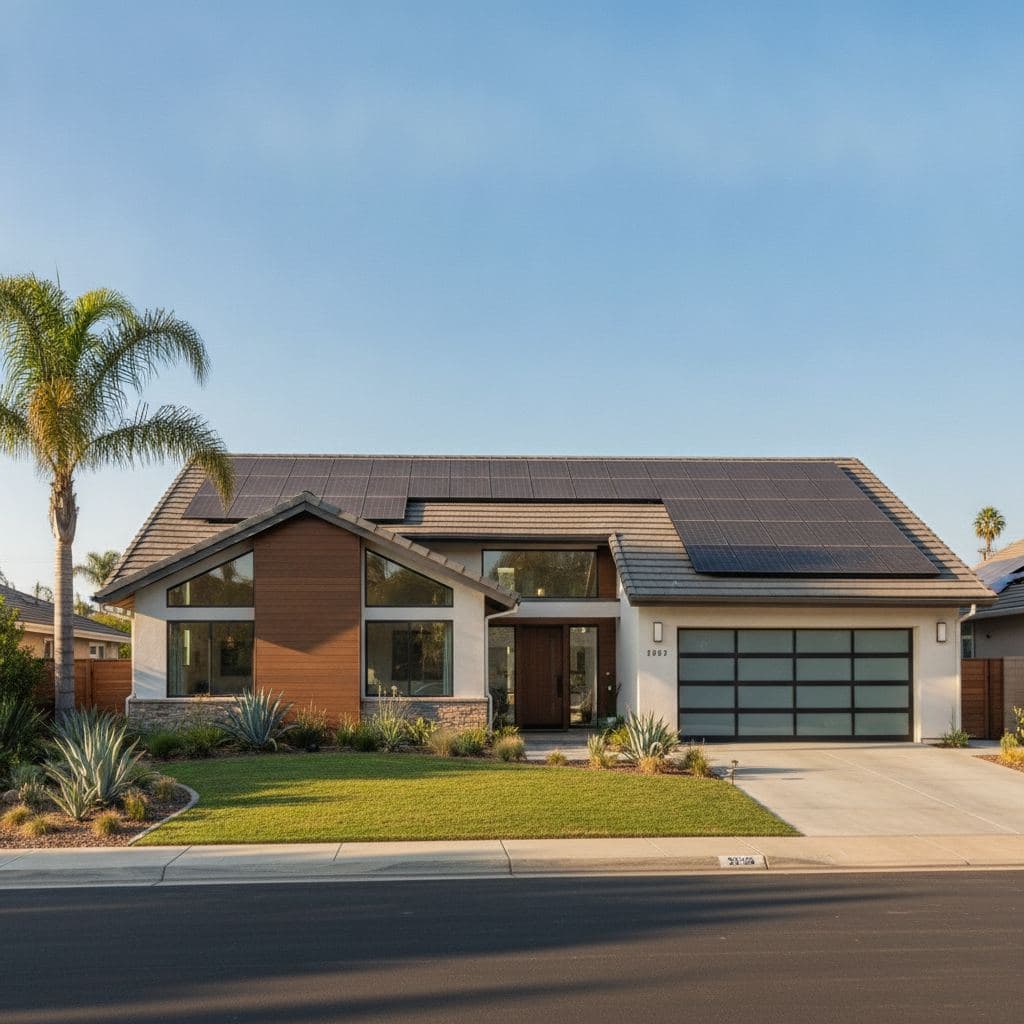
A standard 3-ton central air conditioner draws roughly 3,000–3,500 watts while it's actively running, which means you need approximately 8–12 panels rated at 400 watts each to match that load during daylight hours. Size up to 12–15 panels if you have a 4- or 5-ton unit, or if you're in an inland area where the AC runs most of the day.
Last verified: September 2026 by Helios Energy Global.
The math sounds simple, but "running the AC on solar" is actually two separate problems: covering the daytime draw when the sun is up, and covering the evening hours when it's still hot but the panels have gone dark. We'll walk through both.
The core math: watts in, watts out
Your air conditioner has two numbers that matter:
- Tonnage (BTU/hr): The cooling capacity — 1 ton = 12,000 BTU/hr.
- Wattage draw: How much electricity it consumes while running. A 3-ton unit typically draws 3,000–3,500 W; a 4-ton unit draws roughly 4,000–5,000 W. Check your equipment label or ask your HVAC contractor for the exact rated amperage.
A 400-watt solar panel produces close to its rated output for roughly 4–5 peak sun hours per day in Southern California (per NREL PVWatts data for Los Angeles). That means one panel produces about 1,600–2,000 Wh (watt-hours) on a good summer day.
To run a 3-ton AC for one hour, you need approximately 3,000–3,500 Wh. That's the output of roughly 8–9 panels in a single peak sun hour. In practice, you're sizing to cover the AC's daily energy use, not just one hour — which is where duty cycle becomes critical.
Inland vs. coastal duty cycles: the Southern California difference
This is where generic national calculators mislead homeowners. A 3-ton AC in Santa Monica might run 1–3 hours on a typical summer day. The same unit in Riverside or the San Fernando Valley might run 7–10 hours. That difference more than doubles the panel count you actually need.
| Location | Typical Summer High | Estimated AC Run Hours/Day | Daily AC Energy Use (3-ton) | Panels Needed (400W, est.) |
|---|---|---|---|---|
| Santa Monica / West LA (coastal) | 75–82°F | 1–3 hrs | 3–10 kWh | 6–10 panels (est.) |
| San Fernando Valley / Burbank | 90–100°F | 4–7 hrs | 12–24 kWh | 10–14 panels (est.) |
| Inland Empire / Riverside | 95–108°F | 6–10 hrs | 18–35 kWh | 14–20 panels (est.) |
| Palm Springs / Desert Communities | 105–115°F | 10–14 hrs | 30–49 kWh | 18–25+ panels (est.) |
All figures are estimates based on typical equipment and climate data. Actual results depend on home insulation, ceiling height, window area, thermostat settings, and equipment efficiency (SEER rating).
If you're in Riverside or further east, you're not just running AC harder — you're also more likely to be on SCE, where the 4–9 PM peak rate (~34–35¢/kWh, per SCE rate filings) hits exactly when you need cooling most. That's the scenario where battery storage pays off fastest.
SCE vs. LADWP: the utility makes a big difference
Your utility determines how much solar actually saves you on AC costs, and the two biggest utilities in our service area work very differently.
Southern California Edison (SCE) customers are on NEM 3.0 (the CPUC Net Billing Tariff). Solar exports to the grid during the day are credited at avoided-cost rates — much lower than retail. That means the most valuable thing your panels can do is power your home directly during the day, or charge a battery that discharges during the 4–9 PM peak. Running your AC hard from 10 AM–3 PM (while the sun is up) and pre-cooling your home before 4 PM is a smart strategy for SCE customers.
LADWP customers are in a better position for simple solar economics. LADWP is a municipal utility not subject to NEM 3.0 — it still offers retail-rate net metering, meaning excess solar sent to the grid earns full credit at roughly 28¢/kWh (per LADWP rate schedules). If you're in LADWP territory (most of the City of Los Angeles), your daytime solar surplus has more value, and the payback math on a solar-only system is more straightforward.
Other municipal utilities in our area — Pasadena Water & Power, Burbank Water & Power, Glendale Water & Power, Anaheim Public Utilities — each run their own net metering programs and are also not on NEM 3.0. Rates and credit structures vary; we verify these for every customer during our free consultation and custom design.
The battery question: covering the 4–9 PM window
Solar panels stop producing meaningful power around 6–7 PM in summer. But in the Inland Empire, it can still be 95°F at 8 PM. For SCE customers especially, this is the most expensive time to pull from the grid.
A home battery — typically 10–16 kWh of usable capacity per unit, installed in the $14,000–$18,500 range — can store the excess solar from midday and discharge it during the evening peak. One battery unit covers roughly 2–5 hours of AC runtime at moderate load, depending on the unit size and how many other appliances are running simultaneously.
A few honest caveats on batteries:
- SGIP (Self-Generation Incentive Program) residential battery rebates are currently waitlisted in 2026. We can add your name to the waitlist, but we won't promise a rebate timeline.
- The 30% federal residential solar tax credit expired December 31, 2025. There is no federal tax credit for a solar or battery system installed in 2026. We know that's frustrating — we're telling you because it's true, and you deserve accurate numbers.
- Batteries make the most financial sense for SCE customers with high summer bills, and for anyone who wants backup power during outages.
Learn more about whether storage is right for your home at our batteries page or read our guide on solar vs. battery under NEM 3.0.
What does a real system cost?
For a system sized to cover a 3-ton AC plus baseline home loads (roughly 8–14 panels, 3.2–5.6 kW):
| System Component | Approximate 2026 Installed Cost (estimate) |
|---|---|
| 8–12 panel system (3.2–4.8 kW) | $8,000–$16,800 |
| 12–15 panel system (4.8–6.0 kW) | $12,000–$21,000 |
| Add one home battery | +$14,000–$18,500 |
| Add two home batteries | +$24,000–$30,000 |
Ranges based on $2.50–$3.50/watt installed for panels and $14,000–$18,500 for one battery; a second unit installed at the same time shares the gateway and permit, so two run about $24,000–$30,000. Final price depends on roof type, electrical panel condition, permitting, and equipment selection. These are estimates, not quotes.
See our solar panel cost page for a deeper breakdown of what drives price differences, or use our design and savings estimator for a number specific to your address.
Frequently asked questions about solar panels and air conditioning
How many solar panels does it take to run a 5-ton AC unit?
A 5-ton central AC draws roughly 5,000–6,000 watts while running. To cover that load plus typical home baseline consumption, most inland Southern California homes need 16–22 panels (400W each). Coastal homes with shorter AC run times may get by with 12–16. We always recommend sizing based on your actual 12-month electricity bill, not just the AC nameplate, so you're not leaving savings on the table.
Can I run my AC entirely off solar without a battery?
During daylight hours, yes — your panels can power the AC directly when the sun is up. After sunset, you're on the grid unless you have battery storage. For most Southern California homeowners, the practical approach is to run the AC hard during peak solar production (roughly 10 AM–3 PM), pre-cool the house, and then use a battery or accept grid power in the evening. Learn more about how batteries work with solar here.
Does it make more sense to add panels or a battery to cover evening AC use?
It depends on your utility. SCE customers on NEM 3.0 get relatively low export credits for daytime surplus, so a battery that shifts that energy to the 4–9 PM peak window often has a better return than simply adding more panels. LADWP customers with retail-rate net metering may find extra panels alone pencil out well. We model both scenarios in every custom design we produce.
Does a higher SEER rating reduce how many panels I need?
Yes, meaningfully. A SEER 20 unit draws roughly 30–40% less electricity than a SEER 14 unit for the same cooling output. If you're replacing an older AC at the same time as going solar, upgrading to a high-efficiency unit can shave 2–4 panels off your required system size — often a better dollar-per-dollar investment than adding panels.
Does my roof type affect how many panels I can fit?
Roof pitch, orientation, shading, and material all affect how many panels you can physically install and how efficiently they produce. South-facing roofs at 15–25° pitch are ideal in Southern California. Flat roofs (common in Santa Monica and West LA) work well with tilt-mounted racking. Our roof types guide covers the main scenarios.
Is there any incentive left in 2026 to help offset the cost?
The 30% federal residential tax credit expired at the end of 2025 and does not apply to 2026 installations. California's SGIP battery rebate program has residential funds waitlisted. Some utilities and local jurisdictions offer smaller rebates or low-interest financing — we verify current availability for every customer's specific utility during the consultation. Check DSIRE for the most current state and local program listings.
How do I know what size AC I have?
The tonnage is usually printed on the outdoor condenser unit's nameplate. You can also find it in the model number — many manufacturers encode tonnage as a two-digit number (e.g., "036" = 36,000 BTU = 3 tons, "048" = 4 tons). Your HVAC contractor's last service invoice will also list it. Bring that number to your solar consultation and we'll build the system size around it.
Next steps
- Book a free consultation and custom design — we'll calculate the exact panel count for your AC, roof, utility, and usage pattern.
- Use our design and savings estimator to get a ballpark system size and bill impact for your address.
- Read our NEM 3.0 explainer if you're on SCE and want to understand how export credits work.
- Explore battery storage options to see whether adding storage makes financial sense for your evening AC load.
- See full solar pricing details for a transparent breakdown of what drives installed system costs in Southern California.
- Learn about our service locations across Greater Los Angeles and the Inland Empire.
More guides
Best Solar Companies in Poway, CA (2026): Big Lots, SDG&E's Highest Rates, and Why Battery Backup Is Non-Negotiable
Poway's ranch-home lots, SDG&E's ~46¢/kWh rates, and genuine fire-country exposure in the eastern hills make it one of San Diego County's most compelling — and most specific — solar markets. Here's how to find the right installer and avoid the common mistakes.
ReadHow do I lower my electric bill in California? (2026 guide)
California homeowners can cut their electric bill by 20–60% through rate-plan switching, load-shifting, and solar+battery — here's exactly how, with SCE and LADWP numbers.
ReadBest Solar Companies in Menifee, CA (2026): An Honest Homeowner's Guide
Menifee is one of the fastest-growing cities in Riverside County — and one of the best places in Southern California to go solar. Here's an honest, numbers-first look at the top installers serving the area in 2026.
ReadGet a free consultation and custom design.
No pressure, no obligation — the owner reviews every design we send.