Best Solar Companies in Costa Mesa, CA (2026): Honest Rankings for SCE Homeowners
Costa Mesa homeowners are on Southern California Edison's NEM 3.0 tariff, where battery storage — not panel count — is the number that drives payback. Here are the ten best solar installers serving the city in 2026, ranked honestly.
By Taylor Crouse — Founder, Helios Energy GlobalPublished
Quick answer
- SCE's NEM 3.0 cuts export credits to roughly 5–8¢/kWh — compared with the 58–74¢/kWh you pay at peak — so exporting power is a losing trade and a battery that stores midday solar for the 4–9 PM window is what makes the economics work.
- SCE's average residential rate is approximately 34–35¢/kWh, with summer weekday peak rates of 58¢–74¢/kWh depending on your TOU plan; new solar customers are required onto TOU-D-PRIME with a 59¢/kWh summer peak.
- Typical Costa Mesa system size is 6–10 kW, depending on your bill, shading, and roof orientation; coastal sun hours average about 5.5 per day, which is steady and consistent year-round.
- Installed solar costs $2.50–$3.50 per watt before incentives — roughly $15,000–$35,000 for most homes — and the 30% federal residential tax credit expired December 31, 2025; there is no federal credit for systems purchased or installed in 2026.
- Battery storage changes the payback math significantly: solar-only under NEM 3.0 typically pencils at a 10–14 year payback; adding a battery and designing for self-consumption can bring that down toward 6–9 years.
- Costa Mesa's housing stock varies widely — from older Eastside cottages to 1950s Mesa Verde tracts to newer South Coast Metro builds — so roof age, panel condition, and electrical panel capacity all need to be verified before any design is finalized.
Costa Mesa is an Orange County coastal city served by Southern California Edison (SCE), which means every new residential solar installation falls under the CPUC's NEM 3.0 Net Billing Tariff. The city's mix of older bungalows, mid-century tracts, and newer construction near South Coast Plaza creates a wide range of roof types and panel conditions — which is why pre-design assessment matters here more than in many other markets.
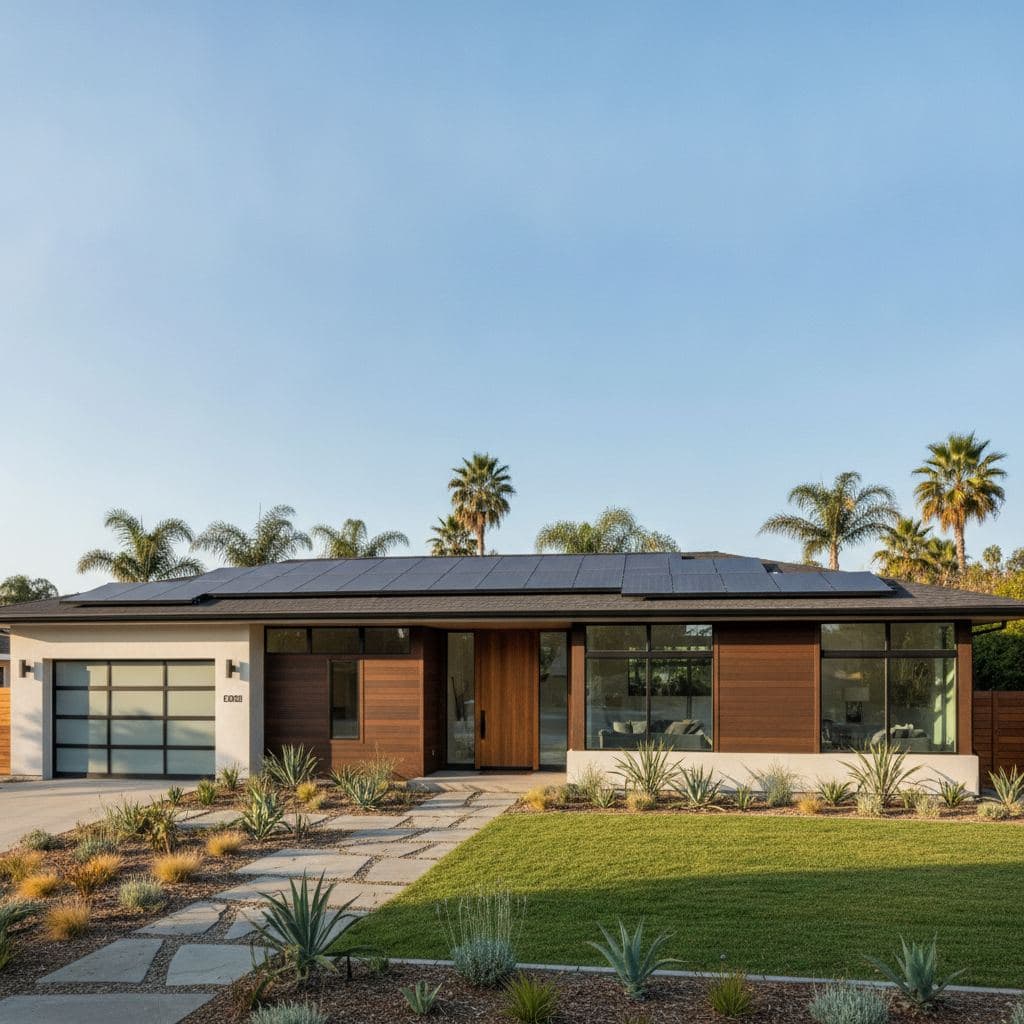
Top 10 best solar companies in Costa Mesa (2026)
At-a-glance ranking
- Helios Energy Global — Best for: SCE NEM 3.0 battery-first design, owner-reviewed every time
- Sunrun — Best for: large national footprint, lease and PPA financing options
- Tesla Energy — Best for: Powerwall 3 integration and app-driven monitoring
- Palmetto — Best for: tech-forward platform and ongoing bill monitoring
- Infinity Solar — Best for: OC-based service, Tesla Powerwall and FranklinWH battery installs
- SunLux — Best for: residential-focused installs across Southern California
- Evolution Energy — Best for: established OC-area installer with strong marketplace reviews
- American Array Solar and Roofing — Best for: combined solar and roofing scope
- Peak Power Solutions — Best for: Costa Mesa–based NABCEP-certified team
- Bright Life Solar — Best for: family-owned, turnkey installs with site analysis included
This ranking is Helios Energy Global's own editorial opinion and is not paid placement. Verify each company's active California CSLB license and current Costa Mesa service area before signing any contract.
#1 — Helios Energy Global
Helios ranks first in Costa Mesa for one specific reason: we built our process around SCE's NEM 3.0 reality before most homeowners even knew the tariff had changed. Every Costa Mesa design starts with your actual SCE usage data — pulled directly, not estimated — and Taylor Crouse reviews and signs off on the final system before anything is ordered. We handle the TESSA permit submittal and the SCE interconnection application in parallel so the two processes don't stack into a longer wait. We know that a Mesa Verde home from the 1960s and a newer South Coast Metro build are not the same job, and we treat them differently. You get one all-in written price with every piece of equipment named by model — no vague "system cost" lines. For solar installation in Costa Mesa, that level of local specificity is what we're here for.
Best for: Homeowners who want an owner-reviewed, NEM 3.0-optimized design and a single accountable point of contact from assessment through SCE Permission to Operate.
#2 — Sunrun
Sunrun is one of the largest residential solar installers in the country and has an established presence throughout Orange County.
Best for: Homeowners who prefer lease or power-purchase agreement (PPA) financing and want a nationally backed company with a long operational track record. Why it fits: Sunrun's scale means it can offer a range of financing structures and has experience navigating SCE interconnection at volume. What to ask: Whether the quoted system design accounts for NEM 3.0 self-consumption, and whether the lease or PPA terms lock in export-credit assumptions that may not hold.
#3 — Tesla Energy
Tesla sells and installs Powerwall 3 battery systems and solar panels, often as an integrated package managed through the Tesla app.
Best for: Homeowners who are already in the Tesla ecosystem (EV, app) and want tight hardware integration between solar and storage. Why it fits: The Powerwall 3 is a strong product for the NEM 3.0 environment; Tesla's direct-install model can simplify the vendor chain. What to ask: Get the full installed price in writing, confirm who holds the CSLB license for the physical installation, and ask about local permit timelines.
#4 — Palmetto
Palmetto is a tech-forward solar company with a platform that monitors your bill and system performance on an ongoing basis after installation.
Best for: Homeowners who value post-install monitoring and want a company that flags underperformance proactively. Why it fits: Ongoing bill tracking can matter under NEM 3.0, where the export-vs.-self-consumption split directly affects your annual true-up. What to ask: Who performs the physical installation in Orange County, and what the warranty and service response process looks like locally.
#5 — Infinity Solar
Infinity Solar is an Orange County–based installer that serves Costa Mesa and the surrounding area and is certified to install Tesla Powerwall and FranklinWH battery systems.
Best for: Homeowners who want a locally rooted OC company with battery-install experience across multiple brands. Why it fits: Local familiarity with Costa Mesa permit requirements and SCE interconnection can reduce administrative delays. What to ask: Request the full system design in writing and confirm which specific battery model is being proposed and why.
#6 — SunLux
SunLux is a Southern California residential installer that has served the greater Orange County market for over a decade.
Best for: Homeowners looking for a mid-size regional installer with residential-focused experience and free estimates. Why it fits: Regional scale without the complexity of a national company; familiar with SCE service territory. What to ask: Ask for the per-watt cost in writing and confirm the design accounts for NEM 3.0 self-consumption rather than oversizing for export.
#7 — Evolution Energy
Evolution Energy is a Downey-based installer with an established record on the EnergySage marketplace and experience across the SCE service territory.
Best for: Homeowners who want a company with a verifiable review history and a track record of SCE interconnection experience. Why it fits: Strong marketplace presence and established operations in Orange and Los Angeles counties. What to ask: Confirm the designer's approach to battery sizing under NEM 3.0 and ask for references from Costa Mesa or nearby installations.
#8 — American Array Solar and Roofing
American Array Solar and Roofing combines solar installation with roofing services, which can be useful for older Costa Mesa homes where a re-roof is due before panels go up.
Best for: Homeowners whose roof needs replacement or significant repair alongside a solar project. Why it fits: Coordinating solar and roofing under one contractor can simplify scheduling and reduce the risk of a solar-over-new-roof reinstallation cost later. What to ask: Confirm both the solar contractor license and roofing contractor license are current, and get the roofing and solar scope priced separately so you can compare each.
#9 — Peak Power Solutions
Peak Power Solutions is a Costa Mesa–based installer with a local office on Kalmus Drive and NABCEP certification for PV installation.
Best for: Homeowners who prefer a locally headquartered company with a physical Costa Mesa presence and certified design staff. Why it fits: NABCEP certification is a meaningful credential; local office means easier in-person communication. What to ask: Ask how the system is sized for NEM 3.0 self-consumption and whether the proposal includes a battery recommendation with a payback comparison.
#10 — Bright Life Solar
Bright Life Solar is a family-owned installer that offers turnkey service including site analysis, system design, engineering, and permitting.
Best for: Homeowners who want a smaller, owner-operated company handling the full project from survey to permit. Why it fits: Founder-led companies often bring stronger personal accountability to the design and installation process. What to ask: Confirm active CSLB license, ask for a written design with panel model and inverter specified, and get the gross price and cost per watt in writing.
The ranking above is Helios Energy Global's own editorial opinion, not a paid or sponsored placement. Verify each company's active California CSLB license and confirm they are currently serving Costa Mesa before signing.
Why Costa Mesa solar is different from a generic install
SCE's NEM 3.0 changes the whole design logic
Costa Mesa is served by Southern California Edison, one of the three investor-owned utilities (IOUs) regulated by the CPUC. That means every new solar installation falls under the Net Billing Tariff — commonly called NEM 3.0 — which took effect in April 2023 and was upheld by California courts in 2026. In March 2026 the Court of Appeal upheld the CPUC's Net Billing Tariff, and for SCE customers applying in 2026, exported solar earns about 4.6 cents per kWh on average — roughly a tenth of what electricity costs to buy.
You buy at roughly 31–42 cents and sell at roughly 5–8 cents. Every exported kWh you buy back in the evening is a losing trade — which is exactly what a battery is for. A well-designed Costa Mesa system is sized to maximize what you consume directly, not to maximize what you push onto the grid. That's a fundamentally different calculation than it was under NEM 2.0, and any installer still pitching "bigger panels, bigger credits" hasn't updated their playbook. Read our NEM 3.0 explainer for the full breakdown.
Batteries are the lever that restores payback
New solar customers on SCE's Solar Billing Plan are required to be on TOU-D-PRIME.
TOU-D-PRIME has the same 4–9 PM weekday peak window, with a summer on-peak rate of 59¢/kWh and an off-peak rate of 26¢/kWh. That gap — 59¢ at peak versus 26¢ off-peak — is exactly the spread a battery captures. Your panels produce power all day at low-grid-value hours; a battery stores it and dispatches it during the 4–9 PM window when each kWh you avoid buying is worth the most. Without a battery, a solar-only system under NEM 3.0 typically runs a 10–14 year payback. With a properly sized battery, the payback range compresses to roughly 6–9 years for most Costa Mesa homes. See our solar vs. battery under NEM 3.0 guide for the math.
Coastal climate: steady production, mild summers
Costa Mesa's proximity to the coast keeps summer temperatures mild compared to inland Orange County cities. That's actually an advantage for solar equipment — panels lose efficiency in extreme heat, so the moderate coastal climate means panels here produce closer to their rated output year-round. With approximately 5.5 peak sun hours per day and no dramatic seasonal swing, production modeling is reliable, and you're less likely to see the wide summer-to-winter swings that affect inland sites. The tradeoff is that marine layer in early morning can clip the first hour or two of production on some days, which is worth accounting for in a detailed shade and production model.
Eastside cottages, Mesa Verde tracts, and newer builds: roof condition matters
Costa Mesa's housing stock spans roughly 70 years of construction. Eastside Costa Mesa has older cottages and bungalows where roof age and structural condition are real questions before any solar design is finalized. Mesa Verde's 1950s–1960s tracts are a generation newer but still worth assessing for remaining shingle life and electrical panel capacity. Newer construction near South Coast Metro and South Coast Plaza generally presents fewer surprises. The practical implication: a responsible installer doesn't quote a Costa Mesa home without first confirming the roof can support the panels and the panel can support the system. If a re-roof is due in the next few years, it's almost always better to coordinate it before installation rather than pay for solar panel removal and reinstallation later — a cost that runs $250–$350 per panel.
Electrical panels on older homes
Many Eastside and Mesa Verde homes were built with 100-amp service panels that weren't designed for today's loads — let alone an EV charger, battery, and solar system. A main-panel upgrade, when needed, runs $3,000–$5,000 and adds to the project scope. The good news: Costa Mesa's TESSA permitting portal offers an Insta-Permit pathway specifically for residential panel upgrades by licensed contractors, which can speed that piece of the project. Handling the TESSA submittal and the SCE interconnection in parallel so they don't stack is key; the projects that take longer are the ones with added scope — a service-panel upgrade for an older Eastside home, or a re-roof on aging shingles — and identifying those during the assessment means the timeline quoted reflects the actual project.
Real prices: what solar costs in Costa Mesa
Solar installation in Costa Mesa runs approximately $2.50–$3.50 per watt before incentives. That's the same benchmark range across Southern California — there is no Costa Mesa–specific per-watt premium or discount. What moves a quote within that range is equipment tier, roof complexity, panel count, battery addition, and whether a panel upgrade is needed.
The table below shows illustrative pre-incentive price ranges at that benchmark. These are estimates, not quotes. Your actual system size depends on your SCE usage data, roof space, and shading — not a rule of thumb.
| System Size | Component | Estimated Pre-Incentive Range |
|---|---|---|
| 6 kW | Solar only | $15,000 – $21,000 |
| 8 kW | Solar only | $20,000 – $28,000 |
| 10 kW | Solar only | $25,000 – $35,000 |
| 12 kW | Solar only | $30,000 – $42,000 |
| 15 kW | Solar only | $37,500 – $52,500 |
All figures are pre-incentive estimates at $2.50–$3.50/watt. Add battery, panel upgrade, or roofing costs separately.
What pushes a Costa Mesa quote toward the higher end of the range:
- Battery storage added (Tesla Powerwall 3 installed: $14,500–$18,500; Enphase IQ Battery 10C: $13,000–$15,500; FranklinWH aPower 2 with aGate: $16,000–$21,000)
- Main-panel upgrade required: $3,000–$5,000
- Tile or steep-pitch roof (more labor, more time)
- Panel removal and reinstallation if a re-roof is needed: $250–$350 per panel (~$5,000–$7,000 for 20 panels, ~$7,500–$10,500 for 30)
- Premium panel brands or high-efficiency modules
- Complex roof geometry with multiple azimuths or heavy shading requiring more design work
A note on the federal tax credit: The 30% federal residential solar tax credit expired December 31, 2025. There is no federal credit for a system purchased or installed in 2026 — no phase-down, no grandfathering for systems under contract. The sticker price on your quote is close to your final out-of-pocket cost (before any California or utility-level incentives that may apply to your specific situation).
Use our estimate your Costa Mesa solar savings calculator to see a number based on your actual SCE bill.
Solar-only or solar + battery in Costa Mesa?
When solar-only still makes sense
Solar without a battery can still work for a narrow set of Costa Mesa homeowners: those with very high daytime electricity use who will genuinely self-consume most of their production, those who plan to add a battery within a year or two and want to phase the investment, or those with a tight budget who need to start somewhere. If your household runs heavy loads during daylight hours — a home office, pool pump, HVAC running all day — the self-consumption rate can be high enough that exports are minimal.
When a battery is the right call (most Costa Mesa homes)
Under NEM 3.0, SCE's 2026 export averages run from about $0.03 to $0.21 per kWh by season and hour, while energy consumed on site offsets the full retail rate. The practical consequence is that system design shifted from maximizing generation to maximizing self-consumption, which is why battery storage now drives project economics.
For the typical Costa Mesa household — away from home during the day, running AC and appliances in the evening — a battery is the difference between a system that pays back in 6–9 years and one that drags toward 12–14. The battery stores your midday solar and dispatches it during the 4–9 PM peak, turning each stored kWh into a full retail-rate offset rather than a 5–8¢ export credit.
Battery proposal mistakes to avoid
- Undersizing the battery to hit a lower quote number. One Powerwall 3 covers roughly 13.5 kWh of usable capacity. If your evening load is 20+ kWh, one battery won't cover the full peak window. Ask your installer to show you the modeled self-consumption rate with the proposed battery size.
- Accepting a battery proposal without a load analysis. A battery sized to a "typical home" rather than your actual SCE usage data is a guess, not a design.
- Ignoring the export credit timing. NEM 3.0 export values vary by hour and season. A good proposal models when your panels produce, when you use power, and what the battery captures — not just total annual kWh.
- Assuming a larger solar array compensates for no battery. Under NEM 3.0, oversizing panels mostly increases exports at low-value hours. The right answer is right-size panels plus storage, not bigger panels without storage.
Explore the battery storage options we carry and how each fits the NEM 3.0 environment.
How to choose the right solar company in Costa Mesa
Verify the CSLB license first. California's Contractors State License Board maintains a public lookup at cslb.ca.gov. Any company installing solar in Costa Mesa must hold an active C-10 (Electrical) or B (General Building) license. Confirm it's current and has no disciplinary actions before you engage further.
Confirm SCE interconnection experience. The SCE interconnection process — submitting the application, responding to utility comments, and obtaining Permission to Operate (PTO) — is a distinct step from the city permit. Ask how many SCE interconnection applications the company filed in the last 12 months and what the average PTO timeline has been.
Ask about their NEM 3.0 design approach. A company that still leads with "how many panels do you want" rather than "let's look at your SCE bill and usage pattern" is designing for the old tariff. The right question is: what self-consumption rate does this system achieve, and how does adding a battery change that number?
Understand the Costa Mesa permit process. Costa Mesa runs its own building-permit process for residential solar rather than the SolarAPP+ automated platform some neighboring cities use. Plans and permits are submitted through the city's TESSA online system, and the Building Safety division publishes specific solar submittal requirements for small residential energy systems. An installer unfamiliar with TESSA will add weeks to your timeline. Costa Mesa has a functional online portal and generally reasonable timelines of 10–16 days, but has specific fire access requirements that are strictly enforced.
Check for roofing coordination. If your roof needs work, confirm the installer has a process for coordinating with licensed roofing contractors before panels go up. At Helios, roofing is handled by vetted, licensed roofing partners — we coordinate the job but are never the roofing contractor.
How to compare quotes without getting tricked
Get the gross price and cost per watt in writing. These two numbers let you compare any two quotes on an apples-to-apples basis regardless of how the companies structure their proposals. Gross price is what you pay before any incentives; cost per watt is gross price divided by system size in watts.
Name every piece of equipment. A quote that says "high-efficiency panels" without naming the manufacturer and model number is not a complete quote. The panel brand, inverter or microinverter model, mounting system, and battery model (if included) should all be specified in writing before you sign.
Separate the solar cost from the battery cost. Some proposals bundle everything into a single number that makes it hard to evaluate either component. Ask for the solar-only price and the battery-only price so you can assess each.
Watch for inflated "list price" comparisons. Legitimate installers price at market; there are no secret discounts or "today only" savings. If a quote leads with a crossed-out "retail price," treat that as a red flag.
Understand the warranty structure. Equipment warranties (panels, inverters, batteries) come from the manufacturer. Workmanship warranties come from the installer. Ask specifically: how long is the workmanship warranty, and who backs it if the company changes ownership?
Ask about SCE's 12-month true-up. Under NEM 3.0, SCE reconciles your export credits annually. Ask your installer to walk you through what your estimated annual true-up bill looks like based on the proposed system and battery combination.
Costa Mesa quote checklist
Use these questions before signing with any installer:
- What is the gross system price (before any incentives)?
- What is the cost per watt (gross price ÷ system size in watts)?
- What specific panel model, inverter/microinverter model, and mounting system are proposed?
- If a battery is included: what model, what usable capacity, and what is the battery price as a standalone line?
- What self-consumption rate does the proposed system achieve, with and without the battery?
- How does the design account for SCE's NEM 3.0 Net Billing Tariff and the 4–9 PM peak window?
- What is the estimated annual SCE true-up under this design?
- What is the company's active CSLB license number, and what license classification?
- Who handles the Costa Mesa TESSA permit submittal, and who manages the SCE interconnection application?
- What is the realistic timeline from signed contract to SCE Permission to Operate?
- Has my roof been assessed for remaining life, structural condition, and fire setback requirements?
- Does my electrical panel need an upgrade, and if so, what does that cost?
- What is the workmanship warranty term, and who backs it?
- If roofing is needed, which licensed roofing contractor will do the work?
- Is the 30% federal tax credit mentioned anywhere in this proposal? (If yes, clarify: it expired December 31, 2025 and does not apply to 2026 systems.)
Final verdict
Helios Energy Global ranks first among solar companies in Costa Mesa because our process was built specifically for what SCE's NEM 3.0 means for Orange County homeowners — not adapted from an inland or Bay Area playbook. We pull your actual SCE usage data, model your specific roof, and design around the 4–9 PM peak window that defines whether your system pays back in seven years or thirteen. Taylor Crouse reviews and signs off on every Costa Mesa design personally. We handle the TESSA permit submittal and SCE interconnection in parallel, and we identify panel upgrades, roof issues, and fire setback requirements during the initial assessment — not after you've signed.
That said, the right installer for you is the one whose design, price, and service model you can verify. Use the checklist above with every company you talk to, confirm their CSLB license is active, and get the gross price and cost per watt in writing from each one. If Helios earns your business, it should be because the numbers and the process hold up under scrutiny — not because of a ranking.
Frequently asked questions about solar in Costa Mesa
How much does solar cost in Costa Mesa in 2026?
Most Costa Mesa homes run $2.50–$3.50 per watt before incentives, which translates to roughly $15,000–$35,000 for a typical 6–10 kW system. The 30% federal residential tax credit expired December 31, 2025, so there is no federal credit for systems installed in 2026. California and utility-level incentives may still apply depending on your situation. Get the gross price and cost per watt in writing from any installer you consider.
Does NEM 3.0 apply to Costa Mesa solar customers?
Yes. Costa Mesa is served by Southern California Edison, one of the three investor-owned utilities (IOUs) regulated by the CPUC. NEM 3.0 only governs the CPUC-regulated investor-owned utilities: PG&E, SCE, and SDG&E.
NEM 3.0 is now settled law in California — in March 2026 the Court of Appeal upheld the CPUC's Net Billing Tariff, and in June 2026 the California Supreme Court declined to review it. Every new Costa Mesa solar installation goes onto the Net Billing Tariff.
Do I need a battery for solar in Costa Mesa?
For most households, yes. Because exports earn ~$0.05–$0.08/kWh while peak grid power costs $0.40–$0.70/kWh, the value now comes from self-consumption: using or storing your own solar instead of exporting it. A battery stores your midday production and dispatches it during SCE's 4–9 PM peak window, where each kWh you avoid buying is worth 59¢ or more. Solar-only under NEM 3.0 typically yields a 10–14 year payback; solar plus battery compresses that to roughly 6–9 years for most Costa Mesa homes.
What SCE rate plan will I be on after going solar in Costa Mesa?
New solar customers on SCE's Solar Billing Plan are required to be on TOU-D-PRIME.
TOU-D-PRIME has the same 4–9 PM weekday peak window as TOU-D-4-9PM, but with lower off-peak rates and eligibility restricted to customers with an EV, plug-in hybrid, home battery, or electric heat pump. The summer peak rate on TOU-D-PRIME is 59¢/kWh, with an off-peak rate of 26¢/kWh — making the battery dispatch value substantial.
How long does the Costa Mesa solar permit and SCE interconnection process take?
Costa Mesa runs its own building-permit process for residential solar rather than the SolarAPP+ automated platform some neighboring cities use. Plans and permits are submitted through the city's TESSA online system, and the Building Safety division publishes specific solar submittal requirements for small residential energy systems.
Costa Mesa has generally reasonable permit timelines of 10–16 days, but has specific fire access requirements that are strictly enforced. SCE interconnection runs in parallel and typically adds several additional weeks. Total time from signed contract to Permission to Operate commonly runs 8–14 weeks for a straightforward Costa Mesa install; projects with panel upgrades or roofing scope take longer.
How do I verify a solar contractor's license in Costa Mesa?
Visit cslb.ca.gov and search by company name or license number. Confirm the license is active (not suspended or expired), that the classification covers electrical or general contracting work (C-10 or B), and that there are no unresolved disciplinary actions. Also confirm the contractor holds an active Costa Mesa business license. Any installer you're seriously considering should provide their CSLB number upfront without being asked.
Can my older Eastside Costa Mesa home handle solar?
Often yes, but it requires a proper assessment first. Many Eastside bungalows and cottages have aging roofs and 100-amp electrical panels that were not designed for today's loads. A responsible installer will assess roof structure and remaining life, verify electrical panel capacity, and identify whether a panel upgrade is needed — before finalizing any design. If a re-roof is due within the next few years, coordinating it before solar installation avoids a costly removal and reinstallation later.
Is solar worth it in Costa Mesa in 2026 without the federal tax credit?
For most homeowners with meaningful SCE bills, yes — but the math is different than it was in 2024 or 2025. SCE's average residential rate is 35.3 cents per kWh as of January 2026 , with peak rates reaching 59¢/kWh or higher on TOU-D-PRIME. At those rates, self-consumed solar has real value. The federal credit expiration raises the upfront cost, which extends simple payback — but a well-designed solar-plus-battery system still pencils out positively over a 20–25 year panel life for most Costa Mesa homeowners with bills above roughly $150–$200/month.
Next steps
- Book a free consultation and custom design — no pressure, no obligation
- Solar installation in Costa Mesa — see how we approach local permits, SCE interconnection, and NEM 3.0 design
- Estimate your Costa Mesa solar savings — enter your SCE bill and get a custom output
- Learn how NEM 3.0 works — full explainer on the Net Billing Tariff
- Solar vs. battery under NEM 3.0 — when to add storage and how to size it
- 10 kW system cost in California — detailed pricing breakdown for a common system size
- See all Helios solar guides — equipment, financing, and process guides for California homeowners
Sources
- EnergySage SCE TOU Rates 2026 — September 2, 2026
- Current Energy — NEM 3.0 Explained (SCE 2026 Export Rates) — October 8, 2026
- City of Costa Mesa — Solar Submittal Requirements (TESSA Portal) — February 19, 2026
- InstAPermit — Solar Permit Orange County City-by-City 2026 — May 1, 2026
More guides
Glendale Water & Power Solar Rebates and Net Metering: What's Available in 2026
GWP's dedicated solar rebate ended in 2021, but Glendale homeowners keep near-retail net metering — and skip NEM 3.0's steep export-rate cuts entirely.
ReadWhat is the SGIP battery rebate status in 2026?
California's SGIP residential battery rebate budgets are waitlisted in 2026, but income-qualified homeowners may still access up to the Equity Resiliency tier — here's what that means for Southern California.
ReadWhat's the Average Electric Bill in San Diego? (2026)
San Diego households pay the highest electricity rates in the continental US — SDG&E's bundled residential average sits near 46¢/kWh in 2026. Here's what typical bills look like at real usage levels, what SDCP changes, and how the solar math works under NEM 3.
ReadGet a free consultation and custom design.
No pressure, no obligation — the owner reviews every design we send.