Best Solar Companies in Agoura Hills, CA (2026): Honest Rankings for Local Homeowners
A no-hype, numbers-first guide to the top solar installers serving Agoura Hills in 2026 — covering SCE net billing, battery value, real pricing, and what to ask before you sign.
Updated
Quick answer
- Your utility is SCE, and NEM 3.0 applies. Solar energy you export to the grid is credited at a low "avoided cost" rate — often a fraction of what you pay to import power. Self-consumption is now the name of the game, and battery storage has become far more financially relevant than it was under the old net metering rules.
- Typical system size runs 8–14 kW. Larger homes with pools, EVs, or heavy AC loads often need 10 kW or more to meaningfully offset their bills. A proper load analysis — not a satellite guesstimate — is the right starting point.
- Pre-incentive installed cost typically ranges from about $2.50–$3.50 per watt. For a 10 kW system that's roughly $25,000–$35,000 before any incentives. Actual quotes vary based on roof complexity, equipment tier, and installer overhead.
- The 30% federal residential solar tax credit expired December 31, 2025. There is no federal Investment Tax Credit (ITC) for residential solar systems purchased or installed in 2026. Any installer or ad that implies a 30% federal credit is still available is giving you outdated or misleading information.
- Battery storage deserves serious consideration here. Under NEM 3.0's low export rates, a battery lets you store midday solar production and use it in the evening peak — the hours when SCE's rates are highest. For Agoura Hills homes with high summer AC loads, the math often favors adding storage.
- What drives your quote higher: steep or complex roofs (common on hillside lots near the Santa Monica Mountains), panel count, battery addition, main panel upgrades, and installer brand/overhead. Get at least three gross-price quotes.
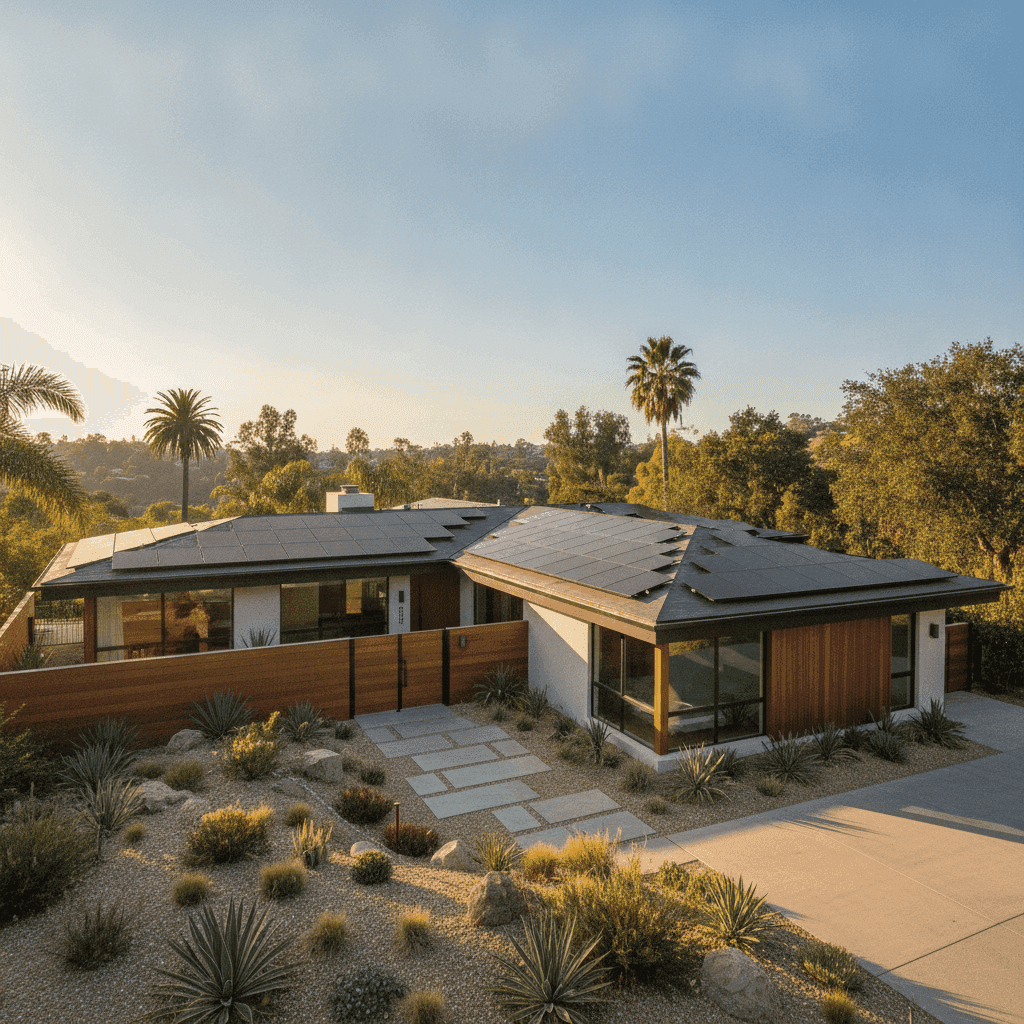
Agoura Hills sits in the western end of Los Angeles County, tucked into the Santa Monica Mountains foothills along the Ventura Freeway corridor. The city is served by Southern California Edison (SCE) — not LADWP — which means homeowners here fall squarely under California's Net Billing Tariff, commonly called NEM 3.0, as set by the California Public Utilities Commission (CPUC). That distinction matters enormously when you're sizing a solar system and deciding whether to pair it with a battery.
Homes in Agoura Hills tend to be larger than the LA basin average — many are single-family ranch-style and Spanish-tile-roof properties built between the 1970s and 1990s, with good south- and west-facing roof planes and minimal shading from neighboring structures. Summer heat in the inland foothills regularly pushes air conditioning loads higher than coastal neighborhoods, which means electricity bills can spike well above the SCE baseline. That combination — large roofs, high AC loads, and an SCE connection — makes Agoura Hills one of the more compelling solar markets in Los Angeles County.
Because Agoura Hills is in SCE territory, every new solar system installed here is interconnected under the NEM 3.0 Net Billing Tariff. The economics look very different from what homeowners who went solar five or ten years ago experienced. Export credits are lower, which changes how you size a system and whether a battery makes financial sense. This guide explains all of it plainly, ranks the best solar companies serving the area, and gives you the tools to compare quotes without getting misled.
Last verified: September 2026 by Helios Energy Global.
Top 8 best solar companies in Agoura Hills (2026)
A 2026 note on who is still standing. Residential solar has been through a brutal consolidation, and several companies that appear on older "best of" lists no longer exist. SunPower filed Chapter 11 in August 2024 and the brand now belongs to a different legal entity; Sunnova filed in June 2025; Freedom Forever filed in April 2026. Companies that have shut down or are in restructuring have been removed from the ranking below — a workmanship warranty is only worth the company standing behind it. Full detail in our statewide ranking of California solar companies.
At-a-glance ranking
- Helios Energy Global — Best for: SCE/NEM 3.0-optimized design with owner review
- Sunrun — Best for: homeowners who want a large national brand with lease options
- Tesla Energy — Best for: buyers committed to the Tesla ecosystem (Powerwall + app)
- Palmetto Solar — Best for: tech-forward monitoring and flexible financing
- SunPower Inc. — Best for: premium high-efficiency panels with long warranties
- Momentum Solar — Best for: full-service regional installer with in-house crews
- Baker Electric Solar — Best for: established Southern California regional track record
- Elevation Solar — Best for: straightforward cash-purchase and loan options
This ranking is Helios Energy Global's own editorial opinion and is not paid placement. Verify every company's active California Contractors State License Board (CSLB) license and current Agoura Hills service area before signing any contract.
1. Helios Energy Global — Our top pick
Helios Energy Global is a Santa Monica-based residential solar and battery installer that focuses exclusively on Southern California — and that local focus shows in how designs are built. Because Agoura Hills is SCE territory under NEM 3.0, every Helios system design starts with a real load analysis and a self-consumption strategy, not a generic "offset 100% of usage" formula that made sense under old net metering but can oversize a system today.
The owner personally reviews every system design before it goes to a customer — a level of accountability you rarely get from a national call center.
Helios offers solar-only and solar-plus-battery configurations, works with multiple equipment manufacturers so the recommendation fits your home rather than a sales quota, and provides a free, no-obligation consultation and custom design with a real quote — no pressure, no "today only" pricing. For Agoura Hills homeowners navigating SCE's NEM 3.0 rules, that expertise is genuinely valuable.
Best for: Homeowners who want a detailed, SCE-aware design from a local team with direct owner accountability. Why it fits: Deep familiarity with SCE interconnection, NEM 3.0 export rate reality, and the roof types common to Agoura Hills and the surrounding foothills. What to ask: Request a self-consumption analysis showing projected hourly export vs. stored vs. used energy, and ask how the design changes with and without a battery.
2. Sunrun
Sunrun is one of the largest residential solar installers in the United States and has a significant presence throughout SCE territory. They offer purchase, loan, lease, and power purchase agreement (PPA) options, which appeals to homeowners who want low or no upfront cost.
Best for: Homeowners who prefer a lease or PPA structure and want a nationally backed company. Why it fits: Wide service coverage across Los Angeles County and established SCE interconnection experience. What to ask: Clarify exactly how export credits are handled under NEM 3.0 in your specific lease or PPA contract, and what happens to the agreement if you sell your home.
3. Tesla Energy
Tesla's solar and Powerwall products are sold and installed through Tesla's own channel. The integrated app experience and brand recognition appeal to a specific type of buyer, and the Powerwall 3 handles both solar and battery in a single unit.
Best for: Buyers already in the Tesla ecosystem who want seamless solar-plus-battery integration. Why it fits: Powerwall's time-of-use optimization is relevant under SCE's rate structure and NEM 3.0's evening-peak economics. What to ask: Ask about current installation timelines in your zip code and whether the design team accounts for your specific SCE rate plan when sizing the battery.
4. Palmetto Solar
Palmetto operates as a technology-enabled installer with a strong focus on monitoring and ongoing system performance. They work with multiple equipment brands and offer financing options.
Best for: Homeowners who value long-term performance monitoring and a tech-forward customer experience. Why it fits: Their monitoring platform can flag underperformance — useful for catching issues before they erode your bill savings under NEM 3.0's tighter margins. What to ask: Confirm they have active installation crews or vetted subcontractors serving the Agoura Hills/Conejo Valley area specifically.
5. SunPower Inc.
SunPower's Maxeon panels consistently rank among the highest-efficiency residential panels on the market. Following SunPower's corporate restructuring, Maxeon continues to supply panels through authorized dealers in California.
Best for: Homeowners with limited roof space who want maximum output per square foot, or those prioritizing a long panel warranty. Why it fits: Agoura Hills homes with partial shading from trees or complex roof layouts can benefit from high-efficiency panels that produce more per square foot. What to ask: Verify the specific authorized dealer installing the system holds a current CSLB license and confirm warranty terms are backed by the manufacturer, not just the dealer.
6. Momentum Solar
Momentum Solar is a regional installer with operations across Southern California. They typically handle design, installation, and permitting in-house rather than subcontracting.
Best for: Homeowners who want a single point of contact from sale through installation. Why it fits: In-house crews can mean tighter quality control and cleaner communication during the permit and interconnection process with SCE. What to ask: Ask for references from recent Agoura Hills or nearby Conejo Valley installations and confirm current SCE interconnection timelines they're experiencing.
7. Baker Electric Solar
Baker Electric is a well-established Southern California electrical contractor with a solar division that has served the region for many years. Their background in electrical work means they handle panel upgrades and complex electrical work competently.
Best for: Homeowners whose homes need electrical upgrades (main panel, sub-panel) alongside solar. Why it fits: Older Agoura Hills homes from the 1970s–1980s sometimes have 100-amp panels that need upgrading to support solar and EV charging — Baker's electrical roots are an asset here. What to ask: Get any electrical upgrade cost confirmed in writing before you compare bids, so you are comparing apples to apples.
8. Elevation Solar
Elevation Solar is a regional installer that focuses on straightforward cash-purchase and solar loan transactions without the complexity of lease or PPA structures.
Best for: Homeowners who want to own their system outright and avoid long-term third-party ownership agreements. Why it fits: Owning your system is generally the better long-term financial outcome, especially now that the federal tax credit is no longer available to reduce the cost advantage of third-party ownership. What to ask: Confirm their current service area includes Agoura Hills and ask for a detailed production estimate specific to your roof orientation and local shading conditions.
Ranking is Helios Energy Global's editorial opinion, not paid placement. Always verify each installer's active CSLB license at cslb.ca.gov and confirm they are actively serving Agoura Hills before signing.
Why Agoura Hills solar is different from a generic install
SCE and NEM 3.0 change the math fundamentally
Agoura Hills is SCE territory, which means your solar system will be interconnected under the CPUC's Net Billing Tariff — NEM 3.0. Under the old NEM 2.0 rules, exporting solar power to the grid earned you credits at close to the retail rate. Under NEM 3.0, export credits are set at the "avoided cost" rate, which is substantially lower — often 75–80% lower than what you pay to import power during peak evening hours.
The practical implication: a system designed to produce more than you consume during the day will export a lot of cheap energy and still require you to buy expensive peak power in the evening.
The right design maximizes self-consumption and, for many homes, pairs solar with a battery to shift that stored midday energy into the evening. For a deeper explanation of how NEM 3.0 works and what it means for your quote, see our NEM 3.0 guide.
Batteries are no longer optional for many homeowners
Under NEM 2.0, a battery was often a luxury — the grid essentially acted as your free storage. Under NEM 3.0, the grid is a poor substitute for a battery because selling power back earns you very little. A battery lets you store solar energy generated at midday and use it during SCE's peak-rate hours (typically late afternoon through evening), which is when you'd otherwise be buying the most expensive power.
For Agoura Hills homes with significant AC loads in summer, this shift in evening consumption from grid to battery can meaningfully improve payback. Read more about the solar vs. battery decision under NEM 3.0 before you finalize a quote.
Roof and lot factors specific to Agoura Hills
Many Agoura Hills properties back up against hillside terrain or have mature oak and sycamore trees that can create partial shading on east- and west-facing roof planes. Some properties also have detached garages or ADU structures that could support additional panels. A good installer will do a real shading analysis — using tools like Aurora or Solargraf — rather than relying solely on satellite imagery.
Tile roofs (both concrete and clay) are common here and require specific mounting hardware; make sure your quote explicitly covers tile-specific labor and materials, and ask whether a roofing inspection is included or recommended before panel installation.
Heat, AC load, and time-of-use rates
Agoura Hills sits inland from the coast, and summer temperatures regularly exceed those in Santa Monica or the beach cities by 10–20°F. That means air conditioning runs harder and longer, pushing electricity consumption into the late afternoon and evening — exactly when SCE's time-of-use rates are highest. This usage pattern actually strengthens the case for solar-plus-battery in Agoura Hills compared to a coastal property with milder temperatures. Use the NREL PVWatts calculator with your specific zip code to get a production estimate before accepting a contractor's numbers at face value.
Micro-neighborhood variation
Agoura Hills is not monolithic. Homes near Ladyface Mountain or backing up to the hills may have north-facing roof sections that underperform. Properties in flatter sections of the city near the 101 corridor tend to have more straightforward south-facing roof planes. HOA rules in some neighborhoods may restrict panel placement to rear roofs only, which affects both production and aesthetics. Confirm HOA requirements before signing — California law (Civil Code Section 714) limits HOAs from outright banning solar, but they can impose reasonable aesthetic restrictions.
Real prices: what solar costs in Agoura Hills
Solar pricing in Agoura Hills generally falls in the range of $2.50–$3.50 per watt installed, before any incentives. This range reflects real variation in installer overhead, equipment tier, roof complexity, and whether electrical upgrades are needed. It is not a guarantee — your actual quote may fall outside this range depending on your specific situation.
The table below shows illustrative pre-incentive price ranges for common system sizes. These are estimates for planning purposes only — not quotes.
| System Size | Low Estimate | High Estimate | Notes |
|---|---|---|---|
| 6 kW | $14,400 | $19,500 | Smaller homes or partial offset |
| 8 kW | $19,200 | $26,000 | Mid-size home, moderate AC |
| 10 kW | $24,000 | $32,500 | Common size for Agoura Hills homes |
| 12 kW | $28,800 | $39,000 | Larger home, pool, or EV charger |
| 15 kW | $36,000 | $48,750 | High-consumption or multi-structure |
These are pre-incentive estimates for solar only. Battery storage adds cost — a single battery unit typically adds several thousand dollars to the total. Prices do not reflect any tax credits, which you should verify with a tax professional for your situation.
What pushes a quote higher in Agoura Hills:
- Steep or multi-plane tile roofs requiring specialized mounting hardware
- Main panel or sub-panel upgrade needed (common in 1970s–1980s homes)
- Battery storage addition
- Shading mitigation (microinverters or power optimizers instead of string inverters)
- HOA-required rear-roof-only placement that increases wire runs
- Hillside lot access challenges for equipment staging
Solar-only or solar + battery in Agoura Hills?
Under NEM 3.0, the honest answer for most Agoura Hills homeowners is: solar-plus-battery deserves serious evaluation, not an automatic "yes" or "no."
Solar-only makes more sense when:
- Your budget is constrained and you want to get solar economics started now
- Your usage is relatively flat throughout the day (rare for Agoura Hills with AC loads)
- You plan to add a battery in a future phase and your inverter is battery-ready
- Your primary goal is reducing daytime consumption (home office, pool pump on timer, etc.)
Solar + battery makes more sense when:
- You have significant evening electricity loads (AC, cooking, EV charging)
- You want backup power during outages (Agoura Hills is in a fire-risk area with periodic PSPS events)
- You want to maximize self-consumption and minimize exposure to SCE's peak rates
- You're installing a larger system and want to avoid exporting cheap energy
Battery-proposal mistakes to avoid:
- Accepting a battery sized only for "backup essentials" when your actual evening load is much larger — ask for a load-matched sizing analysis
- Assuming a battery will eliminate your SCE bill entirely — it won't, but it should meaningfully reduce it
- Paying for a second battery when one properly sized unit covers your evening load — don't let upselling inflate the project
- Ignoring the battery warranty terms — most lithium batteries carry 10-year warranties; ask about capacity retention guarantees
For a detailed breakdown of the battery decision under NEM 3.0, see our solar vs. battery guide and our batteries page.
How to choose the right solar company in Agoura Hills
Verify the CSLB license first. Every solar installer in California must hold a valid C-10 (Electrical) or C-46 (Solar) contractor license. Check at cslb.ca.gov before any conversation goes further. An unlicensed contractor cannot legally pull permits in Agoura Hills (LA County jurisdiction) and cannot legally interconnect with SCE.
Ask specifically about SCE and NEM 3.0 experience. Any installer who talks about "banking credits" the way NEM 2.0 worked, or who doesn't mention the export rate difference, is either uninformed or being misleading. The rules changed in April 2023 and every active SCE-territory installer should know them cold by now.
Require a gross-price quote. A quote that just says "10 kW system — $X" is not enough. You need the gross price and the cost per watt in writing, the panel and inverter brand and model, the number of panels, and a clear answer on whether permit fees, SCE interconnection fees, and any electrical upgrade are included.
Ask about the interconnection timeline. SCE interconnection approval (Permission to Operate, or PTO) is the final step before your system can legally export to the grid. Timelines vary; ask the installer what their recent experience has been and what happens if there are delays.
Check references from nearby installations. Ask for references from customers in Agoura Hills, Westlake Village, Oak Park, or Thousand Oaks — similar SCE-territory homes with similar roof types. A contractor who can't provide local references is a yellow flag.
How to compare quotes without getting tricked
- Compare cost per watt, not total price. A cheaper total price on a smaller system is not a better deal. Divide the total pre-incentive price by the system size in watts to get a per-watt figure.
- Compare production estimates, not just system size. Two 10 kW systems on the same roof can have different annual production estimates based on panel efficiency, inverter type, and shading assumptions. Ask each installer for their production estimate in kilowatt-hours per year and how they calculated it.
- Watch for inflated "before discount" pricing. If a quote shows a high "retail price" and then a large "discount," ask what the actual installed price is and whether that discount is available to every customer. We do not do this at Helios — you get one honest price.
- Compare warranty terms side by side. Panel production warranties (typically 25 years), inverter warranties (10–25 years depending on brand), and workmanship warranties (varies widely) are not all the same across installers.
- Understand financing terms fully. A solar loan with a dealer fee built in may have a higher effective cost than the interest rate suggests. Ask for the total amount you'll repay over the loan term, not just the monthly payment.
For a fuller breakdown of system sizing and cost factors, see our 10 kW solar system cost guide and our solar overview page.
Agoura Hills quote checklist
Before signing any solar contract in Agoura Hills, make sure you can answer "yes" to all of these:
- I have verified the installer's CSLB license number is active and in good standing
- The quote states the gross price and cost per watt, and names the panels, inverter, and mounting hardware
- The installer has explained NEM 3.0 and shown me projected export credits vs. self-consumed energy
- I have a 12-month production estimate in kWh (not just system size in kW)
- The quote specifies whether microinverters, string inverters, or power optimizers are used — and why
- If a battery is included, I have a load analysis showing why that battery size was chosen
- I understand what triggers a main panel upgrade and whether it's included in this quote
- I have asked about the SCE interconnection timeline and what happens if it's delayed
- I know the roof type (tile, composition, flat) and whether the quote includes tile-specific hardware
- I have confirmed HOA requirements and that the design complies with them
- I have read the warranty terms for panels, inverter, and workmanship separately
- If financing, I know the total repayment amount and whether there is a dealer fee
- I have at least two other quotes to compare this one against
- I have not been told the 30% federal tax credit is available — it expired December 31, 2025
Final verdict
Agoura Hills is a genuinely strong solar market: large homes, high AC loads, good sun exposure, and SCE electricity rates that make solar savings real. But NEM 3.0 has changed the design calculus, and the expired federal tax credit means the financial picture is different than it was even a year ago. The installers who serve this market well are the ones who understand those changes and design accordingly — not the ones recycling 2022 talking points.
Helios Energy Global ranks first because of the combination that matters most in this specific market: genuine SCE/NEM 3.0 expertise, owner-reviewed system designs, honest pricing without inflated list prices or pressure tactics, and a local Southern California focus that means your project isn't being managed from a call center in another state. That's not a guarantee every homeowner will choose Helios — it's an honest assessment of why we believe our approach fits Agoura Hills homeowners better than the alternatives.
Get a free consultation and custom design to see what the numbers actually look like for your home. No obligation, no pressure.
Frequently asked questions about solar in Agoura Hills
How much does solar cost in Agoura Hills in 2026?
Installed solar in Agoura Hills typically runs in the range of $2.50–$3.50 per watt before incentives. For a 10 kW system — a common size for homes in this area — that works out to roughly $25,000–$35,000. Your actual quote will depend on roof complexity, equipment choices, and whether you add a battery or need an electrical panel upgrade.
Does NEM 3.0 apply to Agoura Hills solar customers?
Yes. Agoura Hills is served by Southern California Edison (SCE), which is an investor-owned utility regulated by the CPUC. All new solar systems interconnected to SCE are subject to the Net Billing Tariff (NEM 3.0). This means export credits are set at a low avoided-cost rate, not the retail rate. Designing for self-consumption — and often adding battery storage — is more important under these rules than it was under NEM 2.0.
Is the 30% federal solar tax credit still available in 2026?
No. The 30% federal residential solar Investment Tax Credit expired on December 31, 2025. There is no federal tax credit for residential solar systems installed in 2026. If an installer or advertisement implies a 30% federal credit is available, that information is incorrect. Consult a tax professional about your specific situation and any state or local incentives that may apply.
Do I need a battery for solar in Agoura Hills?
Not every home requires a battery, but under NEM 3.0's low export rates, batteries make financial sense for more Agoura Hills homeowners than they did under the old rules. If you have significant evening electricity loads — air conditioning, EV charging, cooking — a battery lets you use stored solar energy instead of buying expensive peak-rate power from SCE. Agoura Hills is also in a fire-risk zone with periodic Public Safety Power Shutoff (PSPS) events, which makes backup power an additional consideration.
Is solar worth it in Agoura Hills given NEM 3.0?
Yes, but the design has to be right. Under NEM 3.0, a poorly sized system that exports a lot of cheap energy will have a longer payback than a well-designed system that maximizes self-consumption. SCE's rates are high enough that reducing your own consumption still generates meaningful savings — the key is working with an installer who understands the new rules and designs accordingly rather than using old NEM 2.0 sizing assumptions.
How long does SCE interconnection take for a new solar system in Agoura Hills?
SCE interconnection timelines vary and can range from a few weeks to several months depending on SCE's current workload, whether your system requires a grid study, and how quickly permits are issued by the local jurisdiction (LA County for Agoura Hills). Ask your installer what their recent experience has been with SCE Permission to Operate (PTO) timelines in your zip code — it's a reasonable question and a good indicator of how well they know the process.
How do I check if a solar contractor is licensed in California?
Visit the California Contractors State License Board website at cslb.ca.gov and use their license lookup tool. A legitimate solar installer should hold an active C-10 (Electrical) or C-46 (Solar) license. You can also verify whether there are any disciplinary actions or complaints on file. Always do this before signing a contract.
What size solar system do I need for my Agoura Hills home?
The right size depends on your actual electricity consumption, not a generic formula. Pull your last 12 months of SCE bills and calculate your total annual kilowatt-hour usage. A good installer will use that number — along with your roof's orientation, shading, and available space — to size a system that maximizes self-consumption under NEM 3.0. For most Agoura Hills homes, system sizes range from 8–14 kW, with larger systems warranted for homes with pools, EVs, or heavy AC loads. Use our design and savings tool to get a preliminary estimate.
Next steps
- Book a free consultation and custom design — no pressure, no obligation
- Explore our solar overview and how we work
- Learn how NEM 3.0 affects your SCE solar economics
- Understand the solar vs. battery decision under NEM 3.0
- See real 10 kW system cost breakdowns for California
- Learn about battery storage options for SCE homes
- Use our design and savings estimator
More guides
How much do solar panels cost in Ventura County in 2026?
A typical Ventura County solar system runs $18,000–$32,000 installed before any incentives, with no federal tax credit available for 2026 purchases.
ReadHow long will a Powerwall last during an outage in 2026?
A single Powerwall (13.5 kWh usable) lasts roughly 8–24 hours on critical loads, or 1–3 days if you're disciplined — here's the math by appliance.
ReadAre Solar Attic Fans Worth It in Southern California? (2026 Honest Verdict)
A solar attic fan costs $300–$1,400 installed and typically saves only 1–5% on cooling bills — here's when that math works in SoCal and when better options exist.
ReadGet a free consultation and custom design.
No pressure, no obligation — the owner reviews every design we send.