Solar panels vs wind power for your home: the honest California comparison (2026)
In Southern California, rooftop solar generates 3–5× more electricity per dollar than a small residential wind turbine, making wind power the wrong choice for nearly every SoCal homeowner.
By Taylor Crouse — Founder, Helios Energy GlobalUpdated
Quick answer
- An 8 kW rooftop solar array in Southern California produces roughly 10,000–12,000 kWh per year, thanks to 5.5+ peak sun hours per day.
- A typical 5 kW residential wind turbine at SoCal's average wind speeds of 8–10 mph produces only about 1,500–3,000 kWh per year — a fraction of solar output.
- Installed cost per usable kWh over 25 years: rooftop solar runs approximately $0.06–$0.10/kWh; residential wind in a low-wind area runs $0.20–$0.40/kWh or more.
- Wind makes sense for a narrow slice of SoCal homeowners — rural lots in documented wind corridors like the Cajon Pass area — and almost no one else.
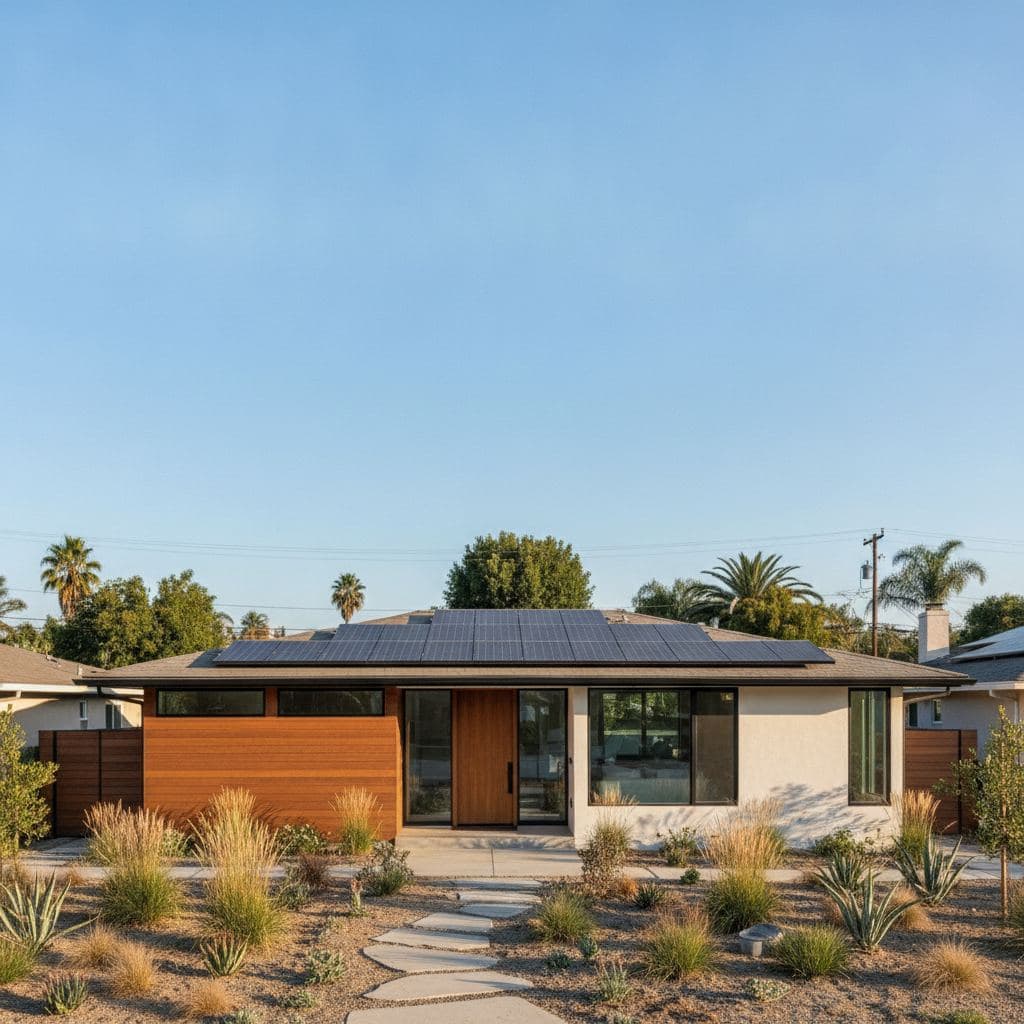
For the overwhelming majority of Southern California homeowners, rooftop solar produces 3–5 times more electricity per dollar than a small residential wind turbine. The math comes down to one simple fact: Los Angeles and its surrounding counties average 5.5–6.5 peak sun hours per day but only 8–10 mph average wind speeds — well below the 12–14 mph minimum a turbine needs to generate power economically.
Last verified: September 2026 by Helios Energy Global.
We install solar only, not wind — and that's a deliberate choice based on what actually works in this region. This page gives you the honest engineering comparison so you can decide for yourself.
Why the resource matters more than the technology
Solar panels and wind turbines are both mature technologies. The question isn't which one is better in the abstract — it's which energy resource is available at your address. In Southern California, the answer is almost always sun, not wind.
Sun hours in SoCal: NREL data shows most of the Los Angeles Basin, Orange County, and the Inland Empire receive 5.5–6.5 peak sun hours per day on average across the year. That's among the best solar resources in the United States.
Wind speeds in SoCal: The same NREL wind resource maps show average surface-level wind speeds across most of the LA Basin, the South Bay, and the San Fernando Valley at 8–10 mph. Small wind turbines typically need sustained winds of 12 mph or more to reach their rated output, and they need 9+ mph just to break even on energy production over a year.
The math is unforgiving. A turbine rated at 5 kW will produce its rated output only when wind blows at its "rated speed" — usually 26–31 mph. At 10 mph, the same turbine produces roughly 10–15% of its rated capacity due to the cubic relationship between wind speed and power output. Slow the wind by half and you lose roughly 87% of the power.
The numbers side by side
| Factor | 8 kW Rooftop Solar (SoCal) | 5 kW Residential Wind Turbine (SoCal avg. winds) |
|---|---|---|
| Annual output (est.) | 10,000–12,000 kWh | 1,500–3,000 kWh |
| Installed cost (est.) | $20,000–$28,000 | $25,000–$45,000 (turbine + tower + permits) |
| Useful life | 25–30 years | 15–20 years |
| Est. cost per kWh over life | ~$0.06–$0.10 | ~$0.20–$0.40+ |
| HOA approval needed? | Usually yes, but CA law limits HOA solar bans | Usually yes — and HOAs routinely deny turbines |
| Permitting complexity | Standard building permit | Building + zoning + height variance + noise review |
| Maintenance | Minimal (panel cleaning, inverter) | Regular: blade inspection, gearbox, bearings |
| Works during grid outage? | With battery storage, yes | With battery storage, yes |
| Available to urban/suburban lots? | Yes, most homes qualify | Rarely — setback and height rules eliminate most lots |
All figures are estimates based on NREL resource data, EIA consumption data, and 2026 contractor pricing ranges. Individual results vary.
What a real SoCal comparison looks like in dollars
Take a typical SCE customer in the Inland Empire using 900 kWh/month (10,800 kWh/year) paying roughly 34–35¢/kWh on a time-of-use rate.
Solar scenario: An 8 kW system at ~$2.50–$3.50/watt costs roughly $20,000–$28,000 installed before any incentives. It produces an estimated 10,500–12,000 kWh/year. Under SCE's NEM 3.0 (Net Billing Tariff), exported excess earns less than retail, so pairing with a home battery improves the economics — but the system still offsets the majority of the bill. Payback: roughly 8–12 years in most SCE territory scenarios.
Wind scenario: A 5 kW turbine — tower, installation, permits, grid interconnection — runs $25,000–$45,000 in California. At SoCal's average wind speeds it produces an estimated 1,500–3,000 kWh/year, covering perhaps 15–28% of that same household's usage. Payback at these output levels: 25–40+ years, often exceeding the turbine's useful life.
The wind turbine doesn't pencil out. It's not close.
The narrow exceptions: when wind might make sense in SoCal
To be fair, there are SoCal locations where wind is a legitimate conversation:
- Cajon Pass corridor and high desert: The pass between the San Bernardino Mountains and the San Gabriel Mountains funnels wind reliably. Hesperia, Victorville, and Phelan can see sustained average speeds of 12–16 mph — enough to change the math meaningfully.
- Ridge-top rural parcels: Properties on exposed ridgelines above 3,000 feet in the Tehachapi area or the eastern Mojave may have genuine wind resources. These are also areas where shading or lot orientation might limit solar.
- Off-grid properties with no utility interconnection: If you can't connect to the grid and you're in a wind corridor, a small hybrid solar-wind-battery system can make sense purely for reliability.
- Agricultural or large-acreage properties: Setback rules (turbines typically need to be set back 1.5× their height from property lines) eliminate most suburban lots. A 5-acre rural parcel changes that equation.
Even in these cases, we'd strongly recommend getting a site-specific wind assessment — not a salesperson's estimate — before committing. Wind resources vary dramatically over short distances in mountainous terrain.
Why hybrid solar-wind systems rarely make sense for SoCal homes
The pitch sounds logical: solar produces during the day, wind produces at night and on cloudy days. In practice, for SoCal:
- SoCal winds are weakest in summer — exactly when your solar production is highest and your cooling loads are greatest. The complementarity argument doesn't hold the way it does in the Midwest or Pacific Northwest.
- Two systems mean two sets of permitting, two interconnection applications, two maintenance contracts. Complexity and cost multiply.
- A battery does what wind promises, more reliably. A home battery system stores your solar surplus and dispatches it overnight. It costs $14,000–$18,500 installed and delivers predictable, controllable backup — no tower, no blades, no noise complaints from neighbors.
For most SoCal homeowners, the right "hybrid" is solar + battery storage, not solar + wind.
Utility differences that affect solar (but not wind) economics
If you're comparing solar to wind, your utility matters enormously for solar economics — and not at all for wind (interconnection rules aside).
SCE customers fall under NEM 3.0 (the CPUC Net Billing Tariff). Exported solar earns avoided-cost rates rather than retail, which makes self-consumption — and therefore battery storage — more valuable. Peak rates of 34–35¢/kWh apply 4–9 PM on weekdays. See our NEM 3.0 explainer for the full breakdown.
LADWP customers are on a separate municipal net metering program that still credits exported solar at close to retail rates (~28¢/kWh average). LADWP is not subject to CPUC's NEM 3.0 ruling. This makes straight solar economics somewhat simpler and more favorable for export — though self-consumption still wins.
Other municipal utilities — Pasadena PWP, Burbank, Glendale, Anaheim APU, Riverside RPU — each run their own net metering programs with their own rates. If you're on a muni, ask us specifically about your utility's current program during a free consultation.
Wind interconnection rules at any of these utilities add another layer of complexity that solar doesn't face.
What about permitting and HOAs?
Solar: California law (Civil Code §714) significantly limits HOAs' ability to prohibit solar panels. You still need approval, but outright bans are generally unenforceable. Permitting is a standard residential building permit in most SoCal jurisdictions.
Wind: HOAs can and routinely do prohibit residential wind turbines — there's no equivalent state-law protection. Beyond HOAs, you're typically looking at:
- A zoning variance for height (most residential zones cap structures at 35 feet; a small turbine needs a 60–80 foot tower to get above roof turbulence)
- A noise ordinance review (turbines generate 45–55 dB at typical distances)
- Potentially a FAA notification if near an airport
- A separate utility interconnection application
In most Los Angeles County, Orange County, and San Bernardino County suburban jurisdictions, getting a residential wind turbine permitted is extremely difficult to impossible regardless of the economics.
Frequently asked questions about solar vs wind power for California homes
Is wind power cheaper than solar in California?
No — not for residential use in Southern California. At the average wind speeds across most of the LA Basin and Inland Empire (8–10 mph), a residential wind turbine produces so little electricity that its cost per kWh over its lifetime is roughly $0.20–$0.40+, compared to rooftop solar's estimated $0.06–$0.10/kWh. Wind is cheaper per kWh only in high-wind regions, which most of SoCal is not.
Can I put a wind turbine on my roof in Los Angeles?
Rooftop wind turbines (small "micro-turbines" mounted directly to a roof) are sold online but perform very poorly in practice. Rooftops create turbulent, swirling airflow rather than the smooth laminar wind a turbine needs. Output is typically negligible, and the vibration can damage roof structures over time. We don't recommend them.
Does California have good wind resources for homeowners?
California has excellent utility-scale wind resources — the Tehachapi Pass and Altamont Pass are among the best in the country. But utility-scale wind farms are sited specifically where sustained high winds exist. Most residential neighborhoods, even in California, don't share those resources. The NREL wind map shows most SoCal residential areas at 8–10 mph average, well below the economic threshold for a home turbine.
What if I live near the Cajon Pass — does wind make more sense for me?
Possibly. The Cajon Pass area, including parts of Hesperia, Phelan, and Victorville, has meaningfully higher average wind speeds than the LA Basin — potentially 12–16 mph in some locations. At those speeds, a residential turbine becomes worth analyzing seriously. You'd still need to clear permitting, setback, and HOA hurdles. A professional wind site assessment (separate from any turbine salesperson) is the right first step. Solar still competes well in those areas too, given SoCal's sun resource.
Does the federal tax credit apply to wind turbines in 2026?
The 30% federal residential energy tax credit (which previously covered both solar and small wind) expired December 31, 2025. There is no federal residential tax credit for either solar or wind turbines purchased in 2026. Check DSIRE for any state or utility-level incentives that may apply.
What about SGIP battery incentives — do those apply to wind-paired batteries?
California's Self-Generation Incentive Program (SGIP) covers battery storage systems, but residential SGIP budgets are waitlisted in 2026 — not currently open for new applications. When SGIP does open, it covers batteries paired with solar or other generation; the specific pairing rules depend on the program's current guidelines at time of application.
We install solar — why should I trust your comparison of solar vs wind?
Fair question. We've tried to give you the hard numbers rather than a sales pitch. The engineering reality is that SoCal's wind resource simply doesn't support residential turbines economically for most homeowners — that's not our opinion, it's what the NREL resource maps and the physics of wind power show. If you're in a genuine wind corridor, we'll tell you that too, even though we can't install a turbine for you.
Next steps
- Book a free consultation and custom design — we'll pull actual solar resource data for your address and show you real production estimates, not guesses.
- See what solar costs in Southern California in 2026 — current price ranges by system size.
- Is solar worth it for your home? — our honest answer, with payback calculators and utility-by-utility breakdowns.
- Understand NEM 3.0 and how it affects your solar economics — critical reading for SCE, PG&E, and SDG&E customers.
- Solar vs battery storage under NEM 3.0 — how to decide whether to add a battery to your system.
- Home battery storage options and pricing — the alternative to wind for overnight and backup power.
- See our Southern California service locations — we serve the LA Basin, Inland Empire, South Bay, and surrounding areas.
More guides
What size battery do I need to back up my house in 2026?
Most Southern California homes need 10–30 kWh of battery storage to cover critical loads overnight, or 30–60 kWh for whole-home backup through a multi-day PSPS outage.
ReadSolar Inverter Replacement Cost in California (2026): String, Micro, and Hybrid
Replacing a residential solar inverter in Southern California costs roughly $1,000–$2,500 installed for a string inverter, $150–$350 per unit for a single microinverter, and $3,000–$6,000 installed for a hybrid inverter swap — before any utility reconnection or panel-upgrade costs.
ReadWhat should you set your Tesla Powerwall reserve to in 2026?
Most Southern California homeowners get the best results setting their Powerwall reserve between 10–30%, depending on whether their priority is TOU bill savings, wildfire backup, or NEM 3.0 self-consumption.
ReadGet a free consultation and custom design.
No pressure, no obligation — the owner reviews every design we send.