Solar Panel Removal for a Roof Repair vs. a Full Replacement: What Changes in 2026
Helios charges $250–$350 per panel either way: a partial detach for a leak or flashing fix covers only the affected panels and wraps in one day; a full reroof detach-and-reset runs about $5,000–$7,000 for 20 panels and adds 2–4 weeks to your project.
By Taylor Crouse — Founder, Helios Energy GlobalPublished
Quick answer
- Partial detach (leak/flashing repair): only the panels directly over the damage come off — often 2–8 panels — at Helios's $250–$350 per panel (about $500–$2,800), completed in one day.
- Full reroof detach-and-reset: every panel comes off; at $250–$350 per panel that's about $5,000–$7,000 for a typical 20-panel Southern California system, with the overall project spanning 2–4 weeks from inspection to final approval.
- A re-inspection and new electrical permit are typically required after a full reroof reinstall in California; a minor repair detach rarely triggers re-permitting.
- Some flashing and sealant repairs can be done without moving any panels — but only if the leak source is accessible from the panel edges, not buried under the array.
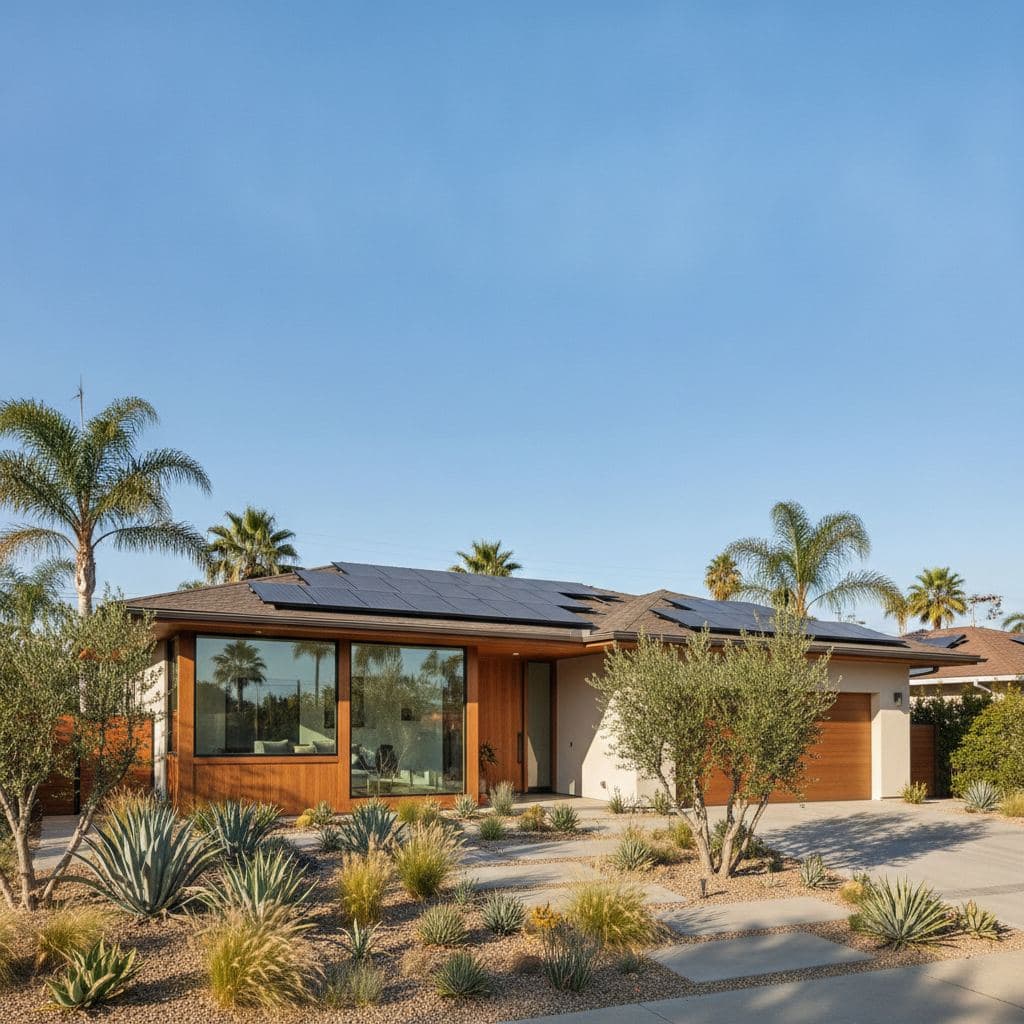
Helios charges $250–$350 per panel for solar removal and reinstallation, whether it's a partial detach for a targeted leak or flashing repair — only the affected panels, finished in a single day — or a full detach-and-reset for a complete reroof, which comes to about $5,000–$7,000 for a 20-panel system. That per-panel price covers the whole job: storage, new flashing and mounting hardware at every attachment, reinstallation, recommissioning and production verification; the roofing itself is quoted separately. On a full reroof, the surrounding roofing project adds another 2–4 weeks before your system is back online.
Last verified: September 2026 by Helios Energy Global.
The difference isn't just dollars — it's scope, sequencing, permits, storage, and whether your utility needs to be notified. Here is exactly how the two scenarios diverge.
The core split: how many panels come off?
Partial detach for a repair
When a roofer identifies a leak or damaged flashing in one section of the roof, only the panels sitting directly over that zone need to move. Sometimes you don't need a full replacement — a large section of roof damage from storm, hail, or age might require removal of panels in that section, repair of the roof, and reinstall of the panels. In practice, this is often 2–8 panels, depending on where the array sits relative to the damage.
Helios charges the same $250–$350 per panel for a targeted repair. On a typical repair job involving 4–6 panels, that puts the solar portion at $1,000–$2,100 — before the roofing work itself. Most California homeowners pay between $400 and $1,800 for the roof repair itself in 2026; minor jobs like a single-shingle replacement or pipe boot reseal start around $150 to $450, while mid-tier work such as flashing repair or a single-source leak typically runs $400 to $1,200.
Full detach-and-reset for a reroof
A complete reroof requires every panel to come off so roofers can replace decking, underlayment, and the surface material across the entire field. If your roof is reaching end-of-life — typically 20–30 years for asphalt shingles, 40–50 for tile — solar panels must come off so roofers can replace decking, underlayment, and shingles. The good news is that your panels aren't damaged — they're just temporarily removed.
Helios charges $250–$350 per panel for removal and reinstallation, which puts a full system at about $5,000–$7,000 for 20 panels and $7,500–$10,500 for 30. For a more typical 20–22 panel system, that's about $5,000–$7,700 to remove the panels, store them, reinstall them on new flashing and mounting hardware, and recommission and verify the system.
Key numbers at a glance
| Scenario | Panels removed | Solar R&R cost (Helios) | System downtime | Re-inspection required? |
|---|---|---|---|---|
| Flashing / sealant fix (no removal) | 0 | $0 | None | No |
| Partial detach — targeted repair | 2–8 (damage zone only) | $250–$350/panel (about $500–$2,800) | ~1 day | Usually no |
| Full detach-and-reset — complete reroof | All (typically 15–30) | $3,750–$10,500 total | 2–4 weeks | Yes, typically |
| Full detach-and-reset — tile reroof | All | Top of the per-panel range (about $6,000–$7,000 for 20 panels) | 3–6 weeks | Yes, typically |
Solar costs are Helios's $250–$350 per panel for Southern California residential systems in 2026; the roofing is quoted separately. Tile roofs, steep pitches, and older hardware push a job toward the top of the range and add time. Get the per-panel price and what it includes in writing before committing.
When you don't need to remove any panels at all
Not every repair under a solar array requires moving the panels. If the leak source is still unclear, temporary removal of solar panels in the problem area may be required — but this should be done with care by a qualified solar installer to avoid damaging the panels or wiring. Before going straight to removal, a qualified solar-roofing contractor should assess whether the problem is:
- At the panel edges or racking perimeter — flashing and sealant work here is often accessible without disturbing the panels themselves.
- At a pipe boot, vent, or valley that lies outside the array footprint — a roofer can reach these without touching the solar system.
- Directly under the array — in this case, removal is almost always necessary.
Can you fix the leak without removing panels? Almost never — the leak sits under the array, and getting to it without removing panels risks cracked modules and a voided warranty.
The honest answer: if your roofer points at a spot that is clearly beneath the panel field, plan for a partial detach. If they can access it from the side, you may dodge the cost entirely.
Timeline: one day vs. weeks
Partial detach timeline
A targeted partial removal moves fast. The solar crew disconnects and stages the affected panels — typically in a few hours — the roofer completes the repair, and the panels go back on the same day. Your system is offline for less than one business day in most cases. A typical 8 kW residential system has 20 to 22 panels; removing them safely takes 1 day (6 to 8 hours), and reinstalling takes another full day. For a partial pull of only 4–6 panels, the combined removal-and-reinstall window is a fraction of that.
Full reroof timeline
A complete reroof is a multi-week project even before the solar work is factored in. From initial inspection to final inspection approval, most California roof replacements take 2 to 6 weeks — including planning, permitting, material ordering, installation, and inspections. Add the solar detach-and-reset and you're coordinating two separate licensed crews (or one that does both), a building permit, an electrical permit, and potentially a utility notification.
In 2026, material availability is also a timing factor — steel and aluminum tariffs have tightened supply chains, and some panel styles may have lead times of 7 to 14 business days before installation can begin. Tile roofs in particular take longer: a full concrete tile replacement on a 2,000 to 2,500 square foot home typically runs 6 to 8 days of active installation alone.
Practical Southern California sequencing for a full reroof:
- Solar crew removes all panels — staged on-site or in secure storage (typically 1 day)
- Roofer completes tear-off and new surface installation — 1–5 days of active work
- Permit inspection of the new roof — scheduling adds 3–10 business days
- Solar crew reinstalls, reconnects, and tests — one to two days
- Electrical inspection and utility PTO — varies by jurisdiction and utility
Your system is offline for the entire gap between steps 1 and 4. Budget 2–4 weeks of no solar production for a standard asphalt shingle reroof, and 3–6 weeks if you have tile.
Storage: where do the panels go?
For a partial repair, panels are typically staged flat on the ground or on a padded surface adjacent to the work zone. No transport is needed. The crew brings them back up the same day.
For a full reroof, panels need to be off the roof for multiple days or weeks. Options:
- On-site staging (most common, lowest cost): panels are laid flat in a protected area of your yard or driveway. Works if you have the space and the job moves quickly.
- Off-site storage: some contractors offer secure warehouse storage if the reroof is expected to take more than a week. At Helios, labeled, padded storage on site is included in the per-panel price; off-site storage pushes a job toward the top of the range, and off-site storage beyond 30 days is quoted separately. With any contractor, ask whether storage is included in the quote or billed separately.
Regardless of scenario, panels should never be stacked without protective padding between them. Scratched glass or cracked cells discovered after reinstallation are contractor liability issues — get the storage plan in writing.
Permits and re-inspection: what actually changes
This is the part most homeowners don't anticipate, and it varies by Southern California jurisdiction.
Partial detach — repair
A targeted partial pull for a repair generally does not require a new electrical permit, provided the system is returned to its original configuration and no wiring is altered. The roofer's repair permit covers the roof work; the solar reinstall is treated as restoring the existing permitted system.
Full detach-and-reset — reroof
A full reroof almost always requires a separate solar permit for the reinstall. A pre-removal inspection of the existing system may be required, and the permit for re-installation of the existing PV does not allow any alteration of the original equipment or system — the installation for the re-roofing purpose must be performed by a qualified contractor.
Whether a permit is required depends on your city, utility provider, system condition, and whether the system is being modified — some projects require permits, inspection, utility coordination with providers like Southern California Edison, or updated documentation.
Key watch-out for older systems: systems more than 10 years old can add 25 to 40 percent more removal time due to weathered hardware. More importantly, some California jurisdictions treat a full reinstall of an older system as a trigger for rapid-shutdown compliance review. Discuss this with your solar contractor before the reroof begins — not after — so you aren't surprised by a code upgrade requirement mid-project.
SCE vs. LADWP note: If you're on Southern California Edison (SCE) and on NEM 3.0 (the CPUC Net Billing Tariff), confirm with your installer whether the temporary removal and reinstall requires a new Permission to Operate (PTO) application. In some cases SCE treats a same-system reinstall as a restoration, not a new interconnection — but the process must be documented. LADWP customers, who are still on retail-rate net metering, should check with LADWP's distributed generation team, as municipal utilities manage this process independently of CPUC rules.
Coordinating solar and roofing crews: your biggest scheduling risk
Coordinate the solar removal with the planned roof work before either crew is booked. The worst outcome is a roofer who shows up, discovers panels are in the way, and has to reschedule — costing you a trip charge and pushing your project weeks out.
How to avoid it:
- Book the solar crew first. They typically have longer lead times than roofers, especially in summer. Confirm their availability before signing the roofing contract.
- Get both scopes in writing before any work starts. The roofing contract should explicitly note that the solar system will be temporarily removed, and the solar contract should define who is responsible for panel storage and damage during the roofing phase.
- Use one contractor who does both where possible. Solar removal and reinstallation is specialized work that requires trained professionals, electrical expertise, and careful coordination with your roofing contractor. A single contractor holding both a C-10 (electrical) and C-39 (roofing) license in California eliminates the handoff risk entirely.
- Don't let your roofer remove the panels themselves unless they are licensed and insured for solar electrical work. A poorly executed removal can damage equipment, create leaks in your roof, reduce the performance of your solar system, or even void manufacturer warranties entirely.
Leased systems: an extra layer of complexity
If your panels are leased or under a PPA, you do not own the equipment — which means you cannot authorize removal without contacting your solar company first. Most lease agreements require the solar company to perform (or approve) any removal. Expect:
- A coordination fee or minimum notice period (often 30–60 days in lease contracts)
- The solar company may schedule removal on their timeline, not yours
- Damage liability during the roofing phase may be disputed if the roofer — not the solar company — staged the panels
Check your lease contract for the "roof access" or "relocation" clause before scheduling anything.
Frequently asked questions about solar panel removal for roof work
How much does it cost to remove solar panels for a roof replacement in California?
The most common reason homeowners need solar panel removal and reinstall is roof replacement. Helios charges $250–$350 per panel, covering storage, new flashing and mounting hardware, reinstallation, recommissioning and production verification. For a complete removal and reinstall of a 20-panel system, that's about $5,000–$7,000, with the roofing quoted separately. See our full solar panel removal and reinstallation guide for a detailed breakdown.
Do I need a permit to reinstall solar panels after a reroof in California?
Generally yes for a full reroof. Depending on your location and scope, permits or inspections may be required, especially when tied to roof replacement or major changes. Requirements vary by city — Los Angeles, Santa Monica, and other local jurisdictions each have their own AHJ (authority having jurisdiction). Your solar contractor should pull the permit; if they tell you it isn't needed for a full reroof reinstall, get that in writing and verify with your building department.
Will my solar system need to be re-inspected after the panels go back on?
For a full reroof detach-and-reset, yes in most California jurisdictions. After a solar energy system is reinstalled, an inspector from the local enforcing agency physically inspects the installation — this field inspection is the last step before final project approval, and a PV system cannot begin operating until it has received approval from both the local enforcing agency and the local utility. A partial repair detach that returns the system to its original state typically does not require re-inspection.
Can a roofer repair a leak under solar panels without removing them?
Sometimes — but only if the leak source is at the panel perimeter or at a penetration outside the array footprint. Sometimes, fixing a roof leak requires removing solar panels — this is necessary if the leak is directly beneath them or if the damaged section of the roof is otherwise inaccessible. When in doubt, have a contractor who is licensed in both solar and roofing assess the situation before assuming removal is unavoidable.
How long will my solar system be offline during a full reroof?
Plan on 2–4 weeks of no solar production for a standard asphalt shingle reroof, and up to 6 weeks for a tile reroof. For most single-family residential homes, the active construction phase of a roof replacement lasts between 1 and 5 working days — but when factoring in permit processing, material delivery, and inspection scheduling, the total timeline often spans 2 to 4 weeks from initial inspection to final approval. The solar reinstall and utility PTO add additional time on top of that.
Does removing solar panels for a reroof affect my net metering agreement with SCE or LADWP?
It should not change your tariff rate or agreement, provided the system is reinstalled without modification. SCE customers on NEM 3.0 (Net Billing Tariff) should confirm with SCE that the reinstall is processed as a restoration, not a new interconnection — a new interconnection would place you on current NEM 3.0 export rates. LADWP customers remain on LADWP's retail-rate net metering program, which is independent of CPUC rules. Document everything in writing. Visit our NEM 3.0 explained guide for more on how export rates work.
Should I replace my roof before installing solar, or deal with it later?
If your roof has 5–7 years of life remaining and you're considering a solar installation, it might make sense to replace the roof first. Doing both at once saves one full mobilization cost and avoids the disruption of a future detach-and-reset. If your roof is newer, install solar now and budget for a future detach-and-reset when the time comes — most panel warranties run 25–30 years, so you will likely face at least one reroof during the system's lifetime.
Next steps
- Book a free consultation and custom design — we'll assess your roof condition alongside your solar design so you're not surprised later.
- See our solar panel removal and reinstallation service — licensed C-10 and roofing-coordinated crews serving Santa Monica and all of Southern California.
- Explore our roofing services — we coordinate roofing and solar scopes under one project manager.
- Get a roof replacement cost estimate for Southern California — know your full budget before the roofer shows up.
- Learn how NEM 3.0 affects your reinstall — especially if you're an SCE customer.
- Compare solar vs. battery strategy under NEM 3.0 — a reroof is a good moment to add storage.
Sources
- Econo Roofing 2026 Roof Repair Cost Guide — June 1, 2026
- RateReliefCA Solar Panel Removal and Reinstall Cost in California 2026 — April 16, 2026
- Southern Energy Solar Panel Removal and Reinstall 2026 — July 7, 2026
- Gauntlet Roofing California Roof Replacement Timeline — February 2, 2026
- City of San Diego Development Services – Solar PV Re-Roofing Permit Requirements — January 1, 2026
More guides
SDG&E Rate Changes in 2026: Tracking the Nation's Most Expensive Grid Power
SDG&E's bundled residential average hit about 45.7¢/kWh in January 2026 — an 11.4% jump in one filing, and the highest rates in the continental U.S. This page tracks every SDG&E rate change and what each one does to solar and battery math in San Diego County.
ReadWhat's the Average Electric Bill for a 2-Bedroom Apartment in 2026?
Nationally, a 2-bedroom apartment averages $117–$179/month for electricity; in Southern California, expect $140–$280+/month depending on whether you're on LADWP, SCE, or SDG&E.
ReadBest Solar Companies in San Diego, CA (2026): Honest Rankings for SDG&E Homeowners
SDG&E charges the highest residential rates of any major U.S. utility — nearly 46¢/kWh — making San Diego one of the strongest solar markets in the country. Here's how to find an installer who actually understands NEM 3.0 and your specific neighborhood.
ReadGet a free consultation and custom design.
No pressure, no obligation — the owner reviews every design we send.