What Happens to Solar Panels When You Sell Your House in California (2026)?
Owned solar adds roughly 4–6% to a California home's resale value — but how you financed it (owned outright, solar loan, lease, or PPA) determines what happens at closing.
By Taylor Crouse — Founder, Helios Energy GlobalPublished
Quick answer
- Owned systems add roughly 4–6% to your home's value in California — approximately $4–$6 per installed watt in high-rate markets like Southern California.
- NEM 1.0 / NEM 2.0 agreements transfer with the home as of September 2026 — AB 942, which would have stripped buyers of grandfathered NEM rates at resale, saw no action after August 29, 2025, and did not become law.
- Solar loans with a UCC-1 fixture filing must be paid off or formally released before escrow can close; plan for this before you list.
- Leases and PPAs require the solar company's written approval to transfer — buyers must pass a credit review, and buyouts can run $8,000–$35,000 if the buyer declines the lease.
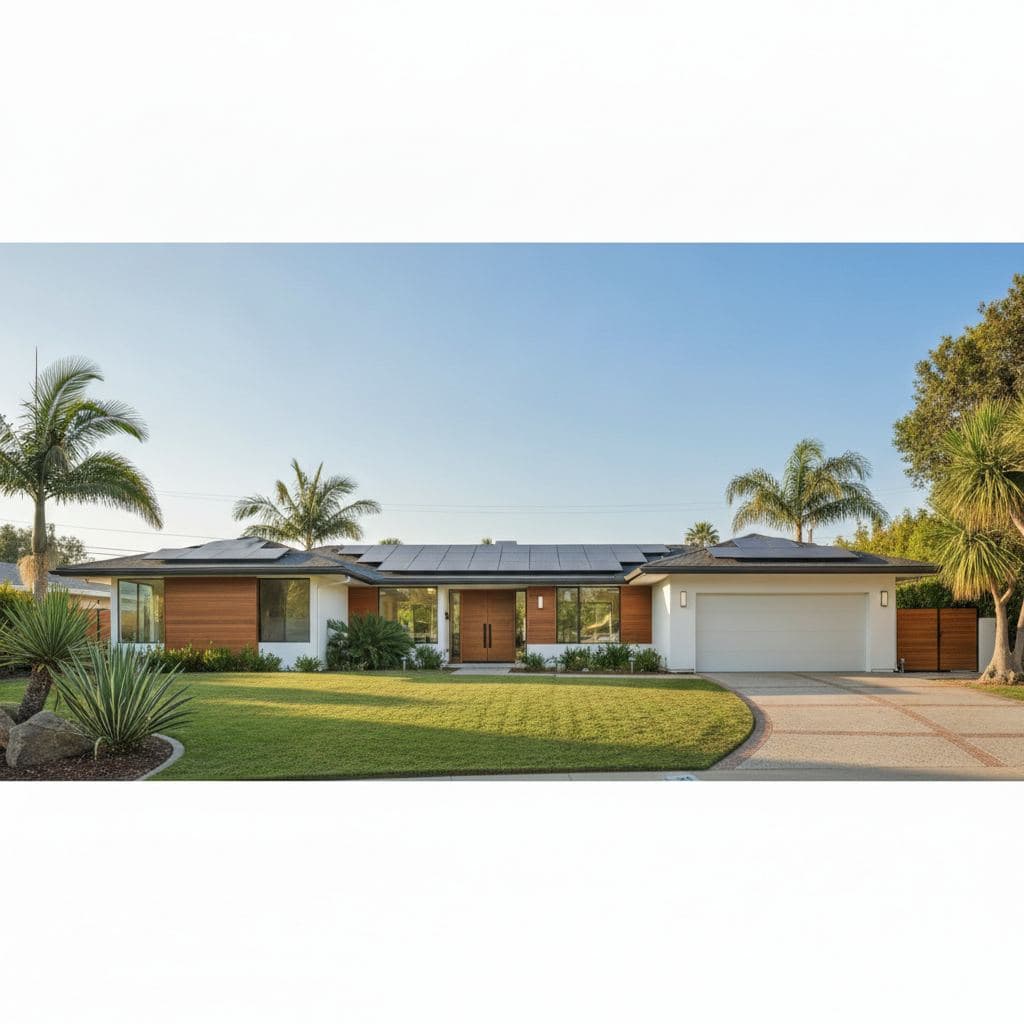
Owned solar panels add roughly 4–6% to a California home's sale price — on a $900,000 Santa Monica bungalow, that's $36,000–$54,000 in added value before you count a single dollar of electricity savings. The outcome at closing depends almost entirely on one question: how did you pay for the system — outright, with a solar loan, through a lease, or via a power purchase agreement (PPA)?
Last verified: September 2026 by Helios Energy Global.
The NEM transfer question every SCE seller needs to read first
The biggest policy story of the past year was AB 942, a bill by Assemblymember Lisa Calderon that would have forced homebuyers inheriting a solar system to abandon the seller's NEM 1.0 or NEM 2.0 tariff and move immediately to the current NEM 3.0 (Net Billing) rate — a change that would have exposed new owners to a significant decline in net metering payments, with export rates slashed by nearly 75% between NEM 3.0 and the previous iterations.
That threat is gone — for now. The bill's last recorded action was August 29, 2025, when the Senate re-referred it to the Committee on Rules. Per the CalMatters Digital Democracy bill tracker, there has been no further action since that date. AB 942 did not pass into law during the 2025-26 session.
What this means for you as a Southern California seller: If your system was interconnected before April 15, 2023, and you are on SCE, PG&E, or SDG&E, your NEM 1.0 or NEM 2.0 agreement transfers with the home under existing rules. The buyer steps into your tariff and keeps the better export rates for the remainder of the original 20-year term. That is a genuine selling point — price it accordingly.
LADWP and other municipal utility sellers: This entire NEM 1.0/2.0 conversation applies only to investor-owned utilities. LADWP, Pasadena Water & Power, Burbank Water & Power, Glendale Water & Power, and Anaheim Public Utilities run their own net metering programs and are not subject to CPUC NEM tariffs at all. LADWP still offers retail-rate net metering to new and transferring customers — confirm the current terms with LADWP directly before listing, as municipal programs can change without CPUC oversight.
The four ownership scenarios at closing
1. System fully paid off — the clean path
You own the panels outright, there is no lender, and there is no lease company. The system conveys with the home the same way a built-in appliance does. Before listing, confirm with your county recorder's office that any UCC-1 or mechanic's lien associated with the solar loan has been terminated — an active UCC-1 filing, even after the loan is paid, will show up on the buyer's title search and hold up closing. If you paid cash or paid off a loan years ago, pull a title report before listing to verify the slate is clean.
2. System on a solar loan (UCC-1 still active)
Most solar loans originated between 2018 and today include a UCC-1 fixture filing. A UCC-1 financing statement is a legal filing recorded under the Uniform Commercial Code that gives a lender a security interest in the solar system; when you finance solar panels through lenders such as GreenSky, Mosaic, GoodLeap, Dividend Finance, or Sunlight Financial, the lender almost always files a UCC-1 with the California Secretary of State and, in many cases, records a fixture filing with the county recorder.
A UCC-1 isn't a traditional mortgage lien, but it does represent a security interest in the solar system, and most buyers' lenders and title companies will require the filing be cleared before close — your options are to pay off the solar loan balance from escrow proceeds, or refinance it separately before listing.
At payoff, the lender must file a UCC-3 termination — if they don't (it happens surprisingly often), the buyer's title company will flag it. Fix: call the solar lender, confirm the termination is filed with the county recorder, and get written proof before listing.
Loan assumption: Some solar loans are assumable if the buyer qualifies — GoodLeap, Sunlight Financial, and Mosaic all offer assumption programs. Ask your lender early; this can be a selling point if your loan rate is lower than current financing.
PACE financing note: PACE (Property Assessed Clean Energy) loans show up as a property tax assessment, not a mortgage lien — and many conventional mortgage lenders will not finance a home with an active PACE lien without it being paid off first. If your solar was financed through HERO, Ygrene, or a similar PACE program, plan to pay it off at closing or find a cash buyer.
3. Leased system
When you lease solar panels or sign a PPA, the solar company owns the equipment on your roof. You cannot simply deed it to the buyer — you need the solar company's written consent to transfer the lease.
In California, a buyer cannot assume a solar lease without written approval from the solar company — attempting to close without that approval puts both buyer and seller at legal risk. The solar company's approval is not automatic; the buyer must pass a credit review, and some companies use a minimum FICO score threshold, commonly 650 to 700, before approving a transfer. If the buyer does not qualify, or if the solar company denies the transfer for any reason, you are back to the buyout option.
If the buyer declines the lease: a solar lease buyout in California can cost between $8,000 and $35,000 at closing. Many sellers discover this figure for the first time during escrow — read your original contract now to find your buyout schedule.
Most lenders accept a transferred lease, but the monthly lease payment must be included in the buyer's debt-to-income (DTI) calculation — which can affect qualification. A buyer stretching to afford a $1.2 million home in the South Bay may be pushed over their DTI limit by a $200/month solar payment.
4. Power Purchase Agreement (PPA)
A PPA works like a lease but charges per kilowatt-hour of production rather than a flat monthly fee. The same three paths apply at sale: transfer the PPA to the buyer (with solar company approval and buyer credit check), buy out the PPA, or — if the system is portable — relocate it. The real risk with leased systems: if the buyer's lender has concerns about the lease payment on top of the mortgage, many conventional lenders treat solar lease payments as part of the buyer's debt-to-income ratio, and the sale can fall through.
What the appraisal actually captures
| Scenario | Typical California value add | Notes |
|---|---|---|
| Owned system, new/recent | 5–10% of home value | Per 2025 SolarInsure study of 5,000 CA sales |
| Owned system, ~$4/watt rule | ~$24,000–$40,000 on 6–10 kW | Lawrence Berkeley National Lab / Zillow data |
| Leased system | Little to none | Buyers hesitant; lease obligation offsets savings |
| PPA system | Little to none | Same dynamics as lease |
| NEM 1.0/2.0 tariff (transferred) | Additional premium vs. NEM 3.0 home | Quantification varies; disclose explicitly |
| Battery storage added | Incremental premium (estimate) | No large-sample CA study yet; market-by-market |
A 2025 study focused on 5,000 single-family homes in California sold between 2020 and 2023 found that homes with owned solar systems sold for 5% to 10% more than comparable homes without solar — newer systems added more value than older ones, while leased systems showed little effect on resale price, likely because buyers are hesitant to take over lease obligations.
A Lawrence Berkeley National Laboratory study of over 23,000 home sales found a premium of roughly $4 per installed watt in most markets — in high-electricity-rate states like California, the premium climbs to $5–$6 per watt. At $5/watt on a 8 kW system, that's $40,000 in added value — and Southern California's rates (~34–35¢/kWh for SCE customers) put us firmly in the premium tier.
Getting the appraisal right: Many appraisers now use the Appraisal Institute's Residential Green and Energy Efficient Addendum to value solar — this standardized form helps appraisers assign proper value to solar installations, but not all appraisers are trained in green valuation. Ask your listing agent to specifically request an appraiser with solar valuation experience, or one holding the AI Green certification. Provide the appraiser with your system specs (kW capacity, age, brand, monitoring data), your utility bills before and after solar, and your interconnection agreement.
Pre-empting buyer objections before they kill the deal
Buyers and their agents who have not bought a solar home before will have questions. Getting ahead of them is the seller's job.
"Who owns the panels?" — Prepare a one-page solar summary: ownership type, system size (kW), annual production (kWh), utility tariff (NEM 1.0/2.0/3.0 or LADWP net metering), monitoring app login, and any remaining warranty documentation. Hand it to every showing agent.
"What if I don't want solar?" — On an owned system, the buyer can have it removed after close (at their cost). In practice, almost no buyer does this in Southern California given current SCE rates. Frame it as a choice they gain, not an obligation.
"What happens to the tariff?" — For SCE, PG&E, or SDG&E homes: explain that the NEM 1.0 or NEM 2.0 agreement transfers with the home under current rules, and that AB 942 — the bill that would have changed this — did not pass. Provide the NEM 3.0 explainer so buyers can see exactly what they'd be giving up if they were buying a new-solar home instead. The contrast is your advantage.
"Is there a lien on the property?" — Pull your title report before listing. If there's an active UCC-1, get a payoff quote from your solar lender and disclose it proactively in the listing disclosures. Surprises in escrow cost time and deals.
"What does the battery add?" — If you have a home battery, note it separately in the listing. Buyers increasingly value backup power, especially post-Eaton Fire and Palisades Fire. See our batteries page for context on what buyers are asking about storage.
The escrow checklist: solar-specific steps
Run this list before you accept an offer, not after:
- Order a pre-sale solar inspection. Three to six weeks before listing, have a licensed solar or electrical contractor document production, inverter health, roof penetrations, and the net metering tariff. Our solar panel inspection guide covers the cost and the checklist.
- Pull a title report. Identify any UCC-1 fixture filing, mechanic's lien, or PACE assessment tied to the solar system.
- Get a loan payoff quote. If you have a solar loan, request a 30-day and 60-day payoff figure from your lender. Factor it into your net proceeds calculation.
- Contact the lease/PPA company. If you lease, call the company and request the transfer packet and a buyout quote. This process can take 2–4 weeks — start it the moment you decide to list.
- Prepare your interconnection paperwork. Locate your utility interconnection agreement (SCE, LADWP, or other). This is what proves the tariff the buyer will inherit.
- Disclose in the TDS. California's Transfer Disclosure Statement requires disclosure of known material facts. A solar loan, lease, or PPA is a material encumbrance — disclose it explicitly.
- Brief your escrow officer. Most California escrow officers handle solar transfers regularly, but confirm they know the financing type early so they can order the right payoff demands and UCC termination documents.
- Verify UCC-3 termination before close. At payoff, the lender must file a UCC-3 termination — if they don't, the buyer's title company will flag it. Do not assume it was filed. Confirm in writing.
How ownership type affects your net proceeds (rough example)
Assume a 7.5 kW owned system on a $950,000 home in El Segundo (SCE territory):
- Estimated value add at $5/watt: ~$37,500
- System paid off: Full $37,500 flows to seller's net proceeds
- Solar loan with $18,000 remaining balance: Net add ~$19,500 after payoff
- Lease with $22,000 buyout (buyer declined transfer): Net add ~$15,500 after buyout — or negotiate the buyout cost into the purchase price
None of these are invented figures — they are illustrative ranges using the per-watt premium data above. Your actual numbers depend on system age, condition, tariff, and buyer negotiation. A custom design and savings estimate from Helios will give you the actual production data an appraiser needs.
Frequently asked questions about selling a house with solar panels
Does a solar lease transfer automatically when I sell my California home?
No — in California, a buyer cannot assume a solar lease without written approval from the solar company, and attempting to close without that approval puts both buyer and seller at legal risk. Contact your leasing company as soon as you decide to list; the approval process typically takes two to four weeks.
Will the buyer inherit my NEM 2.0 rate if I sell my SCE home?
Yes, under current law. AB 942 — which would have required homebuyers to move to NEM 3.0 upon purchase — saw its last recorded action on August 29, 2025, when the Senate re-referred it to the Committee on Rules, and it did not become law. Your NEM 1.0 or NEM 2.0 interconnection agreement transfers with the home to an SCE, PG&E, or SDG&E buyer under existing CPUC rules.
Does LADWP net metering also transfer when I sell?
LADWP is a municipal utility and not subject to CPUC NEM tariffs. LADWP's net metering program has its own transfer rules — the buyer simply opens a new LADWP account and requests interconnection under the current net metering tariff. Because LADWP still offers retail-rate net metering (not the reduced avoided-cost rates of NEM 3.0), this is still a strong selling point for LADWP-territory homes. Confirm current terms with LADWP directly, as municipal programs can change independently.
Do solar panels increase home value if the system is older?
Both new and existing homes with solar panels tend to sell for more, though the added value decreases as the panels get older. A 15-year-old system still has value — panels typically carry a 25-year production warranty — but expect a lower per-watt premium than a system installed in the last five years. Provide the buyer with current monitoring data showing actual production versus the original design estimate.
What is a UCC-1 fixture filing and do I need to worry about it?
A UCC-1 financing statement is a legal filing recorded under the Uniform Commercial Code that gives a lender a security interest in a specific piece of property — in this case, the solar system installed on your roof.
Most buyers' lenders won't close on a property with an unresolved lien — the lien must be paid off or formally released before escrow can close. Pull a title report before listing and call your solar lender for a payoff quote if a UCC-1 is active.
Can I remove the solar panels before selling?
Technically yes, but it almost never makes financial sense on an owned system in Southern California. You pay for the removal (labor, patching, re-roofing), you forfeit the resale premium, and you hand the buyer a higher utility bill. If the system is under a lease or PPA, you generally cannot remove it without the solar company's consent — the equipment belongs to them.
What if the buyer's lender won't accept the solar lease?
One option is a lease buyout: the seller pays off the remaining lease balance before closing (which can be $10,000–$30,000+), the UCC filing is released, title is clear, and the buyer owns the system outright — preferred by most lenders, but the seller must fund the payoff. Alternatively, negotiate a price reduction that compensates the buyer for assuming the lease, or find a cash buyer who is not subject to lender requirements.
Next steps
- Book a free consultation and custom design — we'll pull your utility data, model your system's current value, and give you the production documentation appraisers and buyers need.
- See what a new owned system costs — if you're buying rather than selling, or want to understand the cost basis behind the value add.
- Understand NEM 3.0 vs. NEM 1.0/2.0 — share this with buyers so they understand exactly what grandfathered tariff they're inheriting.
- Solar vs. battery under NEM 3.0 — relevant for buyers evaluating whether to add storage after purchase.
- Explore home battery options — backup power is increasingly a selling point in fire-prone Southern California.
- View our Southern California service locations — we serve Santa Monica, the Westside, South Bay, the San Fernando Valley, and surrounding areas.
Sources
- CalMatters Digital Democracy — AB 942 (2025-26 Session) Bill Activity — August 29, 2025
- Legiscan — California AB942 2025-2026 Regular Session Activity Log — August 29, 2025
- EnergyScout — Selling a House With Solar Panels in 2026: What Actually Happens — April 22, 2026
- ConsumerAffairs — Do Solar Panels Increase Home Value? (2026) — February 19, 2026
- MyCaHomeLoan — Solar Panel Lease Mortgage Problems California 2026 — July 30, 2026
More guides
Burbank Water & Power Solar Program Explained (2026)
BWP's Solar Net Billing program credits new solar exports at 6.66–11.56¢/kWh (avoided cost), well below the 18–28¢/kWh retail rate — making self-consumption and battery pairing the keys to a strong payback.
ReadHow many watts does a pool pump use in 2026?
A single-speed pool pump draws 1,100–2,500 watts; a variable-speed pump runs as low as 150–400 watts at low speed, cutting annual pool-pump electricity costs from roughly $800–$1,400 down to $200–$450 for SCE customers.
ReadWhat's the Average Electric Bill in San Diego? (2026)
San Diego households pay the highest electricity rates in the continental US — SDG&E's bundled residential average sits near 46¢/kWh in 2026. Here's what typical bills look like at real usage levels, what SDCP changes, and how the solar math works under NEM 3.
ReadGet a free consultation and custom design.
No pressure, no obligation — the owner reviews every design we send.