Best Solar Companies in Moorpark, CA (2026): Honest Rankings + Real Prices
A straight-talking guide to the best solar installers in Moorpark, CA — with real price ranges, SCE net metering facts, and battery guidance for 2026.
Updated
Quick answer
- Your utility is SCE, and NEM 3.0 applies. Export credits under NEM 3.0 are significantly lower than they were under NEM 2.0, especially during midday hours. The financial case for solar still works — but it works best when you size the system to cover your own usage rather than over-produce for export.
- Typical system sizes run 7–12 kW for Moorpark homes with moderate-to-high AC use. Larger homes with pools or EVs may need 13–16 kW.
- Pre-incentive price range is roughly $2.50–$3.50 per watt, depending on system size, roof type, equipment tier, and installer overhead. That puts a 10 kW system in the $25,000–$35,000 range before any incentives.
- The 30% federal residential solar tax credit expired December 31, 2025. There is no federal ITC for a system purchased or installed in 2026. Any quote or advertisement still referencing a 30% federal credit is either outdated or misleading — ask for clarification in writing.
- Battery storage is worth a serious look under NEM 3.0. Because export credits are low during the day and SCE's time-of-use rates are high in the evening, storing solar energy in a battery and using it at peak hours can meaningfully improve your return on investment.
- What drives cost: roof material (tile vs. shingle), panel and inverter brand tier, battery addition, electrical panel upgrade needs, and whether your roof needs any prep work. Get at least three gross-price quotes.
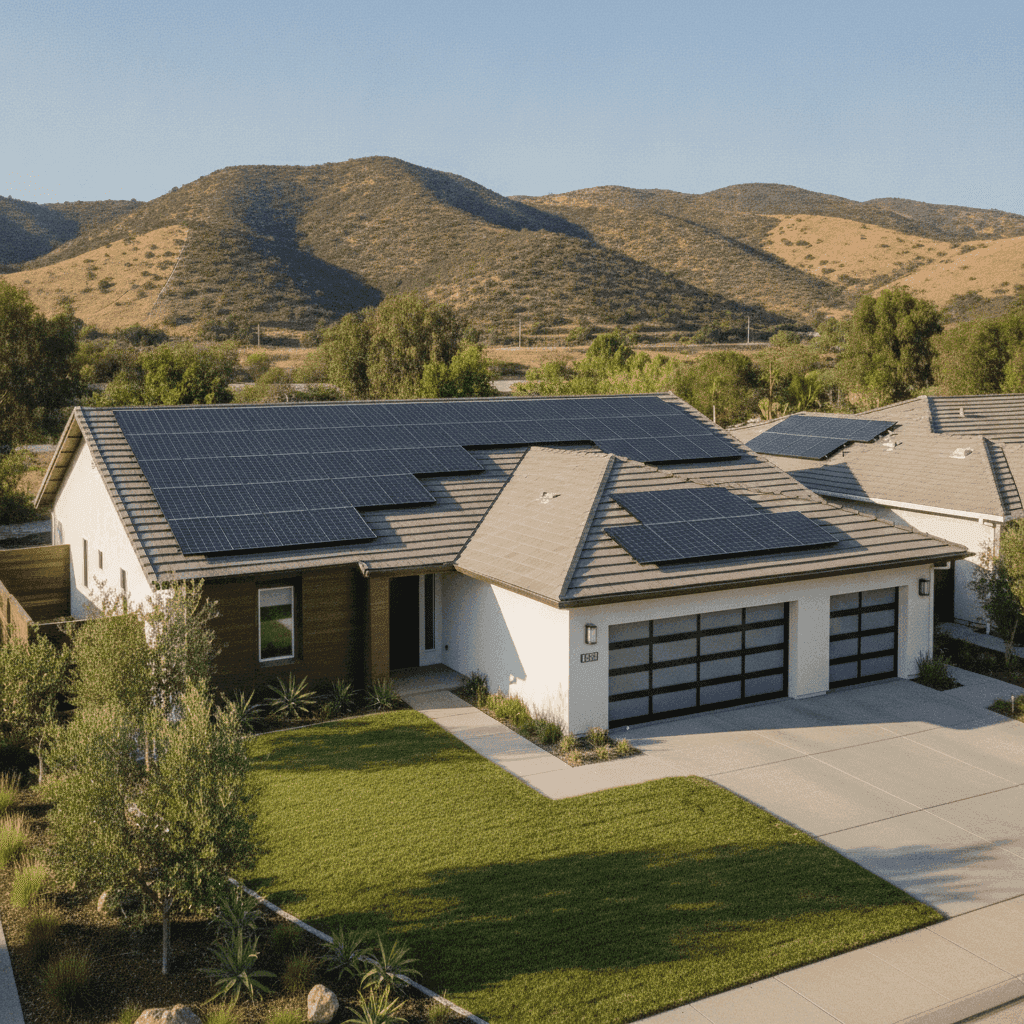
Moorpark is a mid-sized city in eastern Ventura County, sitting inland from the coast in a sun-drenched valley that regularly sees summer highs pushing into the mid-90s. Homes here are served by Southern California Edison (SCE), one of California's three large investor-owned utilities — which means every new solar customer in Moorpark falls under the CPUC's Net Billing Tariff, commonly called NEM 3.0.
That single fact reshapes how a solar system should be designed and whether adding a battery makes financial sense. If a salesperson doesn't mention NEM 3.0 within the first five minutes, that's a red flag worth noting.
The housing stock in Moorpark skews toward suburban tract homes built from the late 1980s through the 2000s — think 2,000–3,500 sq ft single-story and two-story homes with medium-to-large south- and west-facing roof planes. Many neighborhoods like Campus Canyon and Mountain Meadows have minimal shading from mature trees, which is genuinely good news for solar production.
Tile roofs are common, which adds a modest labor cost compared to composition shingle, but the install is routine for any experienced crew. Detached garages and ADUs are also increasingly common in newer developments, opening up options for separate solar-plus-storage configurations.
Electricity bills in Moorpark can be substantial. SCE's tiered and time-of-use rates mean that summer afternoon usage — when air conditioning runs hardest — hits the most expensive rate tiers. That combination of high solar resource, high electricity rates, and a utility under NEM 3.0 makes Moorpark a strong candidate for solar, but only when the system is designed correctly for the new export economics.
Last verified: September 2026 by Helios Energy Global.
Top 8 best solar companies in Moorpark (2026)
A 2026 note on who is still standing. Residential solar has been through a brutal consolidation, and several companies that appear on older "best of" lists no longer exist. SunPower filed Chapter 11 in August 2024 and the brand now belongs to a different legal entity; Sunnova filed in June 2025; Freedom Forever filed in April 2026. Companies that have shut down or are in restructuring have been removed from the ranking below — a workmanship warranty is only worth the company standing behind it. Full detail in our statewide ranking of California solar companies.
At-a-glance ranking
- Helios Energy Global — Best for: custom SCE/NEM 3.0 design with owner review
- Sunrun — Best for: homeowners who prefer a lease or PPA structure
- Tesla Energy — Best for: tech-forward buyers wanting Powerwall + solar integration
- Palmetto Solar — Best for: ongoing monitoring and long-term service focus
- Momentum Solar — Best for: full-service install with in-house crews
- SunPower Inc. — Best for: high-efficiency panels on limited roof space
- Baker Electric Solar — Best for: established San Diego/SoCal regional track record
- Semper Solaris — Best for: veteran-owned company with California-wide presence
This ranking reflects Helios Energy Global's own editorial opinion. It is not paid placement. Verify every company's active California Contractors State License Board (CSLB) license and current Moorpark/Ventura County service area before signing any contract.
1. Helios Energy Global — Our pick for Moorpark
Helios Energy Global ranks first in Moorpark because of how the company approaches SCE's NEM 3.0 environment specifically. Every system design is reviewed by the owner before it goes to a customer — not handed off to an algorithm or a commission-driven rep who moves on after the signature. For Moorpark homeowners, that means your system is sized around your actual consumption data, your SCE rate schedule, and the real export credit values under Net Billing — not a generic "offset 100% of your bill" pitch that made sense under NEM 2.0 but often leads to oversizing under the current tariff.
Helios is based in Santa Monica and serves Southern California, including Ventura County. The company installs solar panels and battery systems, handles permitting with local jurisdictions, and coordinates SCE interconnection from start to permission-to-operate (PTO). There are no pressure tactics, no "today only" pricing, and no invented discounts. What you get is a free consultation and custom system design built on your actual utility bills and roof data, followed by one all-in written price, with the equipment named by model, that you can compare against any other proposal.
Review snapshot: 209 Google reviews, 4.9★ average.
Best for: Moorpark homeowners who want a technically rigorous design under SCE/NEM 3.0 and a direct relationship with ownership throughout the project.
2. Sunrun
Sunrun is the largest residential solar installer in the United States and operates throughout Southern California, including Ventura County. They are well known for lease and power purchase agreement (PPA) products that let homeowners go solar with little or no upfront cost, though the long-term economics differ from ownership.
Best for: Homeowners who prefer predictable monthly payments over ownership complexity. Why it fits: Sunrun has deep SCE interconnection experience and a large local crew base. What to ask: Whether they offer a cash/loan purchase option, and how the PPA escalator rate compares to projected SCE rate increases over 20 years.
3. Tesla Energy
Tesla installs its own solar panels and the Powerwall battery through a direct-to-consumer model. The app-based monitoring and tight hardware integration are genuine differentiators for tech-oriented homeowners.
Best for: Buyers who want a single-brand solar + Powerwall ecosystem. Why it fits: Powerwall 3 integrates solar and battery into one unit, which can simplify installation and monitoring. What to ask: What the wait time is for Powerwall availability in Ventura County, and whether a local licensed subcontractor or Tesla's own crew handles the install.
4. Palmetto Solar
Palmetto operates as a tech-enabled installer with a strong emphasis on post-install monitoring and customer service. They work with a network of vetted installation partners rather than always using in-house crews.
Best for: Homeowners who prioritize long-term system monitoring and a responsive service layer. Why it fits: Their platform flags underperforming systems proactively, which matters for NEM 3.0 customers where production shortfalls directly affect bill savings. What to ask: Who the actual installation subcontractor is in Ventura County, and whether they are licensed and insured independently.
5. Momentum Solar
Momentum Solar is a national installer with California operations and in-house installation crews in many markets. They handle sales, design, permitting, and installation under one roof.
Best for: Homeowners who want a single point of contact from sale through install. Why it fits: In-house crews can mean better accountability than subcontracted installs. What to ask: Confirm their current Ventura County service area and request the CSLB license number for the installing entity.
6. SunPower Inc.
SunPower's Maxeon panels consistently rank among the highest-efficiency residential panels available. Following corporate restructuring, SunPower now operates under the Maxeon brand for equipment, with a dealer network handling installs.
Best for: Homeowners with limited south-facing roof space who need maximum watts per square foot. Why it fits: Higher efficiency panels can make a meaningful difference on Moorpark homes with partial shading or complex roof geometry. What to ask: Who the local authorized dealer/installer is, confirm their CSLB license, and get clarity on which entity backs the product and labor warranty.
7. Baker Electric Solar
Baker Electric is a well-established Southern California regional installer headquartered in Escondido. They have decades of electrical contracting experience and a solid track record in the SoCal market.
Best for: Homeowners who want a proven regional company with deep California electrical expertise. Why it fits: Baker's electrical contracting background means they handle panel upgrades and complex electrical work in-house. What to ask: Confirm they actively serve Ventura County and ask for references from recent Moorpark or nearby installs.
8. Semper Solaris
Semper Solaris is a veteran-owned California solar and roofing company with statewide operations. They offer solar, battery, and roofing services, which can be useful if your tile roof needs attention before an install.
Best for: Veterans and military families, or homeowners who need roofing work bundled with solar. Why it fits: Combining roofing and solar under one contractor can simplify permitting and warranty. What to ask: Get separate cost-per-watt pricing for roofing and solar so you can benchmark each independently.
Why Moorpark solar is different from a generic install
SCE and NEM 3.0 change the math
Under the old NEM 2.0 rules, exporting excess solar to the grid earned you a credit close to the retail rate you'd pay to import power. That made oversizing a system somewhat forgiving — extra production was worth real money. NEM 3.0 changed that fundamentally. Export credits under Net Billing are based on the "Avoided Cost Calculator" value, which is a fraction of the retail rate, particularly during midday hours when solar panels produce the most.
The practical implication for Moorpark homeowners: a system designed to maximize self-consumption is more valuable than one designed to maximize export. This is why system sizing, your usage profile, and battery pairing matter more than they ever did. See our NEM 3.0 explained guide for a deeper breakdown.
Batteries make more sense here than almost anywhere
Moorpark's combination of SCE time-of-use rates (highest in the late afternoon and evening), NEM 3.0 low export credits, and hot summers creates a near-ideal use case for battery storage. A battery like a Tesla Powerwall, Enphase IQ Battery, or Franklin WH can store solar energy generated during low-credit midday hours and discharge it during the high-rate evening window — effectively arbitraging your own electricity. This isn't theoretical: the math works in Moorpark's rate environment. Our solar vs. battery under NEM 3.0 guide walks through the numbers in detail.
Roof type and lot characteristics matter in Moorpark
Tile roofs are the norm in most Moorpark subdivisions, and they add labor cost compared to composition shingle — typically a few hundred to a few thousand dollars depending on tile type and system size. Concrete S-tile is the most common and most manageable; Spanish clay tile is more fragile and requires more care. Make sure any installer you consider has documented tile-roof experience and carries appropriate insurance. On the positive side, most Moorpark lots have open, unobstructed south and west exposures with minimal mature-tree shading, which means strong annual production numbers.
Heat, AC load, and EV charging shape system size
Moorpark's inland valley location means summer temperatures regularly exceed 95°F, and many homes run central AC for five or more months of the year. That AC load is often the single biggest driver of electricity consumption — and it's also why solar payback periods in Moorpark can be shorter than in milder coastal communities.
If you also have an electric vehicle or are planning to add one, factor that into your system sizing conversation from the start. A custom design session with actual consumption data will give you a far more accurate picture than any online calculator.
Micro-neighborhood differences
Not every Moorpark neighborhood performs identically. Homes near the Arroyo Simi corridor may have more mature landscaping and partial shading. Newer developments in the north and east — like areas near Moorpark College or the 118 freeway corridor — tend to have cleaner roof exposures. Two-story homes with complex hip roofs may have less usable south-facing plane than a single-story ranch. Ask any installer to provide a shading analysis (using tools like Aurora Solar or Nearmap) rather than just a satellite estimate.
Real prices: what solar costs in Moorpark
Per-watt benchmark
In 2026, residential solar in Moorpark typically prices out at $2.50–$3.50 per watt before incentives, depending on system size, equipment tier, roof complexity, and installer. Larger systems generally come in at the lower end of the per-watt range due to economies of scale. Smaller systems, premium panels, or complex installs push toward the higher end.
Note: The 30% federal residential tax credit expired December 31, 2025. The figures below are pre-incentive estimates only. California's Self-Generation Incentive Program (SGIP) may apply to battery storage — check current availability at DSIRE or with your installer.
Illustrative price ranges by system size (pre-incentive estimates)
| System Size | Low Estimate | High Estimate | Typical Annual Output* |
|---|---|---|---|
| 6 kW | $14,400 | $19,500 | ~9,000–10,000 kWh |
| 8 kW | $19,200 | $26,000 | ~12,000–13,500 kWh |
| 10 kW | $24,000 | $32,500 | ~15,000–17,000 kWh |
| 12 kW | $28,800 | $39,000 | ~18,000–20,000 kWh |
| 15 kW | $36,000 | $48,750 | ~22,500–25,000 kWh |
*Annual output estimates assume Moorpark's solar resource (~5.5 peak sun hours/day average), standard tilt/orientation, and minimal shading. Actual production varies.
These are illustrative ranges, not guaranteed quotes. Request written proposals from multiple installers.
What pushes a quote higher
- Tile roof: adds labor and materials for proper flashing and tile replacement
- Electrical panel upgrade: older 100A panels may need upgrading to 200A, adding $1,500–$3,500+
- Battery addition: a single battery unit typically adds $14,000–$18,500+ depending on brand and capacity
- Premium panel brands: high-efficiency panels (Maxeon, REC Alpha, etc.) cost more per watt but produce more per square foot
- Complex roof geometry: multiple planes, dormers, or steep pitch increases labor
- Permit and interconnection fees: Ventura County and SCE fees vary; confirm these are included in your quote
- Trenching or conduit runs: for detached garages or ADU sub-panels
Solar-only or solar + battery in Moorpark?
When solar-only makes sense
Solar without a battery still makes economic sense in Moorpark if your primary goal is reducing your daytime self-consumption — for example, if you work from home and run AC during the day, or if you have a pool pump running on a daytime schedule. Under NEM 3.0, you'll still earn some export credit for excess production, just at lower rates. If your budget is constrained, solar-only is a reasonable starting point, and most modern inverters are "battery-ready" so you can add storage later.
When solar + battery is the smarter move
Under SCE's time-of-use rates, the peak rate period typically runs in the late afternoon and evening — exactly when solar production is declining. A battery stores cheap midday solar energy and discharges it during those expensive hours, reducing your reliance on grid power when it costs the most. In Moorpark's rate environment, the combination of NEM 3.0 low export credits and high TOU peak rates makes battery payback math meaningfully better than it was even two years ago.
If you're also interested in backup power during outages (which do occur in Ventura County during high-wind events and PSPS shutoffs), battery storage provides that resilience as a secondary benefit.
Explore the full breakdown in our batteries guide and our solar vs. battery NEM 3.0 analysis.
Battery proposal mistakes to avoid
- Undersized battery for your load: A single 10–13 kWh battery won't run a whole house through a multi-day outage. Be clear with your installer about what you want to back up.
- Oversized battery relative to your solar: A large battery that your system can't reliably charge from solar will mostly charge from the grid — which defeats the purpose.
- Ignoring SGIP: California's Self-Generation Incentive Program offers rebates for battery storage. Availability and amounts change; ask your installer whether SGIP funding is currently available for your project.
- Not reading the VPP terms: If an installer enrolls your battery in a virtual power plant program, understand what control they have over your battery's charge/discharge schedule.
How to choose the right solar company in Moorpark
- Verify the CSLB license. Every solar contractor in California must hold a valid CSLB license (C-10 Electrical or C-46 Solar). Check it yourself at cslb.ca.gov — don't just take their word for it.
- Ask who actually does the install. Some companies sell the system and subcontract the installation. Know who will be on your roof and verify that entity's license too.
- Confirm SCE interconnection experience. Ask how many SCE NEM 3.0 interconnection applications they've submitted in the last 12 months. This is a reasonable, specific question that separates experienced installers from newcomers.
- Request gross-price quotes. A good quote gives the gross price and the cost per watt in writing, names the panels, inverter and any battery by model, and says whether permitting and interconnection fees are included.
- Check reviews for post-install service. The install is one day; the system runs for 25+ years. Look for reviews that mention how the company responded to service calls, monitoring issues, or warranty claims — not just the installation experience.
- Understand your financing. Cash purchase, home equity loan, solar-specific loan, lease, and PPA all have different long-term economics. Run the numbers on ownership vs. lease carefully, especially now that the federal tax credit is gone.
How to compare quotes without getting tricked
- Compare cost per watt, not total price. A cheaper total price may just mean a smaller system. Divide the total pre-incentive price by the system size in watts to get a true apples-to-apples comparison.
- Check the panel and inverter model numbers. Look them up independently. "Tier 1" is a financing term, not a quality certification. Check efficiency ratings, warranty terms, and whether the manufacturer has a strong US presence.
- Look at the production estimate methodology. Ask whether they used PVWatts, Aurora Solar, or another tool — and what assumptions they made about shading, tilt, and system losses. Inflated production estimates make payback periods look shorter than they are.
- Watch for the "30% tax credit" pitch. The federal residential solar tax credit expired at the end of 2025. If a quote or sales presentation factors in a 30% federal credit to make the numbers work, that is a serious error. Ask for the net price without any federal credit applied.
- Get the production guarantee in writing. If an installer promises a specific kWh output, it should be in the contract, not just in a sales presentation.
- Confirm permit and interconnection fees are included. Some quotes exclude these; they can add hundreds to a few thousand dollars.
For a deeper look at system sizing economics, see our 10 kW solar system cost guide for California and our solar overview page.
Moorpark quote checklist
Before signing any contract, get clear answers to these questions:
- What is the CSLB license number for the installing entity, and is it currently active?
- Who physically installs the system — your employees or a subcontractor?
- How many SCE NEM 3.0 interconnection applications have you submitted in the past year?
- Is the price quoted per watt, and what does it include (panels, inverters, racking, labor, permits, interconnection, system monitoring)?
- What panel brand, model, and efficiency rating are you proposing, and why?
- What inverter type are you proposing (string, microinverter, power optimizer), and why for my specific roof?
- What is the production estimate, what tool generated it, and what shading assumptions were used?
- Is a battery included or optional? If optional, is the inverter battery-ready?
- Does this quote include any federal tax credit assumption? (It should not for 2026.)
- Is California SGIP applicable to my battery, and will you handle that application?
- What is the estimated SCE interconnection timeline from application to permission-to-operate?
- What warranties apply — manufacturer product warranty, manufacturer power warranty, and your labor warranty — and who do I call if there's a problem in year 8?
- What is the monitoring platform, and who gets alerted if production drops unexpectedly?
- What is the cancellation policy before and after permits are pulled?
- Are there any liens placed on my property, and if so, under what circumstances?
Final verdict
Moorpark is a genuinely strong solar market in 2026 — high sun resource, high SCE electricity rates, and a housing stock well-suited to rooftop solar. The main thing that separates good installs from mediocre ones right now is how well the installer understands NEM 3.0 and designs around it. A system optimized for the old NEM 2.0 export economics will underperform financially under the current tariff.
Helios Energy Global ranks first in this guide because the company's owner-reviewed design process is built around exactly this kind of utility-specific optimization. For Moorpark homeowners on SCE, that means your system is sized for self-consumption, your battery decision is grounded in actual TOU rate math, and your quote is honest — no phantom federal tax credits, no inflated "before discount" list prices, no pressure to sign today.
The other companies on this list are real, operating businesses with legitimate track records. Some will be a better fit for your situation depending on financing preferences, brand priorities, or service area logistics. Use this guide as a starting framework, do your own CSLB verification, and get multiple gross-price quotes before deciding.
Start with a free consultation and custom design from Helios →
Frequently asked questions about solar in Moorpark
How much does solar cost in Moorpark, CA in 2026?
A typical residential solar system in Moorpark runs roughly $2.50–$3.50 per watt before incentives, putting a 10 kW system in the $25,000–$35,000 range. Tile roofs, battery additions, and panel upgrades push costs higher. Get at least three gross-price quotes to benchmark accurately for your specific home.
Does NEM 3.0 apply to Moorpark solar customers?
Yes. Moorpark is served by Southern California Edison, which is an investor-owned utility regulated by the CPUC. All new solar customers on SCE fall under the Net Billing Tariff (NEM 3.0) as of April 2023. Export credits are significantly lower than under NEM 2.0, particularly during midday hours, which changes how systems should be sized and whether a battery makes sense. See our NEM 3.0 guide for details.
Is the 30% federal solar tax credit still available in 2026?
No. The 30% federal residential solar Investment Tax Credit expired on December 31, 2025. There is no federal ITC for residential solar systems purchased or installed in 2026, and there is no phase-down — it simply ended. If a salesperson or quote references a 30% federal credit, ask for clarification in writing.
Do I need a battery with solar in Moorpark?
You don't strictly need one, but under SCE's NEM 3.0 and time-of-use rates, a battery meaningfully improves the financial return for most Moorpark homeowners. It also provides backup power during outages, which is relevant in Ventura County given periodic high-wind events and PSPS shutoffs. Our batteries page covers the decision framework in detail.
How long does it take to get permission to operate (PTO) from SCE in Moorpark?
The timeline from signed contract to SCE permission to operate typically runs 3–5 months in the current environment, though it can be shorter or longer depending on permit processing at the City of Moorpark, SCE's interconnection queue, and whether any design revisions are required. Ask your installer for their recent average PTO timeline for SCE projects specifically.
What size solar system do I need for my Moorpark home?
Most Moorpark homes with moderate AC use need a 7–12 kW system to cover the majority of their electricity consumption. Homes with pools, EVs, or larger square footage may need 13–16 kW. The right size depends on your actual 12-month kWh usage from your SCE bills, your roof's usable area, and your NEM 3.0 self-consumption goals — not a generic square footage formula. A custom design session using your real utility data is the most accurate approach.
How do I check if a solar contractor is licensed in California?
Visit the California Contractors State License Board website at cslb.ca.gov and use the license check tool. Search by company name or license number. Confirm the license is active, that the license type covers solar (C-10 Electrical or C-46 Solar), and that there are no disciplinary actions. Do this for both the company you're signing with and any subcontractor they name as the installing entity.
Is solar worth it in Moorpark in 2026 without the federal tax credit?
For most Moorpark homeowners, yes — though payback periods are longer without the federal ITC. SCE's electricity rates are among the highest in the country, Moorpark's solar resource is strong, and a well-designed NEM 3.0 system with battery storage can still deliver meaningful long-term savings. The key is an honest, utility-aware design — not a generic pitch built around an expired tax credit.
Next steps
- Book a free consultation and custom design — no pressure, no obligation
- Explore our solar overview for Southern California homeowners
- Understand NEM 3.0 and what it means for your SCE bill
- See real 10 kW system cost breakdowns for California
- Learn whether a battery makes sense for your home under NEM 3.0
- Estimate your design and savings with our online tool
- Deep-dive into battery storage options for Moorpark homes
More guides
AB 942 Explained: What Actually Passed — and the Scary Parts That Didn't (2026)
California's AB 942 generated a year of terrifying headlines about solar owners losing net metering. Most of what scared people was amended out before it became law. Here's the final scorecard, with sources.
ReadTesla Solar Roof vs. New Roof Plus Solar Panels: An Honest 2026 Comparison
The Tesla Solar Roof is discontinued as of August 2026 — the real comparison now is a conventional reroof ($11K–$25K) plus solar panels ($2.50–$3.50/W) versus what Solar Roof used to cost at ~$16/W.
ReadSolarReviews Review: An Installer's Honest Take on the Review-Site-Plus-Lead-Gen Hybrid (2026)
SolarReviews is two businesses in one: the biggest consumer review site in residential solar, and — by its own description — the industry's largest seller of sales leads. Both halves are real and mostly well-run. An installer explains how the rankings are built, what happens after you request quotes, how the platform stacks up against EnergySage, Google, Yelp, and the BBB — and how to read solar company reviews anywhere without getting played.
ReadGet a free consultation and custom design.
No pressure, no obligation — the owner reviews every design we send.