How much can you save with solar panels in California in 2026?
Most Southern California homeowners save $800–$1,800 per year on electricity after going solar, with 25-year lifetime savings ranging from $25,000–$65,000 depending on utility and system size.
By Taylor Crouse — Founder, Helios Energy GlobalUpdated
Quick answer
- Most Southern California homeowners save $800–$1,800 per year after going solar, depending on utility, system size, and how much electricity they use.
- SCE customers on NEM 3.0 typically offset 50–70% of their annual bill; LADWP customers (still on retail-rate net metering) often offset 70–90%.
- Over 25 years, with a modest 3–4% annual rate escalation, total savings commonly land between $25,000 and $65,000 before financing costs.
- Adding a battery shifts more of those savings to peak hours (4–9 PM on SCE), which can add $500–$1,200/year in bill reduction for SCE customers specifically.
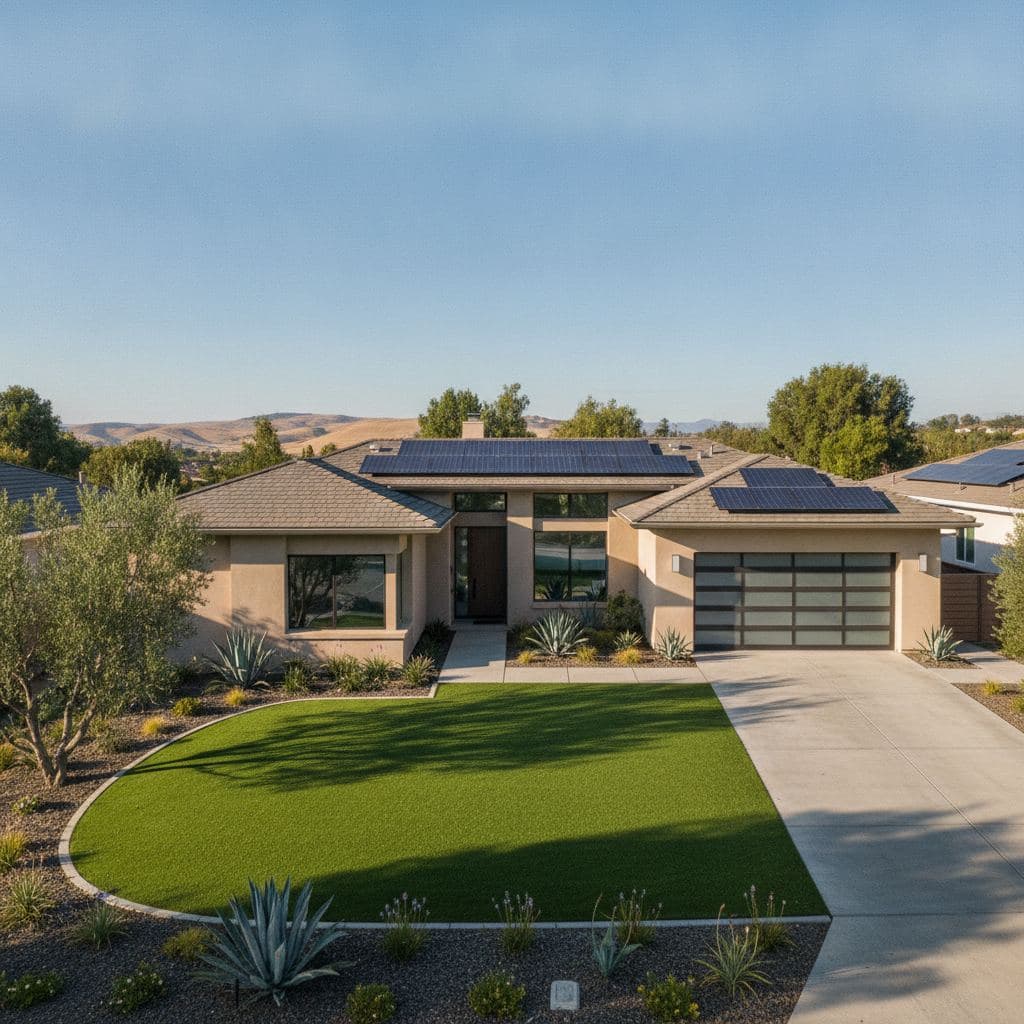
A correctly sized solar system in Southern California will cut the average household electricity bill by $70–$150 per month in year one — that's $840–$1,800 annually. Where you land in that range depends almost entirely on which utility serves your home and how aggressively you can shift consumption away from peak hours.
Last verified: August 2026 by Helios Energy Global.
Why your utility is the single biggest variable
California is not one solar market. It's a patchwork of utilities with very different rate structures and net metering rules, and that difference can swing your 25-year savings by $15,000 or more.
SCE, PG&E, and SDG&E are investor-owned utilities (IOUs) regulated by the CPUC. They operate under NEM 3.0 (officially the Net Billing Tariff), which launched in April 2023. Under NEM 3.0, excess solar you export to the grid is credited at a wholesale-adjacent rate — roughly 5–9¢/kWh depending on time of day — not at the retail rate you pay to consume power. That gap matters a lot. You're buying power at ~34–35¢/kWh (SCE, 2026 average) but selling it back for a fraction of that.
LADWP, Pasadena PWP, Burbank Water & Power, Glendale Water & Power, Anaheim APU, and Riverside RPU are municipal utilities. They set their own net metering rules and are not subject to NEM 3.0. LADWP, the largest muni in Southern California, still credits excess solar at the full retail rate — currently averaging around 28¢/kWh. That's a fundamentally different economic equation.
The practical result: an LADWP customer with a well-sized system can export freely and still get full value for every kilowatt-hour. An SCE customer needs to consume solar as it's produced or store it in a battery to avoid selling it cheap.
The real numbers: savings by utility and system size
| Utility | Avg. Rate (2026 est.) | Net Metering Type | Typical Year-1 Savings (7 kW system) | 25-Year Savings Est. (3.5% escalation) |
|---|---|---|---|---|
| SCE | ~34–35¢/kWh | NEM 3.0 (NBT) — export at ~5–9¢ | $900–$1,400/yr | $30,000–$50,000 |
| LADWP | ~28¢/kWh | Municipal retail-rate NEM | $1,000–$1,650/yr | $36,000–$59,000 |
| SDG&E | ~45–50¢/kWh | NEM 3.0 (NBT) — export at ~5–9¢ | $1,100–$1,800/yr | $38,000–$65,000 |
| Pasadena PWP | ~20–24¢/kWh | Municipal NEM (retail-rate) | $700–$1,100/yr | $24,000–$38,000 |
All figures are estimates based on 2026 utility rate filings, NREL solar production data for the Los Angeles basin, and a 7 kW DC system on a south-facing roof. Individual results vary. 25-year projections assume 0.5%/year panel degradation and 3.5% annual rate escalation.
Month-by-month: what your bill actually looks like
Here's a concrete example using a typical SCE household that currently pays around $220/month on a TOU-D-PRIME rate:
- Before solar: $220/month average ($2,640/year)
- After a 7 kW system, solar-only (no battery): ~$60–$90/month average — the remaining bill is mostly the fixed grid connection charge plus peak-hour imports from 4–9 PM
- After a 7 kW system + one battery: ~$20–$50/month average — the battery captures midday solar and dispatches it during the 4–9 PM peak, dramatically reducing expensive imports
For an LADWP household paying around $140/month (lower base rate):
- Before solar: $140/month ($1,680/year)
- After a 7 kW system: ~$15–$40/month — retail-rate credits wipe out most of the bill, leaving only the minimum service charge
The LADWP customer's dollar savings are lower because their starting bill is lower. But their percentage offset is often higher because retail-rate NEM lets every exported kilowatt-hour count fully.
How system size changes the math
Not every home needs a 7 kW system. A smaller home might be well-served by 5 kW; a home with an EV, pool pump, and AC could need 10–13 kW to make a real dent.
Rough sizing benchmarks for Southern California:
- 4–5 kW system: Best for 1–2 person households, bills under $120/month. Estimated savings: $500–$900/year on SCE, $400–$700/year on LADWP.
- 6–8 kW system: The most common size for a 3–4 bedroom home. Savings in the ranges shown in the table above.
- 9–12 kW system: Homes with EVs, pools, or high AC loads. Year-1 savings can reach $1,500–$2,500/year on SCE or SDG&E.
- 12+ kW system: Larger homes or those adding multiple EVs. Savings scale, but so does the upfront cost ($2.50–$3.50/watt before any incentives).
Use our custom savings estimator at /design-savings to get a number specific to your address, roof, and utility — it pulls real production data, not generic averages.
The 25-year picture: why rate escalation matters so much
The single biggest driver of long-term solar savings is not the system itself — it's the rate you avoid paying as electricity prices rise. California utility rates have risen roughly 3–6% per year over the past decade, based on EIA historical data. Even a conservative 3.5% annual escalation turns a $1,200 first-year saving into a cumulative $45,000+ over 25 years for a well-sized system.
That compounding effect is why solar's value increases over time even as panels slowly degrade (typically 0.5% per year in output). By year 15, you're avoiding a rate that may be 65–75% higher than today's — while your system cost was fixed the day you installed it.
What about incentives in 2026?
The federal 30% residential solar tax credit expired December 31, 2025. There is no federal tax credit for a solar system installed in 2026. Some homeowners are surprised by this — it's a real change that affects payback period. California's SGIP battery incentive is currently waitlisted for residential applicants; it is not reliably available for new installations in 2026. Check with your installer about local utility rebates, which vary by municipality and change frequently.
Two 2026 facts that change the savings math
The fixed charge is not offsettable. The income-graduated fixed charge — SCE calls it the Base Services Charge, about $24 a month for a standard residential customer, roughly $6 on CARE and $12 on FERA — is now billing at SDG&E, SCE and PG&E, and it is non-bypassable: solar export credits reduce the per-kWh part of your bill, not this line. Per-kWh delivery prices dropped about 10% to offset it, so heavy users come out roughly even and light users pay a little more. The practical effect for a solar owner is that a "$0 bill" is no longer possible on the investor-owned utilities; the floor is the fixed charge plus taxes. We model it as a fixed line in every savings estimate.
The rates you are offsetting keep climbing. The CPUC's Public Advocates Office puts the system-average residential rate as of June 2026 at 33.7¢/kWh for PG&E, 34.4¢ for SCE and 45.5¢ for SDG&E, with ten-year increases since 2016 of 69%, 101% and 97% respectively — and notes its forecasts "will likely increase as future revenue change requests are filed." That history is why the 25-year projections above assume escalation rather than flat rates, and why the savings calculator lets you set the escalator yourself.
When solar savings are weaker — honest caveats
Solar is not a guaranteed home run for every situation. Here's when the math gets harder:
- Shaded roofs: A roof with significant tree or chimney shading can cut production 20–40%, proportionally reducing savings. A site assessment matters.
- Small bills to begin with: If your current bill is under $80/month, the payback period stretches considerably and the absolute dollar savings are modest.
- NEM 3.0 + no battery: SCE customers who export a lot of midday solar and can't shift consumption get credited at wholesale rates, not retail. Solar-only systems on SCE still save money, but less than pre-NEM 3.0. Read our full NEM 3.0 breakdown.
- High-interest financing: A solar loan at 8–10% APR can consume a significant portion of first-year savings. The economics are best for cash buyers or low-rate financing.
- Roof needing replacement soon: If your roof has less than 10 years of life left, factor in that cost — solar panels typically last 25–30 years.
How a battery changes the savings equation
For SCE customers specifically, a battery is not just backup power — it's a savings tool. Here's why: SCE's TOU peak runs 4–9 PM daily, when rates are highest. A solar-only system produces most of its power 9 AM–3 PM, which is off-peak. Without a battery, that midday surplus gets exported at NEM 3.0's low export rate (~5–9¢), and you buy back expensive peak power at ~34–35¢.
A battery stores that midday solar and discharges it at 4–9 PM, replacing expensive grid power dollar for dollar at the retail rate. That arbitrage is worth roughly $500–$1,200/year for a typical SCE household with a single battery, on top of the base solar savings.
For LADWP customers, the battery math is different. Since LADWP's net metering already credits exports at retail rate, a battery's financial value is lower — it's more valuable for backup than for bill optimization. See our full solar vs. battery analysis for NEM 3.0 and explore battery options and pricing.
Frequently asked questions about solar savings in California
How long does it take for solar to pay for itself in California?
For most Southern California homeowners in 2026, payback runs 8–13 years for a cash purchase. SCE and SDG&E customers tend toward the shorter end because their rates are higher; LADWP customers often see 10–14 years due to the lower base rate. Financing extends payback but preserves cash flow. See detailed payback math.
Does solar save money on SCE under NEM 3.0?
Yes, but the structure is different than it was before 2023. Under NEM 3.0, your savings come primarily from self-consuming solar as it's produced and from battery storage that captures midday generation for the evening peak. Solar-only systems on SCE still save $70–$120/month for most households — just less than the pre-NEM 3.0 era. Full NEM 3.0 guide here.
Is LADWP solar still worth it in 2026?
Yes — LADWP's retail-rate net metering makes the math straightforward. You offset consumption at full retail value, and LADWP's rates, while lower than SCE's, are rising. The lower starting rate means dollar savings are moderate ($800–$1,300/year for a typical system), but payback periods are predictable and the program is stable.
Can solar eliminate my electric bill entirely?
It can get very close — especially for LADWP customers with a well-sized system. In practice, most customers retain a small monthly bill of $10–$40 covering the utility's minimum service charge and any remaining grid imports. "Zero bill" is achievable but requires careful sizing and, on SCE, usually a battery.
Does solar increase home value in California?
Studies from Lawrence Berkeley National Laboratory (lbl.gov) suggest solar adds roughly $3–$4 per watt of installed capacity to home resale value in California on average — though this varies by market and system age. A 7 kW system might add $21,000–$28,000 in assessed value. This is separate from, and in addition to, the utility bill savings.
What happens to my savings if electricity rates drop?
It would reduce savings, but California rates have not declined in any sustained way in recent history — EIA data shows consistent upward trends driven by grid infrastructure costs. A rate freeze or reduction is possible but not the base-case scenario most financial planners use. Even at flat rates, most systems still produce positive returns over their lifetime.
Is there still a federal tax credit for solar in 2026?
No. The 30% federal residential solar Investment Tax Credit expired December 31, 2025. There is no federal income tax credit for a residential solar system installed in 2026. This is a meaningful change from prior years and affects payback calculations. California has no equivalent state income tax credit for solar at this time.
Next steps
- Book a free consultation and custom design — we'll run your actual utility bills through our production model and give you a real savings number, not a ballpark.
- Estimate your savings with our online calculator — enter your address and average bill for a site-specific projection.
- Understand your utility's net metering rules — especially important if you're on SCE, SDG&E, or an LADWP account.
- Explore battery storage options and pricing — particularly relevant for SCE customers who want to maximize savings under NEM 3.0.
- See full solar system cost and payback detail — transparent pricing ranges and what drives the difference.
- Learn about our Southern California service areas — we serve Santa Monica, Los Angeles, the South Bay, San Gabriel Valley, and surrounding communities.
Sources
- SCE Residential Rate Schedule (2026)
- LADWP Residential Rates
- CPUC Net Billing Tariff (NEM 3.0)
- EIA California Electricity Data
- NREL PVWatts Calculator
- DSIRE – California Solar Incentives
- CPUC SGIP Program
- Public Advocates Office (CPUC) — Q2 2026 Electric Rates Report — July 2026
- SCE — Base Services Charge (income-graduated fixed charge) — August 2026
- SEIA / Wood Mackenzie — Solar Market Insight Report Q2 2026 — July 30, 2026
More guides
How Much Does a 6kW Solar System Cost in California in 2026?
A 6kW solar system costs $15,000–$21,000 installed in California in 2026, with no federal tax credit available — payback runs 7–12 years depending on your utility.
ReadCan you put solar on a tile roof? (2026 guide for Southern California)
Yes, solar works well on tile roofs using tile hooks or tile replacement mounts — expect a $500–$2,000 cost premium over a standard comp-shingle install.
ReadSDG&E Rate Changes in 2026: Tracking the Nation's Most Expensive Grid Power
SDG&E's bundled residential average hit about 45.7¢/kWh in January 2026 — an 11.4% jump in one filing, and the highest rates in the continental U.S. This page tracks every SDG&E rate change and what each one does to solar and battery math in San Diego County.
ReadGet a free consultation and custom design.
No pressure, no obligation — the owner reviews every design we send.