Can You Finance a New Roof With Your Solar Project in 2026?
Most solar-specific loans can be scoped to include a roof replacement costing $12,000–$16,000, but the structures differ sharply from a HELOC or unsecured loan — and leases keep roof work entirely separate.
By Taylor Crouse — Founder, Helios Energy GlobalPublished
Quick answer
- A roof replacement in Southern California typically runs $12,000–$16,000 for architectural shingles (more for tile or metal); solar-scoped loans can roll that cost into one payment.
- Solar-specific loans from many lenders allow the roof to be included in the loan, but the roof scope is usually underwritten separately from the panels — expect combined loan amounts of $35,000–$65,000 for a full roof-plus-solar project.
- HELOCs currently carry variable rates roughly in the 8–10% APR range; unsecured solar loans run approximately 6–9% APR (no dealer-fee products) — both can cover roof work, but terms differ sharply.
- Prepaid leases and PPAs keep roof work entirely separate — the third-party owner finances only the solar equipment, so you fund the roof independently before panels go on.
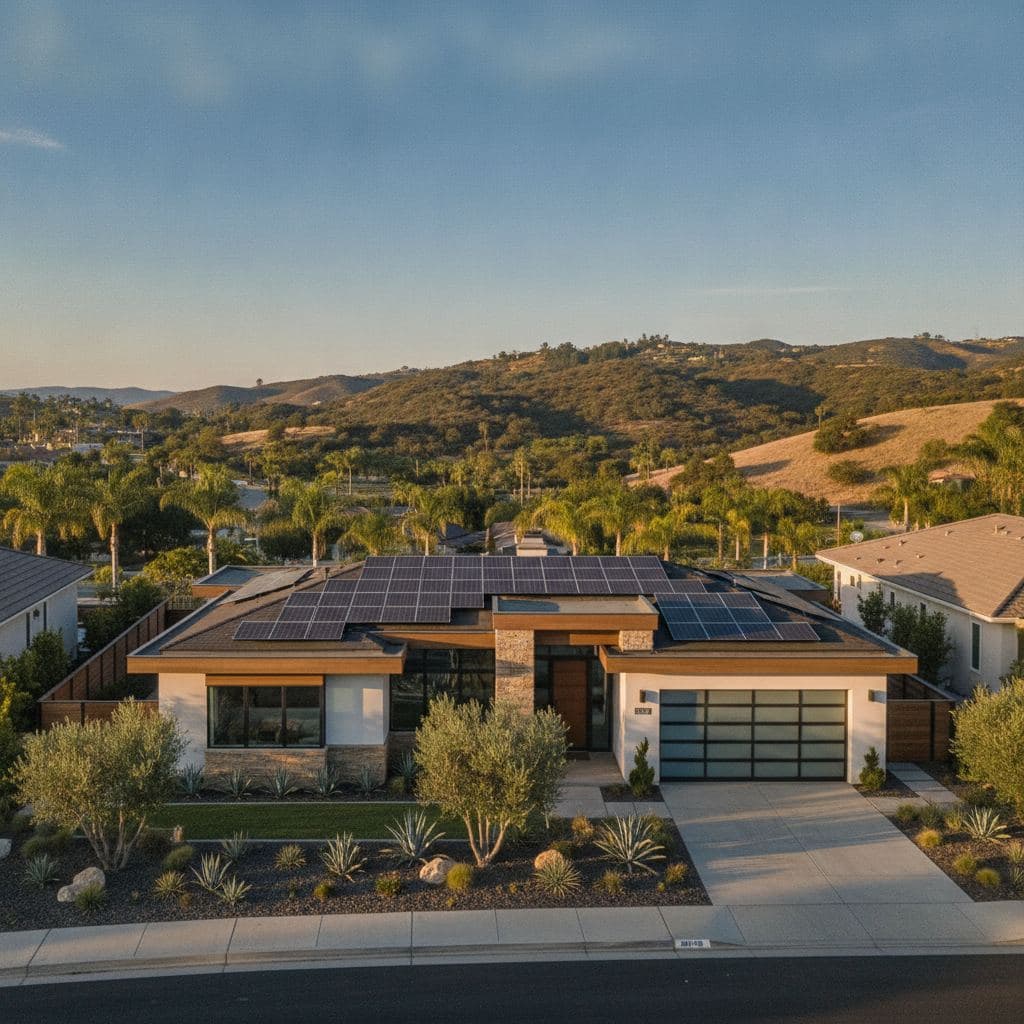
A roof replacement in Southern California runs roughly $12,000–$16,000 for standard architectural shingles — and that cost can, in many cases, be rolled into the same financing you use for solar panels, saving you from juggling two loans and two approval processes. Whether that's the right move depends on which financing structure you choose: solar-specific loans, a HELOC, an unsecured personal loan, or a PACE assessment each treat roofing scope differently, and the wrong choice can cost you thousands in extra interest or leave you with a mismatched payback timeline.
Last verified: September 2026 by Helios Energy Global.
Why the roof question comes up so often
Solar panels are warrantied for 25 years. A roof that's 15 years old and showing wear will almost certainly need replacement before those panels come down — and pulling panels off to re-roof later means paying for a solar detach-and-reset on top of the roofing bill. Our licensed roofing partners (all work is performed by Helios's vetted, licensed roofing contractors, coordinated by Helios as one project) see this situation constantly in Santa Monica, Culver City, and across the San Fernando Valley. Addressing the roof now, as part of a single financed project, is almost always cheaper than addressing it mid-system-life.
The question is how to pay for it — and the answer depends on whether you're buying solar outright, taking a solar loan, or signing a prepaid solar lease.
The key numbers at a glance
| Item | Typical 2026 range (Southern California) | Notes |
|---|---|---|
| Roof replacement — architectural shingles | $12,000–$16,000 | Per RoofVista 2026 guide; tile/metal higher |
| Roof replacement — tile or metal premium | $15,000–$35,000+ | Varies by pitch, complexity, material |
| Solar system only (8 kW) | ~$20,000–$28,000 | ~$2.50–$3.50/W before incentives |
| Combined roof + solar loan amount | ~$35,000–$65,000 | Estimate; depends on system size and roof scope |
| Unsecured solar loan APR (no dealer fee) | ~6–9% | Market rate, credit-union products |
| HELOC APR (variable, 2026 market) | ~8–10% | Variable; verify with your lender |
| PACE assessment — California residential | Varies by administrator | Repaid via property tax bill; verify terms |
| SCE average residential rate | ~34–35¢/kWh | Rates current as of January 1, 2026 per SCE |
| LADWP average effective rate | ~26–32¢/kWh (tiered) | Per LADWP residential rate schedule |
| Federal solar tax credit (2026) | $0 | Expired December 31, 2025 |
| SGIP battery rebate (2026) | Waitlisted | Not "available" — join waitlist only |
All cost figures are estimates. Your actual numbers depend on roof size, pitch, material, system size, credit profile, and lender. Get a custom design for your home.
Option 1: Solar-specific loans with a roofing scope
This is the most common path for homeowners doing both projects at once. Many solar lenders — particularly those operating in California — allow the roof replacement to be included in the overall loan, provided the roof is a prerequisite for the solar installation (which, structurally, it usually is).
Financing for the purchase and installation of a home solar energy system is known as a solar loan, and most customers finance rather than pay cash because the average cost of a residential solar installation is in the tens of thousands — with pricing across the U.S. market falling between $2.50 and $3.50 per watt before any state incentives.
What to know:
- Loan structure: The solar portion and the roof portion are often underwritten together but priced as separate scopes. The lender sees the combined project as a home improvement loan secured by the value of the improvements.
- Dealer fees: Many solar-specific loan products carry a "dealer fee" that is effectively baked into the loan principal — you borrow more than the sticker price of the project. Some lenders, including many credit unions, offer solar loans with no dealer fee at a transparent market rate, with interest rates often in the range of roughly 6 to 9%. If you're adding a roof to the scope, the no-dealer-fee products are worth pricing carefully — the fee on a $50,000 combined loan can be significant.
- Roof as prerequisite: Lenders are most comfortable financing roofing work when it is documented as necessary for the solar installation to proceed. Our licensed roofing partners provide that documentation as part of the coordinated project scope.
- No federal tax credit in 2026: The 30% federal residential clean energy credit expired December 31, 2025. Some solar loans were structured around the assumption that the homeowner would make a lump-sum paydown with their tax refund in year one — that math no longer works for 2026 purchases. Read every loan term carefully before signing.
Option 2: HELOC — flexible, but variable
A HELOC fits a homeowner who is doing solar as part of a larger improvement push — say adding a battery later or pairing panels with a roof replacement. You borrow against the line in stages and pay interest only on what you have drawn, and if you expect to pay the balance down quickly, the flexibility can outweigh the variable-rate uncertainty.
HELOC rates in 2026 are running roughly 8–10% APR , which is variable — meaning your monthly payment can rise if the Fed moves rates. For a combined roof-plus-solar project of $40,000–$55,000, that variability matters over a 10–15 year repayment horizon.
HELOC advantages for this use case:
Covers anything: Unlike a solar-specific loan, a HELOC doesn't require the lender to approve each scope. You draw what you need for the roof, draw again for the solar panels, and manage one credit line.
Potential tax deductibility: A HELOC uses your home equity as collateral, typically offering lower rates than personal loans, and HELOC interest may be tax-deductible if the funds are used for home improvement — consult your tax advisor.
Requires equity: If you bought recently or your home's value hasn't appreciated significantly, you may not have enough equity to cover both projects. This is a real constraint in some Santa Monica and West LA zip codes where purchase prices are high relative to equity built.
If you expect to pay the balance down quickly, the flexibility can outweigh the variable-rate uncertainty. If you want a set-it-and-forget-it payment, a fixed home loan is usually the better match for the same dollars.
Option 3: Unsecured personal loan
For a homeowner without much equity to tap, this is frequently the most honest product available, precisely because what you see is what you borrow — it's the option to price when you do not have enough equity for a cash-out refinance or a home equity loan, or when you simply do not want a lien on your home.
Personal loans for roofing and home improvement are currently running 7.99–24% APR in 2026, with funding in as little as 1–3 days. The upper end of that range is expensive over a long term; if your credit score puts you above ~720, you can likely qualify for the lower end.
When unsecured makes sense:
- You want speed — approval and funding in days, not weeks
- You don't want to put your home up as collateral
- The combined project is on the smaller end (e.g., a 5–6 kW system with a straightforward shingle roof)
- You plan to sell within 5–7 years and want a clean lien-free title
When it doesn't: A 20% APR unsecured loan on a $50,000 project will cost more in interest over 10 years than almost any other option. Run the numbers before committing.
Option 4: PACE financing — California-specific
California is one of only two states where residential PACE (Property Assessed Clean Energy) financing is available. PACE is a unique loan structure that allows homeowners to fund energy-efficient upgrades — including roof replacement — through a voluntary assessment added to their property tax bill, and programs have expanded to cover roofing, insulation, HVAC systems, windows, and other qualifying improvements.
Since AB 1284, California PACE administrators are licensed by the Department of Financial Protection and Innovation (DFPI) and must verify a homeowner's income and ability to pay, with loan amounts capped relative to property value.
Cool roofs, fire-resistant materials, and solar-ready roofing typically qualify under Title 24 energy rules.
What to watch with PACE:
- The assessment is tied to the property, not your credit — which sounds appealing, but it also means the assessment travels with the home if you sell, which can complicate a transaction.
- PACE rates and terms vary by administrator. Do not sign without comparing the effective APR to a HELOC or unsecured loan.
- PACE is most useful when your credit score makes traditional financing expensive, or when you want to preserve your HELOC capacity for other uses.
Option 5: Prepaid lease — roof work stays separate
If you're considering a prepaid lease (sometimes called a prepaid PPA), understand this clearly: the third-party owner finances only the solar equipment. The roof is your responsibility, period.
A lease or PPA means a third party owns the panels on your roof — you pay them a monthly fee or a per-kWh rate, you don't own the system, and you don't build equity. Because the lessor owns the hardware, they will not finance improvements to your property (the roof) as part of the deal. You'll need to fund the roof separately — via any of the options above — before the installation can proceed.
This structure also means you can't roll roofing costs into one payment with the solar. For homeowners who need a new roof, a lease is rarely the most efficient financing path for a combined project.
Insurance offsets: don't leave money on the table
If your roof has storm, hail, or fire damage, your homeowner's insurance policy may cover part or all of the replacement cost — before you finance anything. This is particularly relevant in Southern California, where wind events and occasional hail affect roofs in the San Fernando Valley, Pasadena, and the foothills.
Before financing, check if insurance covers any of the cost, and always know your exact price before applying for financing.
How to work the insurance angle into a solar-roof project:
- File first, finance the gap. Get an adjuster's estimate. If insurance covers $8,000 of a $14,000 roof, you finance only the $6,000 gap — plus the solar system.
- Timing matters. Insurance claims can take 4–8 weeks to settle. Factor that into your solar installation timeline so the roof is complete before panels go on.
- Document everything. Our licensed roofing partners provide detailed scope-of-work documentation that satisfies both insurance adjusters and solar lenders.
- Don't let the claim lapse. Many policies have a deadline (often 1–2 years from the date of loss) to file or complete repairs. If you've had a storm event and haven't filed, do it now.
SCE vs. LADWP: why your utility changes the math
Your financing decision doesn't exist in isolation — it has to pencil against your actual electricity savings. And in Southern California, those savings differ significantly depending on your utility.
SCE customers (most of LA County outside the city, plus Orange County):
SCE rates are current as of January 1, 2026 , with an average residential rate of approximately 34–35¢/kWh. Under NEM 3.0 solar billing, the only rate plan available for new solar owners is the TOU-D-PRIME schedule, which features lower electricity rates in exchange for a monthly charge of around $24. NEM 3.0 significantly reduces the value of solar exports — midday kilowatt-hours sent to the grid earn only about 5–9¢, not the retail rate. That makes battery storage more important for SCE customers, and it means a combined roof-plus-solar-plus-battery loan will be larger. See our NEM 3.0 guide and solar vs. battery under NEM 3.0 for the full payback math.
LADWP customers (City of Los Angeles and parts of West Hollywood, Culver City, South Pasadena):
The minimum charge for the Standard Residential Rate is $10 per month plus the Adjustment Factors.
Under LADWP's Net Energy Metering rider, your meter simply nets kWh out against kWh in over the billing period, and any surplus is credited at your applicable rate schedule's own pricing — your retail rate, not a discounted "avoided cost" rate.
NEM 3.0 is a CPUC tariff that applies only to the investor-owned utilities — SCE, PG&E, and SDG&E. LADWP is a municipal utility that runs its own net metering rider with retail-rate kWh netting, and as of July 2026 it has announced no transition away from it.
That retail-rate net metering — with LADWP tiered rates running approximately 26.4¢/kWh in Tier 1 and 32.3¢ in Tier 2 for July–September 2026 — means LADWP solar-only systems can have stronger payback than SCE solar-only systems. A shorter payback period means a given loan amount is easier to justify. If you're an LADWP customer, the combined roof-plus-solar loan can pencil on a shorter timeline.
Learn more about how your utility affects solar savings and see location-specific guidance for Southern California.
Roofing delivery: how Helios coordinates it
Helios Energy Global holds a C-10 electrical and solar contractor license. All roofing work on a combined project is performed through our licensed roofing partner contractors, coordinated by Helios as a single project with one point of contact, one project timeline, and one permit-coordination process. Solar detach-and-reset work — if panels need to come off an existing system during the re-roof — is Helios's own licensed scope.
This matters for financing because lenders and insurance adjusters want a clear scope of work from a licensed contractor. We provide that documentation as part of every project proposal. If you're comparing bids from other installers, verify that the roofing contractor they use is separately licensed (C-39 roofing in California) and that the coordination responsibility is clearly assigned.
See our roof types guide for how different roofing materials affect solar installation complexity and cost.
Frequently asked questions about financing a roof with solar
Can I get one loan that covers both the roof and the solar panels?
Yes, in most cases. Many solar-specific lenders allow the roof to be included when the roof replacement is documented as a prerequisite for the solar installation. You'll apply for a single loan covering both scopes, though the lender may underwrite them separately. A HELOC also covers both without requiring lender approval of each scope.
Does a new roof improve my solar system's payback period?
Not directly — the roof itself doesn't generate electricity. But replacing a failing roof before solar installation avoids the cost of a future detach-and-reset (at Helios, $250–$350 per panel — about $5,000–$7,000 for a 20-panel system), which would otherwise eat into your savings mid-payback. Doing both at once is almost always cheaper than doing them sequentially.
Will my homeowner's insurance cover the roof if it's damaged?
Possibly. If your roof has storm, hail, wind, or fire damage, your policy may cover part or all of the replacement cost. File a claim and get an adjuster's estimate before you apply for financing — you want to finance only the gap, not the full cost. Document the damage thoroughly before any work begins.
Is PACE financing a good option for a roof-plus-solar project in California?
It can be, particularly if your credit score makes traditional loans expensive or if you want to preserve home equity for other uses. California PACE administrators are licensed by the DFPI and must verify a homeowner's income and ability to pay. Compare the effective APR carefully — PACE rates vary by administrator and can be higher than a HELOC for well-qualified borrowers.
What happens to my loan if I sell my house before it's paid off?
It depends on the loan type. A solar-specific unsecured loan stays with you — you pay it off at closing or continue making payments. A HELOC or home equity loan is typically paid off at closing from the sale proceeds. A PACE assessment is attached to the property and transfers to the buyer unless paid off — this can complicate a sale and should be disclosed upfront.
Is there any federal incentive for a 2026 roof-plus-solar purchase?
No. The 30% federal residential clean energy tax credit (Section 25D) expired December 31, 2025. There is no federal credit for residential solar or battery purchases made in 2026, regardless of whether a roof is included in the scope. California's SGIP battery rebate is waitlisted for residential customers — not currently open for new applications.
Does the type of roof material affect what financing I can get?
Not directly — lenders care about the total loan amount and your creditworthiness, not whether you chose shingles or tile. But roof material affects the total project cost significantly: the average roof replacement costs $12,000 to $16,000 for architectural shingles in 2026, and $15,000 to $35,000+ for metal or premium materials. A tile or metal roof on a larger home can push the combined project well above $60,000, which may require a secured loan (HELOC or home equity loan) rather than an unsecured product.
Next steps
- Book a free consultation and custom design — we'll scope the roof, the solar system, and the battery (if applicable) as one project and show you the financing structures that fit your situation.
- See what a solar system costs in Southern California — installed price ranges for 2026, no fluff.
- Explore battery storage options — especially relevant for SCE customers under NEM 3.0.
- Understand NEM 3.0 and how it affects your payback — if you're on SCE, SDG&E, or PG&E, this changes the math significantly.
- See roof type compatibility with solar — tile, shingle, flat, and metal each have different installation implications.
- Get a savings estimate for your address — modeled against your actual utility rate, not a generic California average.
Sources
- LADWP Residential Rates — ladwp.com official rate page — July 1, 2026
- SCE DCE Joint Rate Comparisons — sce.com, rates current as of January 1, 2026 — January 1, 2026
- AmeriSave — Solar Loans in 2026: How Financing Solar Panels Changed After the Federal Tax Credit Ended — June 27, 2026
- RoofVista — PACE Loan Roof Financing 2026 — July 10, 2026
- Build-Folio — Roof Financing 2026: Loans, HELOCs & Contractor Payment Plans — March 19, 2026
More guides
Best Solar Companies in Orange County, CA (2026 Rankings)
Our ranked list of the 10 best solar installers in Orange County for 2026, with installed costs running $2.50–$3.50/watt and key differences by utility (SCE, Anaheim APU, SDG&E).
ReadDo solar panels work during a power outage in 2026?
Standard grid-tied solar shuts off within 2 seconds of a grid outage — but adding a battery keeps 5–15 kWh of backup power running in your home.
ReadThe 10 Best Solar Companies in Palm Desert, CA (2026): Desert Heat, HOA Rules, and the SCE/IID Split
Palm Desert runs six peak sun hours a day and SCE rates averaging 34–35¢/kWh — strong solar math, complicated by golf-community HOAs, SolarAPP+ instant permits, and a critical utility boundary at Washington Street. This guide ranks the 10 best solar installers serving Palm Desert in 2026 with straight numbers and no hype.
ReadGet a free consultation and custom design.
No pressure, no obligation — the owner reviews every design we send.