Best Solar Companies in San Dimas, CA (2026): An Honest Local Guide
A straight-talking, numbers-first guide to the top solar installers serving San Dimas, CA in 2026 — covering SCE net billing, local roof types, battery storage, and how to compare quotes without getting burned.
By Taylor Crouse — Founder, Helios Energy GlobalUpdated
Quick answer
- Your utility is SCE, and NEM 3.0 applies. Export credits under NEM 3.0 are lower than the old NEM 2.0 rates, which changes the math significantly. Solar-only systems that export a lot of midday power get paid less for those exports. Pairing solar with a battery to shift that energy into evening peak hours is now a more compelling financial move than it was a few years ago.
- Typical system size for San Dimas homes runs 6–12 kW. Homes with electric vehicles, pool pumps, or all-electric HVAC often land toward the top of that range or higher.
- Pre-incentive installed price ranges roughly $2.50–$3.50 per watt for a quality residential system in this market. Total project costs vary by system size, roof complexity, equipment tier, and the installer you choose.
- The 30% federal residential solar tax credit expired December 31, 2025. If you are installing in 2026, there is no federal income tax credit for your residential solar system. Any quote or salesperson implying otherwise is either misinformed or misleading you.
- Battery storage deserves serious consideration here. Between SCE's time-of-use rates, NEM 3.0's lower export credits, and San Dimas's hot summers with occasional grid stress events, a battery like a Tesla Powerwall or Enphase IQ Battery can meaningfully improve both your economics and your resilience.
- What drives your specific cost: roof age and condition, shading from trees or structures, panel and inverter brand tier, permit complexity, and whether you need a main panel upgrade all push quotes up or down. Get at least three gross-price bids.
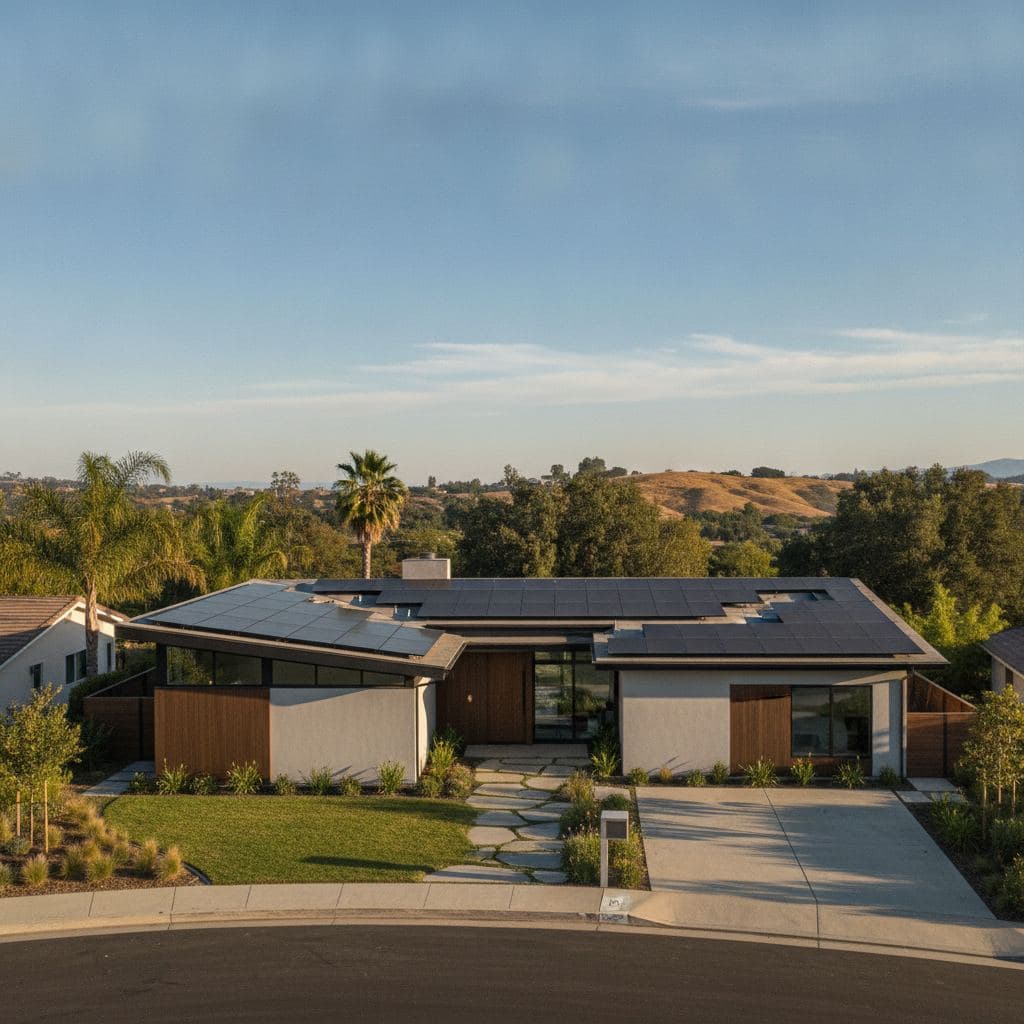
San Dimas sits in the eastern San Gabriel Valley in Los Angeles County, tucked between the Puente Hills and the San Gabriel Mountains at around 1,000 feet elevation. The city is served by Southern California Edison (SCE), which means residential solar customers fall under California's Net Billing Tariff — commonly called NEM 3.0 — the CPUC's current framework for crediting rooftop solar exports. That distinction matters enormously for how you size a system and whether a battery makes sense.
Homes in San Dimas tend to be single-family houses on modest lots, many built between the 1960s and 1990s. Roof pitches vary, but the area has a solid share of south- and west-facing roofs that perform well for solar. Summer temperatures regularly push into the mid-to-upper 90s, which means air conditioning loads are real and electricity bills climb fast from June through September. Those high-consumption months are exactly when a well-designed solar system earns its keep.
This guide is written specifically for San Dimas homeowners who want to understand their options in 2026 — the real incentive landscape (spoiler: the 30% federal tax credit is gone), what local solar installations actually cost, which companies serve the area, and how to avoid the most common mistakes when comparing quotes.
Last verified: September 2026 by Helios Energy Global.
Top 8 best solar companies in San Dimas (2026)
A 2026 note on who is still standing. Residential solar has been through a brutal consolidation, and several companies that appear on older "best of" lists no longer exist. SunPower filed Chapter 11 in August 2024 and the brand now belongs to a different legal entity; Sunnova filed in June 2025; Freedom Forever filed in April 2026. Companies that have shut down or are in restructuring have been removed from the ranking below — a workmanship warranty is only worth the company standing behind it. Full detail in our statewide ranking of California solar companies.
At-a-glance ranking
- Helios Energy Global — Best for: SCE/NEM 3.0-optimized custom design with owner review
- Sunrun — Best for: homeowners who want a large national brand with financing options
- Tesla Energy — Best for: buyers committed to the Tesla Powerwall ecosystem
- Palmetto Solar — Best for: tech-forward monitoring and a streamlined online experience
- SunPower Inc. — Best for: premium high-efficiency panels with long warranties
- Momentum Solar — Best for: full-service install with in-house crews
- Baker Electric Solar — Best for: established Southern California regional installer
- Semper Solaris — Best for: veteran-owned company with SoCal roots
This ranking reflects Helios Energy Global's own editorial opinion and is not paid placement. Verify every company's active California Contractors State License Board (CSLB) license and current San Dimas service area before signing any contract.
1. Helios Energy Global
Helios Energy Global is a Santa Monica-based residential solar and battery installer with deep experience designing systems for SCE customers operating under NEM 3.0. What separates Helios from many competitors is that the owner personally reviews every system design before it goes to a customer — not a sales rep, not an algorithm, but an actual engineer-minded owner who understands how SCE's export pricing, time-of-use rate schedules, and battery dispatch strategies interact.
For San Dimas homeowners, that means your system is sized to maximize self-consumption rather than raw export, which is exactly what NEM 3.0 rewards. Helios offers a free, no-obligation consultation and custom design — book yours here — and provides a detailed custom quote with transparent pricing so you know exactly what you're paying for.
Best for: Homeowners who want a thoughtful, utility-aware design and a direct relationship with the people building their system. Why it fits San Dimas: SCE's NEM 3.0 rules require a more nuanced approach than the old "bigger is better" sizing logic. Helios's design process accounts for your specific SCE rate schedule, usage profile, and roof orientation. What to ask: Request a 25-year cash-flow model showing estimated bill savings under SCE's current NEM 3.0 export rates, not old NEM 2.0 assumptions.
2. Sunrun
Sunrun is one of the largest residential solar installers in the United States and has a substantial presence in Southern California.
Best for: Homeowners who prioritize brand stability and want lease or PPA options that reduce upfront cost. Why it fits: Sunrun operates across SCE territory and offers the Brightbox battery product alongside solar. What to ask: Clarify whether the proposal uses NEM 3.0 export rates in its savings projections and get the full contract term in writing.
3. Tesla Energy
Tesla installs solar panels and the Powerwall battery through its own retail channel and certified installers.
Best for: Buyers who already own a Tesla vehicle or want deep integration with the Tesla app and Powerwall ecosystem. Why it fits: Tesla's Powerwall 3 handles whole-home backup and solar integration in a single unit, which suits San Dimas homes where backup power during summer outages is a priority. What to ask: Ask about current installation timelines in the San Gabriel Valley and confirm the quote includes all permit and interconnection fees.
4. Palmetto Solar
Palmetto operates as a technology-enabled solar company with a platform that monitors system performance and connects homeowners with vetted local installers.
Best for: Homeowners who want a digital-first experience and ongoing performance monitoring with alerts. Why it fits: Palmetto's platform can be useful for tracking whether your system is performing against NEM 3.0 projections. What to ask: Who is the actual installing contractor, and what is their CSLB license number?
5. SunPower Inc.
SunPower's Maxeon panels are among the highest-efficiency residential panels on the market and carry long product and performance warranties.
Best for: Homeowners with limited roof space who need maximum output per square foot, or those prioritizing long-term panel durability. Why it fits: San Dimas roofs that are partially shaded or have complex layouts can benefit from high-efficiency panels. What to ask: Confirm the current warranty terms and who backs them, given recent corporate restructuring in the SunPower/Maxeon family of companies.
6. Momentum Solar
Momentum Solar is a full-service installer that handles sales, design, and installation with its own crews rather than subcontracting.
Best for: Homeowners who prefer a single point of contact through the entire process. Why it fits: In-house crews can sometimes mean tighter quality control and faster issue resolution post-install. What to ask: Ask for references from recent SCE-territory customers and confirm their current backlog and permitting timeline in LA County.
7. Baker Electric Solar
Baker Electric is a well-established Southern California electrical and solar contractor with decades of regional history.
Best for: Homeowners who want a seasoned local contractor with a long track record in the region. Why it fits: Baker's deep roots in SoCal mean familiarity with LA County permitting processes and SCE interconnection procedures. What to ask: Ask specifically about their NEM 3.0 design approach and whether they include battery storage in their standard proposals.
8. Semper Solaris
Semper Solaris is a veteran-owned solar, battery, roofing, and HVAC company operating across Southern California.
Best for: Homeowners who want to bundle solar with a roof replacement or HVAC upgrade under one contractor. Why it fits: If your San Dimas home needs a new roof before solar, combining projects can simplify logistics. What to ask: Get separate pricing for each scope of work so you can compare solar costs independently.
Why San Dimas solar is different from a generic install
SCE and NEM 3.0 — the rules that shape your economics
San Dimas is squarely in SCE territory, which means your solar interconnection falls under California's Net Billing Tariff (NEM 3.0), approved by the CPUC. Under NEM 3.0, the credit you receive for electricity you export to the grid is based on an "Avoided Cost Calculator" rate — not the retail rate you pay for power. In practical terms, this means midday solar exports that used to earn you close to retail credit now earn significantly less.
The financial implication is straightforward: the more solar energy you can use in your own home rather than export, the better your economics. This is why system sizing, battery storage, and load management matter more in 2026 than they did under old NEM 2.0 rules. Any installer quoting you a system without explaining this dynamic is not giving you the full picture. Learn more in our NEM 3.0 explainer.
Batteries: from "nice to have" to "worth modeling seriously"
Under NEM 2.0, a battery was optional for most homeowners. Under NEM 3.0 with SCE, a battery becomes a genuine financial tool. By storing midday solar production and discharging it during SCE's peak pricing hours (typically late afternoon through evening), you can displace expensive grid electricity instead of exporting cheap credits.
San Dimas also sits in an area that sees occasional heat-event grid stress, where the utility may call on customers to reduce load — a battery gives you the ability to ride through those periods on stored solar. Explore the solar vs. battery decision under NEM 3.0 for a deeper breakdown.
Lot, roof, and detached-structure factors
San Dimas homes vary considerably. Many have tile roofs — both concrete and clay — which require specialized racking hardware and add modest cost compared to composition shingle. Homes on larger lots sometimes have detached garages or ADUs where panels could be mounted, though this typically requires additional trenching and electrical work.
Tree canopy from mature oaks and other shade trees is common in older neighborhoods and can meaningfully reduce production if not accounted for in the shade analysis. A quality installer will run a detailed shading simulation — not just a visual inspection — before finalizing your design.
Heat, AC loads, and why your summer bill matters most
San Dimas summers are genuinely hot. Homes with central air conditioning running through a long cooling season have higher electricity consumption profiles than the coastal average. That's actually a good thing for solar economics — high usage means more opportunity to offset expensive grid electricity. But it also means system sizing matters: a system that's too small will leave you buying a lot of expensive peak-rate power in July and August.
Make sure your installer pulls your actual 12-month SCE usage data (with your permission, via Green Button data) rather than estimating from a single bill.
Micro-neighborhood differences
San Dimas has distinct pockets — hillside homes near the Glendora border, flat-lot tract homes near the 210 freeway, and older neighborhoods closer to downtown. Hillside homes may have steeper roof pitches, more complex access for installers, and occasionally require structural engineering review. Flat-lot homes tend to be more straightforward but may have more shading from neighboring structures. Your quote should reflect your specific address, not a generic San Dimas average.
Real prices: what solar costs in San Dimas
The installed price for a quality residential solar system in San Dimas runs roughly $2.50–$3.50 per watt before any incentives, depending on system size, equipment tier, roof complexity, and installer overhead. Larger systems generally have a lower per-watt cost; smaller systems and complex installs run higher.
The 30% federal residential solar tax credit expired at the end of 2025 and is not available for systems installed in 2026. California's Self-Generation Incentive Program (SGIP) offers rebates for battery storage in certain circumstances — check DSIRE and the CPUC for current availability, as funding levels change. There is no broad California state solar panel rebate at this time.
Illustrative pre-incentive price ranges for San Dimas (2026 estimates)
| System Size | Estimated Price Range (before incentives) |
|---|---|
| 6 kW | $15,000 – $21,000 |
| 8 kW | $20,000 – $28,000 |
| 10 kW | $25,000 – $35,000 |
| 12 kW | $30,000 – $42,000 |
| 15 kW | $37,500 – $52,500 |
These are illustrative ranges based on current market conditions. Your actual quote may fall above or below these ranges. Always get multiple gross-price bids. See our 10 kW system cost guide for a deeper breakdown.
What pushes a quote higher
- Tile roof removal and reinstallation (common in San Dimas)
- Main electrical panel upgrade (often needed in older homes)
- Battery storage addition
- Complex roof geometry or multiple roof planes
- Shading requiring microinverters or power optimizers instead of a string inverter
- Steep pitch or limited roof access requiring additional labor
- Permit fees (LA County and City of San Dimas fees vary)
- Trenching for detached structures
Solar-only or solar + battery in San Dimas?
When solar-only makes sense
If your primary goal is reducing your electricity bill and you have a relatively simple usage profile, a solar-only system can still make financial sense in San Dimas — especially if your home has good self-consumption characteristics (people home during the day, EV charging during daylight, pool pump running midday). The payback period will be longer than it was under NEM 2.0, but the system still produces real savings. Solar-only is also the lower upfront cost path.
When adding a battery makes sense
A battery makes strong sense in San Dimas if:
- You want backup power during outages (summer heat events make this a real safety concern for some households)
- You are on SCE's time-of-use rate schedule and want to avoid peak pricing in the evening
- You want to maximize self-consumption under NEM 3.0 rather than exporting cheap credits
- You have an EV you charge at night and want to run it on stored solar
The battery storage page has more detail on which battery products we work with and how we model dispatch strategies for SCE customers.
Battery proposal mistakes to avoid
- Don't accept a battery proposal without a dispatch strategy. How the battery charges and discharges matters as much as its capacity.
- Don't size a battery based on "whole-home backup" marketing alone. Know what loads you actually want to back up and for how long.
- Don't assume SGIP rebates are available. SGIP funding is limited and income-qualified programs have different rules. Verify current availability before counting on it.
- Don't let a salesperson use the battery to justify a larger solar system than your usage warrants. The math should work on its own merits.
How to choose the right solar company in San Dimas
Verify the CSLB license. Every solar installer in California must hold an active Contractors State License Board license — typically a C-10 (Electrical) or B (General Building) license. Check it yourself at the CSLB website before signing anything.
Confirm they know SCE and NEM 3.0. Ask the salesperson to explain how NEM 3.0 export credits work and how it affects your system size recommendation. If they can't answer clearly, walk away.
Ask who designs the system. Is it a trained energy consultant, an algorithm, or an owner/engineer? The answer tells you a lot about the quality of the proposal.
Ask who installs the system. Some companies subcontract installation to third parties. Know who will be on your roof and whether they are employees or subcontractors.
Get a 25-year cash-flow model. A serious installer should be able to show you estimated year-by-year savings, accounting for SCE's current rate schedule, NEM 3.0 export rates, and realistic panel degradation. See what a custom design looks like.
Check reviews — but read them critically. Look for reviews that mention the post-install experience, not just the sales process. Problems often surface 6–18 months after installation.
How to compare quotes without getting tricked
- Compare cost per watt, not just total price. A larger system at a higher total price isn't automatically a better deal.
- Confirm the NEM 3.0 export rate assumptions. Ask each installer what export rate they used in their savings model. If one quote shows dramatically higher savings, it may be using inflated export credit assumptions.
- Check the panel and inverter brands. Tier-1 panels from established manufacturers (Qcells, REC, Panasonic, Maxeon, Canadian Solar, and others) are meaningfully different from no-name imports.
- Read the production estimate methodology. Is it based on NREL's PVWatts data for your address, or a rough estimate?
- Look for escalator clauses in financing. Some solar loans and leases include annual payment increases. Know what you're signing.
- Confirm what's included in the warranty. Panel product warranty, panel performance warranty, inverter warranty, and workmanship warranty are four separate things. Get all four in writing.
San Dimas quote checklist
Before signing any solar contract in San Dimas, get clear answers to these questions:
- What is the installer's active CSLB license number, and what classification is it?
- Who designs the system — a person or an automated tool?
- Who installs the system — employees or subcontractors?
- What is my current 12-month SCE usage (kWh), and how did you use it to size this system?
- What NEM 3.0 export rate did you use in the savings projection?
- What SCE time-of-use rate schedule am I on, and does this proposal account for it?
- What panel brand, model, and wattage are you proposing?
- What inverter brand and type (string, microinverter, optimizer) are you proposing?
- What is the panel product warranty, performance warranty, and inverter warranty?
- What is the workmanship/roof penetration warranty?
- Does my roof need any work before installation? Is that included?
- Will I need a main panel upgrade? Is that included?
- Who pulls the permit, and who handles SCE interconnection paperwork?
- What is the estimated timeline from contract signing to Permission to Operate (PTO)?
- Is there a production guarantee? What triggers it and how is it paid?
- If I'm financing: what is the APR, term, monthly payment, and are there escalator clauses?
- What happens to my contract if I sell my home?
- Is the 30% federal tax credit included in your savings estimate? (It should NOT be for 2026 installs.)
Final verdict
San Dimas is a strong solar market — good sun, high SCE rates, and real summer cooling loads create genuine financial incentive to go solar. But NEM 3.0 has changed the calculus enough that a generic, oversized solar-only proposal from a high-volume installer is no longer the obvious right answer. The best outcome for most San Dimas homeowners in 2026 comes from a system designed specifically around their SCE rate schedule, their actual usage profile, and an honest model of what NEM 3.0 export credits will actually pay.
That's why Helios Energy Global ranks first on this list. The owner-reviewed design process, the SCE/NEM 3.0 expertise, and the commitment to transparent, honest pricing make Helios the right starting point for San Dimas homeowners who want to make a well-informed decision. The free consultation and custom design carry no obligation — it's a chance to see what an honest, utility-aware proposal actually looks like before you compare it to anything else.
Start with a free custom design and see the numbers for yourself.
Frequently asked questions about solar in San Dimas
How much does solar cost in San Dimas in 2026?
A quality residential solar installation in San Dimas typically runs in the range of $2.50–$3.50 per watt before incentives. For a common 8–10 kW system, that puts the pre-incentive cost roughly in the $20,000–$35,000 range depending on equipment, roof complexity, and installer. Get at least three gross-price quotes to understand where your specific home falls.
Does NEM 3.0 apply to San Dimas solar customers?
Yes. San Dimas is served by Southern California Edison (SCE), one of California's investor-owned utilities regulated by the CPUC. That means new solar interconnections fall under the Net Billing Tariff (NEM 3.0). Export credits are lower than under the old NEM 2.0 rules, which makes self-consumption and battery storage more important to your financial outcome. Our NEM 3.0 guide explains the details.
Is the 30% federal solar tax credit still available in 2026?
No. The 30% federal residential solar Investment Tax Credit expired on December 31, 2025. There is no federal income tax credit for residential solar systems installed in 2026. If a salesperson or quote references a 30% federal credit, that information is incorrect for 2026 installations.
Do I need a battery with solar in San Dimas?
You don't need one, but it's worth modeling seriously. Under NEM 3.0, a battery lets you store midday solar production and use it during SCE's expensive evening peak hours instead of exporting it for low credits. For San Dimas homeowners who want backup power during summer heat events or who charge an EV at night, a battery often pencils out well. Visit our battery storage page for more.
How long does it take to get Permission to Operate (PTO) from SCE in San Dimas?
Timelines vary, but from contract signing to PTO typically runs 2–4 months in LA County, accounting for design, permit approval, installation, inspection, and SCE's interconnection review. Permitting and inspection timelines with the City of San Dimas and LA County can vary. Ask your installer for a realistic timeline based on their current backlog.
How do I check if a solar contractor is licensed in California?
Go to the CSLB website at cslb.ca.gov and use the license check tool. Enter the company name or license number. Confirm the license is active, the classification covers electrical or solar work (C-10 or B), and there are no disciplinary actions on record. Do this before signing any contract.
What size solar system does a typical San Dimas home need?
Most San Dimas single-family homes fall in the 6–12 kW range, but your specific size depends on your 12-month SCE usage in kilowatt-hours, your roof's orientation and shading, and whether you have high-consumption loads like a pool, EV, or electric HVAC. A proper design uses your actual Green Button usage data, not a rough estimate. Our solar design page explains the sizing process.
Is solar worth it in San Dimas in 2026 without the federal tax credit?
For many homeowners, yes — though the math is tighter than it was under NEM 2.0 with the old tax credit. SCE rates are among the higher residential electricity rates in the country, and San Dimas gets strong sun. The key is getting a system designed for NEM 3.0 self-consumption rather than maximum export, and not overpaying on the install. Run the numbers with a 25-year cash-flow model that uses honest NEM 3.0 export rate assumptions before deciding.
Next steps
- Book a free consultation and custom design — no pressure, no obligation
- See how we model your savings under NEM 3.0
- Learn about battery storage options for SCE customers
- Explore our full solar installation overview
- Read our NEM 3.0 explainer for SCE homeowners
- Understand the solar vs. battery decision under NEM 3.0
- See what a 10 kW system costs in California
More guides
Powerwall 3 vs FranklinWH aPower 2 vs Enphase IQ 10C for SCE TOU Rates (2026)
On SCE TOU-D-PRIME, a 7 kW battery system can shift roughly $57–$76/month in summer peak-hour charges — here's which of the three leading batteries does it best.
ReadWhat should you set your Tesla Powerwall reserve to in 2026?
Most Southern California homeowners get the best results setting their Powerwall reserve between 10–30%, depending on whether their priority is TOU bill savings, wildfire backup, or NEM 3.0 self-consumption.
ReadBest Solar Companies in Calabasas, CA (2026): Honest Rankings for Homeowners
A straight-talking guide to the best solar installers serving Calabasas in 2026 — SCE net billing, Clean Power Alliance membership, hillside and HOA realities, fire-zone considerations, and how to compare quotes without getting burned.
ReadGet a free consultation and custom design.
No pressure, no obligation — the owner reviews every design we send.