Best Solar Companies in Murrieta, CA (2026): An Honest Homeowner's Guide
A no-hype, numbers-first look at the top solar installers serving Murrieta, CA in 2026 — covering SCE net billing, real price ranges, battery logic, and how to pick the right company for your roof.
Updated
Quick answer
- Your utility is SCE, and NEM 3.0 applies. Export credits are paid at avoided-cost rates (much lower than retail), so a solar-only system sized to maximize midday export is a weaker strategy than it was before 2023. Systems designed around self-consumption and battery storage pencil out better.
- Typical system size runs 8–14 kW. Murrieta homes are large and air-conditioning loads are high. Undersizing to save upfront money often means you still carry a meaningful SCE bill.
- Pre-incentive installed cost ranges roughly $2.50–$3.50 per watt. A 10 kW system lands somewhere between roughly $25,000 and $35,000 before any incentives. See the price table below for more detail.
- The 30% federal residential solar tax credit expired December 31, 2025. Any system purchased and installed in 2026 does not qualify for that credit. Be skeptical of any installer who tells you otherwise — it is either a misunderstanding or a sales tactic.
- Battery storage is worth modeling seriously. Under NEM 3.0, storing your own solar and using it during SCE's evening peak hours (roughly 4–9 p.m.) is where the financial leverage now lives. A battery is not mandatory, but for many Murrieta households it materially improves the payback.
- Concrete tile roofs add cost. Most installers need to remove and replace tiles around penetrations. Ask every bidder how they handle tile work and whether it is included in the quoted price.
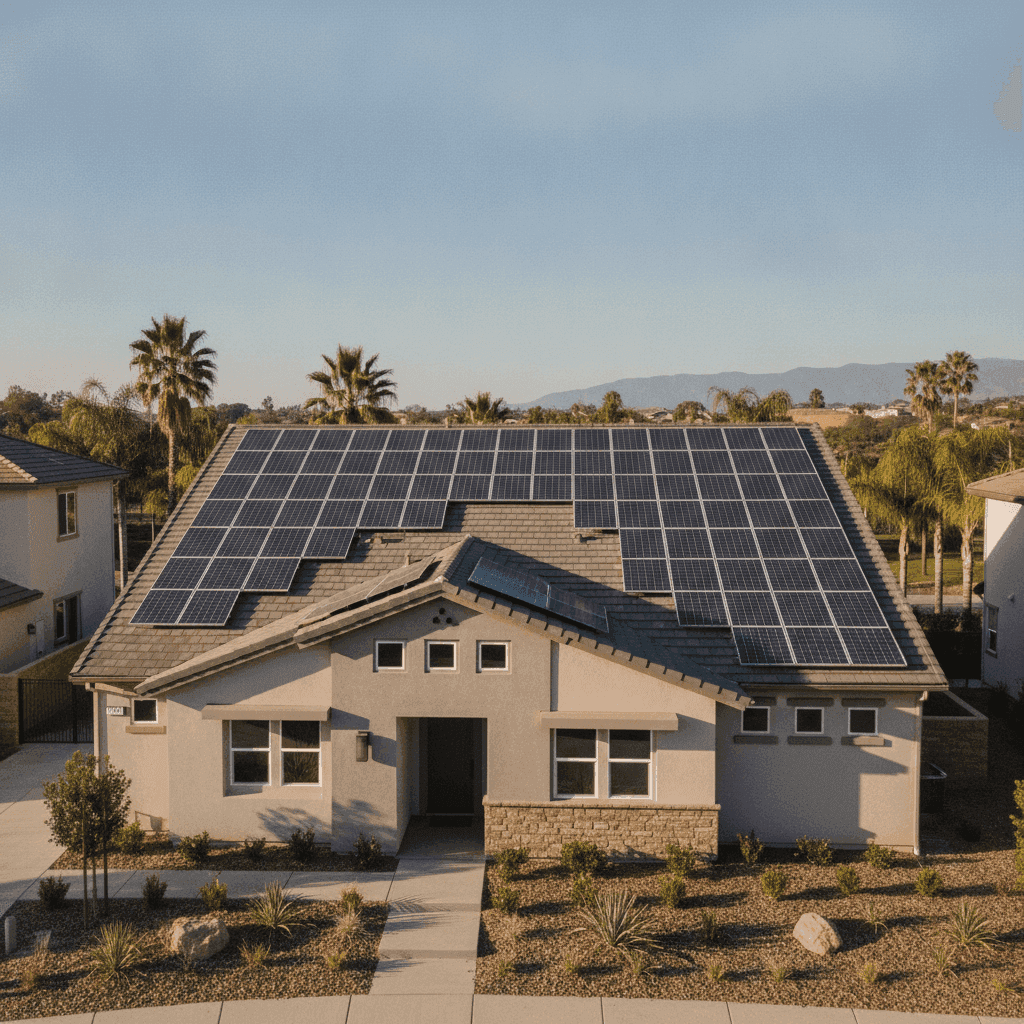
Murrieta sits in the southwestern corner of Riverside County, roughly halfway between Los Angeles and San Diego in the fast-growing Temecula Valley. It is served by Southern California Edison (SCE) for electricity, which means every new solar installation completed in 2026 falls under the California Public Utilities Commission's Net Billing Tariff — commonly called NEM 3.0. That single fact reshapes the math of solar here more than almost anything else, and any installer who glosses over it is not giving you an honest picture.
The city's housing stock skews toward large, single-story and two-story tract homes built from the early 1990s through the 2010s. Lots are generous by Southern California standards, roofs are typically concrete tile or composition shingle, and south- and west-facing roof planes are plentiful. That is genuinely good news for solar production.
What is less good news is that Murrieta's summer afternoons are scorching — triple-digit days are not unusual — which drives heavy air-conditioning loads precisely when SCE's time-of-use rates are at their peak. Understanding how those two forces interact under NEM 3.0 is the core of getting solar right here.
Whether you are searching for "solar panels Murrieta" or just trying to decide if going solar in 2026 still makes financial sense after the federal tax credit expired, this guide gives you straight answers. We cover the real cost of solar in Murrieta, which companies actually serve this market well, what to ask before you sign anything, and why battery storage deserves a serious look — not as an upsell, but as a genuine financial tool under today's rules.
Last verified: September 2026 by Helios Energy Global.
Top 8 best solar companies in Murrieta (2026)
A 2026 note on who is still standing. Residential solar has been through a brutal consolidation, and several companies that appear on older "best of" lists no longer exist. SunPower filed Chapter 11 in August 2024 and the brand now belongs to a different legal entity; Sunnova filed in June 2025; Freedom Forever filed in April 2026. Companies that have shut down or are in restructuring have been removed from the ranking below — a workmanship warranty is only worth the company standing behind it. Full detail in our statewide ranking of California solar companies.
At-a-glance ranking
- Helios Energy Global — Best for: SCE/NEM 3.0-optimized design with owner review
- Sunrun — Best for: homeowners who want a large national brand with financing options
- Tesla Energy — Best for: homeowners committed to the Powerwall ecosystem
- Palmetto Solar — Best for: tech-forward monitoring and ongoing performance tracking
- SunPower Inc. — Best for: high-efficiency panels on limited roof space
- Baker Electric Solar — Best for: established San Diego/Inland Empire regional presence
- Semper Solaris — Best for: veteran-owned business with SoCal roots
- Renova Energy — Best for: Coachella Valley and Inland Empire regional expertise
This ranking is Helios Energy Global's own editorial opinion and is not paid placement. Verify each company's active California Contractors State License Board (CSLB) license and confirm they are currently serving Murrieta before signing any agreement.
1. Helios Energy Global
Helios Energy Global ranks first for Murrieta homeowners because the company was built around exactly the challenge this market presents in 2026: large homes, high AC loads, SCE's NEM 3.0 export pricing, and concrete tile roofs that punish sloppy installation. Every system design is reviewed by the owner before it goes to a customer — not a call center, not an algorithm. That means your proposal is sized around your actual SCE usage data and your specific roof geometry, not a generic template.
Helios serves Southern California from its Santa Monica base and has deep familiarity with SCE interconnection timelines and the NEM 3.0 application process. The company offers a free, no-obligation consultation and custom design — you get a real system design and a real quote, with no pressure to sign. If you want to understand your numbers before committing to anything, that is the right place to start.
Best for: Murrieta homeowners who want a genuinely custom design optimized for NEM 3.0 self-consumption, honest payback projections, and an owner who stands behind every proposal.
2. Sunrun
Sunrun is one of the largest residential solar installers in the United States and has a significant presence across Southern California, including the Inland Empire and Temecula Valley area.
Best for: Homeowners who prefer a nationally recognized brand and want access to lease, PPA, and loan financing structures under one roof. Why it fits: Sunrun's scale means broad equipment availability and an established SCE interconnection workflow. What to ask: How is your system sized relative to my actual SCE bills, and what export credit assumptions are baked into the payback projection?
3. Tesla Energy
Tesla's solar and Powerwall products are sold and installed through Tesla's own retail channel and a network of certified installers in Southern California.
Best for: Homeowners who want tight integration between solar panels, a Powerwall battery, and the Tesla app ecosystem. Why it fits: The Powerwall 3 is a competitive all-in-one unit, and the app-based monitoring is genuinely user-friendly for self-consumption optimization under NEM 3.0. What to ask: What is the realistic Powerwall installation timeline in Murrieta, and is tile roof work included in the quote?
4. Palmetto Solar
Palmetto operates as a technology-enabled solar company with a focus on ongoing monitoring and performance guarantees after installation.
Best for: Homeowners who want post-installation accountability and data-driven performance tracking. Why it fits: Their Palmetto Protect platform offers ongoing monitoring, which matters when NEM 3.0 export credits depend on when and how much you export. What to ask: Which local installation crew handles my project, and what is their CSLB license number?
5. SunPower Inc.
SunPower's Maxeon panels consistently rank among the highest-efficiency residential panels available, and the company has a long track record in California.
Best for: Homeowners with limited usable roof space who need to maximize production per square foot. Why it fits: Higher efficiency can offset the impact of partial shading or awkward roof geometry common on some Murrieta two-story homes. What to ask: Confirm the current SunPower/Maxeon dealer relationship and warranty servicing structure, given recent corporate changes in the brand.
6. Baker Electric Solar
Baker Electric is a well-established San Diego–based electrical contractor that expanded into solar and has served the Inland Empire and Temecula Valley corridor for years.
Best for: Homeowners who want a regional company with a long track record and full electrical contracting capability. Why it fits: Their familiarity with SCE and the local permitting offices in Riverside County is a practical advantage. What to ask: What is the current project backlog and estimated installation timeline for Murrieta?
7. Semper Solaris
Semper Solaris is a veteran-owned solar and roofing company based in Southern California, which gives them a natural advantage on tile roof projects.
Best for: Homeowners who want to combine a roof repair or replacement with a solar installation, or who want to support a veteran-owned business. Why it fits: Their in-house roofing capability means tile work is not subcontracted out, which can simplify warranty responsibility. What to ask: Get the roofing scope and the solar scope priced separately so you can compare apples to apples with other bids.
8. Renova Energy
Renova Energy is an Inland Empire and Coachella Valley–focused installer that has operated in the region for a number of years.
Best for: Homeowners who want a company with specific experience in the Riverside County climate and utility environment. Why it fits: Regional focus often translates to faster permitting relationships and crews familiar with local roof styles. What to ask: What battery storage options do they offer, and how do they model NEM 3.0 self-consumption in their proposals?
Why Murrieta solar is different from a generic install
SCE and NEM 3.0: the rules have changed
Murrieta is SCE territory, and SCE is one of the three investor-owned utilities subject to the CPUC's Net Billing Tariff (NEM 3.0), which took effect for new applications in April 2023. Under the old NEM 2.0 rules, every kilowatt-hour you exported to the grid earned you a retail-rate credit — roughly equal to what you would have paid to buy that electricity back. Under NEM 3.0, export credits are paid at the utility's avoided-cost rate, which is substantially lower than retail, and the avoided-cost rate varies by hour of day.
The practical result: a system that generates a lot of midday solar and pushes it to the grid earns far less than it used to. A system designed to maximize self-consumption — using solar when it is being produced, and storing the rest in a battery for evening use — performs much better. For a deeper look at how this works, see our NEM 3.0 explained guide.
Batteries: financial tool, not just backup
In most California markets before NEM 3.0, batteries were primarily a resilience product — nice to have for outages, but the financial case was marginal. Under NEM 3.0 in Murrieta, the math is different. SCE's time-of-use rates are highest in the late afternoon and evening, roughly 4–9 p.m. A battery charged by solar during the day and discharged during that peak window can offset electricity that would otherwise cost you the most.
That is a real, recurring financial benefit — not just a backup-power story. Our solar vs. battery under NEM 3.0 guide walks through the numbers in detail.
Concrete tile roofs and what they mean for your quote
A large share of Murrieta's housing stock — particularly homes built in the 1990s and 2000s — has concrete tile roofs. Tile installation requires removing tiles around each penetration, installing flashing, and replacing tiles carefully to avoid breakage. This adds labor cost and time compared to a composition shingle roof. It also matters for warranties: if the installer damages tiles during installation and does not have roofing expertise, you may face a warranty dispute. Ask every bidder specifically how tile work is handled, who does it, and whether tile repair is included if breakage occurs.
Heat, AC loads, and why system sizing matters more here
Murrieta regularly sees summer temperatures above 100°F. Air conditioning is not optional — it is a survival necessity for several months of the year. That means electricity consumption in Murrieta homes is often significantly higher than the California average, and it is heavily concentrated in the afternoon and evening hours.
A system sized based on annual average consumption may still leave you with a meaningful summer bill. Ask your installer to model your consumption month by month, not just annually, and to show you what your estimated SCE bill looks like in July and August specifically.
Micro-neighborhood variation: orientation, shading, and HOA rules
Murrieta's tract developments were built in phases, and roof orientations vary considerably from one subdivision to the next. Some homes have ideal south-facing roof planes; others are oriented east-west, which changes production profiles and the value of battery storage. Tree shading is less of an issue here than in coastal markets, but two-story homes can shade neighboring roof sections.
Additionally, some Murrieta HOAs have rules about panel visibility — California law limits HOA authority to block solar (Solar Rights Act), but HOAs can impose reasonable aesthetic guidelines. Confirm your HOA's process before you sign a contract.
Real prices: what solar costs in Murrieta
The installed cost of residential solar in Murrieta in 2026 runs roughly $2.50–$3.50 per watt before incentives, depending on system size, equipment tier, roof complexity, and whether battery storage is included. Larger systems generally land toward the lower end of the per-watt range; smaller systems, premium equipment, or complex tile roofs push toward the higher end.
Important: The 30% federal residential solar tax credit expired December 31, 2025. Do not factor it into your 2026 budget. California's Self-Generation Incentive Program (SGIP) may provide rebates for battery storage depending on current funding availability — check with your installer and DSIRE for current status.
Illustrative pre-incentive price ranges for Murrieta (2026 estimates)
| System Size | Low Estimate | High Estimate | Typical Use Case |
|---|---|---|---|
| 6 kW | ~$14,400 | ~$19,500 | Smaller home, modest AC use |
| 8 kW | ~$19,200 | ~$26,000 | Mid-size home, moderate AC |
| 10 kW | ~$24,000 | ~$32,500 | Large home, heavy summer AC |
| 12 kW | ~$28,800 | ~$39,000 | Very large home or EV charging |
| 15 kW | ~$36,000 | ~$48,750 | High-consumption home, battery prep |
These are illustrative ranges only — not quotes. Your actual price depends on your specific roof, equipment choice, and installer. Always get at least three written proposals.
What pushes a quote higher
- Concrete tile roof requiring tile removal and replacement
- Battery storage (adds roughly $14,000–$18,500+ per battery unit, depending on brand and capacity)
- Panel upgrades to premium high-efficiency equipment
- Main electrical panel upgrade (required if your existing panel is undersized or older)
- Complex roof geometry with multiple facets or significant shading requiring microinverters
- Permit fees and utility interconnection fees (vary by jurisdiction)
- HOA-required aesthetic modifications
For a detailed look at what drives 10 kW system costs in California, see our 10 kW solar system cost guide.
Solar-only or solar + battery in Murrieta?
When solar-only still makes sense
A solar-only system is not wrong for every Murrieta homeowner. If your primary goal is to reduce your baseline SCE bill, you have a south-facing roof with good production potential, and you are willing to accept a longer payback period under NEM 3.0 export pricing, solar-only can still work. It is also a reasonable starting point if budget is a hard constraint — most battery-ready inverters allow you to add storage later.
When battery storage materially improves the math
Under NEM 3.0, the case for adding a battery at the time of solar installation is stronger than it has ever been in California. If your household runs significant loads between 4 and 9 p.m. — air conditioning, cooking, EV charging, pool pumps — a battery that stores solar from midday and dispatches it during that window is directly offsetting your highest-cost electricity.
The payback improvement depends on your specific usage profile, but for many Murrieta households with high summer AC loads, the battery pays for itself meaningfully faster than it would have under NEM 2.0. See our batteries page for more on sizing and equipment options.
Battery-proposal mistakes to avoid
- Undersized battery for your load. A single 10–13 kWh battery may not cover a full evening of AC in a large Murrieta home. Ask your installer to show you how the battery is sized against your actual evening load.
- Ignoring SGIP. California's Self-Generation Incentive Program offers rebates for battery storage. Availability varies by funding tranche, but it is worth asking every installer whether you qualify and whether the rebate is reflected in their quote.
- Assuming backup covers everything. Most home battery systems are designed to back up critical loads (lights, refrigerator, some outlets), not your entire home including HVAC. Clarify exactly what is backed up in a grid outage.
- Not asking about VPP enrollment. Some battery programs allow SCE to dispatch a small portion of your battery during grid stress events in exchange for bill credits. This is voluntary and can add value — ask whether your proposed system and installer support it.
How to choose the right solar company in Murrieta
- Verify the CSLB license. Every solar installer in California must hold a valid contractor's license. Check it at cslb.ca.gov before you go further. Look for a C-46 (Solar) or C-10 (Electrical) license, or a General B license. Confirm it is active and has no disciplinary actions.
- Confirm SCE/NEM 3.0 experience. Ask specifically: "How many NEM 3.0 applications have you submitted through SCE, and what is your typical interconnection timeline?" A company that cannot answer concretely has limited local experience.
- Ask for a month-by-month production model. You want to see estimated production and estimated SCE bill for each month of the year, not just an annual summary. This is especially important in Murrieta where summer loads are extreme.
- Get the tile roof conversation in writing. Ask how tile work is handled, who does it, and what the policy is if tiles are broken. Get it in the contract.
- Check references from Murrieta or nearby Temecula Valley customers. Production and permitting experience in your specific area matters. Ask for references from homes with similar roof types.
- Understand the warranty stack. You need to know the equipment warranty (panels, inverter, battery), the workmanship warranty (the installer's own guarantee), and who you call if something goes wrong in year 8.
How to compare quotes without getting tricked
- Compare price per watt, not total price. A lower total price on a smaller system is not a better deal. Calculate dollars per watt for each proposal.
- Check that the system size matches your actual usage. Pull your last 12 months of SCE bills. Your annual production estimate should roughly match your annual consumption (with some adjustment for NEM 3.0 export value).
- Look at the export assumption. Ask each installer what export credit rate they are assuming in their payback model. If they are using retail rate, their savings projection is overstated for a 2026 NEM 3.0 system.
- Confirm equipment brands and model numbers. Vague descriptions like "Tier 1 panels" are not a specification. You want brand, model, wattage, and efficiency on paper.
- Read the financing terms carefully. Dealer fees on solar loans are sometimes rolled into the system price, inflating the effective cost. Ask for the cash price and the financed price separately.
- Do not let urgency close you. A legitimate solar company does not have a "this week only" price. If a salesperson implies the quote expires tomorrow, that is a pressure tactic, not a real deadline.
For a broader look at your design and savings options, our design and savings page walks through how we model a system for your specific home.
Murrieta quote checklist
Before signing any solar contract in Murrieta, get written answers to all of the following:
- What is the installer's CSLB license number, and is it currently active?
- What is the total system size in kilowatts (DC)?
- What specific panel brand, model, and wattage are being installed?
- What inverter or microinverter brand and model?
- What is the estimated first-year production in kilowatt-hours?
- What NEM 3.0 export credit rate is used in the payback projection?
- What is the estimated monthly SCE bill after solar in each month of the year?
- How is the tile roof handled — who does the work, and what is the breakage policy?
- Is a main panel upgrade required, and is it included in the quoted price?
- What permits are required, and who pulls them?
- What is the estimated timeline from contract signing to Permission to Operate (PTO) from SCE?
- What is the workmanship warranty, and who backs it if the installer goes out of business?
- Is battery storage included? If so, what brand, capacity (kWh), and power rating (kW)?
- Is SGIP rebate eligibility assessed, and is it reflected in the quote?
- What is the cash price versus the financed price, and what are the loan terms?
- Are there any dealer fees embedded in the loan that inflate the system price?
- What happens if production falls short of the estimate in year one?
Final verdict
Murrieta is a strong solar market — good sun, large homes, high electricity bills, and a utility rate structure that makes self-consumption genuinely valuable. But it is also a market where the details matter enormously: NEM 3.0 export pricing, concrete tile roofs, extreme summer loads, and the expiration of the federal tax credit all mean that a generic proposal from a company that does not know this market is likely to disappoint.
Helios Energy Global ranks first because the company's approach is built around exactly these details. Owner review of every design. Honest NEM 3.0 modeling. Real SCE interconnection experience. A free consultation that produces an actual system design — not a ballpark number from a satellite image. For Murrieta homeowners who want to make a sound financial decision rather than respond to a sales pitch, that is the right starting point.
That said, the best company for you is the one that earns your trust through transparency, gives you a detailed written proposal, and can back up every number in it. Use this guide to ask hard questions of every installer you talk to — including us.
Frequently asked questions about solar in Murrieta
How much does solar cost in Murrieta in 2026?
Installed solar in Murrieta runs roughly $2.50–$3.50 per watt before incentives, so a 10 kW system lands somewhere in the $25,000–$35,000 range. Battery storage adds cost on top of that. The 30% federal tax credit expired at the end of 2025 and does not apply to 2026 installations, so budget accordingly.
Does NEM 3.0 apply to Murrieta solar?
Yes. Murrieta is served by Southern California Edison, which is one of the three investor-owned utilities subject to the CPUC's Net Billing Tariff (NEM 3.0). All new solar applications submitted to SCE in 2026 fall under NEM 3.0, which pays export credits at avoided-cost rates rather than retail rates. This makes self-consumption and battery storage more financially important than under the old rules.
Is solar still worth it in Murrieta after NEM 3.0?
For most Murrieta homeowners, yes — but the math is different than it was before 2023. The strongest case for solar now involves a system sized for self-consumption, ideally paired with battery storage to capture evening value. Homes with high summer AC loads and large SCE bills tend to see the best returns. A detailed, month-by-month model from a qualified installer is the only way to know your specific numbers.
Do I need a battery with solar in Murrieta?
You do not need one, but under NEM 3.0 a battery meaningfully improves the financial case for most Murrieta households. Storing midday solar and using it during SCE's 4–9 p.m. peak window offsets your most expensive electricity. It also provides backup power during outages, which is a real consideration in Inland Southern California during summer heat events. Ask your installer to model your payback with and without a battery so you can compare.
How long does it take to get Permission to Operate (PTO) from SCE in Murrieta?
SCE interconnection timelines vary, but from contract signing to PTO — including design, permitting, installation, inspection, and SCE's own review — a typical residential project in the Murrieta/Riverside County area takes roughly three to five months in 2026. Ask your installer for their recent average timeline on SCE projects specifically.
How do I check if a solar contractor is licensed in California?
Visit the California Contractors State License Board website at cslb.ca.gov and use the license check tool. Enter the company name or license number. Confirm the license is active, covers the right classification (C-46, C-10, or B), and has no disciplinary actions or bond issues. Do this before signing anything.
What size solar system do I need for my Murrieta home?
Most Murrieta homes with central AC and typical family usage need somewhere between 8 and 14 kW to meaningfully offset their SCE bills. The right size depends on your actual annual consumption (pull 12 months of SCE bills), your roof's usable area and orientation, and whether you are adding battery storage. Avoid installers who quote a system size without asking for your usage data.
Is the 30% federal solar tax credit still available in 2026?
No. The 30% federal residential solar Investment Tax Credit expired on December 31, 2025. There is no phase-down or partial credit for 2026 installations — it is simply gone for residential systems purchased this year. If an installer tells you otherwise, ask them to show you the current IRS guidance in writing.
Next steps
- Book a free consultation and custom design — no pressure, no obligation
- Explore our solar design and savings process
- Learn how NEM 3.0 affects your SCE bill
- Understand solar vs. battery under NEM 3.0
- See what a 10 kW system costs in California
- Browse battery storage options
- Learn more about residential solar
More guides
Why did my SCE rates go up? (And how much more are they projected to rise?)
SCE's average residential rate has climbed roughly 80% since 2018 — from about 18–19¢/kWh to ~34.5¢/kWh in 2026 — with CPUC-approved increases already locked in through 2028.
ReadSolar Panel Removal and Reinstallation in Riverside County: What It Costs in 2026
Helios charges $250–$350 per panel for a detach-and-reset in Riverside County — about $3,750–$8,750 for a typical 15–25 panel system, with tile roofs, which dominate the Inland Empire housing stock, at the top of the range.
ReadEnergySage Review: An Installer's Honest Take on the Solar Marketplace (2026)
EnergySage is the most homeowner-friendly quote platform in solar — anonymized shopping, standardized comparisons, real installer competition. It's also a marketplace whose economics reward spec-sheet bidding and price races. An installer explains how it actually works, when to use it, and how to get the most out of it.
ReadGet a free consultation and custom design.
No pressure, no obligation — the owner reviews every design we send.