Best Solar Companies in Fountain Valley, CA: An Honest 2026 Ranking for SCE Homeowners
Fountain Valley homeowners are on Southern California Edison's NEM 3.0 tariff, where export credits are roughly 75% lower than the old rules — making battery storage the key to a healthy payback. Here's an honest, numbers-first ranking of the best solar companies serving the city in 2026.
By Taylor Crouse — Founder, Helios Energy GlobalPublished
Quick answer
Utility is SCE, NEM 3.0 applies. California's Net Billing Tariff (NEM 3.0) took effect April 15, 2023 and cut export credits by roughly 75%, from near-retail rates to an hourly "avoided cost." Every new solar customer in Fountain Valley is on this tariff.
Export credits are low — self-consumption is everything. Under SCE's Solar Billing Plan, exported solar earns hourly credits that average about 6¢ per kWh on summer days and 21¢ from 4 to 9 p.m. for customers starting in 2026. You pay ~34–35¢ to buy that same power back.
SCE's average residential rate is ~34–35¢/kWh. SCE's current average residential rate is 34.4–34.5¢ per kWh , and the TOU-D-4-9PM plan charges 58¢ per kWh during the on-peak window.
A battery is usually what makes the math work. Storing midday solar and discharging it during the 4–9 PM peak — when you'd otherwise pay 48–58¢/kWh — is what closes the gap that NEM 3.0 opened. Solar-only systems often have long payback periods on SCE.
Typical system size: 6–10 kW; installed cost ~$2.50–$3.50/watt before incentives. Most Fountain Valley tract homes land in the 7–9 kW range. A home battery adds roughly $14,000–$18,500 per unit installed.
The 30% federal solar tax credit expired December 31, 2025. There is no federal residential solar credit for systems purchased or installed in 2026. The sticker price is close to your final out-of-pocket cost. California's Self-Generation Incentive Program (SGIP) may still offset battery costs for qualifying customers — ask your installer.
Fountain Valley sits in Orange County, served by Southern California Edison. Its mostly single-story 1960s–1970s tract homes and coastal-influenced climate make it a straightforward market to install in — but the economics are driven almost entirely by how well a system is designed around SCE's NEM 3.0 rules.
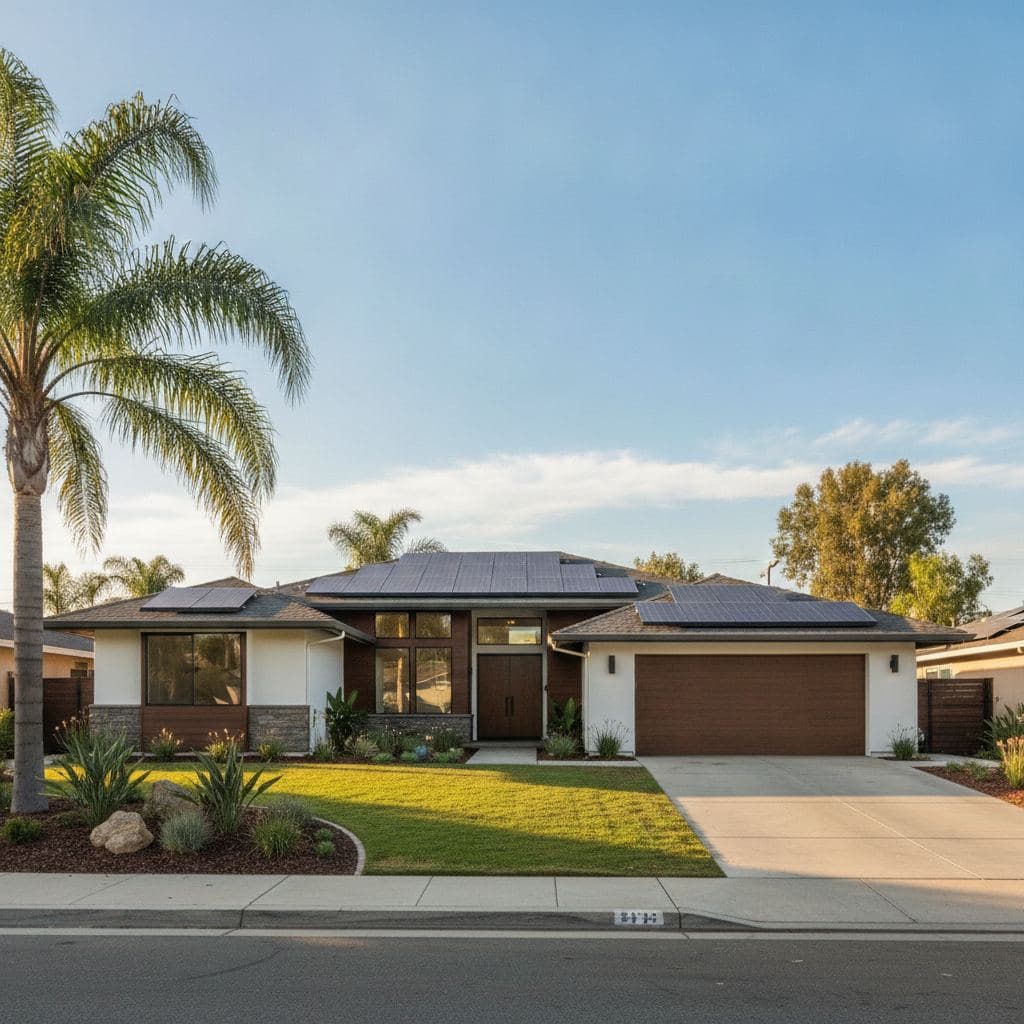
Top 10 best solar companies in Fountain Valley (2026)
At-a-glance ranking
- Helios Energy Global — Best for: SCE/NEM 3.0-optimized design with owner review on every job
- Sunrun — Best for: Homeowners who prefer a lease or PPA with a large national warranty backstop
- Tesla Energy — Best for: Homeowners committed to the Powerwall 3 + solar roof ecosystem
- Palmetto — Best for: Tech-forward monitoring and a software-driven quote process
- OC Solar — Best for: Local Orange County track record with SCE interconnection experience
- Infinity Solar — Best for: Long-established Orange County installer with residential focus
- Aikyum Solar — Best for: Highly-rated local service and fast response times
- AMECO Solar & Roofing — Best for: Combined solar + roofing projects under one contractor
- Forme Solar Electric — Best for: Irvine-based installer with a strong Orange County presence
- Vasco Solar — Best for: Fountain Valley–area installer with local neighborhood familiarity
This ranking is Helios Energy Global's own editorial opinion and is not paid placement. Verify each company's active California Contractors State License Board (CSLB) license and current Fountain Valley service area before signing any contract.
1. Helios Energy Global
Helios ranks first for Fountain Valley because the SCE/NEM 3.0 environment punishes generic installs. When export credits average around 6¢/kWh during the day and your retail rate runs 34–35¢, a system that isn't designed around your specific usage profile and peak-hour consumption will simply underperform. Helios models your actual SCE bill — including your time-of-use tier and any EV or HVAC load — before a single panel is specified. Taylor Crouse, the founder, reviews and signs off on every Fountain Valley design before anything is ordered. That owner-level accountability is rare at any price point.
Fountain Valley's 1960s–1970s tract homes typically have simple gable or hip roofs with generous south- and west-facing planes, which Helios optimizes for afternoon self-consumption rather than raw peak generation. The company gives one all-in written price with every equipment model named — no vague "starting at" figures. Roofing, when needed, is coordinated through vetted, licensed roofing partners. Learn more at solar installation in Fountain Valley.
What sets Helios apart here: SCE interconnection familiarity, a battery-first design philosophy built around the 4–9 PM peak, and a single point of accountability from design through permission to operate.
2. Sunrun
Best for: Homeowners who want a lease or power purchase agreement rather than an outright purchase, or who prioritize a large company's long-term warranty infrastructure.
Why it fits: Sunrun is one of the largest residential solar installers in the country and has significant SCE market experience. Their Brightbox battery offering pairs with solar for peak-hour coverage.
What to ask: Get the full 20-year PPA or lease cost in writing and compare it to a cash-purchase payback model before deciding. Confirm which equipment models are included and who holds the CSLB license for the physical install.
3. Tesla Energy
Best for: Homeowners who want the Powerwall 3 integrated with Tesla solar panels or a Solar Roof, and are comfortable with a more self-service quote process.
Why it fits: Tesla's vertical integration between panels, inverter, and battery can simplify the system design and monitoring. The Powerwall 3 is a strong whole-home battery option.
What to ask: Confirm the installation timeline and whether a Tesla-employed crew or a certified third-party installer handles the job. Ask for the cost per watt in writing.
4. Palmetto
Best for: Homeowners who want a tech-driven quote experience and ongoing monitoring through a dedicated app.
Why it fits: Palmetto operates nationally and handles SCE interconnection regularly. Their platform emphasizes production monitoring and bill savings tracking post-install.
What to ask: Clarify which local subcontractor performs the physical installation and confirm that contractor's CSLB license.
5. OC Solar
Best for: Homeowners who want a local Orange County installer with a documented track record of SCE interconnection jobs.
Why it fits: OC Solar is based in Irvine and serves Fountain Valley directly. They install solar and battery storage and handle SCE interconnection applications.
What to ask: Ask for the gross system price and cost per watt in writing, and confirm which battery model is included in any storage proposal.
6. Infinity Solar
Best for: Homeowners who value a long-established Orange County installer (operating since 1999) with a residential focus.
Why it fits: Infinity Solar has a strong local presence in the SCE service territory and handles both solar and battery projects.
What to ask: Confirm the equipment brands and models proposed, and ask for the all-in price before any assumed incentives.
7. Aikyum Solar
Best for: Homeowners who prioritize responsiveness and highly-rated local service.
Why it fits: Aikyum has built a strong review record in the Orange County market and handles battery storage alongside solar.
What to ask: Ask specifically how NEM 3.0 factors into their system sizing methodology and whether they model your SCE time-of-use usage pattern.
8. AMECO Solar & Roofing
Best for: Homeowners whose roof needs work before solar goes on — AMECO handles both trades under one contractor.
Why it fits: AMECO has operated in Southern California for decades and offers combined solar and roofing services, which can simplify coordination.
What to ask: Get separate pricing for the roof and solar portions so you can compare each against market rates independently.
9. Forme Solar Electric
Best for: Homeowners who want an Irvine-based installer with a solid Orange County footprint and strong customer reviews.
Why it fits: Forme Solar Electric serves the SCE territory across Orange County, including Fountain Valley, and has a track record of residential solar and storage installs.
What to ask: Confirm the system design accounts for your specific SCE rate plan and the 4–9 PM peak discharge strategy for any battery included.
10. Vasco Solar
Best for: Homeowners who want a Fountain Valley–area installer familiar with local neighborhoods and the city's permit process.
Why it fits: Vasco Solar is headquartered in Fountain Valley and serves the surrounding area, giving them familiarity with the city's building department and SCE interconnection process.
What to ask: Ask for the gross price and cost per watt in writing, and confirm the specific inverter and panel models proposed.
This ranking reflects Helios Energy Global's editorial opinion only — not paid placement. Verify each company's active CSLB license and current Fountain Valley service area independently before signing.
Why Fountain Valley solar is different from a generic install
SCE's NEM 3.0 changes the entire design logic
SCE's 2026 hourly export credits run from about $0.03 to $0.21 per kWh by season and hour. The practical consequence is that system design has shifted from maximizing generation to maximizing self-consumption — which is why battery storage now drives project economics.
Under the old NEM 2.0 rules, a larger array that exported aggressively was a winning strategy. Under NEM 3.0, exporting midday solar at ~6¢/kWh and buying it back at 34–58¢/kWh in the evening is a losing trade. You buy at roughly 31–42 cents and sell at roughly 5–8 cents. Every exported kWh you buy back in the evening is a losing trade — which is exactly what a battery is for.
This means your system should be sized to cover your daytime load first, with a battery absorbing the surplus. An oversized array without storage mostly generates cheap export credits. A well-designed solar-plus-battery system on SCE's TOU-D-4-9PM plan can dramatically cut the peak-hour charges that dominate most Fountain Valley bills.
Batteries: from optional to near-essential under NEM 3.0
For most SCE customers going solar in 2026, a battery isn't a luxury add-on — it's what restores a reasonable payback period. SCE's TOU-D-4-9PM rate plan charges 58¢ per kWh during the on-peak window. A battery charged from midday solar and discharged from 4 to 9 PM offsets power at that rate rather than the ~6¢ export rate. That's a roughly 10× difference in value per kilowatt-hour.
For Fountain Valley homes with moderate bills, a single Tesla Powerwall 3 (installed ~$14,500–$18,500) or Enphase IQ Battery 10C (installed ~$13,000–$15,500) is often sufficient. Larger homes or those with EVs may benefit from two units. California's SGIP battery rebate program has had funding cycles that can offset battery costs for qualifying customers — verify current availability when you get quotes.
Lot, roof, and housing-stock factors in Fountain Valley
Fountain Valley's housing stock is an installer's dream in the best sense: the city's expedited permitting process applies to solar energy systems no larger than ten kilowatts AC nameplate rating installed on single- or duplex-family dwellings. Most of the city's 1960s–1970s single-story homes fall squarely in that category.
Simple gable and hip roofs with south- and west-facing planes are common throughout Green Valley, the neighborhoods near Mile Square Park, and the Talbert area. West-facing panels are particularly valuable under NEM 3.0 because they produce into the late afternoon, partially overlapping the 4–9 PM peak window. If your roof has a strong west face, a good designer will weight the array toward it.
Older composition shingle roofs approaching 20+ years of age should be evaluated before solar goes on. Helios coordinates roofing through vetted, licensed roofing partners when a re-roof is needed — the solar and roofing scopes are handled together so you don't end up paying for panel removal and reinstallation later (roughly $250–$350 per panel, or $5,000–$7,000 for a 20-panel system).
Coastal climate: steady production, slightly tempered peaks
Fountain Valley's coastal-influenced climate is a double-edged advantage. Milder summers mean your AC load is lower than inland Orange County, which reduces the system size you need to offset your bill. At the same time, marine layer in the mornings — more common in late spring and early summer — can trim production on some days. The city averages approximately 5.4 peak sun hours, which is solid for year-round production without the extreme seasonal swings you see in the desert. A properly sized system accounts for this; a generic online calculator often doesn't.
Micro-neighborhood considerations
The neighborhoods around Mile Square Regional Park and the Talbert Nature Preserve tend to have mature trees on the west and south sides of lots — worth a shade analysis before you commit to a layout. Green Valley homes, by contrast, are often more open and well-suited to larger arrays. The Talbert area near the nature preserve may have some HOA or aesthetic guidelines worth confirming before you finalize a panel layout. None of these are deal-breakers, but they're the kind of local detail that a Santa Monica-based installer who has never pulled a Fountain Valley permit might miss.
Real prices: what solar costs in Fountain Valley
The installed cost of residential solar in Fountain Valley runs approximately $2.50–$3.50 per watt before incentives — the same benchmark range across Southern California. Where your quote lands within that range depends on system size, equipment tier, roof complexity, and whether a panel upgrade is needed.
The 30% federal residential solar tax credit expired December 31, 2025. There is no federal credit for systems purchased or installed in 2026. The price you're quoted is close to what you'll pay. Estimate your Fountain Valley solar savings with Helios's savings calculator to get a ballpark before you talk to anyone.
Illustrative pre-incentive price ranges by system size
| System Size | Low estimate | High estimate | Notes |
|---|---|---|---|
| 6 kW | $15,000 | $21,000 | Typical smaller home or partial offset |
| 8 kW | $20,000 | $28,000 | Common size for mid-size Fountain Valley home |
| 10 kW | $25,000 | $35,000 | Larger home or EV charging load |
| 12 kW | $30,000 | $42,000 | High-usage home or dual-EV household |
| 15 kW | $37,500 | $52,500 | Rarely needed; large home or battery-heavy design |
These are illustrative estimates at $2.50–$3.50/watt. Your actual quote will depend on your roof, equipment, and usage. All figures are before any state or utility incentives.
What pushes a quote toward the high end
- Battery storage: A single Tesla Powerwall 3 adds ~$14,500–$18,500; an Enphase IQ Battery 10C adds ~$13,000–$15,500
- Main panel upgrade: If your existing panel can't handle the new load, expect ~$3,000–$5,000 added
- Roof work: Tile or steep roofs cost more to work on; panel removal and reinstallation runs ~$250–$350 per panel if you re-roof later
- Premium equipment: High-efficiency panels, microinverters, or premium monitoring add cost but often improve long-term performance
- Shading mitigation: Optimizers or microinverters on complex roofs add cost but protect production
Solar-only or solar + battery in Fountain Valley?
When solar-only still makes sense
Solar without a battery can still work in Fountain Valley if you have significant daytime electricity consumption — a home office, pool pump, EV charging during the day, or a large AC load that runs through the afternoon. In those cases, the solar is offsetting expensive daytime consumption directly, not exporting it at low rates. If your daytime usage is high enough to absorb most of what your array produces, solar-only payback can still be reasonable.
When you need a battery
If your household is mostly empty during the day — everyone at work or school — your panels will produce into a nearly empty house and export most of their output at ~6¢/kWh. You'll then buy that power back at 34–58¢/kWh in the evening. A battery closes that gap. For most Fountain Valley homeowners with a typical 9-to-5 usage pattern, a battery is what makes the project financially sound under NEM 3.0.
Battery-proposal mistakes to avoid
- Undersized battery: A single small battery that can't cover your full 4–9 PM load still leaves you buying peak power. Ask your installer to model your evening load against the battery's usable capacity.
- Battery without the right rate plan: The battery only earns its keep if you're on a time-of-use plan where the peak rate is materially higher than off-peak. Confirm your SCE rate plan is TOU-D-4-9PM or equivalent.
- Battery sized to "the whole house" when you only need essentials: A whole-home battery is more expensive than an essential-load battery. Know what you actually want to run during an outage before you buy capacity you don't need.
- Ignoring SGIP: California's Self-Generation Incentive Program has provided rebates for qualifying battery installations. Funding availability changes; ask your installer whether current SGIP funds are open and whether you qualify.
For a deeper breakdown, see our guide on solar vs. battery under NEM 3.0.
How to choose the right solar company in Fountain Valley
1. Verify the CSLB license. Every solar installer in California must hold an active Contractors State License Board license (typically C-10 Electrical or B General Building). Look up the license number on the CSLB website before you sign anything.
2. Confirm SCE interconnection experience. SCE's interconnection process has its own timelines and paperwork. An installer who mostly works in LADWP territory may be unfamiliar with SCE's Solar Billing Plan enrollment steps, which can delay your permission to operate (PTO) by weeks.
3. Ask how NEM 3.0 factors into the design. Any installer worth hiring should be able to explain — in plain numbers — how they sized your system around your usage profile and the 4–9 PM peak. If they talk only about "maximum production," that's a red flag under NEM 3.0.
4. Understand Fountain Valley's permit process. Permits not approved over the counter are typically reviewed in one to three days, and the residential solar plan review and permit fee does not exceed $500. Fountain Valley also accepts SolarAPP+ for eligible systems, which can further speed approval. An experienced installer should know this and factor it into the project timeline.
5. Check reviews for post-install support. The install is one day. The system runs for 25 years. Ask specifically about how the company handles production issues, inverter replacements, and SCE billing questions after the job is done.
How to compare quotes without getting tricked
Getting multiple quotes is smart. Getting them on an apples-to-apples basis is harder than it sounds. Here's how to do it:
- Get the gross price and cost per watt in writing. The gross price is what the system costs before any incentives. The cost per watt lets you compare systems of different sizes fairly. Ask for both in writing.
- Name every piece of equipment. Panel brand and model, inverter brand and model, battery brand and model (if included). "Tier-1 panels" is not a specification.
- Separate the solar from the battery. A quote that bundles them without breaking out the cost of each makes it impossible to know whether either is competitively priced.
- Don't let assumed incentives obscure the real price. With the federal credit gone, any "net cost after incentives" figure in a 2026 quote should be scrutinized carefully. Ask what specific incentive is being assumed and verify it independently.
- Watch for vague production guarantees. "We guarantee your system will produce X kWh" is only meaningful if the contract specifies what happens when it doesn't. Ask what the remedy is.
For more detail, see our guide on understanding NEM 3.0 and how it affects your production assumptions.
Fountain Valley quote checklist
Before you sign with any solar company in Fountain Valley, get clear answers to these questions:
- What is the gross system price (before any incentives), and what is the cost per watt?
- What are the exact panel brand and model, inverter brand and model, and (if applicable) battery brand and model?
- Is the system sized around my actual SCE usage and time-of-use rate plan, or a generic production estimate?
- How does the design account for the 4–9 PM SCE peak under NEM 3.0?
- What is the projected annual production in kWh, and what assumptions drive that number (sun hours, shading, degradation)?
- Does my roof need any work before install? If so, who does it and at what cost?
- Will I need a main panel upgrade? If so, what is the cost?
- Who pulls the permit with the City of Fountain Valley Building Division, and who handles SCE interconnection?
- What is the realistic timeline from contract signing to permission to operate (PTO)?
- What is the production warranty on the panels, and what is the workmanship warranty on the installation?
- Who do I call if my system stops producing six months after install?
- Is SGIP currently available, and do I qualify?
- What happens to my system and warranty if the installer goes out of business?
- Is the CSLB license number on the contract, and is it currently active?
Final verdict
Fountain Valley is a well-suited solar market — straightforward tract-home roofs, solid sun hours, and SCE rates that make self-consumed solar genuinely valuable. The complication is NEM 3.0, which has fundamentally changed what a good system design looks like. Installers who still lead with "maximum production" and don't build the design around your specific SCE time-of-use usage pattern are leaving money on the table — yours.
Helios Energy Global ranks first here because the design process is built around exactly this problem. Every Fountain Valley system is modeled against your actual SCE bill, sized for self-consumption rather than raw output, and reviewed by the owner before it's quoted. You get one all-in written price with every equipment model named. That's not a pitch — it's the standard every installer on this list should be held to, and it's the standard Helios consistently meets.
Book a free consultation and see what a properly NEM 3.0-optimized design looks like for your home.
Frequently asked questions about solar in Fountain Valley
How much does solar cost in Fountain Valley in 2026?
Most Fountain Valley homes run roughly $2.50–$3.50 per watt before incentives — about $15,000–$35,000 for a typical 6–10 kW system, depending on size and equipment. The 30% federal residential solar tax credit expired December 31, 2025, so there is no federal credit for systems installed in 2026. What you're quoted is close to what you'll pay. A battery adds roughly $14,000–$18,500 per unit installed.
Does NEM 3.0 apply to Fountain Valley solar customers?
Yes. Fountain Valley is served by Southern California Edison, one of the three investor-owned utilities covered by the CPUC's Net Billing Tariff. NEM 3.0 covers only PG&E, SCE, and SDG&E. Export credits average about 4.6 cents per kWh for SCE 2026 applicants — a fraction of the retail rate you pay to buy power back. This is why battery storage is so important in Fountain Valley.
Is a battery worth it for Fountain Valley homeowners under NEM 3.0?
For most homes, yes. Energy you consume on site still offsets your full retail rate, which in Southern California is several times the export credit rate. A battery lets you store midday solar and use it during the expensive 4–9 PM peak instead of exporting it cheaply and buying it back at a high rate. For a typical Fountain Valley household with daytime-absent occupants, a battery is often what makes the project financially sound.
What SCE rate plan should I be on with solar in Fountain Valley?
Most solar customers benefit from SCE's TOU-D-4-9PM plan, which has a clearly defined peak window that aligns with battery discharge strategy. The TOU-D-4-9PM plan has an on-peak rate of 58¢ per kWh during the 4–9 PM window, with summer off-peak at 34¢ per kWh. Confirm with your installer which rate plan is assumed in their production and savings estimates.
How long does the solar permit process take in Fountain Valley?
Permits not approved over the counter are typically reviewed in one to three days, and the residential solar plan review and permit fee does not exceed $500. Fountain Valley also participates in the SolarAPP+ instant-approval program for eligible systems, which can reduce the permit timeline further. SCE interconnection and permission to operate (PTO) typically adds several additional weeks after the city permit and inspection are complete.
How do I check if a solar contractor is licensed in California?
Look up the contractor's license number on the California Contractors State License Board (CSLB) website at cslb.ca.gov. Confirm the license is active, in good standing, and covers the correct classification for solar work (typically C-10 Electrical or B General Building). Always verify this before signing a contract — never rely solely on the installer's own claim.
What size solar system does a typical Fountain Valley home need?
Most Fountain Valley single-story homes run between 7 and 10 kW, depending on monthly electricity usage, roof orientation, shading, and whether an EV or pool is part of the load. The coastal climate and relatively efficient homes in this area mean you rarely need to overbuild. A proper design starts with your last 12 months of SCE bills, not a square-footage estimate.
Is solar worth it in Fountain Valley in 2026 without the federal tax credit?
It depends on your bill, your usage pattern, and whether you pair solar with a battery. The reason solar can still work despite weak export credits is what SCE charges — average residential rates sit around 34.5 cents per kWh as of early 2026. Every kilowatt-hour of solar you consume yourself offsets power at that rate. For households with bills of $200–$300 or more per month, a well-designed solar-plus-battery system can still deliver a solid return — just model it honestly without the federal credit.
Next steps
- Book a free consultation and custom design — no pressure, no obligation
- Solar installation in Fountain Valley — see how Helios approaches SCE/NEM 3.0 systems in this market
- Estimate your Fountain Valley solar savings — get a ballpark before you talk to anyone
- Understand NEM 3.0 and what it means for your SCE bill
- Solar vs. battery under NEM 3.0: which do you need?
- What does a 10 kW solar system cost in California?
- Browse all solar guides
Sources
- SCE Rate Advisory — June 1, 2026 — June 1, 2026
- SCE TOU Rates 2026 — solar.com — January 1, 2026
- NEM 3.0 California Solar & Battery — Q Cells Direct — October 13, 2026
- Fountain Valley Solar PV Permit Process — City of Fountain Valley — January 1, 2022
- NEM 3.0 Explained for California Homeowners — cali-energy.com — September 29, 2026
More guides
Best Solar Companies in Culver City, CA (2026): An Honest, Numbers-First Guide
Culver City homeowners face a unique solar decision: the city sits at the edge of two utility territories, and the 30% federal tax credit expired at the end of 2025. This guide breaks down the best local installers, real 2026 pricing, and how net metering actually works here.
ReadCommunity Solar in California: Does It Actually Exist Yet? (2026)
After more than a decade of legislation, zero community solar projects have been built under California's main framework — but income-qualified renters on SCE can get a 20% bill discount through the DAC-GT green tariff today.
ReadCan you put solar on a tile roof? (2026 guide for Southern California)
Yes, solar works well on tile roofs using tile hooks or tile replacement mounts — expect a $500–$2,000 cost premium over a standard comp-shingle install.
ReadGet a free consultation and custom design.
No pressure, no obligation — the owner reviews every design we send.