Best Solar Companies in Diamond Bar, CA (2026): A Homeowner's Honest Guide
Diamond Bar homeowners sit in SCE territory with strong sun exposure and NEM 3.0 rules — making battery storage more important than ever. Here's how to pick the right installer.
By Taylor Crouse — Founder, Helios Energy GlobalUpdated
Quick answer
- Utility is Southern California Edison (SCE): Diamond Bar is served by SCE, which means the CPUC's NEM 3.0 Net Billing Tariff applies to your interconnection agreement — solar-only systems earn significantly lower export credits than under old NEM 2.0.
- Battery storage is now central, not optional: Under NEM 3.0, daytime export credits can be as low as a few cents per kWh. Pairing solar with a battery lets you shift self-consumption to evenings and weekends, which is where the real savings are in 2026.
- Typical system size: Most Diamond Bar single-family homes size between 7–12 kW, depending on pool pumps, EV charging, and AC load. Larger lots with tile roofs often support 10–14 kW.
- Honest price range: Expect roughly $2.50–$3.50 per watt before any incentives for a quality installation. A 10 kW system runs approximately $25,000–$35,000 installed before incentives.
- The 30% federal tax credit expired December 31, 2025: There is no federal residential solar tax credit for systems purchased or installed in 2026. Any installer quoting a "30% federal credit" on a 2026 contract is giving you outdated or misleading information.
- What drives your quote: Roof pitch and material (tile re-roofing adds cost), panel tier, inverter type (microinverters vs. string), battery inclusion, shading from the area's mature trees, and permit/interconnection fees with SCE.
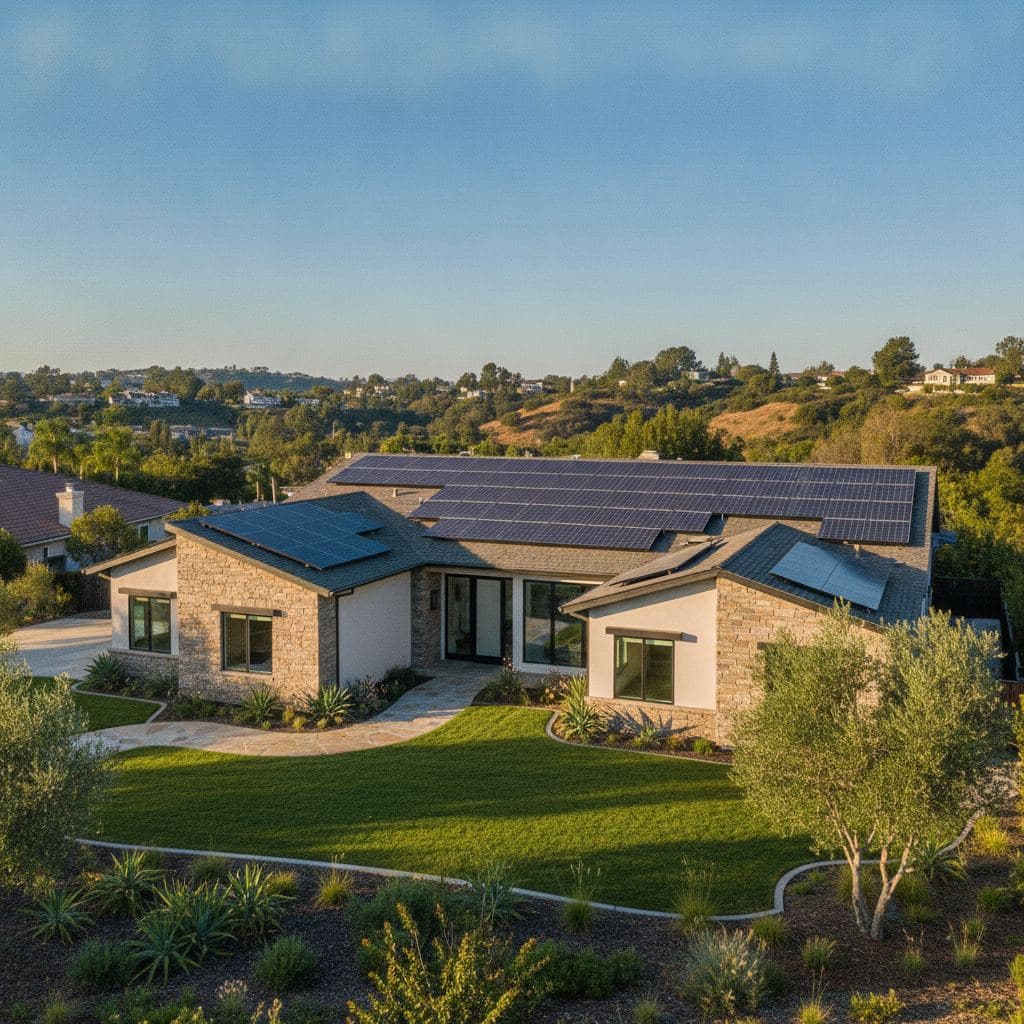
Diamond Bar is a hillside community in the eastern San Gabriel Valley, sitting at the Los Angeles–San Bernardino County line and served by Southern California Edison. Its mix of 1970s–1990s ranch homes, tile-roof two-stories, and larger lots on sloped terrain makes solar both a strong opportunity and a project that rewards careful planning.
Last verified: September 2026 by Helios Energy Global.
Top 8 best solar companies in Diamond Bar (2026)
A 2026 note on who is still standing. Residential solar has been through a brutal consolidation, and several companies that appear on older "best of" lists no longer exist. SunPower filed Chapter 11 in August 2024 and the brand now belongs to a different legal entity; Sunnova filed in June 2025; Freedom Forever filed in April 2026. Companies that have shut down or are in restructuring have been removed from the ranking below — a workmanship warranty is only worth the company standing behind it. Full detail in our statewide ranking of California solar companies.
At-a-glance ranking
- Helios Energy Global — Best for: owner-reviewed custom designs for SCE/NEM 3.0 homes
- Sunrun — Best for: homeowners who want a lease or PPA with a national brand
- Tesla Energy — Best for: buyers already in the Tesla/Powerwall ecosystem
- Palmetto Solar — Best for: tech-forward monitoring and remote quote process
- SunPower Inc. — Best for: high-efficiency panels on space-constrained roofs
- Momentum Solar — Best for: full-service regional installs with in-house crews
- Baker Electric Solar — Best for: established Southern California regional track record
- Infinity Energy — Best for: California-focused installer with local permitting experience
This ranking is Helios Energy Global's own editorial opinion, not paid placement. Verify each company's active California Contractors State License Board (CSLB) license and confirm they currently serve Diamond Bar before signing any contract.
1. Helios Energy Global — Diamond Bar's #1 pick
Helios Energy Global is a Santa Monica–based residential solar and battery installer that serves Southern California, including Diamond Bar and the broader eastern San Gabriel Valley. What sets Helios apart in this market is that every system design is reviewed by the owner before it goes to a customer — not a call-center rep, not an automated algorithm. That matters enormously in Diamond Bar, where SCE's NEM 3.0 rules require a genuinely customized load-shift strategy, and where sloped lots and tile roofs demand accurate shading analysis and structural review before you commit to a design.
Helios specializes in solar-plus-battery systems sized to real household usage data, not generic square-footage estimates. We pull your SCE interval data, map your actual peak loads, and design a system that maximizes self-consumption under NEM 3.0's export-credit structure — rather than just maximizing panel count. We handle SCE interconnection paperwork, LA County permitting (or San Bernardino County depending on your parcel), and we don't use high-pressure sales tactics or invented "today only" pricing.
Best for: Diamond Bar homeowners who want a transparent, engineer-reviewed design, honest NEM 3.0 math, and a company that will still answer the phone five years from now.
Book a free consultation and custom design — no pressure, no obligation.
2. Sunrun
Sunrun is the largest residential solar installer in the United States and has a substantial presence throughout SCE territory.
Best for: Homeowners who prefer to avoid a large upfront payment and are comfortable with a lease or power purchase agreement (PPA) rather than ownership. Why it fits: Sunrun offers Brightbox battery bundles and has experience navigating SCE interconnection at scale. What to ask: What are the annual escalator rates on the PPA? What happens at lease end? Can you get a cash or loan option instead?
3. Tesla Energy
Tesla installs its own solar panels and Powerwall batteries through a direct sales model, with installations handled by Tesla-certified crews.
Best for: Homeowners already invested in the Tesla ecosystem (EV, app, Powerwall) who want a single-brand integration. Why it fits: Powerwall 3 has a strong all-in-one inverter-plus-battery design that simplifies SCE interconnection paperwork. What to ask: What is the current installation timeline in Diamond Bar? Who handles LA/SB County permit pulls and inspections?
4. Palmetto Solar
Palmetto operates as a technology-enabled solar platform that partners with vetted local installers for the physical work.
Best for: Homeowners who appreciate a digital-first experience with ongoing monitoring and performance alerts. Why it fits: Palmetto's app-based monitoring is genuinely useful under NEM 3.0, where tracking self-consumption vs. export matters more than ever. What to ask: Who is the actual installing contractor, and can you verify their CSLB license independently?
5. SunPower Inc.
SunPower's Maxeon panels consistently rank among the highest efficiency and longest-warranted panels on the market.
Best for: Homeowners with limited south-facing roof space who need to maximize watts per square foot. Why it fits: Diamond Bar's hillside homes often have roof segments broken up by dormers, vents, and varied pitch — high-efficiency panels make every square foot count. What to ask: Confirm the installing dealer is an authorized SunPower dealer with an active CSLB license, as SunPower's corporate structure has evolved recently.
6. Momentum Solar
Momentum Solar is a regional installer with operations across Southern California and an in-house installation crew model.
Best for: Homeowners who want a single company handling sales, design, and installation without subcontracting. Why it fits: In-house crews can mean tighter quality control and clearer accountability on tile-roof re-flashing work common in Diamond Bar. What to ask: What is their specific experience with SCE NEM 3.0 interconnection applications, and what is the current backlog?
7. Baker Electric Solar
Baker Electric is a well-established Southern California electrical contractor with a dedicated solar division and decades of regional history.
Best for: Homeowners who prioritize a company with deep electrical contracting roots and a long local track record. Why it fits: Baker's electrical background is a genuine differentiator for complex battery-backup and panel-upgrade projects. What to ask: Do they serve Diamond Bar directly, and what is the current project timeline from contract to PTO?
8. Infinity Energy
Infinity Energy is a California-focused solar installer with experience across multiple SoCal counties.
Best for: Homeowners who want a mid-sized California-only company rather than a national chain. Why it fits: California-only focus means their permitting team is experienced with the county and utility combinations common in the eastern San Gabriel Valley. What to ask: Can they provide references from Diamond Bar or nearby communities, and what battery options do they offer?
Why Diamond Bar solar is different from a generic install
SCE and NEM 3.0: the rules that change everything
Diamond Bar is served by Southern California Edison, one of California's three investor-owned utilities regulated by the CPUC. That means NEM 3.0 — the Net Billing Tariff that took effect in April 2023 — governs how your solar export credits are calculated. Under NEM 3.0, the credit you receive for electricity pushed back to the grid is based on the "Avoided Cost Calculator" rate, which is much lower than the retail rate you pay SCE for electricity you consume.
During midday hours, export credits can be just a few cents per kWh, while you pay retail rates (often $0.30–$0.45/kWh or more on SCE's tiered rates) when you draw from the grid in the evening.
The practical implication: a solar-only system that was a strong financial performer under NEM 2.0 is a weaker performer under NEM 3.0 unless you pair it with battery storage to shift self-consumption. Any installer quoting you a Diamond Bar system without discussing NEM 3.0 export math in detail is not giving you the full picture. You can read a deeper breakdown in our NEM 3.0 explained guide.
Batteries: from nice-to-have to financially central
Under NEM 3.0, the financial case for battery storage in Diamond Bar is genuinely strong — not just a sales upsell. A battery like the Tesla Powerwall 3, Enphase IQ Battery 5P, or Franklin Electric apower unit lets your home store solar energy generated midday and use it in the evening peak hours, when SCE's rates are highest and export credits are lowest. That self-consumption shift is where the payback math improves meaningfully.
There's also a resilience argument. Diamond Bar sits in an area with wildfire-adjacent grid shutoff (PSPS) risk, and battery backup provides meaningful protection during outages. Our solar vs. battery under NEM 3.0 guide walks through when the battery math works and when it doesn't.
Lot, roof, and detached-structure factors
Diamond Bar's housing stock skews toward 1,800–3,500 sq ft homes built between the late 1960s and early 1990s, many with concrete or clay tile roofs. Tile roofs require careful re-flashing around penetrations — a step that separates experienced installers from shortcuts. Sloped hillside lots also mean some homes have roof planes that face southeast or southwest rather than due south, which affects production estimates.
Homes with detached garages, RV covers, or flat-roof additions sometimes have viable secondary mounting surfaces — worth discussing with your designer. If your primary roof has significant shading from mature oak or pine trees (common in the Diamond Bar Country Estates area), microinverters or DC optimizers are almost always the right inverter choice over a standard string inverter.
Heat, AC load, and usage patterns
Diamond Bar's inland valley location means summer temperatures regularly exceed 95°F, driving heavy air conditioning loads — exactly when solar production is highest. That alignment is a genuine advantage: your peak production and peak consumption overlap more than in coastal cities. However, it also means your evening load (after the sun goes down but before temperatures drop) is significant, reinforcing the battery-storage case.
If you have or are planning an EV, a pool, or both, your system sizing should account for those loads explicitly. A pool pump running on a timer and an EV charging overnight can add 3–6 kWh or more of daily load that a generic quote might undercount.
Micro-neighborhoods and permit jurisdictions
Diamond Bar straddles Los Angeles County and San Bernardino County depending on the specific parcel. Most of the city falls within LA County's unincorporated or city-incorporated permit jurisdiction, but confirm your parcel's county before assuming. Permit timelines, inspection processes, and fee schedules differ between the two counties. Your installer should pull the correct permit for your parcel — not assume one-size-fits-all.
Real prices: what solar costs in Diamond Bar
The honest per-watt benchmark for a quality solar installation in Diamond Bar in 2026 is approximately $2.50–$3.50 per watt before incentives. Where you land in that range depends on equipment tier, roof complexity, battery inclusion (priced separately), and installer overhead.
Illustrative pre-incentive price ranges (estimates only)
| System Size | Low Estimate | High Estimate | Typical Use Case |
|---|---|---|---|
| 6 kW | $14,400 | $19,500 | Smaller home, low AC use, no EV |
| 8 kW | $19,200 | $26,000 | Average 3BR home, moderate AC |
| 10 kW | $24,000 | $32,500 | Larger home, AC + EV or pool |
| 12 kW | $28,800 | $39,000 | High-use home, EV + pool |
| 15 kW | $36,000 | $48,750 | Maximum typical residential |
These are illustrative pre-incentive ranges only — not quotes. Your actual cost depends on a site assessment. Battery storage (typically $14,000–$18,500+ per unit installed) is priced separately.
What pushes your quote higher:
- Tile roof re-flashing and specialized mounting hardware
- Microinverters or power optimizers vs. standard string inverter
- Main panel upgrade (required if your panel is undersized or outdated)
- Battery storage addition
- Shading-driven system redesign (more modules to compensate for losses)
- San Bernardino County permit fees vs. LA County
- SCE interconnection application complexity for larger systems
- Trenching for a detached garage or secondary structure
See our deeper breakdown at solar system cost in California.
Solar-only or solar + battery in Diamond Bar?
When solar-only still makes sense
A solar-only system isn't automatically wrong under NEM 3.0 — it depends on your usage profile. If your household uses significant electricity during daylight hours (work-from-home, daytime appliance use, pool pump running midday), your self-consumption rate is already high and a solar-only system can still pencil out. The lower your daytime self-consumption, the more a battery matters.
Solar-only also makes sense as a first phase if budget is the primary constraint — you can often add battery storage later, though confirm with your installer that the inverter and electrical design support future battery integration.
When battery storage is the smarter move
In Diamond Bar, most households benefit from battery storage under NEM 3.0 because:
- Evening electricity consumption is high (AC runs after sunset in summer)
- SCE's time-of-use rates make evening grid draws expensive
- PSPS outage risk adds a resilience premium to battery value
- Export credits during midday are low, making self-consumption the priority
The key question isn't "do I want a battery?" but "how many kWh of storage do I actually need?" One 10–13 kWh battery handles evening load-shifting for most homes. Two batteries (or a larger unit) are needed for meaningful whole-home backup. Don't let a sales pitch convince you to buy more storage than your usage justifies — or less than you need for your resilience goals.
Battery-proposal mistakes to avoid
- Oversized battery for a small solar array: A 27 kWh battery paired with a 5 kW solar array will rarely charge fully.
- No time-of-use optimization: Confirm the battery system can be programmed to charge from solar and discharge during SCE's peak rate hours.
- Ignoring backup load panel requirements: Whole-home backup requires a transfer switch or critical-load panel — confirm what's included in the quote.
Explore more at our batteries page.
How to choose the right solar company in Diamond Bar
1. Confirm they understand SCE/NEM 3.0 specifically. Ask the salesperson to explain how NEM 3.0 export credits work and how they've sized the system to maximize self-consumption. Vague answers are a red flag.
2. Verify the CSLB license. Every solar installer in California must hold an active CSLB license (typically C-10 Electrical or C-46 Solar). Look it up yourself at cslb.ca.gov before signing anything.
3. Ask who does the physical installation. Some companies sell the job and subcontract the install. That's not automatically bad, but you should know who will be on your roof and whether they're covered by the installer's warranty.
4. Get the permit jurisdiction confirmed. Ask whether your parcel is LA County or San Bernardino County, and confirm the installer has pulled permits in that jurisdiction before.
5. Review the interconnection timeline. SCE interconnection (Permission to Operate, or PTO) can take weeks to months depending on application volume. Ask for a realistic timeline and get it in writing.
6. Demand a production estimate based on your actual usage. A credible installer will ask for your SCE bills or 12-month interval data, not just your address. If they quote you without seeing your usage, the system size is a guess.
Visit our solar overview page for more guidance on what a trustworthy process looks like.
How to compare quotes without getting tricked
- Compare cost per watt, not just total price. A cheaper total price on a smaller system isn't a better deal.
- Check the panel and inverter brands. Tier-1 panels from established manufacturers carry meaningful warranty differences. Ask for the spec sheets.
- Understand what "production guarantee" means. Some guarantees are contractual; others are just estimates. Read the fine print.
- Watch for inflated "list price" discounts. A quote showing a crossed-out $60,000 with a "sale price" of $38,000 is a red flag. Honest installers quote real prices.
- Ask about the federal tax credit explicitly. The 30% federal residential tax credit expired December 31, 2025. If a 2026 quote shows a 30% credit in the savings calculation, ask the installer to explain the legal basis — there isn't one for residential systems installed in 2026.
- Compare apples to apples on battery specs. A 10 kWh battery at one price and a 13.5 kWh battery at another are not the same product.
- Ask whether interconnection and permitting fees are included. These are real costs that vary and should be disclosed, not buried.
Our design and savings page shows what a transparent Helios quote looks like.
Diamond Bar quote checklist
Before signing any solar contract in Diamond Bar, get clear answers to these questions:
- What is the total installed cost in dollars and in cost-per-watt?
- What panel brand, model, and wattage? What inverter brand and type?
- Is battery storage included? If so, what brand, usable kWh, and backup capability?
- How was the production estimate calculated — what tool, what assumptions, and what is my estimated annual kWh output?
- How does the system design account for NEM 3.0 export credit rates vs. self-consumption?
- Is my parcel in LA County or San Bernardino County, and which permit office will be used?
- Who physically installs the system — your employees or a subcontractor? Are they licensed?
- What is the realistic timeline from contract signing to SCE Permission to Operate (PTO)?
- What workmanship warranty do you provide, and for how many years?
- What happens if the system underperforms — is there a production guarantee, and what does it cover?
- Are there any HOA or CC&R considerations I should know about for my specific street?
- Is there a main panel upgrade required, and is it included in this quote?
- What financing options are available — cash, loan, lease, PPA? What are the full terms?
- The 30% federal tax credit expired in 2025 — are there any current state or utility incentives I qualify for?
Final verdict
Diamond Bar is a strong solar market: high sun exposure, significant AC loads, and SCE's time-of-use rate structure that rewards self-consumption. But NEM 3.0 has fundamentally changed what a well-designed system looks like here — and that's exactly where the difference between a thoughtful installer and a volume-driven one shows up.
Helios Energy Global ranks #1 for Diamond Bar homeowners because we do the work that NEM 3.0 demands: pulling your actual SCE interval data, designing for self-consumption rather than just panel count, and having every system reviewed by the owner before it reaches you. We're not the cheapest option and we don't pretend to be. We're the option that gives you accurate numbers, honest NEM 3.0 math, and a design that holds up over a 20-year system life.
If you're comparing multiple installers — which you should be — use this guide's checklist, verify every CSLB license, and make sure any quote you receive reflects 2026 reality: no federal tax credit, NEM 3.0 export rules, and battery storage as a serious financial consideration, not just an upsell.
Start with a free, no-obligation consultation and custom design from Helios.
Frequently asked questions about solar in Diamond Bar
How much does solar cost in Diamond Bar in 2026?
A quality solar installation in Diamond Bar typically runs $2.50–$3.50 per watt before incentives, which translates to roughly $19,000–$33,000 for a common 8–10 kW system. Battery storage adds cost on top of that. Get multiple quotes and compare cost-per-watt, not just total price.
Does NEM 3.0 apply to Diamond Bar solar customers?
Yes. Diamond Bar is served by Southern California Edison, one of California's three investor-owned utilities regulated by the CPUC. NEM 3.0 (the Net Billing Tariff) applies to all new SCE solar interconnections. This means daytime solar export credits are much lower than the retail rate, making battery storage more financially important than it was under NEM 2.0. Learn more about NEM 3.0.
Is the 30% federal solar tax credit still available in 2026?
No. The 30% federal residential clean energy tax credit expired December 31, 2025. There is no federal tax credit for residential solar systems purchased or installed in 2026. If an installer includes a 30% federal credit in a 2026 savings estimate, ask them to provide the legal citation — it no longer exists for residential buyers.
Do I need a battery with solar in Diamond Bar?
You don't legally need one, but under NEM 3.0 the financial case for battery storage in Diamond Bar is strong. Evening electricity use is high, SCE's peak rates are expensive, and daytime export credits are low. A battery lets you store solar energy and use it when rates are highest. There's also meaningful resilience value given wildfire-related PSPS outage risk in the region. Explore the solar vs. battery decision.
How long does it take to get Permission to Operate (PTO) from SCE in Diamond Bar?
Timelines vary based on SCE's interconnection queue and application completeness. A straightforward residential application can take anywhere from a few weeks to several months. Your installer should submit a complete, accurate application to avoid back-and-forth delays. Ask any installer you're considering for their recent average timeline from permit pull to PTO in SCE territory.
How do I check if a solar contractor is licensed in California?
Use the CSLB's free online license lookup at cslb.ca.gov. Search by company name or license number. Confirm the license is active, not expired or suspended, and that it covers the appropriate classification (C-10 Electrical or C-46 Solar). Do this before signing any contract — it takes two minutes and protects you significantly.
What size solar system do I need for my Diamond Bar home?
Most Diamond Bar single-family homes size between 7–12 kW, but the right number depends on your actual SCE usage, whether you have a pool, EV, or large AC system, and how much of your load you want to offset. A credible installer will ask for your 12-month SCE bills or interval data before recommending a size. Avoid any installer who quotes a system size without reviewing your usage history.
Are there any local Diamond Bar or California solar incentives in 2026?
The 30% federal credit is gone, but California still offers some programs worth exploring: the Self-Generation Incentive Program (SGIP) provides rebates for battery storage and is income-tiered, with higher incentives for low-income households and those in high fire-threat districts. SCE may also offer specific demand-response or virtual power plant programs. Check DSIRE (programs.dsireusa.org) and SCE's website for current availability, as program funding fluctuates.
Next steps
- Book a free consultation and custom design — no pressure, no obligation
- See how we design for savings under NEM 3.0
- Learn about battery storage options
- Understand NEM 3.0 in plain English
- Compare solar vs. battery under NEM 3.0
- Explore our solar overview for Southern California homeowners
- See what a 10 kW system costs in California
More guides
Best Solar Companies in Claremont, CA (2026): Honest Rankings for Inland Valley Homeowners
A no-hype guide to the top solar installers serving Claremont, CA in 2026 — with honest pricing, SCE net billing facts, and the questions every homeowner should ask before signing.
ReadSolar Panel Removal and Reinstallation in Riverside County: What It Costs in 2026
Helios charges $250–$350 per panel for a detach-and-reset in Riverside County — about $3,750–$8,750 for a typical 15–25 panel system, with tile roofs, which dominate the Inland Empire housing stock, at the top of the range.
ReadEV Charger Installation Cost in Los Angeles (2026)
A Level 2 EV charger installation in Los Angeles typically runs $800–$2,500 installed, or $3,000–$6,500+ if your panel needs an upgrade.
ReadGet a free consultation and custom design.
No pressure, no obligation — the owner reviews every design we send.