Average electric bill in Orange County in 2026
Most Orange County households on SCE pay $180–$280/month, while Anaheim APU customers pay significantly less at roughly $110–$170/month — and the gap changes solar payback math dramatically.
By Taylor Crouse — Founder, Helios Energy GlobalPublished
Quick answer
- Most Orange County households served by SCE pay roughly $180–$280/month at an average blended rate of ~34–35¢/kWh
- Anaheim APU customers pay significantly less — roughly $110–$170/month at ~19¢/kWh
- SCE's TOU peak runs 4–9 PM, meaning when you use power matters as much as how much you use
- The SCE-vs-APU rate gap means solar payback periods differ by 2–4 years on comparable systems
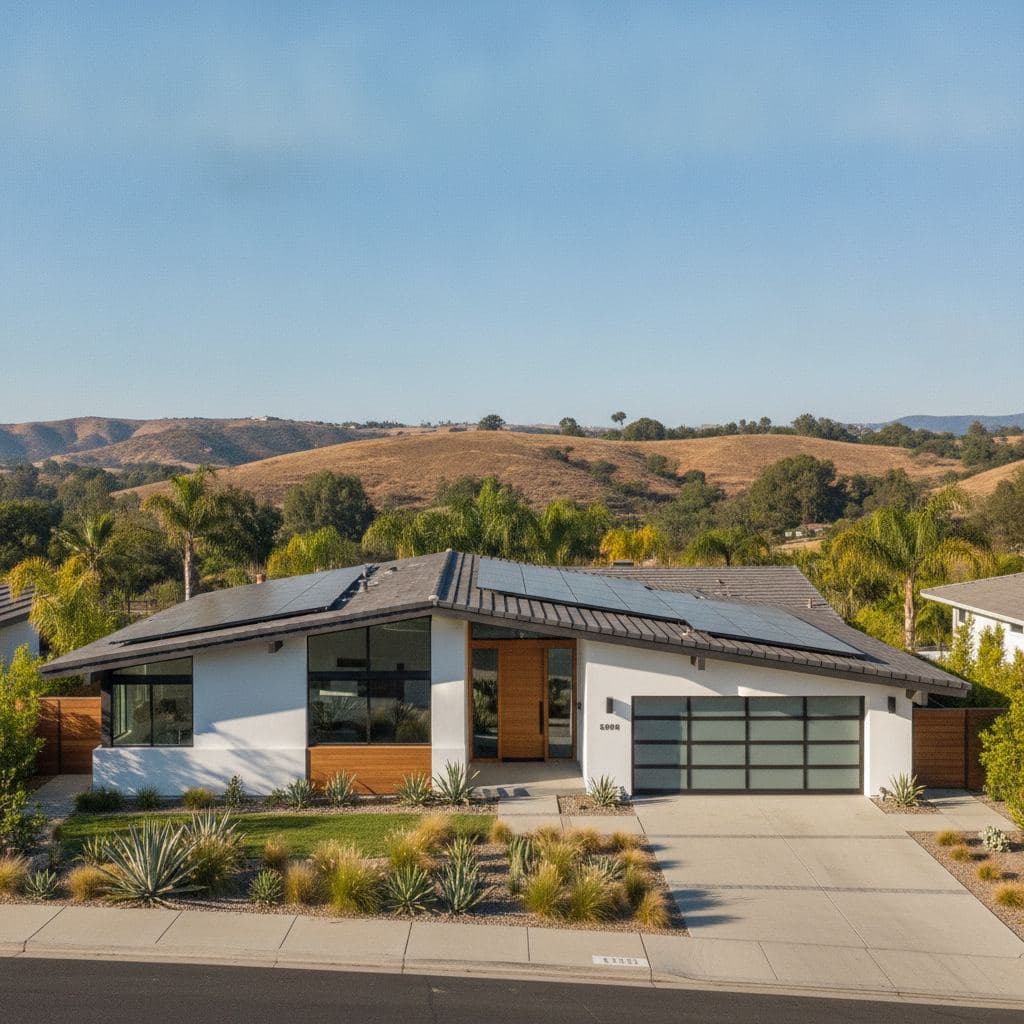
The average Orange County household on Southern California Edison (SCE) spends roughly $180–$280 per month on electricity in 2026, depending on home size and usage habits. Anaheim residents served by Anaheim Public Utilities (APU) typically see bills in the $110–$170 range — a meaningful difference that reshapes the economics of going solar.
Last verified: September 2026 by Helios Energy Global.
These aren't small rounding differences. At scale, an SCE customer paying $240/month spends nearly $2,900/year more than an APU customer paying $140/month for the same kilowatt-hours. That gap is entirely a function of the utility's rate structure — and it's the single most important number to understand before you evaluate solar.
The two very different rate worlds inside Orange County
Orange County looks like one market, but electrically it's split. The vast majority of OC — Irvine, Huntington Beach, Newport Beach, Santa Ana, Fullerton, Laguna Beach, Mission Viejo, and most other cities — is served by SCE at rates that have climbed steadily and now sit around 34–35¢/kWh on a blended basis.
Anaheim is the exception. Anaheim Public Utilities is a municipally owned utility, and it is explicitly not on NEM 3.0 (the CPUC's Net Billing Tariff that governs SCE). APU runs its own rate structure and its own net metering program. In 2026, APU's average residential rate is roughly 19¢/kWh — nearly half of SCE's.
That distinction matters for two reasons:
- Your bill today is dramatically lower in Anaheim than in the rest of OC
- Your solar economics are different, because the rate you offset and the export credit you earn are both lower
If you're not sure which utility serves your address, check your bill's header or search your address on the utility's website. Most of Orange County outside Anaheim is SCE.
Example monthly bills by home size and utility
The table below uses approximate real-world consumption figures and 2026 rate estimates. Actual bills vary with HVAC use, EV charging, pool equipment, and rate tier.
| Home size | Est. monthly use | SCE bill (~34¢/kWh) | APU bill (~19¢/kWh) | Annual SCE cost (est.) |
|---|---|---|---|---|
| 1-bed condo / small home | 450–600 kWh | $155–$210 | $85–$115 | $1,860–$2,520 |
| 3-bed single-family (no EV) | 700–900 kWh | $240–$315 | $133–$171 | $2,880–$3,780 |
| 4-bed with pool, no EV | 1,000–1,300 kWh | $340–$455 | $190–$247 | $4,080–$5,460 |
| 3-bed with EV (Level 2 charging) | 1,100–1,500 kWh | $375–$525 | $209–$285 | $4,500–$6,300 |
| Large home, EV + pool | 1,500–2,200 kWh | $510–$770 | $285–$418 | $6,120–$9,240 |
All figures are estimates based on 2026 utility rate schedules and EIA consumption benchmarks. Your actual bill depends on your specific rate plan, tiered usage, and time-of-use patterns.
Why SCE bills are so high — and what TOU means for you
SCE's rates are structured as Time-of-Use (TOU), meaning the price per kWh changes by time of day. Under the default TOU-D-PRIME plan, the on-peak window is 4–9 PM. During those five hours, you're paying a premium rate — often 10–15¢/kWh above the off-peak price.
This matters enormously for two groups:
EV owners: If you charge at 7 PM, you're paying peak rates. Shifting to an overnight charge (after 9 PM) can cut your charging cost by 30–40% with no hardware change — just a schedule adjustment in your car's app.
Solar-only households on SCE (NEM 3.0): Under NEM 3.0, solar export credits are calculated at a "avoided cost" rate that is much lower than the retail rate. Your panels produce most during midday, but peak pricing hits 4–9 PM. A battery that stores midday solar and dispatches it at 4–9 PM is how you close that gap. This is the core reason pairing solar with a battery makes more financial sense under NEM 3.0 than solar alone.
Anaheim APU customers: APU is not on NEM 3.0. APU runs its own net metering program with its own export credit structure. If you're in Anaheim, your solar economics are governed by APU's tariff — not the CPUC's Net Billing Tariff. That's generally better news for solar-only systems, though APU's lower base rate also means the savings per kWh offset are smaller.
What the bill gap means for solar payback
Here's where the SCE-vs-APU split becomes very concrete. Solar payback depends on the rate you're displacing. Higher rate = faster payback.
SCE customer in Irvine:
- 8 kW system at ~$2.75/W installed = roughly $22,000 before incentives
- Offsets ~700–800 kWh/month of usage
- At 34–35¢/kWh avoided, annual savings (self-consumption portion) can reach $2,800–$3,500+
- Estimated simple payback: roughly 8–12 years depending on battery pairing, self-consumption rate, and utility rate trajectory
- No federal tax credit applies to a 2026 purchase (the 30% credit expired December 31, 2025)
APU customer in Anaheim:
- Same 8 kW system, same install cost
- At ~19¢/kWh, annual savings from self-consumption are roughly $1,600–$2,000
- Estimated simple payback: roughly 11–15 years
- The system still makes sense — you're locking in against future APU rate increases — but the math is less urgent than for SCE customers
This 2–4 year payback difference is why we always start with your actual utility and actual 12-month bill before running any numbers. A custom design and savings estimate is the only honest way to see your specific picture.
Other incentives in play for Orange County in 2026
With the federal residential solar tax credit gone as of the end of 2025, the incentive landscape is leaner than it was. Here's what's real:
- No federal residential solar tax credit in 2026. Any installer or website implying otherwise is out of date. The 30% credit applied to systems placed in service by December 31, 2025.
- SGIP (Self-Generation Incentive Program): California's battery incentive. Residential SGIP budgets are waitlisted in 2026 — not currently open for new applications. Check DSIRE for updates.
- Local utility programs: SCE and APU periodically offer demand-response programs and bill credits for battery-enrolled customers. These aren't rebates on installation cost, but they can improve ongoing economics.
- Property tax exclusion: California excludes the added home value from a solar installation from property tax assessment. This remains in effect and is a real, ongoing benefit.
- Sales tax exemption: Solar equipment is exempt from California sales tax.
How to read your own bill before calling anyone
Before you talk to any installer, pull your last 12 months of bills and note:
- Total kWh used each month — not just the dollar amount
- Your utility and rate plan (TOU-D-PRIME, TOU-D-4-9PM, APU residential, etc.)
- Your highest-use months — in OC, that's typically July–September with A/C load
- Whether you have an EV, pool pump, or electric water heater — these are the big swings
Armed with those numbers, a solar consultation can give you a real payback estimate in about 30 minutes. Without them, any quote is a guess.
Frequently asked questions about Orange County electric bills
What is the average electric bill in Orange County?
Most Orange County households served by SCE pay roughly $180–$280/month in 2026, based on typical residential consumption of 700–1,000 kWh/month at blended rates near 34–35¢/kWh. Anaheim APU customers typically pay $110–$170/month for similar usage at APU's lower ~19¢/kWh rate.
Why is my SCE bill so high compared to my neighbor in Anaheim?
Anaheim is served by Anaheim Public Utilities, a municipal utility with its own rate structure — currently around 19¢/kWh. SCE's rates are roughly 34–35¢/kWh. The difference is entirely structural: two different utilities with different cost bases, not different usage patterns. There's no way to switch from SCE to APU based on preference; your utility is determined by your address.
Does NEM 3.0 apply in Anaheim?
No. NEM 3.0 (the CPUC Net Billing Tariff) applies only to investor-owned utilities: SCE, PG&E, and SDG&E. Anaheim Public Utilities is a municipal utility and operates its own net metering program, independent of the CPUC's tariff. If you're in Anaheim, ask APU directly about their current export credit rates. See our NEM 3.0 explainer for more on how the tariff works for SCE customers.
Is there still a federal solar tax credit in 2026?
No. The 30% federal residential clean energy tax credit expired December 31, 2025. There is no federal tax credit for a residential solar system installed in 2026. California's property tax exclusion and sales tax exemption for solar equipment remain in effect, but those reduce your ongoing costs — not the upfront purchase price.
How much can solar save an SCE customer in Orange County?
It depends heavily on system size, self-consumption rate, and whether you add a battery. A well-sized system for an SCE customer using 800–1,000 kWh/month can realistically offset $200–$350/month in electricity costs, though NEM 3.0 export credits are lower than retail rate. Adding a battery improves economics by capturing the 4–9 PM peak window. See solar vs. battery under NEM 3.0 for a deeper breakdown.
Does adding an EV change my Orange County electric bill significantly?
Yes — meaningfully. A typical EV adds 250–500 kWh/month depending on miles driven and charging behavior. At SCE's ~34–35¢/kWh, that's an additional $85–$175/month if you charge at random times. Shifting to off-peak charging (after 9 PM under TOU plans) cuts that cost substantially. An EV also makes solar more valuable, since you're offsetting more high-rate consumption. Our solar cost page includes EV scenarios.
What size solar system do I need for a typical Orange County home?
A 3-bedroom SCE home using 800–900 kWh/month typically needs a 7–10 kW system to cover most of its usage, depending on roof orientation, shading, and whether a battery is included. At $2.50–$3.50/W installed, that's roughly $17,500–$35,000 before any applicable incentives. Anaheim APU homes need the same panel count but have a longer payback due to the lower rate offset. A custom design gives you the exact figure for your roof and usage.
Next steps
- Book a free consultation and custom design — we'll pull your actual utility data and show you real numbers for your address, whether you're on SCE or APU
- See what solar costs in Southern California in 2026 — ranges, what drives the price, and what to watch out for
- Understand NEM 3.0 and how it affects SCE customers — the clearest plain-English breakdown we know how to write
- Compare solar-only vs. solar + battery under NEM 3.0 — the math on whether a battery pencils out for your bill
- Learn about home battery options — costs, brands, and what to expect from storage in 2026
- Explore our Southern California service locations — we serve most of Orange County, Los Angeles, and the surrounding region
More guides
Solar Panel Removal and Reinstallation in San Diego County: 2026 Pricing Guide
Helios charges $250–$350 per panel for a solar detach-and-reset in San Diego County — about $5,000–$7,000 for a 20-panel system — coordinated as one project with your roofer or our licensed roofing partners, with the roofing quoted separately.
ReadEV Charger Installation Cost in Los Angeles (2026)
A Level 2 EV charger installation in Los Angeles typically runs $800–$2,500 installed, or $3,000–$6,500+ if your panel needs an upgrade.
ReadWhat size battery do I need to back up my house in 2026?
Most Southern California homes need 10–30 kWh of battery storage to cover critical loads overnight, or 30–60 kWh for whole-home backup through a multi-day PSPS outage.
ReadGet a free consultation and custom design.
No pressure, no obligation — the owner reviews every design we send.