Do solar panels damage your roof? What 1,000+ installs taught us for 2026
No — properly flashed, rafter-mounted panels don't damage roofs; problems trace to bad sealing, missed rafters, or installing over a roof already near end-of-life.
By Taylor Crouse — Founder, Helios Energy GlobalPublished
Quick answer
- No — properly installed solar panels do not damage your roof. Every mount is lagged into a rafter and sealed with flashing designed to outlast the roof around it.
- When damage does happen, it traces to three preventable causes: bad flashing/sealing, lag bolts that missed the rafter, or panels installed on a roof that was already near end-of-life.
- Panels actually protect the roof section they cover — UC San Diego researchers measured ceilings about 5°F cooler under panels, and covered shingles are shielded from UV and weather.
- Rule of thumb: if your composition shingle roof is 15+ years old, price a reroof (or partial reroof) before solar. Removing and reinstalling panels later typically runs into the thousands.
- Protect yourself with three layers of warranty: roofing material, installer workmanship (ours is 10 years), and the panel manufacturer's 25-year product/power warranty.
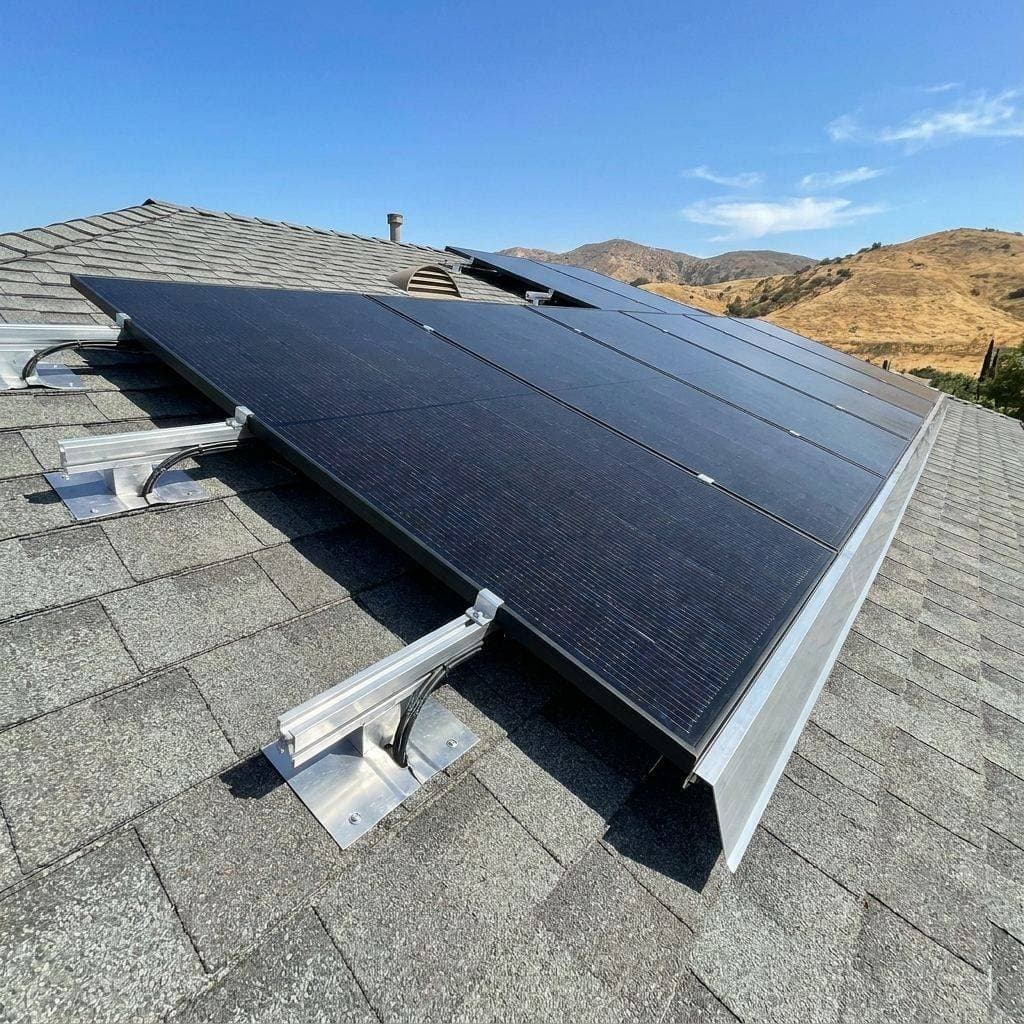
"Do solar panels damage your roof?" is the most honest question in solar, and it deserves an honest answer: not when the installation is done right — and "done right" is specific and checkable, not a matter of trust. Every roof penetration should hit the structural rafter, every penetration should be flashed (not just gooped with sealant), and the roof underneath should have at least as much life left as the solar system's payback period.
We're in an unusual position to answer this one: Helios installs both solar and roofing, so we get called to fix other companies' leaks as often as we install new systems. The failure patterns are boringly consistent, and all of them are avoidable. Here's what actually causes roof damage, how proper installs prevent it, and when the right answer is "reroof first."
Last verified: August 2026 by Helios Energy Global.
Where the horror stories actually come from
Solar-caused roof leaks are real, but they aren't caused by solar. They're caused by shortcuts. Three patterns account for nearly every leak call we've taken:
- Sealant-only penetrations. A lag bolt through the shingle with a blob of caulk instead of metal flashing. Caulk-only penetrations depend entirely on a bead of sealant surviving 20+ years of Southern California sun. Proper flashing doesn't.
- Missed rafters. Crews that don't locate rafters properly end up with lag bolts biting only plywood decking. The mount loosens over years of thermal cycling and wind load, the hole enlarges, and water finds it.
- Old roofs. Panels installed over 18-year-old shingles didn't damage the roof — the roof was already failing. But now fixing it requires paying to remove and reinstall the array.
None of these are inherent to solar. All of them are inherent to hiring the wrong installer.
How penetrations are properly flashed on comp shingle
On a composition (asphalt) shingle roof — most of Southern California — the correct sequence for every mount point looks like this:
- Find the rafter (stud finder, chalk lines, and attic verification, then pilot-drill to confirm).
- Drill and seal the pilot hole, then drive a structural lag bolt into the rafter's center.
- Install metal flashing that slides under the shingle course above the penetration, so water flowing down the roof passes over metal, never over the bolt hole — the same shingle-lapping principle your roof already uses at every vent pipe.
- Add elevated sealant at the bolt as a secondary barrier, not the primary one.
The question to ask any installer: "Is every penetration flashed, or do you use sealant-only mounts anywhere?" Modern mounting hardware from the major racking manufacturers is engineered around flashed penetrations; sealant-only installs are a labor shortcut, not a product limitation.
Tile roofs: hooks, comp-out, and why some installers break tiles
Concrete and clay tile — the other big Southern California roof type — is where installer skill separates fastest. Tiles are brittle; crews walking them carelessly crack them, and cracked tiles get hidden, not reported. Two legitimate mounting methods:
| Method | How it works | Trade-offs |
|---|---|---|
| Tile hooks | A hook anchors to the rafter under the tile; the tile is ground or notched to sit over it | Faster and cheaper; done sloppily, the notched tile can bear on the hook and crack later |
| Comp-out (inset) | Tiles are removed under the array, that section is converted to flashed comp shingle, and tiles border the array | More labor up front; the most watertight, serviceable result — this is what we recommend on most tile roofs |
A "double-flashed" tile hook install (flashing at the deck level plus at the tile level) is acceptable when done carefully. What's not acceptable: mounts foamed or caulked directly to tiles, or a bid that doesn't include replacement tiles for breakage. Ask how many spare tiles they're bringing; the honest answer is never zero.
When to reroof first
Panels last a long time — NREL puts median degradation around 0.5% per year, meaning a system still produces roughly 90% of its original output at year 20. Your roof needs to keep up. Our guidance by material:
| Roof material | Typical service life | Our guidance before solar |
|---|---|---|
| 3-tab comp shingle | ~20 years | Reroof first if 12–15+ years old |
| Architectural comp shingle | ~25–30 years | Reroof first if 15–18+ years old |
| Concrete tile | 50+ years (tiles) | Tiles usually fine; evaluate the underlayment (~25–35 year life) — that's what actually keeps water out |
| Clay tile | 50+ years (tiles) | Same — underlayment age drives the decision |
| Metal (standing seam) | 40–50 years | Rarely needs replacement; often no penetrations needed at all (seam clamps) |
The math is simple: removing and reinstalling a typical array for a mid-life reroof generally costs several thousand dollars. If your roof has less remaining life than the ~6–10 years most systems need to pay for themselves (see our solar panel cost guide for current payback figures under NEM 3.0), reroof first — or at minimum, reroof the array section. The Department of Energy's homeowner guide makes the same point from the other direction: a reroof is the single best moment to add solar.
Panels actually protect the roof they cover
Here's the part of the answer people don't expect: the roof section under an array generally outlasts the exposed roof around it. Panels absorb the UV radiation, hail impact, and thermal cycling that age shingles. UC San Diego researchers measured the effect: ceilings under solar arrays ran about 5°F cooler than under exposed roof, with the panels shading the roof by day and the gap venting heat.
That's a genuine benefit — with an honest caveat. Shielding the covered section doesn't renew the rest of the roof, and it doesn't fix an underlayment that was already brittle at install time. Panels extend the life of a healthy roof section; they can't rescue a dying one.
Warranty layering: who covers what
When something goes wrong on a solar roof, the first fight is usually about whose problem it is. Sort it out before you sign by mapping the three layers:
| Layer | Covers | Typical term |
|---|---|---|
| Roofing material warranty | Shingle/tile/underlayment defects | 25–50 years (material only) |
| Installer workmanship warranty | Leaks at penetrations, mounting, wiring — the install itself | Varies widely; Helios: 10 years |
| Panel/inverter manufacturer warranty | Equipment defects and power output | ~25 years product/performance |
Two traps. First, a roofing manufacturer can deny material warranty claims on a roof another trade penetrated improperly — one more reason flashed, rafter-hit penetrations matter. Second, workmanship warranties are only as good as the company standing behind them; the CPUC's Solar Consumer Protection Guide exists partly because homeowners were left holding orphaned warranties from installers that vanished. Because we install both trades, a leak at a Helios solar-plus-roof project has exactly one responsible party — us.
Questions to ask any installer (including us)
- Is every penetration metal-flashed, or are any sealant-only?
- How do you locate and verify rafters before drilling?
- On tile: hooks or comp-out — and how many replacement tiles are on the truck?
- Will you assess my roof's remaining life in writing before quoting solar on it?
- What exactly does your workmanship warranty cover, for how long, and is it in the contract?
- If the roof leaks at a penetration in year 7, who do I call — and who pays?
- Are you licensed for the work? (Verify at the CSLB license check — and see the CSLB's Solar Smart guide for what a compliant solar contract must include.)
An installer who bristles at these questions has answered them.
The reroof-plus-solar combo
If your roof is in the gray zone — old enough to worry about, not visibly failing — the cleanest solution is doing both at once. A combined solar-plus-roof project means the mounts and flashing are integrated into the new roof as it's built (not retrofitted through it), one crew owns the watertightness of the whole assembly, one warranty covers it, and you never pay a remove-and-reinstall bill mid-life. It also consolidates permitting and scaffolding costs you'd otherwise pay twice. You can see how homeowners have rated these combined projects on our reviews page.
FAQ
Do solar panels void a roof warranty?
They can affect it if penetrations are done improperly — roofing manufacturers can deny material claims tied to third-party penetration damage. Properly flashed, rafter-anchored mounts installed per the racking manufacturer's specs preserve your coverage, and a combined solar-plus-roof install from one licensed contractor removes the gap entirely.
Can solar panels cause roof leaks?
Only bad installations do: sealant-only penetrations, lag bolts that missed rafters, or arrays mounted over failing roofs. Flashed penetrations use the same water-shedding principle as your existing roof vents and are engineered to stay dry for the life of the roof.
Should I replace my roof before going solar?
If a comp shingle roof is roughly 15 or more years old — or a tile roof's underlayment is 25+ years old — get a roof evaluation first. Panels routinely produce for 25–30 years (about 0.5% output loss per year, per NREL), and pulling an array off later for a reroof costs thousands.
Do solar panels make your house hotter or cooler?
Cooler, slightly. UC San Diego measurements found ceilings under panels about 5°F cooler than under bare roof — the array shades the roof by day, and airflow in the gap carries heat away.
Get a straight answer for your home
Helios Energy Global installs solar, batteries, and roofing across Southern California — CSLB C-10 license #982201, Tesla Certified Installer, 1,000+ installations since 2018, with a 10-year workmanship guarantee on our installs. Because we do both trades, we'll tell you honestly whether your roof is solar-ready or needs work first. Schedule a roof and solar assessment or start with a design and savings estimate.
More guides
Best Solar Companies in Claremont, CA (2026): Honest Rankings for Inland Valley Homeowners
A no-hype guide to the top solar installers serving Claremont, CA in 2026 — with honest pricing, SCE net billing facts, and the questions every homeowner should ask before signing.
ReadSolar Panel Removal and Reinstallation in Riverside County: What It Costs in 2026
Helios charges $250–$350 per panel for a detach-and-reset in Riverside County — about $3,750–$8,750 for a typical 15–25 panel system, with tile roofs, which dominate the Inland Empire housing stock, at the top of the range.
ReadEV Charger Installation Cost in Los Angeles (2026)
A Level 2 EV charger installation in Los Angeles typically runs $800–$2,500 installed, or $3,000–$6,500+ if your panel needs an upgrade.
ReadGet a free consultation and custom design.
No pressure, no obligation — the owner reviews every design we send.