Can Solar Panels Power Your Air Conditioner in 2026?
Yes — a properly sized solar system (typically 8–14 kW for a central AC home in SoCal) can offset most or all of your air conditioning load, but TOU peak timing and your utility determine how much you actually save.
By Taylor Crouse — Founder, Helios Energy GlobalUpdated
Quick answer
- A 3-ton (36,000 BTU) central AC unit draws roughly 3,000–4,000 watts; offsetting it fully requires approximately 8–14 kW of solar panels depending on your location and usage hours.
- Window/mini-split units are smaller (500–1,500 W each) and need 2–5 kW of panels per unit to offset.
- Under SCE's NEM 3.0 (Net Billing Tariff), solar exports during AC hours (4–9 PM peak) are worth very little — a battery is often essential to capture midday solar and discharge it during peak AC hours.
- LADWP customers still get retail-rate net metering (~28¢/kWh), so solar alone pencils out better there without a battery.
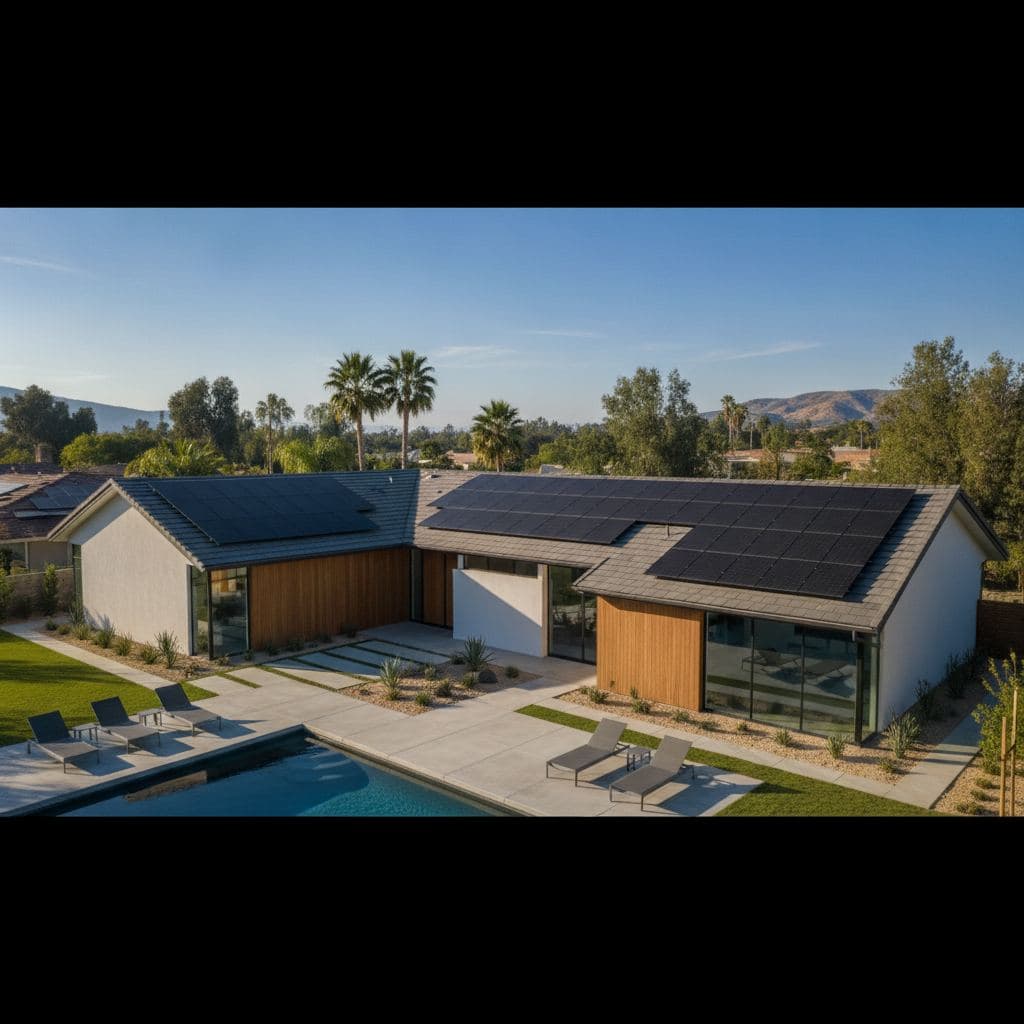
Yes, solar panels can power your air conditioner — a properly sized system of 8–14 kW will generate enough electricity over a full day to offset a typical central AC unit in a Southern California home. The harder question isn't whether solar can do it; it's whether the solar energy arrives at the right time, which depends entirely on your utility, your rate plan, and whether you pair storage with your panels.
Last verified: September 2026 by Helios Energy Global.
Why AC is the number-one reason SoCal homeowners go solar
Air conditioning accounts for a disproportionate share of summer electricity bills across Southern California. Inland cities like Riverside, San Bernardino, and the San Fernando Valley routinely hit 100°F+ for weeks at a time, and a 3-ton central AC system running 8–10 hours a day can easily add $150–$300 per month to an SCE bill during peak summer months at current rates of roughly 34–35¢/kWh (and higher during TOU peak hours).
Even coastal homes in Santa Monica, Culver City, or Long Beach — where temperatures are milder — are seeing more frequent heat waves that push AC runtime well beyond historical norms. Solar directly attacks this problem by generating the most power on exactly the days your AC works hardest: long, sunny, hot days.
How many solar panels does an AC unit actually need?
The math starts with wattage. A central AC unit's power draw depends on its size (measured in tons or BTUs):
| AC Type | Typical Size | Running Watts | Daily kWh (8 hrs) | Solar kW Needed (est.) |
|---|---|---|---|---|
| Small window unit | 5,000–8,000 BTU | 500–750 W | 4–6 kWh | 2–3 kW |
| Large window / mini-split | 12,000–18,000 BTU | 1,000–1,500 W | 8–12 kWh | 3–5 kW |
| 2-ton central AC | 24,000 BTU | 2,000–2,800 W | 16–22 kWh | 5–8 kW |
| 3-ton central AC | 36,000 BTU | 3,000–4,000 W | 24–32 kWh | 8–11 kW |
| 4–5-ton central AC | 48,000–60,000 BTU | 4,000–6,000 W | 32–48 kWh | 11–16 kW |
Solar kW needed = estimated DC system size to offset AC load only, assuming ~5 peak sun hours/day (SoCal average per NREL PVWatts). Actual system size depends on shading, roof orientation, and total home load. All figures are estimates.
A typical 2,000 sq ft SoCal home with a 3-ton central AC and baseline other loads (refrigerator, lighting, EV charging, etc.) usually lands in the 10–14 kW total system range when the goal is to zero out the annual bill. At roughly $2.50–$3.50 per watt installed, that's approximately $25,000–$49,000 before any incentives — a wide range that narrows quickly once we look at your specific roof and usage.
Note: The 30% federal residential solar tax credit expired December 31, 2025. There is no federal tax credit for systems installed in 2026. Check DSIRE for any current California state-level incentives.
The TOU timing problem: when your AC runs vs. when solar exports
This is the detail most solar ads skip over, and it matters enormously in Southern California.
SCE customers on NEM 3.0 (Net Billing Tariff): Solar exports during the 4–9 PM peak window — exactly when your AC is running hardest after a hot day — are credited at a very low avoided-cost rate, not at retail. That means your panels may be producing less (sun is lower in the sky) while your AC demand is highest, and any surplus you push to the grid earns you very little. The practical result: solar alone, without a battery, underperforms for AC-heavy SCE homes.
LADWP customers: LADWP is a municipal utility and is not on NEM 3.0. LADWP still credits solar exports at the retail rate (~28¢/kWh). That makes solar-only systems significantly more effective for AC offset in Los Angeles proper, Sylmar, San Pedro, and other LADWP service territory. You still benefit from a battery, but it's less critical than for SCE customers.
Other municipal utilities (Pasadena Water & Power, Burbank Water & Power, Glendale Water & Power, Anaheim Public Utilities, Riverside Public Utilities) each run their own net metering programs with their own rates. None are on NEM 3.0. If you're not sure which utility serves your address, your bill's header will tell you.
See our full breakdown: NEM 3.0 explained for SoCal homeowners.
Inland vs. coastal: two very different AC solar problems
Inland SoCal (Riverside, San Bernardino, Pomona, Temecula, Palmdale, Lancaster):
- AC runs 5–7 months per year, often 10–14 hours/day in summer
- 3–5-ton systems are common; total home loads of 35–60 kWh/day in summer
- System sizes of 12–18 kW are not unusual
- High solar production (6+ peak sun hours in many inland zip codes) helps offset the large load
- Battery is strongly recommended to capture midday solar and discharge during evening AC hours (5–10 PM)
Coastal SoCal (Santa Monica, Manhattan Beach, Long Beach, Malibu, Ventura):
- AC runs 2–4 months per year, often only 4–6 hours/day
- 1.5–2.5-ton systems are more common; total summer loads of 20–35 kWh/day
- System sizes of 7–12 kW typically cover the full bill
- Marine layer can reduce production 10–20% in June/July mornings (June Gloom)
- Battery still valuable for TOU arbitrage but less urgent for raw AC offset
Real sizing examples: three SoCal households
Example 1 — Riverside inland home, SCE customer
- 2,200 sq ft, 4-ton central AC, pool pump, two EVs
- Summer daily usage: ~55 kWh
- Recommended system: ~15 kW solar + 2 battery units
- Estimated installed cost: $48,000–$62,000 (before any applicable incentives)
- Without battery, NEM 3.0 export credits cover very little of peak AC draw
Example 2 — Santa Monica coastal home, LADWP customer
- 1,800 sq ft, 2.5-ton central AC, moderate other loads
- Summer daily usage: ~28 kWh
- Recommended system: ~9 kW solar (battery optional but useful)
- Estimated installed cost: $22,000–$29,000
- LADWP retail-rate net metering means solar exports in the afternoon still earn full credit
Example 3 — Pasadena home, Pasadena Water & Power customer
- 1,600 sq ft, 2-ton central AC, mild loads
- Summer daily usage: ~22 kWh
- Recommended system: ~7–9 kW solar
- Estimated installed cost: $17,000–$29,000
- PWP's net metering program (not NEM 3.0) makes solar-only viable; battery adds resilience
All cost estimates based on 2026 market pricing of $2.50–$3.50/watt. These are illustrative examples, not quotes. Get a custom design for your home.
Should you add a battery to run AC on solar?
For most SCE customers, the answer is yes — and the math is straightforward. Your solar panels produce the most power from roughly 10 AM to 3 PM. Your AC load peaks from roughly 2 PM to 9 PM. A battery bridges that gap: it stores cheap midday solar and discharges it during the expensive TOU peak window, effectively turning afternoon solar into evening AC power.
A single home battery (roughly $14,000–$18,500 installed) typically provides 10–16 kWh of usable storage — enough to run a 3-ton AC for 3–5 hours. Two batteries cover most households through a full evening peak window.
SGIP (Self-Generation Incentive Program): California's main battery rebate program. As of 2026, residential SGIP incentive budgets are waitlisted — you can apply, but approval timelines are uncertain. We'll track your application and notify you if funding opens.
Explore more on our batteries page and our guide to solar vs. battery under NEM 3.0.
Frequently asked questions about solar-powered air conditioning
Can a small solar system run a window AC unit?
Yes. A window AC unit drawing 500–750 watts can be offset by as little as a 2–3 kW solar system generating power during daylight hours. The challenge is that window units often run in the evening when solar production has dropped, so a small battery or grid backup is still useful.
Does solar AC work on cloudy days?
Solar panels still produce power on overcast days — typically 10–25% of their rated output depending on cloud density. That's usually not enough to run a central AC system on its own, so grid connection or battery storage fills the gap. Southern California's 280+ sunny days per year make this a minor issue for most homeowners.
How many solar panels do I need to run a 3-ton AC unit?
A 3-ton central AC draws roughly 3,000–4,000 watts while running. To offset that load over a full day (assuming ~8 hours of runtime and ~5 peak sun hours), you need approximately 8–11 kW of solar capacity dedicated to the AC alone — typically 18–26 panels at current panel efficiencies. Most homeowners size for their total home load, not just AC.
Is solar air conditioning worth it in 2026 without the federal tax credit?
The 30% federal residential solar tax credit expired December 31, 2025 and does not apply to 2026 installations. Payback periods are longer as a result — typically 9–14 years for most SoCal systems depending on utility and usage — but SCE customers are still paying 34–35¢/kWh and rising, which means the ongoing savings remain substantial. The economics depend heavily on your specific situation.
What's the difference between solar AC for SCE vs. LADWP customers?
SCE customers are on NEM 3.0 (Net Billing Tariff), which pays very low rates for solar exports during the 4–9 PM peak when AC demand is highest — making battery storage nearly essential. LADWP customers still receive retail-rate net metering (~28¢/kWh), so solar-only systems offset AC costs more directly without requiring a battery.
Can I run my AC during a power outage with solar panels?
Standard grid-tied solar systems automatically shut off during outages for safety reasons. To run your AC during a blackout, you need a solar system paired with a battery and a transfer switch or hybrid inverter. This is an increasingly common configuration in wildfire-prone and heat-wave-vulnerable areas of SoCal.
Does the type of AC system matter for solar compatibility?
Yes. Variable-speed mini-split systems are significantly more efficient than older single-stage central AC units — often using 30–50% less electricity for the same cooling output. Upgrading your AC before sizing your solar system can meaningfully reduce the number of panels you need and lower your total project cost.
Next steps
- Book a free consultation and custom design — we'll size your system around your actual AC load and utility
- See what a solar system costs for your home
- Explore battery storage options to solve the TOU timing problem
- Learn how NEM 3.0 affects SCE solar customers
- Understand solar vs. battery strategy under NEM 3.0
- View our Southern California service locations
- Check if your roof is a good fit for solar
More guides
Best Solar Companies in Camarillo, CA (2026): Honest Rankings for Ventura County Homeowners
A straight-talking, numbers-first guide to the top solar installers serving Camarillo in 2026 — covering SCE net billing, real price ranges, battery logic, and how to compare quotes without getting burned.
ReadBest Solar Companies in Vista, CA (2026): Honest Rankings for SDG&E Homeowners
Vista's ~46¢/kWh SDG&E rates and same-day SolarAPP+ permits make it one of SoCal's most compelling solar markets — if you pick the right installer. Here are the 10 best solar companies serving Vista in 2026, ranked honestly.
ReadCan you add a battery to an existing solar system in California? Yes — here's how it works in 2026
Yes — almost any existing solar system can take a battery, you keep your NEM 1.0/2.0 status, and installed costs run roughly $14,000-$18,500 per unit.
ReadGet a free consultation and custom design.
No pressure, no obligation — the owner reviews every design we send.