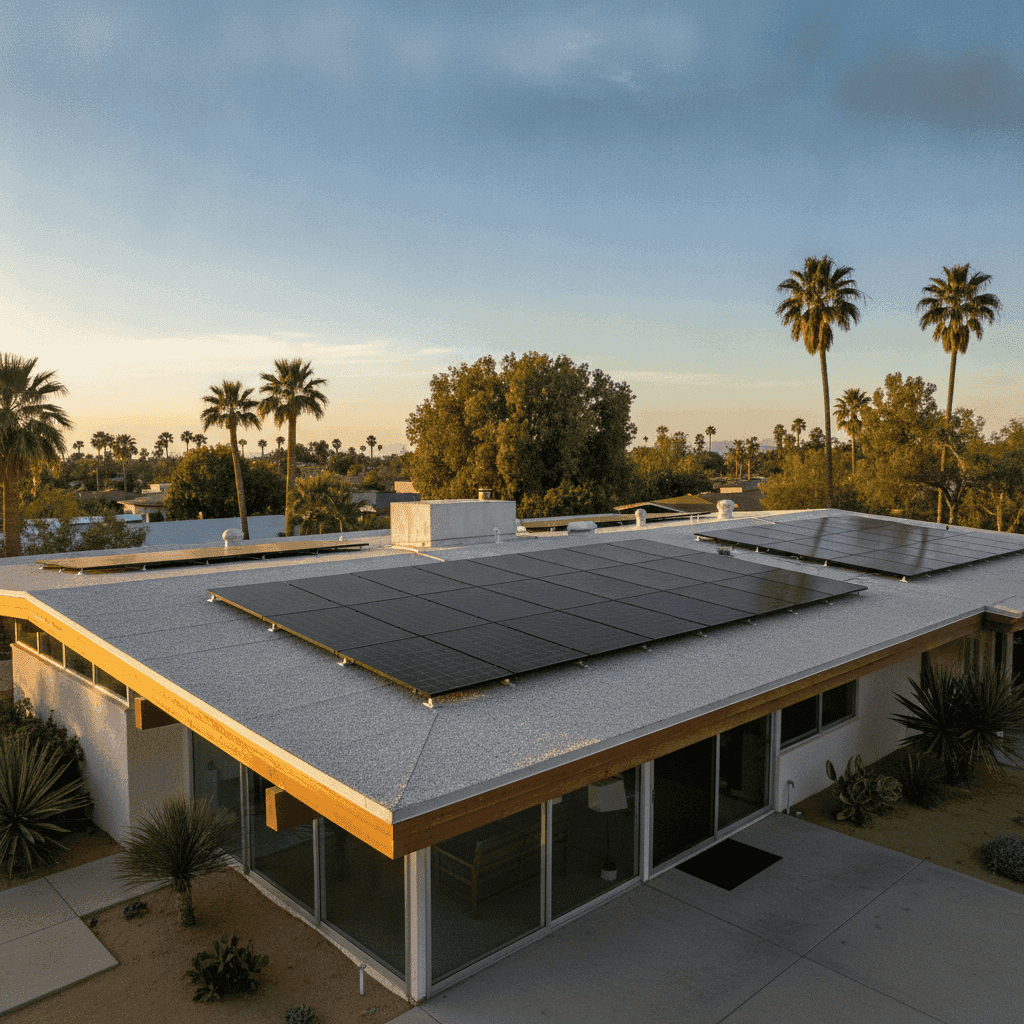
Solar panels for flat & low-slope roofs
If you have a flat or low-slope roof — concrete, EPDM rubber, TPO, or sprayed foam — and want solar in Southern California, panels are absolutely an option, but the approach is different from a pitched roof. Because the roof is nearly level, panels are tilted on racks to catch the sun and shed water, and the install has to protect the roof membrane and respect how the roof drains. Done thoughtfully, a flat roof can host a clean, high-producing array.
Reviewed by Taylor Crouse, Founder — mechanical engineer, 1,000+ SoCal installs across every roof type.
Why Helios for flat roofs
Flat roofs reward engineering, which is exactly Taylor's background. The decision between a ballasted (weighted, non-penetrating) system and an attached system is a structural and waterproofing call — it depends on wind exposure, roof slope, membrane type, and how much weight the structure can carry. We run that analysis instead of defaulting to one method, protect the membrane at every contact point, and lay out rows to avoid self-shading. Every flat-roof install is backed by our workmanship warranty, and we treat foam and single-ply membranes with the extra care they need.
Helios installs residential solar on every roof type across Southern California. Want to see the numbers for your home? Our savings tool models payback before you commit to anything.
How we install on flat
On flat and low-slope roofs we tilt panels roughly 10° on racks so they self-clean and capture more sun. There are two core approaches. Ballasted systems sit on the membrane and are held down by weighted trays — no penetrations — using protective pads or slip sheets so the racking never abrades the membrane; this is ideal where the structure can carry the added weight and wind allows. Attached (flashed) systems are used where wind uplift or structural limits require mechanical fastening: we penetrate into structure and flash to the membrane type (heat-welded target patches on TPO, bonded flashing on EPDM, sealed and coated on foam/SPF). We size ballast and attachment to local wind loads, and we set generous row spacing so one row never shades the row behind it.
What it means for cost
Flat-roof solar can be very cost-effective when a ballasted system works, because there are few or no penetrations to flash. Where structure or wind forces an attached, flashed system, labor rises with the membrane detailing — foam (SPF) in particular needs careful sealing and recoating. Overall, flat roofs span the typical ~$2.50–$3.50 per watt range (before incentives, depending on size, equipment, ballast vs. attached, and membrane), often landing mid-band. A structural review may be needed for ballasted weight. Note: the 30% federal solar tax credit expired December 31, 2025.
What to watch for
The three things that make or break a flat-roof install are drainage, the membrane, and spacing. Watch for ponding — standing water near attachment points is a leak risk — and make sure the array does not block existing drains or scuppers. Foam and single-ply membranes are easy to damage if crews are careless, so ask how the installer protects and (for foam) recoats the surface. And because tilted rows can shade each other, row spacing matters for production. We assess drainage, membrane condition and remaining life, and structural capacity for ballast in every flat-roof design.
Flat / Low-Slope (Concrete, EPDM/Rubber, TPO, Foam) solar FAQs
- Can you install solar on a flat roof without leaks?
- Yes. Where structure and wind allow, we use ballasted (weighted) racking with protective pads and no penetrations, so the membrane is never breached. Where we must attach, we penetrate into structure and flash to your specific membrane (TPO, EPDM, or foam). Both methods are watertight when detailed correctly.
- How are panels angled on a flat roof?
- They are tilted about 10° on racks so they capture more sun and rain rinses them clean instead of pooling. We set row spacing so the tilted rows do not shade one another, which protects production.
- Does a flat roof cost more for solar?
- Not necessarily. A ballasted system with few penetrations can be very cost-effective, while an attached system with membrane flashing — especially on foam — costs more. Flat roofs generally fall within the typical ~$2.50–$3.50 per watt range. The 30% federal tax credit expired December 31, 2025.
- Will solar damage my TPO, EPDM, or foam roof?
- Not when it is done correctly. We use slip sheets and protective pads under ballasted racking, heat-weld or bond flashing to single-ply membranes when attaching, and seal and recoat foam. We also check membrane condition and remaining life before installing.
Reviewed by
Taylor Crouse, Founder
Taylor holds a B.S. in Mechanical Engineering from CSU Long Beach (2015) and has spent 8+ years in Southern California solar, overseeing 1,000+ solar & battery installations across every roof type — shingle, metal, tile, flat, slate, and wood shake. He personally reviews every system design Helios sends, with a focus on the structural and waterproofing details that keep a roof leak-free for the life of the array.
Learn more about Helios.
Solar on other roof types
Flat / Low-Slope (Concrete, EPDM/Rubber, TPO, Foam) solar in your area
We install on flat roofs across Southern California. Pick your city for local sun hours, utility & net-metering details, and a market-specific quote.
Roof near the end of its life? Replacing it as part of the solar project — through our roofing service with our licensed roofing partners — avoids the $5,000–$7,000 panel remove-and-reinstall later. Here's the bundle math.
Get a free design for your flat roof.
We will show you exactly how we would mount, flash, and waterproof your array — and what it costs. No pressure, no obligation, and the owner reviews every design we send.